

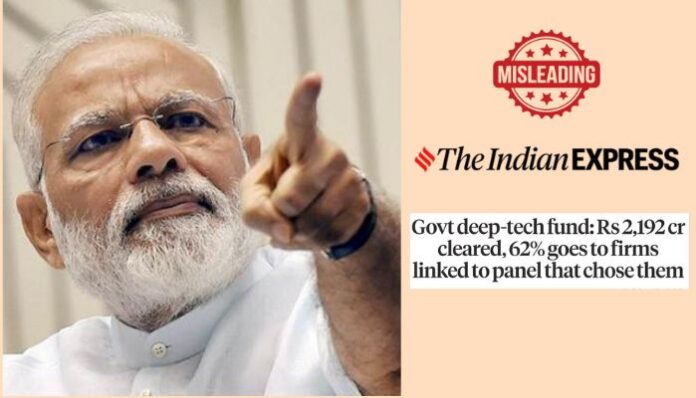
On Friday (7th August), the Indian Express published an ‘investigative report’ insinuating corruption and conflict of interest in the flagship initiative of the Modi government, the Research, Development and Innovation (RDI) Fund.
The article was maliciously titled, ‘Rs 2,192 crore cleared, 62% for firms linked to government tech fund panel’. For a large majority of newspaper readers who don’t look beyond the headlines, they will be convinced that the Modi government was somehow involved in a high-level scam.
The ‘investigative report’ takes 18 minutes to read online, thereby actively discouraging the vast majority of low-attention-span readers. But once you have invested your precious time with the hopes of unearthing a ‘massive scandal’, you are only left high and dry.
Because it leads you to absolutely nothing. You are forced to ask yourself – Why the hell did these ‘journalists’ Amitabh Sinha and Sandeep Singh even write such a report?
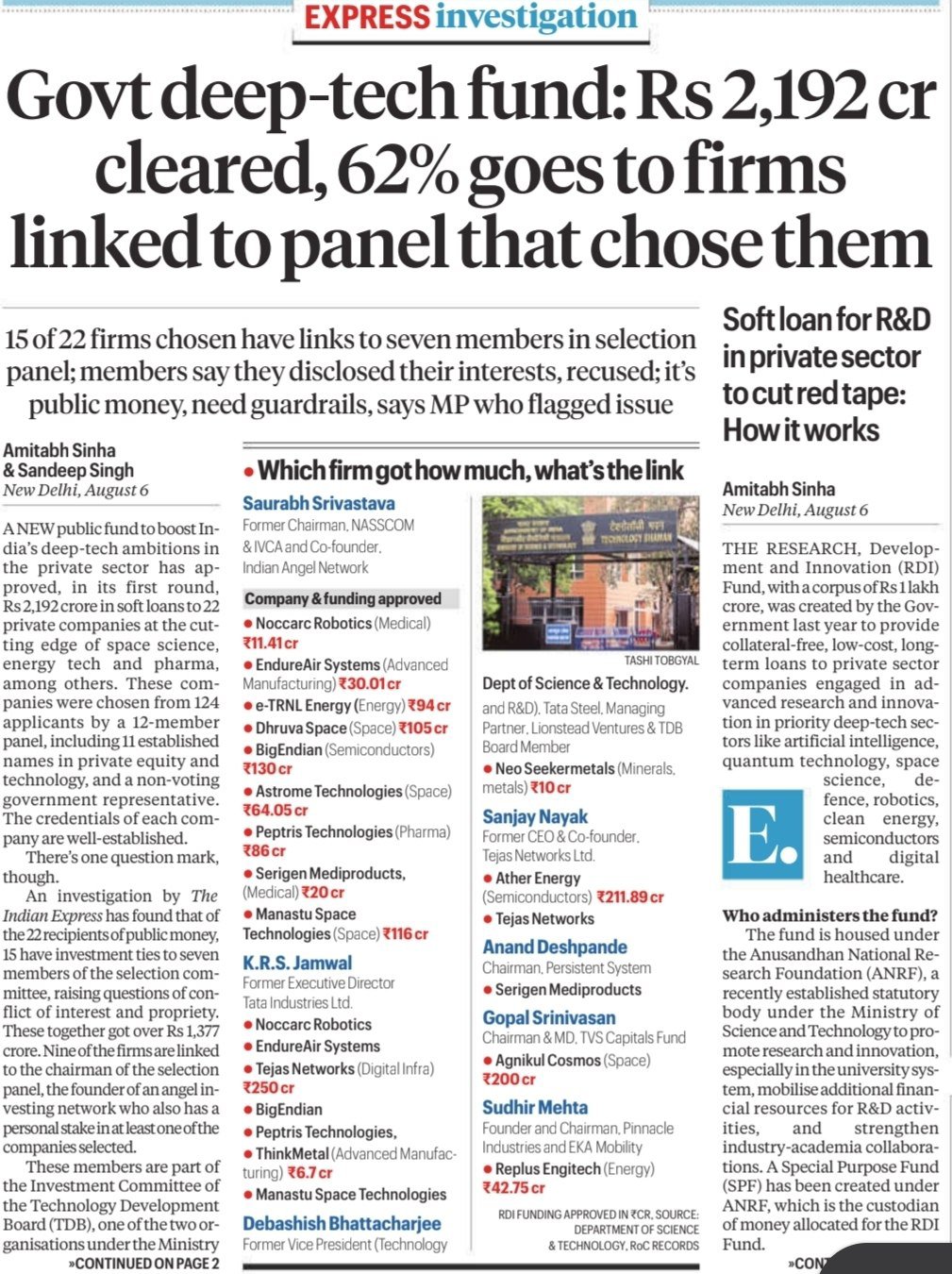
For the unversed, the RDI fund is a game changer for the Research & Development (R&D) ecosystem of India. A corpus of ₹1 lakh crore was kept aside for this scheme. The broader objectives were to accelerate investment in India’s Innovation ecosystem and support Indian private entities working in emerging sectors. As such, a 12-member investment committee (IC) has been constituted to decide and sanction long-term, low-cost loans to these companies.
1 member of the committee is a government representative and thus has no ‘voting right’. The remaining 11 members are private-sector experts in technology and private equity and have voting rights. It is thus obvious that these experts will have stakes and interests in multiple companies cutting across various industries.
And this was something that the Modi government foresaw when the scheme was conceptualised. This is why the government had introduced guardrails to prevent any cases of ‘conflict of interest’. These are some of the safeguards that were put in place:-
- Independent expert evaluation of every proposal.
- Mandatory disclosure of all interests.
- Mandatory recusal wherever any potential conflict exists.
- Approval only through a supermajority of eligible members.
- Government officials do not determine technical merit, and the Member Secretary has no voting rights.
- Final approval rests with the Technology Development Board after due process.
The Indian Express concedes that there is no ‘wrongdoing’
So, before you invest 18 minutes into reading that article, watch this one-minute video by Indian Express Hindi about the same issue. It claims that 15 companies that were sanctioned loans had investors who were part of the Investor Committee.
The video thereafter alleges that 7 other companies that were benefitted by the government scheme had links to the Investor Committee. Okay, so what?
Did these investors engage in ‘conflict of interest’ and have a say in sanctioning loans for the companies where their interests lay? The answer is NO.
सरकारी फंड से टेक कंपनियों को कैसे मिला करोड़ों का सस्ता लोन? Express Investigation में सामने आया सच. देखिए पूरी रिपोर्ट. #DeepTech #RDIFund #indianexpressinvestigation #StartupIndia #IndianExpressHindi pic.twitter.com/Dij5VNu3rO
— Indian Express Hindi (@IEhindi) August 7, 2026
And guess what, even The Indian Express acknowledged that those investors have recused themselves. Now, take a look at this longer 6-minute video published by the newspaper on its YouTube channel. It is about the same issue as well.
‘Journalist’ Amitabh Sinha concedes, “Now, the situation was very well foreseen, and adequate steps had been taken to mitigate the conflict of interest situation. The members from the selection panel had to recuse themselves from the evaluation process of the companies that they had interest in and this process was followed for all the members and for all the companies. So there has been no wrongdoing as such.”
Later in the video, he accepted, “…These kind of possible potential conflict of interest situations would arise because the people who have a very good knowledge or the people who are operating in this ecosystem would obviously have interests in this ecosystem; they would be connected to the ecosystem. So the best way to deal with this kind of a situation is to have upfront declarations, proper transparency code and mandatory recusal and it seems all these were followed.”
Fellow ‘journalist’ Sandeep Singh thereafter remains fixated on the statement of Congress Rajya Sabha MP Praveen Chakraborty that ‘additional safeguards’ must have been put in place. As expected, there are no specific recommendations or suggestions but vague political rhetoric.
Singh larps on it and shrewdly emphasises the phrase ‘public money given to private people.’ What is this supposed to mean? Is it free money being distributed for optics and votes? No, it is a loan and a bet on India’s future.
Furthermore, they talk about how many investors had interests in which companies but categorically fail to prove even a single instance of conflict of interest. Now, let me tell you what is written in that atrocious ‘deep dive’ that the Indian Express published yesterday.
Let me spare you the torture and the ‘premium subscription.’ The ‘investigative report’ does not lead to any conclusion. It talks about 7 different members of the Investing Committee, namely, Saurabh Srivastava, K R S Jamwal, Gopal Srinivasan, Sudhir Mehta, Sanjay Nayak, Anand Deshpande and Debashish Bhattacharjee and their stakes in companies that have received loans.
The article also includes their statement. But this shoddy and borderline dumb report fails to prove that these members were part of the evaluation process for companies where they served as investors.
Conclusion
When there is no proof of conflict of interest, then what’s up with the politically loaded and clickbait headline? As a reader, you are forced to wonder – If propaganda is an art, then this Indian daily is certainly the master of it. But we must credit where it is due.
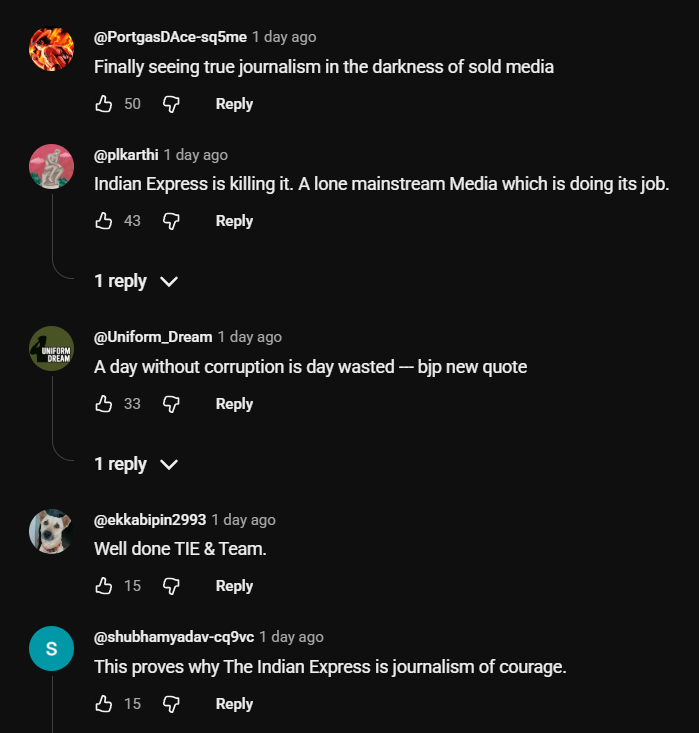
While they have been able to prove nothing, they did win the narrative war temporarily. I saw YouTube comments hailing ‘The Indian Express’ for doing alleged ‘journalism of courage.’ Their clickbait headline convinced amateur political enthusiasts that a scandal exists where it doesn’t.
And my friends, this is how you create a story with no head or tail but with malicious intent. India is spending 0.8% of its Gross Domestic Product (GDP) now on its R&D. This is the highest that India has invested since 2010.
When we are progressing in the right direction, certain vested interests are clearly unhappy with the development. It is very much evident from the latest ‘investigative piece’ of The Indian Express.


