It took five centuries of struggle, sacrifices, and legal battles for Hindus to reclaim the Shri Ram Janmabhoomi in Ayodhya. However, that hard-earned civilisational triumph is now being tarnished by the petty greed and negligence of a few with insider access. The preliminary report by the SIT into the embezzlement of funds and valuables from daily chadhava, or donations, at the Ram Mandir reveals that the ‘Chanda Chori’ was a preventable theft had the temple authorities been less egoistic and more accountable.
Ram Mandir chanda chori
Consecrated in January 2024, the Ayodhya Ram Mandir attracts lakhs of devotees every year. Numerous of these devotees donate cash, gold, silver, and ornaments through hundi boxes installed inside the temple. The Shri Ram Janmabhoomi Teerth Kshetra Trust handles collection, counting, accounting, and utilisation for the temple’s management and related activities.
For daily cash handling, the Ram Mandi temple trust deploys its staff along with those hired via private agencies. These employees are tasked with counting notes, preparing bundles, and maintaining records. There are handling processes for ornaments, etc. According to the Temple Trust, regular internal audits are conducted to maintain transparency.
The allegations of ‘chadhava chori’ or the ‘chadhava scam’ at the Ayodhya Ram Mandir were first highlighted by local media. The matter gained political traction on 7th June 2026 after Samajwadi Party supremo and former Uttar Pradesh Chief Minister Akhilesh Yadav cited media reports of crores in unaccounted donations and called for judicial intervention. Alarming claims emerged about alleged discrepancies in donation collections, sudden wealth accumulation by several low-paid counting staff, and possible missing funds.
Allegations emerged that crores of rupees from daily cash offerings or chadhava were siphoned by temple management insiders. While initially it was claimed that the alleged unaccounted donations ranged from Rs 5 to 7.5 crores, media reports later claimed that the missing funds exceed the Rs 200 crore estimates.
CCTV footage covering periods of several months, from cash-counting areas, was alleged to be deleted, further raising suspicion of a cover-up.
Named in the media as the whistleblower of the alleged Ram Mandir donation theft, Mahipal Singh, who claims to be the Shri Ram Temple’s former accounts-in-charge, alleged that the theft of temple donations has been ongoing for quite some time and Shri Ram Janmabhoomi Teerth Kshetra Trust General Secretary Champat Rai was aware of it.
What the preliminary report of the SIT revealed
Amidst the allegations and denials, the Special Investigation Team (SIT) formed by the Uttar Pradesh government on the request of the Shri Ram Janmabhoomi Teerth Kshetra Trust submitted its preliminary report. The SIT report indicated systemic failures rather than a massive organised heist.
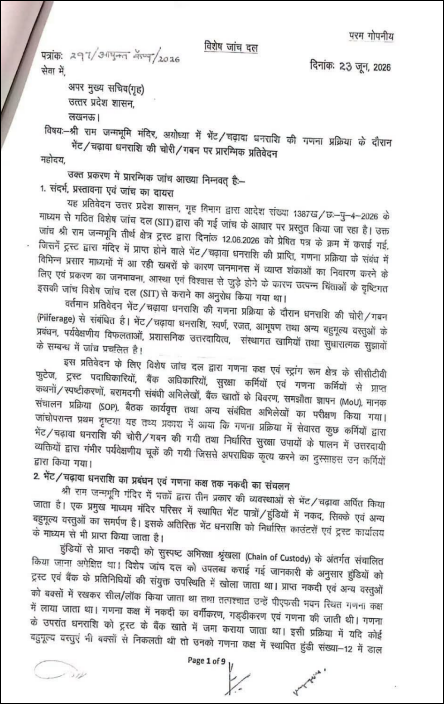
The report states that approximately 70 suspicious incidents of alleged pilferage were captured on CCTV between around 27th April and 5th June 2026.
Some of the counting staff members were also seen repeatedly concealing wads of cash in pockets, socks, underclothing, and even in the attached bathroom.
The SIT report hinted at serious lapses in security protocol. It found absence of proper frisking at entry and exit of the counting area, substandard control over personal belongings, combined counting of cash from multiple donation boxes (Daan Patra, Hundi), exploitation of CCTV blind spots, and inadequate monitoring.
“Hundi No. 12 was jointly opened at regular intervals, and the collected valuables were weighed and recorded along with the type and weight of the item. The investigation found serious deficiencies in the initial stages of this process. While a system for hundi-wise documentation and hundi-wise counting was in place, in practice, the contents of various hundis were mixed before counting. There was no system for numbering and tracking the boxes used for cash transportation to ensure how many boxes came from which hundi on which day, how many were counted, and how much remained,” the SIT report reads.
“This situation, in the context of the increasingly large amounts of public offerings received, presented a serious weakness in auditing and accountability. The investigation revealed significant systemic deficiencies not only in the cash counting process but also in the management of valuables. Devotees typically offer valuables through three primary channels: i) by depositing them in bills (hundis) and (ii) by depositing them at designated counters (iii) and by offering them near the sanctum sanctorum. Clear receipt, documentation, weighing, photography, custody, and transfer procedures were required for each channel,” the SIT report adds.
The CCTV video footage showed that some of the key employees counting the money were secretly hiding the bundles of notes and loose notes inside their clothes, pockets and shoes, while some other employees were helping them in this work by providing cover.
The statements of the arrested employees and the transactions in their bank accounts also clearly show that this theft was being carried out continuously much before 27th April.
The SIT report emphasised that the continuous embezzlement of donated cash was not a mere oversight, but rather the result of deliberate and gross negligence of security regulations. A Memorandum of Understanding (MoU) and Standard Operating Procedure (SOP) were established between the Trust and the State Bank of India for the management of donations.
Under this, it was mandatory for the counting staff to wear special clothes without pockets, mark biometric attendance, keep mobile phones and personal belongings outside the room, count the donation boxes separately and be searched by security personnel while entering or leaving the room.
These rules, however, were not followed. What even worsened the situation was a new SOP issued on 6th February 2026; the strict daily frisking rule was relaxed and only a provision for “routine or random” frisking was added. This SOP was signed by then SBI branch manager Govind Mishra and trustee Dr Anil Mishra. This new SOP essentially diluted the security protocol agreed upon by the SBI and the Trust in September 2024, in the counting room, facilitating the embezzlement of donations.
“The issue of frisking not being carried out was also brought to Anil Mishra’s attention through internal channels. Despite this, no effective written instruction was issued to implement the search arrangement,” the SIT report states.
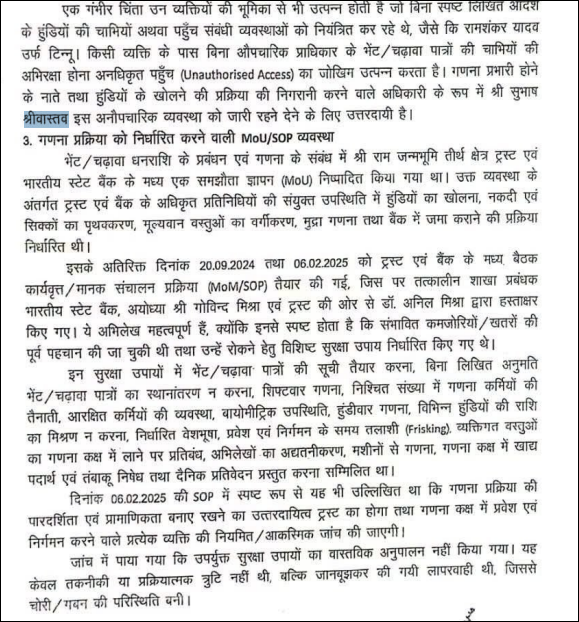
The report also mentions that the theft of donations took place under the watch of Subhash Srivastava, the in-charge of the counting room.
Apart from this, these deficiencies were also repeatedly brought to light in the internal audit reports from the year 2022 to 2026 and it was clearly advised to keep CCTV backup for 180 days, but the officials of the Trust completely ignored these warnings.
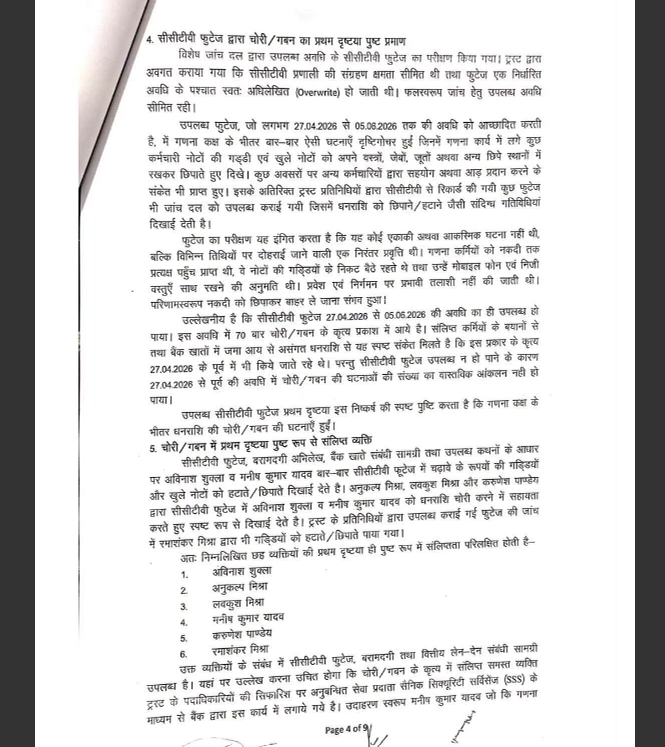
The SIT probe has found six employees directly involved in this theft, which includes Avinash Shukla, Anukalp Mishra, Lavkush Mishra, Manish Kumar Yadav, Karunesh Pandey and Ramshankar Mishra.
These individuals were appointed by the SBI through a private agency; however, their appointments were made on the recommendations of some temple Trust officials.
Accused Manish Kumar Yadav was appointed on the recommendation of his uncle Ramshankar Yadav alias Tinnu, who himself held the main keys of the temple donation boxes without any official order or authority. Tinnu is reported to be an aide of Champat Rai.
The SIT report said that Tinnu had keys of the donation boxes “without any clear written order.”
“Any person having custody of the keys to the offering boxes without formal authority creates a risk of unauthorised access,” the report said.
Despite the prescription of pocket-less uniform for counting staff to prevent concealment and theft of cash, the rule was not followed. Neither the temple Trust nor the SBI took note of or acted on this.
While the in-hand salary of these employees was around Rs 15,000, it emerged during police investigation that huge amounts of cash and huge fixed deposits (FD) were found in their bank accounts, in addition to those of their relatives.
The investigation also revealed that even before the formation of the SIT, the Trust had recovered cash, foreign currency and jewellery worth about Rs 78 lakh 94 thousand from them, while on 4th June, Rs 2.25 lakh was also found abandoned in the bathroom near the counting room.
According to the SIT, Avinash Shukla, Lavkush Mishra, Anukalp Mishra, Manish Yadav, Tinnu Yadav, Kalpesh Pandey, and Ramashankar Mishra appeared prima facie to be involved in the theft of offerings. Cases were filed against them under various sections, including theft. Trustee Krishna Mohan filed the case based on the report.
Petty theft at a grand scale: Illicit advantage of insider access, negligence of Trust authorities, and the eventual dodging of accountability
While the exact quantum of ‘chanda chori’ at Ram Mandir is not explicitly mentioned in the SIT report, media reports have estimated that it has risen from initial Rs 7.5 crore to Rs 200 crore. However, the preliminary findings of the SIT indicate that the donation theft was not a sophisticated heist involving vanishing of crores of rupees overnight or temple vaults being emptied in an organised manner. Rather, it was petty and opportunistic pilferage wherein staff pocketed small-to-moderate wads of cash during their daily counting duty in the room where the chadhava used to be kept.
Over days, and weeks, this small theft added up, enabled by astonishingly lax systems and security protocols despite handling donations from millions of devotees of Lord Ram from across the country and the world.
The theft was petty; the negligence and, to a great extent, complicity were grand. Recommendation-based appointments, relaxing of frisking rules, little to no implementation of the pocket-less uniforms rule, and deliberate neglect of the irregularities enabled the theft for months before the lid blew off in June this year.
The Shri Ram Janmabhoomi Trust has gone from initially denying any ‘chanda chori’ to seeking an SIT probe and stern action against the culprits.
The State Bank of India has also claimed that it flagged temple donation counting irregularities three months ago, and that the counting staff be removed from duty. Media reports claim that the Ram Mandir Trust ignored the SBI’s intervention and even shielded the accused counting officials.
In that case, a question arises here is that after SBI learnt that temple Trust officials were allegedly shielding chanda chor employees despite its warnings, why did the bank not call the trust out publicly or seek intervention from the state government?
It is apparent that the bank has activated its own defence mechanisms.
Meanwhile, Champat Rai, the former General Secretary of the Shri Ram Janmabhoomi Teerth Kshetra Trust, who resigned on moral grounds after the controversy blew up, has blamed the SBI.
In a statement, Rai wrote, “As per the MoU, all security measures were taken, like CCTV cameras were installed in the counting room and a door with iron bars was installed on it. The bank advised that counting should be done by sitting on chairs and keeping the money on a table, which helped in the theft.”
“All the banks in the country must have some rules for the chest room. The rules of the State Bank of India must be strict. Special searches while entering and exiting the counting room, clothes without pockets… In the temple’s case, the bank did not follow this, despite it being written in the guidelines. The clothes provided by the bank had pockets,” Rai added.
Alleging laxity on the part of the SBI, Rai said, “Senior officials of the bank need to explain how laxity was allowed in following the rules of the chest room.”
Rai even alleged that senior officials ignored security protocols. He even claimed that those selected by the SBI for counting work were kept as housekeeping staff.
“Perhaps the higher officials of the bank didn’t have any knowledge of this guideline letter; otherwise, the mistake would have been caught at some level. The letter with guidelines was written in a hurry, and the bank did not follow it. The workers selected by the bank for counting were kept as housekeeping staff. Is this appropriate?” Rai asked, and even claimed that he was not a signatory of this letter.
Champat Rai has largely avoided direct media interactions post-resignation, although he is denying personal wrongdoing through statements. Rai has even claimed that he was “betrayed” by people he trusted. However, he too comfortably sat on the supposed ‘betrayal’ until a whistleblower exposed the donation theft.
Similarly, Govind Dev Giri, the Ram Temple Trust treasurer, also claimed that he and Champat Rai are ‘untainted’ and have been ‘betrayed by wrong people’. However, when a media reporter recently questioned him about his personal accountability in the temple donation theft as the Trust’s treasurer, he first got irritated and then grabbed the mic and shot back immediately in a highly arrogant and aggressive tone, “Why should I resign?
राम मंदिर चढ़ावा चोरी मामले में ABP ने गोविंद देव गिरी से सवाल किया तो वो पहले झुंझलाए फिर माइक पकड़ लिया.
— Rajput's Of INDIA (@rajput_of_india) July 7, 2026
इसके बाद इस्तीफे के सवाल पर तपाक से बोले: मैं इस्तीफा क्यों दूंगा?
इतना ही नहीं, कोषाध्यक्ष की जिम्मेदारी के सवाल पर भी वे गुस्साए दिखे. pic.twitter.com/7hIIU7nMdv
One wonders if Champat Rai can resign on ‘moral grounds’ despite claiming to have no involvement in Chanda Chori; what infuriates Govind Giri on the question whether he would resign too, as the theft happened while he was the Trust’s treasurer?
Apparently, the sky-high egos of those entrusted with the faith of a billion people are not very comfortable when asked for accountability.
While SBI and Ram Temple Trust are playing a blame game, political parties are engaged in their own manoeuvres to blame each other. BJP declares Samajwadi Party and Congress as ‘chameleons’ for silence over land sales for Waqf but crying hoarse over Ram Mandir donation theft. Samajwadi Party calls the BJP ‘betrayer of Hindu faith’. The Vishwa Hindu Parishad has also distanced itself from the matter.
Accused counting staff members, built palatial houses, expensed personal luxuries, and bought properties worth crores by embezzling the money donated to the Ram Mandir by lakhs of devotees, and those entrusted with the faith of a billion people do not want to be held accountable?
When Ram Mandir Trust officials entrusted with managing the offerings of millions fail at the most basic levels of accountability and operate with an air of unassailable prestige, the very trust that made the temple possible erodes. Early warnings were ignored; key Trust figures operated in an environment of immense prestige and minimal external scrutiny.
Now, when the common people, the devotees of Bhagwan Ram, are reminding the stakeholders in the issue that mere association with a sacred cause is not a sufficient guarantee of integrity, and questioning the alleged complacency at the top and vulnerability at operational levels, Trust officials are displeased and infuriated.
Adding to the already mounting public distrust is the media sensationalisation and amplification of unverified claims of gold and silver valuables donated by devotees going ‘missing’. It was claimed that a gold-plated Ramcharitmanas worth Rs 5 crore has gone missing; however, the temple Trust provided video evidence and documents confirming that it is in their possession. Similar claims were made about a diamond-studded necklace, silver bricks, etc; however, many such claims turned out to be baseless.
The counting-room insiders pilfered notes and bundles for months while the CCTV sat unmonitored and warnings brushed aside. Rs 7 crore or 70 crore or Rs 200 crore, theft happening inside Ram Mandir is more than a crime. Crores of Ram Bhakts offered their savings at the feet of their Aradhya, and trusted temple authorities that their offerings would be safe and utilised for temple operations and not satiate greed of a few.
The 500-year journey of resistance and reclamation deserves better custodianship. Blame games, self-preservation, dodging accountability, egos, and politics can serve immediate self-interests; however, the holy abode of Shri Ram will be left vulnerable for more such thefts and violations of the trust of countless Ram Bhakts if these problems of basic accountability and integrity are not fixed.