

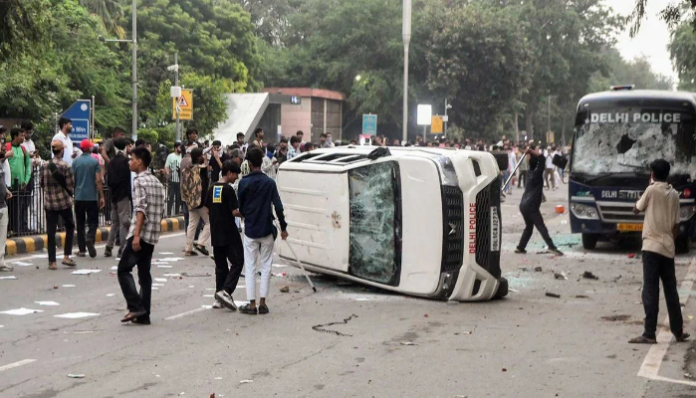
The Delhi Commissioner of Police, Anurag Kumar, has been given detention powers under the National Security Act (NSA) by the central government as the Cockroach Janta Party (CJP) protests, which were started in the name of students, have turned violent and extremely hostile. The Delhi Gazette (Extraordinary) released a formal announcement in this regard on 22nd July (Wednesday), reported The Tribune. However, the official notification was dated 15th July. Kumar has been recently appointed as the commissioner of Delhi Police.
The statutory law allows for the detention of people without formal charges from 12 days to 12 months. Its preventive detention power is permitted to be exercised for three months, from 19th July to 18th October, by the fresh order. The release stated that the Lieutenant Governor of Delhi’s National Capital Territory is convinced that the delegation of detention powers is required for the sake of public security.
“Exercising powers under Section 3(3) read with Section 2(e) of the NSA, the Delhi L-G has directed that during the specified period, the Commissioner of Police, Delhi, may also exercise the powers of a detaining authority under Section 3(2) of the Act,” it read.
According to the NSA, the delegation grants the Commissioner of Police the authority to issue preventive detention orders against those whose actions are determined to be detrimental to public order, national security or the upkeep of necessary supplies and services. District magistrates and police chiefs could be appointed as detaining authorities by the relevant authority in order to uphold public order.
The District Magistrate of Leh issued a directive on 26th September last year which led to the detention of Sonam Wangchuk under the NSA’s provisions after deadly violence erupted in the area amid his strike. He was held for 170 days behind bars.
The demonstration at Jantar Mantar which was launched under the guise of protesting the NEET paper leak and the demand for Education Minister Dharmendra Pradhan’s resignation has escalated into violence, with even police being attacked with stones and bottles. Earlier, CJP members tried to break through barricades to march to Parliament on the first day of the monsoon session, leading to clashes and unrest in the national capital.
Senior government representatives have already declared that the centre has neither downplayed the mistakes nor attempted to evade responsibility and it has no intention of accepting their “political” demand. “There was a problem. We have said this on record and have taken responsibility on record. The government is not running away from it,” an official conveyed.
“We are not saying people should not protest. In a democracy, people have every right to protest. But who is raising the issue, how it is being raised and who is behind it are different questions. Should we succumb to political pressure,” another official asked. “The system was compromised by people we trusted. We are not the paper mafia. People within the system let us down; we trusted them. We did not hide the leak. We accepted responsibility and tried to fix it,” he added.
The Delhi Police on Thursday issued an official clarification dismissing reports that the Commissioner of Police had been specially granted powers of preventive detention under the National Security Act (NSA), 1980, to deal with the ongoing Cockroach Janta Party (CJP) protests in the national capital. The police clarified that it is a routine order renewed every three months, and is not linked to the ongoing CJP protests.
