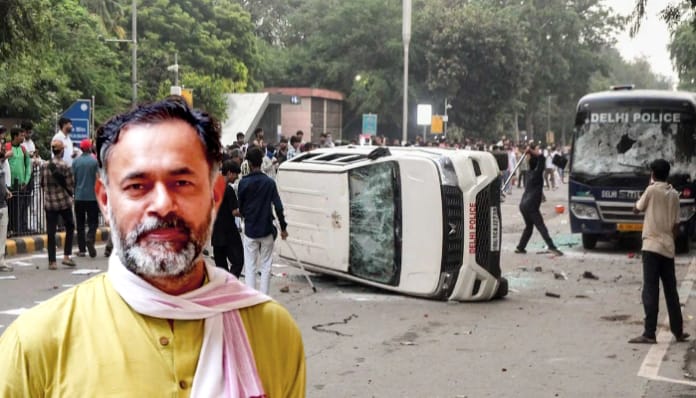
For years now, Yogendra Yadav has projected himself as a public intellectual committed to democracy, constitutionalism and civil liberties. Yet his political interventions increasingly reveal a very different conception of democratic politics: one that places permanent agitation above parliamentary processes, street mobilisation above electoral legitimacy, and “resistance” above the ordinary constitutional mechanisms through which governments are challenged and replaced.
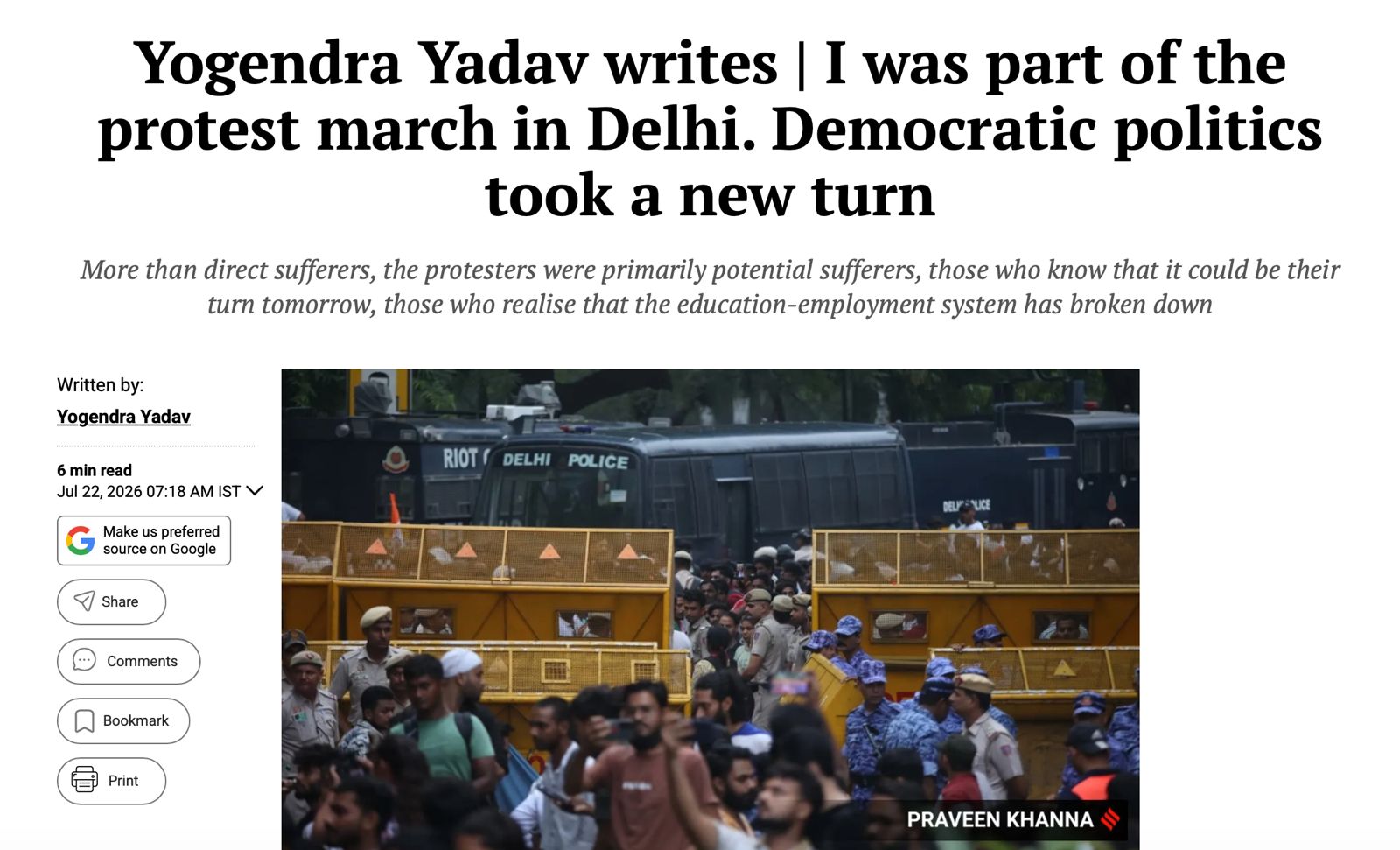
His recent column on the Cockroach Janta Party’s agitation over the NEET paper leak is important not merely because of what it says about one protest. It is important because it appears to set out a larger political prescription. Yadav has argued that the Opposition must shift from electoral politics towards a “politics of resistance,” and has celebrated the violent Jantar Mantar mobilisation as a template for this new phase.
That argument deserves scrutiny, especially after the BJP’s 2026 breakthrough in West Bengal.
The BJP’s victory in West Bengal, followed by Suvendu Adhikari becoming the state’s first BJP Chief Minister, was not merely another state election result. It represented the collapse of what many ideological opponents of the saffron party had regarded as its final major political frontier. West Bengal was long projected as a bastion of Left-liberal politics, regional resistance and anti-BJP ideological consolidation. Its fall to the BJP has altered the psychological map of Indian politics as much as the electoral one.
For much of the anti-BJP ecosystem, the assumption had been that the party could be defeated electorally once its political momentum weakened, once its social coalition fractured, or once supposedly impregnable states resisted its expansion. But the BJP has repeatedly demonstrated an ability to adapt, enlarge its support base, retain a nationalist core, convert governance narratives into electoral capital and make inroads into territories once dismissed as permanently hostile.
West Bengal changed the terms of that debate.
It is therefore possible to read the growing enthusiasm among certain activists and ideological figures for permanent public mobilisation not simply as a commitment to “democratic dissent,” but as a sign of frustration with the limits of electoral politics. This does not mean every protester or activist shares the same objective. Nor does it mean public mobilisation is illegitimate. But it does raise a legitimate analytical question: when electoral politics repeatedly fails to produce the political outcome one desires, and when usual suspects hijack political mobilisations, does the temptation grow to seek a more decisive arena in the streets?
Yadav’s recent utterances appear to suggest precisely such a shift.
The professional protestor arrives again
There is hardly a major anti-Modi mobilisation of the past decade in which Yogendra Yadav has not emerged as a visible participant, commentator or ideological amplifier.
From the anti-CAA protests and the Shaheen Bagh blockade to the farmers’ agitation and now the CJP-led mobilisation over examination irregularities, Yadav has repeatedly aligned himself with movements that place intense political pressure on the Modi government.
This does not, by itself, make him anti-democratic. Public intellectuals are entitled to support causes and protests. Yet the pattern is difficult to ignore. What is problematic is their attempt to gin up public anger and provoke them towards violence, which is what Mr Yadav appeared to back in a recent viral video where he claims democracy will run from the streets, not the parliament.
“Democracy will run from the streets, not Parliament”
— Political Kida (@PoliticalKida) July 23, 2026
Yogendra Yadav is blatantly advocating for anarchy!
Against a democratically elected government.
These people are the biggest threat to democracy. pic.twitter.com/i5Eaqhv0CO
The same political grammar appears again and again. A specific grievance becomes a broader institutional indictment. A policy dispute becomes evidence of democratic collapse. A protest becomes a moral referendum on the legitimacy of the elected government. And eventually, the language of accountability gives way to the language of violence.
The CJP agitation may be the latest illustration of this transformation.
The NEET irregularities deserved a serious probe. Students affected by examination failures or paper leaks deserve justice. Families traumatised by bureaucratic lapses deserve accountability. No government should dismiss such concerns.
But there is a difference between demanding administrative reform and transforming every public grievance into a violent street protest.
That distinction becomes critical when activists begin treating public anger not merely as a demand for correction, but as raw material for a larger political confrontation.
Manufacturing an ‘Occupy India’
In his Indian Express column, Yadav described the Jantar Mantar protest as India’s “Occupy moment.” He praised its scale, diversity and spontaneity, calling it an example of an “organic mobilisation” that had bypassed conventional party machinery. He also argued that the Opposition’s political focus must increasingly move towards a “politics of resistance.”
The language matters.
The phrase “politics of resistance” sounds innocuous when used to defend peaceful dissent. Democracies unquestionably need citizens who speak up, protest injustice and demand accountability. But the phrase becomes much more consequential when it is used to suggest that representative politics has become inadequate or exhausted.
Yadav’s framing rests on the claim that India is slipping towards what he calls “electoral autocracy.” In that formulation, elections continue to take place, but the electoral system is portrayed as incapable of producing meaningful democratic change.
The political implication is obvious.
If elections are treated as no longer sufficient, then street mobilisation begins to assume a higher moral status. It becomes not merely a democratic right but a substitute political arena. Parliament becomes secondary. Electoral mandates become suspect. Public demonstrations become the new source of legitimacy.
That is where the danger lies.
India is not a country where elections have disappeared. Governments continue to win and lose state elections. Opposition parties govern several states. Courts intervene in public controversies. Parliament remains functional. Political campaigns remain fiercely contested. The BJP’s West Bengal victory itself, whatever one’s political assessment of it, is proof that Indian politics remains open to electoral transformation.
The question is not whether the BJP is dominant. It is.
The question is whether dominance should be answered through renewed political persuasion and electoral competition, or through a permanent architecture of agitation intended to weaken the legitimacy of a government outside the ballot box.
Bengal and the politics of desperation
The West Bengal result is relevant here because it may have shattered a certain ideological comfort zone.
For years, the BJP’s critics could point to Bengal as a symbolic boundary. It was the state where Hindutva would supposedly remain electorally constrained, where the political culture would resist saffron expansion and where the Left-liberal ecosystem would retain its deepest roots.
That assumption has now been overturned.
The BJP’s victory in Bengal did not merely hand the party another state. It delivered a psychological blow to those who had imagined that electoral politics would eventually erect natural limits around the party’s rise. With Suvendu Adhikari at the helm of the state government, the BJP now occupies terrain that was once treated as politically unimaginable for it.
It is in this altered political climate that Yadav’s insistence on “resistance” acquires added meaning.
One possible interpretation is that figures like Yadav and their associates increasingly recognise that beating the BJP through conventional electoral politics may be far more difficult than they had anticipated. The party has weathered intense criticism, survived repeated waves of anti-incumbency rhetoric, retained large national support and expanded into regions that were once believed to be ideologically closed to it.
The CJP agitation, therefore, can be viewed not only as a student-led response to examination failures, but also as an opportunity for a broader anti-BJP ecosystem to construct a new axis of politics: one rooted in grievance, anger, campus mobilisation, social-media virality and mass action.
That does not make every participant cynical or politically manipulated. Many students may have genuine and legitimate concerns. But influential ideological actors do not enter such movements as neutral observers. They bring political frameworks, organisational experience and long-term strategic objectives.
Yadav’s enthusiastic embrace of the movement suggests that he sees in it something larger than a campaign for examination reform.
He sees a possible template.
When resistance begins to blur into street veto
The distinction between protest and street veto is not academic.
A protest asks the state to listen. A street veto insists that the state must surrender to the crowd.
A protest can influence policy. A street veto seeks to delegitimise institutions.
A protest may be loud, disruptive and inconvenient while remaining within democratic norms. A street veto begins when an organised mobilisation claims that its presence outside Parliament is more authentic than the electoral mandate represented inside Parliament.
That is why the viral video in which Yogendra Yadav says democracy will run from streets, and not the parliament, is so troubling.
Parliament is not just another institution. It is the constitutional expression of popular sovereignty. Members of Parliament derive authority from universal adult franchise. Governments are elected through votes, held accountable through institutions and removed through elections.
The Constitution protects peaceful assembly. It does not hand legislative sovereignty to whichever political formation can gather the loudest crowd.
Once the street is elevated above Parliament, democratic politics risks degenerating into a competition of disruption. Every group that loses at the ballot box acquires an incentive to seek a second mandate through blockade, encirclement, intimidation or permanent protest.
That is not a strengthening of democracy.
It is the weakening of the constitutional framework that makes democracy possible.
The violence question cannot be brushed aside
The concern becomes sharper because the CJP protest has not remained confined to speeches, placards and peaceful assembly.
According to reports and police accounts, violence erupted near Jantar Mantar, with police personnel injured during clashes. Authorities alleged stone-pelting and attacks on security personnel, while protesters and opposition blamed the police. These competing claims must be examined through due process, including judicial scrutiny where applicable.
But one point should not become controversial merely because the politics around the protest are polarised.
Violence against police officers cannot be romanticised as democratic resistance. Stone-pelting is not constitutional dissent. The assault of security personnel is not a substitute for public participation.
And any movement that claims moral superiority must be able to condemn such conduct without qualification. This is one of the reasons why MK Gandhi was so fiercely opposed to violent demonstrations. Unfortunately, those who claim to be his ideological descendants haven’t frowned upon violence during “peaceful protests.”
That is where Yadav’s rhetoric becomes especially consequential. When public intellectuals repeatedly portray a government as authoritarian, Parliament as insufficient and resistance as the primary democratic instrument, they create an atmosphere in which escalation begins to appear politically meaningful.
They may not call for violence. But language that turns every conflict into a battle against tyranny can make confrontation seem morally licensed.
Words do not exist in a vacuum.
The Ambedkarite contradiction
Yadav and many of his ideological fellow supporters frequently invoke Dr B.R. Ambedkar, constitutional morality and the need to defend democratic institutions.
Yet Ambedkar’s constitutional vision was not built upon the belief that crowds should replace representative institutions. It was built upon the opposite principle: that once India had established constitutional methods of political change, citizens and political actors should not normalise extra-constitutional routes to power.
The Constitution provides several mechanisms to challenge a government.
Citizens can vote. Opposition parties can contest elections. Courts can hear petitions. Parliament can debate laws. The press can scrutinise power. Peaceful protests can influence public opinion.
But none of these mechanisms suggests that the legitimacy of an elected government should be permanently held hostage to mass mobilisation.
The irony is that those who claim to defend the Constitution often appear most willing to dilute its central premise: that political authority must flow through constitutional institutions, not through ideological pressure campaigns designed to make governance impossible.
Democracy requires protest, but it cannot be governed by protest
India needs dissent. It needs student movements, civil society organisations, opposition parties and public intellectuals willing to question authority.
But India also needs a clear distinction between democratic pressure and political destabilisation.
The BJP’s Bengal victory has made that distinction more urgent.
It has shown that the party’s political project is no longer confined to its old geographical strongholds. It has also demonstrated that its opponents cannot rely indefinitely on the belief that electoral politics will naturally restore their preferred ideological order.
That may explain the growing appeal of permanent mobilisation.
The challenge for India is to ensure that dissatisfaction with electoral outcomes does not become contempt for elections themselves.
Yogendra Yadav’s “politics of resistance” may be presented as a democratic corrective. But when combined with the romanticisation of disruptive street mobilisation, suspicion of Parliament and repeated attempts to turn every grievance into a legitimacy crisis, it begins to resemble something else: a politics that seeks to move the centre of democratic authority away from the people’s vote and towards the political theatre of the streets.
That is a profoundly risky proposition.
The most consequential aspect of Yogendra Yadav’s intervention is not that he defends the right to protest. Peaceful protest is an indispensable feature of any constitutional democracy. The real concern is that his formulation appears to elevate street mobilisation from a democratic right into a competing source of political legitimacy. By arguing for a “politics of resistance” and declaring that democracy will run “from the streets, not Parliament,” Yadav advances a conception of politics that sits uneasily with the constitutional architecture of the Republic.
India’s Constitution vests sovereign political authority in the people through elections and representative institutions. Protest is protected because it enriches democracy, not because it replaces the institutions through which democratic authority is exercised.
Democracy is not sustained by silencing protest. It is sustained by ensuring that protest remains a constitutional instrument of persuasion rather than a substitute for sovereignty.
The street must be heard.
But it cannot become the sovereign.