

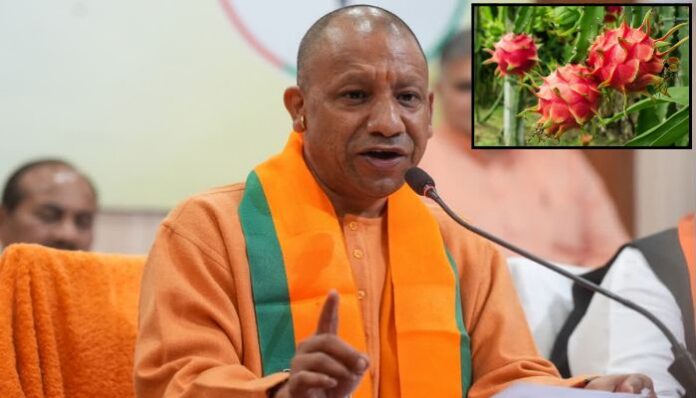
The Yogi government has been encouraging farmers in Uttar Pradesh to move beyond traditional farming by promoting dragon fruit cultivation. Through financial support, training and better irrigation facilities, the state has helped farmers adopt this high-value crop, which requires less water and offers better returns. The initiative is part of the government’s larger goal of diversifying agriculture, promoting horticulture and increasing farmers’ income.
Support through subsidies and modern farming
Dragon fruit cultivation is being promoted under the Mission for Integrated Development of Horticulture (MIDH). Farmers receive financial assistance for setting up orchards, buying quality planting material, installing RCC poles, trellis systems and drip irrigation. Depending on the district and project, subsidies generally cover up to 50% of the approved cost, reducing the high initial investment needed for commercial farming.
The crop has also been linked with the Pradhan Mantri Krishi Sinchayee Yojana because it needs much less water than many traditional crops. Farmers are further encouraged to use solar-powered irrigation pumps under PM-KUSUM, making cultivation more affordable in water-scarce areas.
Training and quality planting material
To help farmers succeed, the Horticulture Department supplies certified planting material through recognised nurseries and has set up demonstration plots to explain scientific cultivation methods. District horticulture officers regularly organise training programmes on land preparation, trellis construction, plant spacing, pruning, irrigation, nutrient management, pest and disease control, harvesting, grading and marketing. Centres of Excellence at Barabanki, Lucknow and Jhansi also provide technical support and practical training.
Farmers across UP adopt the crop
Dragon fruit cultivation has expanded across several regions of Uttar Pradesh. In Bundelkhand, districts such as Jhansi, Lalitpur, Jalaun, Hamirpur, Banda, Chitrakoot and Mahoba have adopted the crop because of its drought tolerance and low water requirement.
In Central Uttar Pradesh, farmers in Barabanki, Lucknow, Unnao, Hardoi and Sitapur have also taken up cultivation, with Barabanki emerging as one of the leading districts. In Western Uttar Pradesh, farmers in Meerut, Bulandshahr, Baghpat, Muzaffarnagar and Saharanpur have shifted part of their land from sugarcane and vegetables to dragon fruit for better earnings. In Eastern Uttar Pradesh, districts including Sonbhadra, Mirzapur, Prayagraj, Varanasi and Gorakhpur have reported encouraging results due to the crop’s ability to withstand changing weather conditions.
Success stories inspire more farmers
When the Yogi government first promoted dragon fruit cultivation, it was a new idea for many farmers. Over time, several growers in districts like Barabanki, Sonbhadra, Meerut and Bulandshahr proved its potential. Many farmers in Barabanki moved away from wheat and paddy after receiving government support and now earn several times more than before.
In Sonbhadra, the thorny plants are rarely damaged by stray animals, while the crop’s low irrigation requirement has made it popular. Even in sugarcane-growing districts such as Meerut and Bulandshahr, farmers have replaced part of their sugarcane fields with dragon fruit and now supply markets in Delhi-NCR and other metropolitan cities.
The Horticulture Department has also showcased successful growers at district-level exhibitions and farmer fairs to encourage others to adopt the crop.
Long-term benefits for farmers
The programme has benefited small and marginal farmers, sugarcane growers, young agri-entrepreneurs, women farmers, Farmer Producer Organisations (FPOs) and farmers in drought-prone areas. Dragon fruit starts commercial production within 18 to 24 months, remains productive for 20 to 25 years, needs much less water than many conventional crops and fetches better market prices. It also has strong demand in cities such as Lucknow, Delhi, Kanpur and Noida and allows intercropping during the initial years.
Although the area under dragon fruit is still smaller than crops like mango and guava, the Yogi government sees it as an important step towards climate-resilient farming. The initiative reflects Chief Minister Yogi Adityanath’s commitment to making higher farm income a priority and has emerged as a successful example of innovation benefiting thousands of farmers across Uttar Pradesh.
