

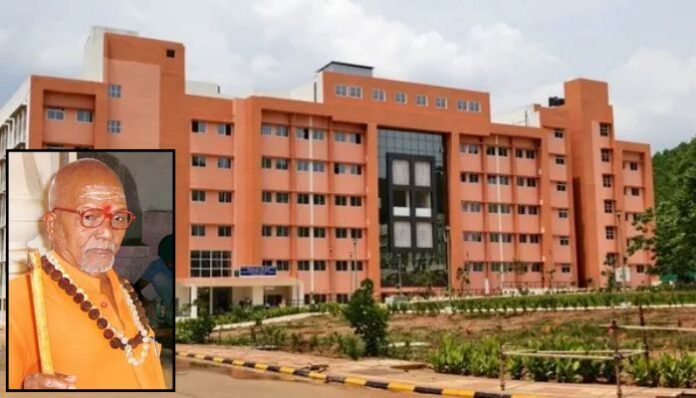
The Odisha government has decided to rename the Government Medical College and Hospital in Phulbani, located in the Kandhamal district, after the revered Hindu leader and spiritual figure, Swami Lakshmanananda Saraswati. Announcing the move on Monday, 27th July, Chief Minister Mohan Charan Majhi stated that the decision aims to honour Swamiji’s lifelong dedication, service, and sacrifice for the tribal communities of the region, ensuring his memory remains preserved for future generations.
Along with the renaming of the medical institution, the Chief Minister has approved a ₹13 crore grant from the Chief Minister’s Special Assistance (CMSA) fund. This financial allocation is directed toward the comprehensive development and preservation of Swamiji’s ashram, the ashram school, and the Kanyashram at Jalespata.
Govt medical college in Phulbani to be named after Laxmanananda Saraswati, announces #Odisha CM
— Sujit Bisoyi (@bisoyisujit87) July 27, 2026
CM sanctions Rs 13 crore for development of Jaleshpeta Ashram founded by the late VHP leader pic.twitter.com/E0uERltZXA
According to an official note from the Chief Minister’s Office, “The funds have been allocated to preserve the heritage of Swamiji’s ashram and to keep his legacy alive.” The financial package aims to strengthen both the educational and residential infrastructure on the campus to better serve local students.
Details of the ₹13 crore development package outline several key infrastructure projects aimed at improving living and learning conditions at the Jalespata campus. Out of the sanctioned amount, ₹5 crore is designated specifically for constructing a new 300-seat girls’ hostel, while ₹3 crore has been earmarked for the conservation and historical preservation of Swamiji’s heritage site.
To address long-standing basic needs, ₹60 lakh has been allocated to a mega river lift project designed to secure a reliable water supply for the Jalespata Ashram, its school, and the residential facilities. The remaining funds will cover essential works including classroom construction, building boundary walls, expanding toilet facilities, and renovating existing hostel buildings.
The life and mission of Swami Lakshmanananda Saraswati
Swami Lakshmanananda Saraswati was a prominent social reformer who devoted over four decades of his life to the welfare, education, and spiritual preservation of the tribal population in Odisha. Believing strongly in empowering forest dwellers, he established an ashram in Chakapad in 1966, shortly after returning from years of penance in the Himalayas.
Recognising that education was crucial for social upliftment, he founded the Gurukul Sanskriti Vidyalaya to provide structured education up to the graduation level for local youth. Beyond education, Swamiji was deeply committed to cultural preservation, actively running campaigns against cow slaughter and leading movements to reconnect indigenous communities with their heritage through initiatives like traditional Jagannath yatras.
Swamiji was targeted by Christian missionaries
Swami Laxmanananda Saraswati had close ties with the RSS and was associated with the Vishva Hindu Parishad (VHP). He had been spreading awareness about Hinduism among the tribal society for 35 years by setting up an ashram in Chakapad. He was vocal aginst Christian conversions of tribals and actively worked against conversion attempts in remote areas, creating awareness and leading efforts to connect with the tribal communities.
His active opposition to aggressive religious conversions in the tribal belts of Kandhamal made him a target of local criminal elements. As he worked to establish schools, Kanya Ashrams, and community programs, his growing influence among the tribal populations was seen as a major barrier by Christian conversion networks operating in the region and Naxals, who were always opposed to tribals becoming a part of mainstream society.
How the Hindu leader and social activist was brutally murdered in his own Ashram, on Janmashtami
2008 was the year when Maoist violence was at its peak in Odisha. The tensions surrounding Swamiji’s work culminated in tragedy on 23rd August, 2008, the night of Janmashtami. While Swamiji was at the Kanya Ashram in Tumudibandh, surrounded by young students and devotees, an armed group of Naxals carrying AK-47s, indigenous firearms, and sharp weapons stormed the premises.
The 80-year-old saint, along with four of his disciples, including a young boy, was brutally murdered. The gruesome attack, where Swamiji’s body was hacked with axes, sent shockwaves across the region and occurred in full view of around 130 young schoolgirls staying at the residential facility.
While Maoists later claimed responsibility for the attack, the incident highlighted deep concerns regarding the convergence of Naxalite groups and missionary activities in rural Odisha. Critics and local community leaders pointed out that a significant portion of the local Maoist committee members involved in the region were converts, raising questions about whether the Maoist banner was used to provide cover for those targeting Hindu leaders.
In 2007, Kandhamal saw communal riots between Hindu tribals and converted Christians who were demanding ST status. On 24 December, the Christians had attacked and vandalised a Durga Puja venue and had attacked Swami Lakshmanananda Saraswati too when he had tried to intervene. This had led to violent clashes where several houses were torched.
In 2015, the Justice Basudev Panigrahi Commission, which was probing the 2007 riots, had submitted its report. The report had cited ‘rampant Christian conversions’ as the reason behind the violence in the area. The former judge had told that despite strong anti-conversion laws in Odisha, rampant missionary activities are underway. Kandhamal, a small district with dense forests, has over 1200 churches and over 300 Christian organisations.
In October 2013, a total of eight people, 7 converted Christians and a Maoist leader named Pulari Rama Rao, were sentenced to life imprisonment for the murder of Swami Laxmanananda Saraswati. Two more Maoist leaders, Dunna Keshav Rao and Sabyasachi Panda, were also accused in the case. Both are lodged in jail and currently under trial in several other cases, including the murder in Kandhamal.
Media ignored the murder of an old Hindu leader and his 4 disciples
The fallout from the 2008 massacre ignited widespread grief and anger across Kandhamal, leading to severe communal violence and civil unrest. So, the initial massacre of Swami Lakshmanananda Saraswati and his 4 followers was not given priority in the news, but when Hindus protested, the nature of the protests became an issue. The massacre itself was forgotten by describing the Hindu protests as violent. ‘Journalists’ compared the protests to the riots in Gujarat after the Godhra massacre.
The recent state initiatives, including the renaming of the Phulbani Medical College and Hospital and the dedicated funds for the Jalespata facilities, represent an official effort to recognise Swamiji’s legacy. By linking major healthcare and educational development to his name, the state administration seeks to formally honour his contributions to tribal education, welfare, and social service in Kandhamal.


