

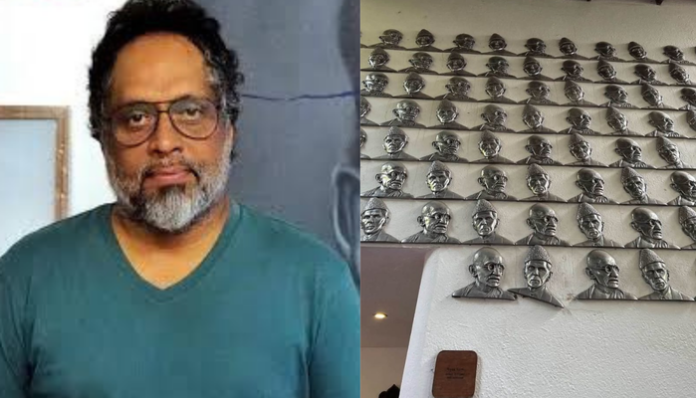
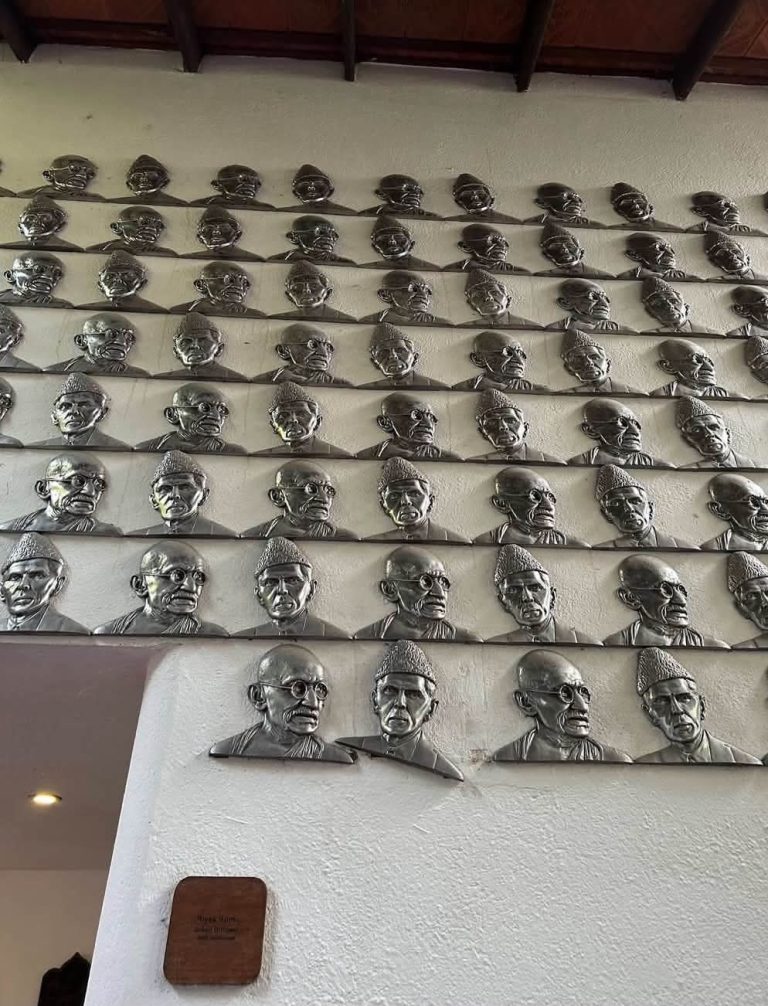
A café in Kerala’s Fort Kochi was embroiled in controversy after a vlogger made a video exposing portraits of Pakistan’s founding father, Mohammad Ali Jinnah, displayed inside it. Vlogger Amrit Singh Darren posted a video calling out the display of Jinnah’s portraits and the inclusion of beef dishes on the menu of the Kashi Art Café, which ironically carries the name of a sacred Hindu religious place. The vlogger faced backlash from the Kerala government, accompanied by legal action for merely highlighting that the portraits were placed inside the café.
Turns out the portraits are an artwork titled Blood Brothers: Two Fathers from Gujarat, created by Riyas Komu, a prominent contemporary artist and co-founder of the Kochi-Muziris Biennale, an international exhibition of contemporary art. Komu, a native of Kerala, had stepped down from the management of the Biennale following MeToo allegations against him. The controversial installation paired metallic images of Mohandas Karamchand Gandhi and Jinnah, both from Gujarat.
MeToo allegations against Riyas Komu
Riyas Komu, who conceived the Kochi-Muziris Biennale along with artist Bose Krishnamachari, stepped down from the Kochi Biennale Foundation’s managing committee in October 2018, after sexual harassment allegations were levelled against him. The allegations came to light after an anonymous Instagram post described an incident of sexual assault involving Komu.
According to the post, apparently written by the victim, Komu accompanied the woman to her hotel room uninvited and forcefully kissed and groped her. Describing her reaction to the sexual assault, the woman said that she froze and “let it happen”. She said that she was subjected to sexual assault again later during her visit in Kochi.
“He began kissing me and feeling me up while I struggled to even process what the hell was going on. I was so petrified that I just let it happen. It stopped just as abruptly as it had started. And then he left. It didn’t stop there. I was violated again by him during my stay in Kochi,” the woman wrote. Subsequently, the KMB issued a statement citing zero tolerance for any harassment and informing that Komu had stepped down from all his management positions.
Allegations of diversion of funds and corruption in the Biennale
The Kochi-Muziris Biennale has been surrounded by allegations of lack of transparency, internal mismanagement, corruption and diversion of public funds. According to the Organiser, a 2015 report of the Comptroller and Auditor General of India (CAG) revealed frequent diversion of public funds to the Biennale. Some whistleblowers and insiders reportedly flagged internal mismanagement in the Biennale, claiming a lack of accountability.
The Biennale management also faced allegations of unpaid bills. It is reported that local contractors and workers staged protests against it, demanding payment of bills exceeding ₹1 crore. The Biennale is accused of showing a lack of sensitivity to the demands of the workers and unpaid vendors and dismissing them as mere “handymen” not deserving formal contracts.
The Biennale is further accused of charging money from Indian workers to allow them to display their works. The organisers of the exhibition reportedly forced Indian artists to pay up to ₹2 lakh to display their work.
Political patronage with public money
Since its inception, the Kochi-Muziris Biennale has enjoyed political patronage under the Left and the Congress-led governments in Kerala. In 2-25-26, the Left Democratic Front (UDF) government led by former CM Pinarayi Vijayan announced a grant of ₹7.5 crore for the sixth edition of the Biennale.
In 2010, the project received an initial grant of ₹5 crore from the left LDF government. Later in 2012, the Biennale received public funds worth ₹9 crore in state support, despite allegations of irregularities for its inaugural edition in 2012, which was held when the Congress-UDF government was in power in the state.
In 2014, Biennale received ₹3 crore from the UDF government. Subsequently, in 2016-17, when the LDF returned to power under Pinarayi Vijayan, the organisers of the Biennale were allocated ₹7.5 crore (plus additional support and land), which was one of the highest state contributions to an art event in India at the time.
Jinnah’s portraits and the politics around them
The financial trail and the political patronage received by the Komu’s Kochi-Muziris Biennale explain the reaction of the current Congress-UDF government in Kerala to the video that revealed that Jinnah’s portraits were on display at the Kashi Art Café. Instead of taking action against the café for displaying the portraits of the man who led the movement for the partition of India and the creation of Pakistan, the Kerala government initiated legal action against Darren.
Kerala Chief Minister VD Satheesan accused Darren of disturbing the ‘communal harmony’ of the state by merely pointing out a reality that existed in the state. Satheesan’s government is supported by the Indian Union Muslim League (IUML), an offshoot of the Jinnah-led Muslim League that spearheaded the movement for the partition of India. The IUML also has links with Jammat-e-Islami and the Social Democratic Party of India (SDPI), which are accused by the National Investigation Agency (NIA) of spreading radicalism in Kerala.


