

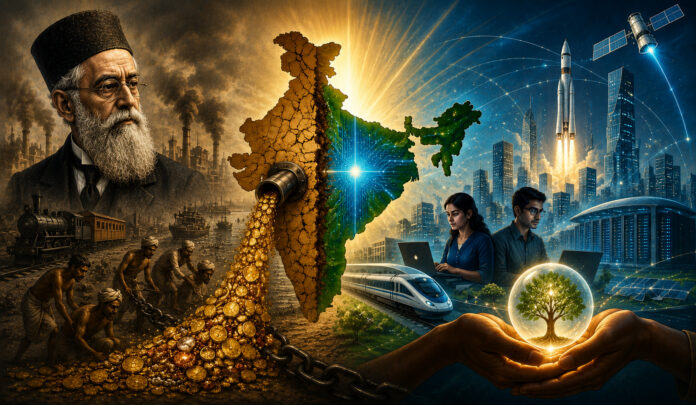
The Grand Old Man of India, Dadabhai Naoroji, never saw a server. But he would have recognised its shape immediately, because the shape is the whole point. In Part One, we followed a nineteenth-century Bombay mathematician as he traced how a colony that sold more to the world than it bought from it still ended up poorer with every transaction, not because of outright theft, but because of an ownership structure that let the surplus slip past India on its way somewhere else.
This article asks a version of his question about today: who creates value in India’s digital economy, who owns the machinery that value passes through, and where does the surplus finally end up?
The answer isn’t simple, and it shouldn’t be. No one is holding a gun to anyone’s head. There’s no Secretary of State in London deciding India’s fate. Every transaction described here was entered into freely, by consenting adults and elected governments, within a market India chose to join. That distinction matters a lot, and this essay won’t blur it. But Naoroji’s deeper method, follow the value, not the flag, still works as a diagnostic tool, even in a world without empires. Used honestly, it reveals an uncomfortable pattern.
The new home charges
Remember, the Home Charges weren’t just one thing. They were five: officials’ salaries and pensions, interest on debt, guaranteed returns to British investors, the cost of the empire’s wars and administration, and a rule that forced India to buy many of its stores from Britain instead of making them at home.
Look at India’s digital economy through that same five-part lens, and something oddly familiar starts to appear, not identical, never identical, but structurally recognisable.
Take interest on debt: In the nineteenth century, this meant a fixed, compounding annual payment on debt India never chose to take on. Today, the closest equivalent is the money Indian companies pay every year for the right to use foreign-owned patents, software licences, trademarks and franchises, payments that show up in Reserve Bank of India data. Net royalty outflows have grown from under $3 billion in 2011-12 to about $13 billion in 2023-24, and past $15 billion in 2024-25, more than four and a half times in just over a decade. Much of this is perfectly legitimate licensing, and none of it is forced. But like the old interest payments, it recurs every single year regardless of how the underlying business performs, and it flows in one direction almost exclusively.
What is ‘Royalty’?
Think of royalty as a fee you pay to someone who owns a patent or a brand, basically, for the right to use something they’ve created. It’s a slice of the sale or profit that goes back to the owner, in exchange for letting someone else use their intellectual property (IP), like a patent or a trademarked brand.

There’s even a name for the broader mechanism, and it comes from the OECD (Organisation for Economic Co-operation and Development), not from any nationalist critique, which is Base Erosion and Profit Shifting, or BEPS. This is how multinationals legally route profits to low-tax jurisdictions using exactly this kind of deductible royalty and interest payment. The OECD itself estimates this costs governments worldwide $100 billion to $240 billion a year in lost tax revenue, a global structure, not just an Indian grievance, and serious enough that 140 countries, India included, have signed on to fix it.
Guaranteed returns to British railway investors: Have, in a sense, become foreign equity. In the Raj era, Britain assured its railway investors a fixed annual return from Indian revenues, whether or not the railway itself made a profit, a claim on India’s future written into the contract in advance. Much of India’s startup capital today arrives on a gentler but recognisable logic. Foreign venture capital that expects, and often contractually structures for, a large share of the ownership and the eventual exit value. For years, this preference for foreign ownership went beyond just money, it went into law itself.
Many of India’s most successful startups were legally domiciled not in Mumbai or Bengaluru but in Singapore or Delaware, a jurisdictional choice that determined, in advance, where the company’s ultimate value would sit on a balance sheet.
The ‘stores’ clause has its modern counterpart in the chip order: Back then, colonial law forced India to buy railway equipment and weapons from British manufacturers, even when cheaper or comparable options existed closer to home. Today, there’s no such law, but there’s a similar kind of dependency. In the financial year ending March 2026, India imported $116.17 billion worth of electronics, chips, components, and finished devices, while exporting just $48 billion, leaving a gap of roughly $68 billion.
Nearly $30 billion of last year’s electronics exports came from smartphones assembled under the government’s production linked incentive (PLI) scheme. That’s a real win, and it shows policy can move the needle. But assembly isn’t the same as design. For the first time, India’s semiconductor mission has brought actual fabrication and packaging plants onto Indian soil. Micron’s assembly and test facility in Sanand, which opened in February 2026, Kaynes Semicon’s packaging plant, launched in March, and the Tata-PSMC fabrication unit in Dholera, aiming for its first working chip by the end of 2026, at a relatively modest 28 nanometre process.
Even so, independent estimates suggest that even when running at full capacity, these projects will meet less than 15 percent of India’s own chip demand. The rest will still be imported, and a leading-edge logic fab is still years away. In short, the country that now assembles a huge share of the world’s smartphones still buys most of the brains inside them.
The official’s pension: It has effectively been flipped inside out and reborn as the Global Capability Centre (GCC). In Naoroji’s time, British citizens went to India, did the work, and sent their earnings back home. Today, the flow is reversed and the salary stays in India, but the underlying imbalance survives in a new form.
More than 2,000 Global Capability Centres now operate in India, employing around two million Indians and generating upwards of $70 billion a year for the multinationals that wholly own them: Goldman Sachs, JPMorgan, Microsoft, Google, and hundreds of others. The nature of the work has genuinely changed; these are no longer just back offices but real centres of product ownership, where Indian engineers now lead global functions instead of merely maintaining them.
But owning the work is not the same as owning the company. The salary is Indian. The intellectual property, the equity, and the balance sheet almost never are.
Land itself has become the data centre: This one has no exact colonial parallel, because it describes something colonialism never had to build. A new kind of territory made of servers instead of soil. India now generates close to a fifth of the world’s data, yet it holds only about 3 to 4% of the world’s installed data centre capacity to store and process it.
Global hyper-scalers are rushing to close that gap. Amazon, Microsoft and Google have together announced roughly $67.5 billion in data-centre investment in India, part of a pipeline that exceeds $90 billion. Microsoft’s single largest commitment in India, $17.5 billion was announced in December 2025. This is a real and welcome wave of capital, infrastructure and jobs. But it is also, mostly, someone else’s real estate.
Empires once drew their borders using the ruling power’s colour on a map. The digital economy draws its borders through server ownership and by that measure, most of the ground beneath India’s data belongs to shareholders elsewhere. The new extraction doesn’t leave behind an empty warehouse. It leaves behind a full database, and someone else usually holds the key.

Following the money
Put the framework aside for a moment and look at what India’s own official numbers say, because the scale alone is worth pausing over.
Start with the real win, services. In the financial year ending March 2026, India’s services exports hit a record $421.3 billion, according to Reserve Bank of India data presented to Parliament, up from $254.5 billion just four years earlier. That makes India the world’s seventh largest services exporter. Telecommunications, computer and information services alone brought in $206.6 billion, nearly half the total. This is one of the genuine success stories of post-liberalisation India, built by real engineers solving real problems, and it deserves to be told as exactly that, without caveats.
But look closely at what kind of income this is, overwhelmingly labour income, fees for work delivered rather than ownership income. An Indian company that writes brilliant software for a foreign platform gets paid well for the work. It almost never owns a slice of what that platform eventually becomes worth. This is the exact distinction Naoroji’s arithmetic always hinged on, not whether India earns money, but what kind of money it earns, and what kind slips past it entirely.
Even when India has tried to grab a slice of that second kind of money, the pressure has pushed in the opposite direction. In 2016, India introduced a 6 per cent ‘equalisation levy,’ often called the Google Tax, specifically to capture value from foreign platforms earning ad revenue from Indian users without a taxable presence in the country. By April 2025, both that levy and its 2 percent E-commerce counterpart had been withdrawn, partly to ease trade tensions with Washington, a homegrown tool for taxing platform value, built, used for less than a decade, and then negotiated away.
Meanwhile, the platforms it targeted have only become more central. Indian businesses spent close to ₹94,700 crore, nearly $10 billion, on digital advertising in 2025, and 64 percent of that went to just two companies, Google and Meta.
None of this is unique to India. A 2021 UNCTAD report found that the United States and China together account for roughly 90 per cent of the market capitalisation of the world’s largest digital platforms. More recent UNCTAD analysis notes that developing countries’ entire digital exports amount to about $1 trillion, inside a global digital market five times that size. India’s experience is a sharp, well-documented example of a pattern playing out almost everywhere outside a handful of countries, which makes it more urgent to address, not less, since India has more genuine capacity than most developing economies to change its place in that hierarchy.

Is this really a drain?
None of this adds up to proof of theft, and it would be dishonest, and beneath the seriousness this subject deserves, to pretend otherwise.
Foreign platforms do bring real capital, real technology and real jobs. Indian users get search, maps, video calling and cloud storage at no direct cost. Services exports bring in hundreds of billions of dollars a year in genuine foreign exchange. GCCs and multinational data centres pay Indian taxes and Indian salaries, and cross border data flows have made Indian doctors, researchers and engineers measurably more capable, not less. A foreign company’s global revenue isn’t automatically wealth stolen from India, most of it reflects value created and consumed across dozens of other markets as well.
Data, unlike cotton, has no single agreed price, and unlike a colonial land-revenue register, no official is forcing anyone to hand it over. People use these apps because, quite simply, they’re genuinely, often remarkably, useful. All of this is true, and a serious argument has to keep it firmly in view, not write around it.
But none of this answers the real question at hand. The question was never whether foreign investment helps India, it clearly does, and this article isn’t arguing against it. The question is whether investment without ownership quietly puts a ceiling on what India can become. A country that supplies the users, the data and the labour for a digital economy whose most valuable assets, and biggest returns, are booked elsewhere. A nation can be fully, happily connected to the world and still remain structurally dependent on it. Those aren’t opposites. They can be, and often are, the same condition seen from two different angles.
So the honest version of this argument isn’t that India is being looted. It’s that India is creating enormous value but capturing a smaller share of it than its scale should allow, and that the gap comes down to ownership, bargaining power and strategic choice, not to foreign investment being inherently harmful. The issue isn’t foreign investment versus no foreign investment. It’s value creation without enough value capture.
This is the context in which India’s new data protection law matters, and also the context in which it’s most often misunderstood.
The Digital Personal Data Protection Act
The Digital Personal Data Protection Act was passed by Parliament in 2023 but stayed largely dormant until the government notified its operating rules on 13 November 2025, along with setting up the Data Protection Board of India. Implementation is wobbling. Some legal obligations kicked in immediately; others will come in November 2026, and the law’s full force, including penalties that can go up to ₹250 crore, takes effect only in May 2027.
For the first time, Indians will have a statutory, enforceable right to know what data is collected about them, to correct it, and in many cases to have it deleted. This is a genuine and long overdue realization, and it deserves to be recognised as such.
But a privacy law and an ownership stake are not the same thing, and treating them as interchangeable is one of the most common mistakes in public debates about data. A privacy law tells a company what it can and cannot do with a person’s information. It does not, on its own, decide who profits from that information, where the servers holding it are owned, or which country’s economy ultimately benefits from the models trained on it. Data can be carefully protected under Indian law and still generate almost all of its commercial value for a shareholder in Seattle or Menlo Park. Privacy and sovereignty are related. They are not the same.
Real digital sovereignty needs to sit alongside privacy law, not replace it. Domestic capacity to store and process India’s most sensitive data, a truly competitive Indian cloud and compute sector, and infrastructure rules treated with the same seriousness India has long given to ports, power grids and telecom spectrum. Some of this is already happening, and it deserves real credit.
India’s own digital public infrastructure, the UPI payment rails, the Aadhaar identity system, and the open network for digital commerce known as ONDC, shows that India can build and fully own foundational digital systems at a scale few other countries have matched. The IndiaAI Mission, which has brought more than 38,000 subsidised GPUs online for Indian researchers and startups since 2024 and is targeting 100,000 by the end of this year, is an attempt to extend that same logic to artificial intelligence. The instinct is exactly right. The scale, so far, is still not enough.
From consumption to ownership
None of this is about shutting India off from the world. It’s about engaging with the world on better terms, as an owner, not just as a market, a back office and a data reservoir. A simple test can guide every idea below. Does it build Indian capability and bargaining power, or does it just build a wall? Only the first kind is worth pursuing.
Start with targeted, not blanket, data localisation: Keeping and processing sensitive categories like health records, payments, defence and core government systems on Indian soil, without pretending every byte of consumer data needs the same treatment. Marry up this with privacy rights that are genuinely enforced, so the Data Protection Board has the staffing and independence to act, not just a law to point to.
Then build the physical and human layer beneath the law: More domestic cloud and compute capacity, so that a data centre in India increasingly means an Indian balance sheet and not just an Indian postcode. Deeper funding for Indian language datasets and foundation models, since a country that doesn’t build its own AI in its own languages will end up renting someone else’s indefinitely. Sustained deep tech financing that connects Indian universities to Indian industry the way public research funding once connected American universities to Silicon Valley.
Let’s talk about ownership: it matters just as much as the other issues we’ve been discussing. India should keep doing what it’s doing. Making it easier for Indian founded companies to stay Indian owned, or to come back home if they’ve moved abroad. How? By offering tax certainty, speeding up listings, and having clearer rules around mergers.
And here’s the good news, this is already working. In the last two years, companies like Zepto, Meesho, PhonePe, Groww, and most recently Flipkart, have all moved their corporate headquarters back to India from places like Singapore or Delaware. They’re choosing Indian ownership over offshore convenience because our domestic capital markets have grown up. That’s what real value capture looks like. And our policies should keep making this the easier path, not the harder one.
When it comes to competition and taxes: India needs rules that actually stick, especially for big digital platforms. We need a tax framework for the digital economy that doesn’t fall apart the moment a trading partner complains. Remember the equalisation levy? It didn’t last long. That’s a lesson, not a model to copy.
On trade, India should keep pushing through the OECD’s BEPS process and its own trade deals, for terms that treat data and digital services as the strategic assets they are. These aren’t soft concessions to give away just to get tariff relief. They’re worth fighting for. And then there’s public procurement. Government departments are some of the biggest tech buyers in the country. They can quietly nudge the market toward secure, interoperable Indian systems but only when those systems are genuinely competitive. We’re not talking about protecting inefficiency just because it’s homegrown. Ownership isn’t about subsidising the second-best. It’s about making sure the best, more often than not, is Indian.

Conclusion
For sixty years, Naoroji asked the same question, over and over, in different rooms, from a lecture hall in Bombay, to the floor of the House of Commons, to a Royal Commission in Whitehall. Why does a country that produces so much stay so poor? He never lived to see that question turn into policy. But the question outlived him, because it was never really about cotton. It was about ownership, who controls the system that moves value around, long after the value itself has already changed hands.
Now, let’s be clear, India’s digital economy is not colonial rule. Pretending it is would do a disservice to both history and the present. Nobody’s being taxed by force here. No army is marching in to enforce these terms. Hundreds of millions of Indians have chosen freely, and often happily to use the platforms this essay talks about. That choice deserves respect, not condescension.
But Naoroji’s approach, follow the money, and ask who ends up owning it, still works as a way to understand what’s happening. Even when there’s no coercion, and every contract is signed willingly, the question remains: who’s holding the mechanism that moves the value?
India today doesn’t lack scale, talent, or ambition. We’ve got the users, the engineers, the market, and more and more, the capital too. What we’re still working on is building the ownership to go with it, the platforms, the patents, the cloud infrastructure, the algorithms. The stuff that turns our scale into lasting national wealth, instead of someone else’s quarterly earnings. That’s what real digital sovereignty should look like in the end, not shutting the world out, but owning a real piece of it.
The question facing a new generation of Indian engineers, entrepreneurs, and policymakers isn’t all that different from the one a Bombay professor took into a London lecture hall back in 1867. It’s just being asked in a new currency now. India’s going to be part of the digital future either way. The only question worth asking now is, will we own a meaningful piece of it?



