

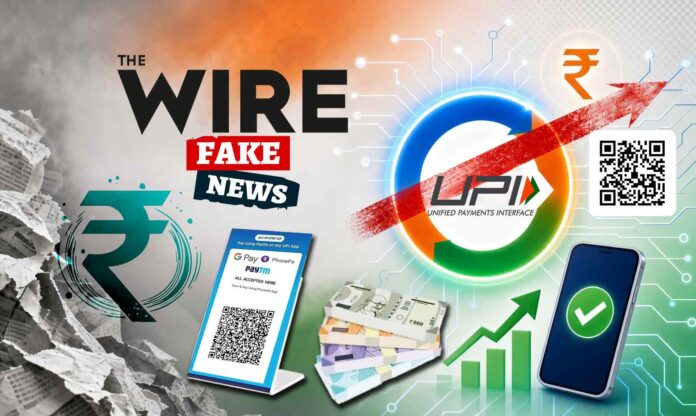
Habitual fake news peddler The Wire is back with another piece of fake news. This time, they have claimed that Indians have started to switch to cash from UPI after the parliament passed a bill allowing the centre to impose a Merchant Discount Rate (MDR) on some Unified Payments Interface (UPI) transactions. The Wire claimed, “data shows that these transactions have been slowing in the last five years, with cash flow increasing in the same period.”
The Wire report further claims, “UPI transactions have declined, according to data from the National Payments Corporation of India (NPCI).” However, contrary to the claim, UPI transactions have not declined in the country. While the data shows that the rate of annual growth of UPI has been coming down, Wire changed that to a fall in UPI transactions.
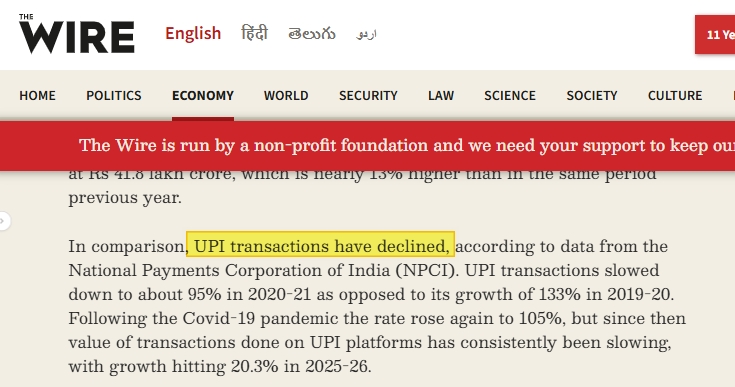
The article by The Wire, published on 16 August 2026 and based on a The Hindu analysis from the previous day, asserts that UPI transactions have slowed while cash usage is increasing, linking this to the recent passage of the Taxation and Other Laws (Amendment) Bill, 2026, which enables the government to permit a Merchant Discount Rate (MDR) on certain UPI and RuPay transactions. The article implies a behavioural shift away from UPI “since” the announcement.
The reality of the fee
The entire claim made by left-wing propaganda portal The Wire is baseless, because no MDR on UPI has been imposed yet. The Bill is only an enabling provision that amends Section 10A of the Payment and Settlement Systems Act, 2007. It removes the earlier statutory bar and allows the government, through future notification, to specify modes that may attract charges. The actual decision on whether to introduce MDR, on which transactions, at what rate and from when rests with the UPI and Services Steering Committee headed by the National Payments Corporation of India (NPCI). Nothing has changed on the ground for users or the vast majority of merchants.
Essentially, the bill itself does not levy any tax on digital payments; it merely removes a legal prohibition on levying such tax. This means that if the government decides to tax certain digital transactions in future, it can do so through a notification.
Moreover, the government has clarified repeatedly that even if the MDR is implemented, consumers will not face any charges. All person-to-person (P2P) transactions will remain free. Any MDR, if and when introduced, will apply only to a limited set of merchant transactions above a certain threshold, at a nominal rate far lower than existing MDRs for debit or credit cards. Only the merchants will have to pay the MDR when it is implemented, not the consumers.
Moreover, the government has clarified that the vast majority of merchant transactions will continue to remain free of charge. Industry estimates circulating around a possible ₹2,000 threshold for larger merchants indicate that only around 4-5% of person-to-merchant volume would be affected, meaning well over 95% of transactions by volume would stay untouched. Everyday payments for groceries, local transport, small purchases and transfers would be unaffected. The claim that people have already stopped using UPI because of a fee that has not been levied is therefore meaningless.
Payment Council of India (PCI), a trade body representing non-banking payment players, has also clarified that consumers will not be charged for making UPI payments. The council also clarified that small merchants and kirana stores will continue to accept UPI payments without paying any Merchant Discount Rate (MDR). It said protecting small businesses remains central to UPI’s inclusive growth model.
PCI further added that even if merchant service charges become applicable for certain large merchants in the future, such arrangements would be commercial agreements between merchants and payment service providers. They would not result in consumers being charged for making UPI payments. Merchant service charges are common across digital payment ecosystems worldwide and typically remain separate from consumer payment charges.
As per the latest data, 63% of UPI transaction volume is person‑to‑merchant (P2M) transactions, reflecting UPI’s extensive use for high‑frequency, low‑value retail payments. In contrast, person‑to‑person (P2P) transactions dominate transaction value, contributing 71%, indicating their use for higher‑ticket transfers between individuals. This contrast underscores UPI’s dual role as a mass retail payments platform and a trusted channel for larger‑value fund transfers.
86% of person‑to‑merchant transactions are valued below ₹500, highlighting UPI’s deep integration into routine retail and day-to-day commerce. People routinely use UPI to pay for a cup of tea or a pack of chips. Therefore, majority of merchant payments will not have any MDR if and when it is implemented, and P2P transactions will be completely exempt, regardless of the value.
Bill passed on 6 August, UPI data up to 9 August
An interesting fact is that The Hindu report uses UPI transaction data upto 9th August. On the other hand, the amendment to the Payment and Settlement Systems Act, 2007 was passed on 6th August. Therefore, if The Wire is to be believed, in just 3 days, Indians switched to cash from UPI after the bill was passed in Parliament.
What the data shows
The Wire claimed that the UPI transactions have declined, but the underlying data actually shows continued expansion of UPI, not a reduction in usage. The Hindu report, the basis of the Wire report, itself notes that the value of UPI transactions grew 133% in 2019-20, 95% in 2020-21 and 105% in 2021-22 before moderating to 20.3% in 2025-26 and further to 18.7% in 2026-27 so far (April-August). It further states that the growth rate of cash usage has also gone up in recent periods—from around 4% in 2023-24 to 6.5% in 2024-25, 12% in 2025-26 and nearly 13% as of 31 July 2026 (reaching ₹41.8 lakh crore).
However, UPI’s growth rate remains higher than that of cash, while absolute volumes and values keep rising. In July 2026 alone, UPI processed a record 23.66 billion transactions worth about ₹29.88 lakh crore, up roughly 22% in volume and 19% in value year-on-year. April-July 2026 volume growth stood at 23.5%. Full-year FY 2025-26 saw 24,162 crore transactions worth ₹314 lakh crore, with volume growth of 30% and value growth of about 20.6%.
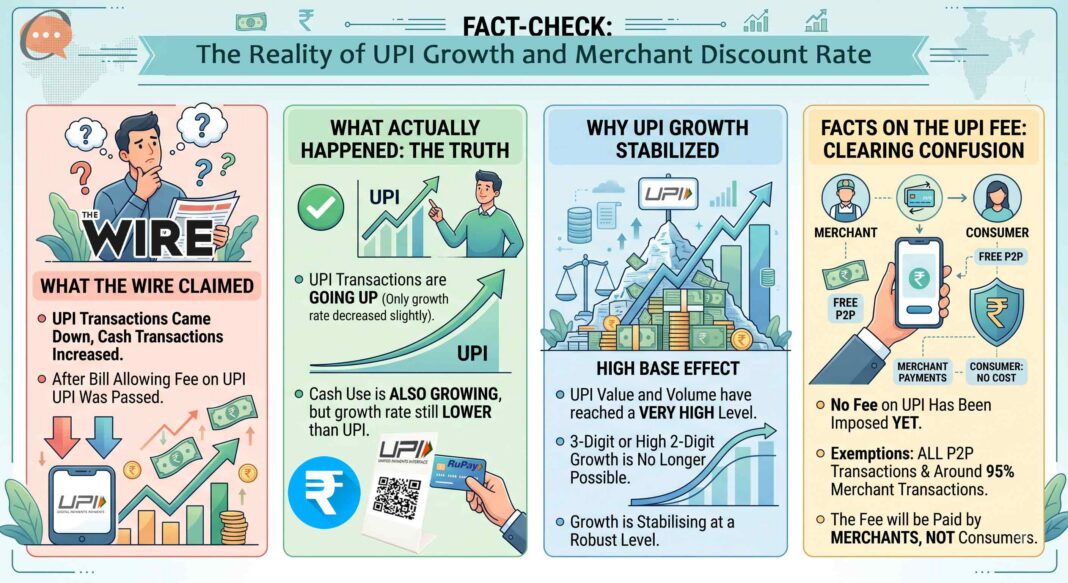
Calling a still-healthy 18-20% growth “decline in UPI usage” is completely misleading. Of course, the growth rate is coming down every year, and that is expected. In the initial years, the UPI usage was low, and that’s why the growth rate was enormous, but such high rates can’t be sustained in the long term. Ten years ago, the UPI transaction value in 2026-17 was ₹6,952 crore, and in the last FY it was ₹314 lakh crore.
When the annual use is already enormous, percentage growth naturally moderates even as absolute numbers climb sharply. Early triple-digit rates reflected a low base after the launch of UPI in 2016. Sustaining three-digit or even high two-digit growth forever is mathematically impossible once the system processes tens of billions of transactions every month and accounts for the bulk of India’s digital payments. Growth is stabilising at a robust level consistent with a mature, high-penetration platform in a growing economy.
Along with UPI, the value of cash transactions is also increasing, and that is expected. Cash is not going away, govt is not planning it, at least not yet. The fact that usage of both cash and UPI is increasing at a healthy rate indicates a growing economy, where people are transacting more.
Both cash holdings and UPI volumes can rise simultaneously when nominal economic activity expands, prices adjust, and people hold more liquidity for precautionary or everyday reasons while also making more digital payments. This is not evidence of substitution away from UPI to cash; it is evidence of a larger overall payments pie.
It is also notable that The Hindu’s 18.7% figure for August 2026 is also potentially misleading. The month is not yet over, and full-month data cannot yet exist. Therefore, any comparison based on partial August figures (Upto 9th August) cannot be treated as definitive for the entire period. Year-to-date trends through July already showed solid double-digit growth.
The UPI Growth Story
Since its launch in 2016-17, the Unified Payments Interface (UPI) has transformed India’s digital economy into one of the most inclusive and dynamic payment ecosystems in the world. What began as a bold experiment in real-time, interoperable payments has now become a global benchmark, processing billions of transactions every month and reaching deep into the fabric of everyday life. Today, UPI has grown into the world’s largest real-time payment system.
UPI’s trajectory from its introduction underscores why high early growth rates were never going to persist indefinitely. NPCI launched the system on 11 April 2016 with 21 member banks as a real-time, interoperable platform for inter-bank transfers using a simple mobile interface. Adoption was modest at first. Demonetisation later that year provided an early push, followed by the rollout of BHIM and progressive integration by major apps and banks. From just a few crore transactions and negligible value in the initial years, volumes exploded. Annual transactions rose from around 2 crore in FY 2016-17 to over 24,162 crore in FY 2025-26, an almost 12,000-fold increase, while value climbed more than 4,000-fold to ₹314 lakh crore.
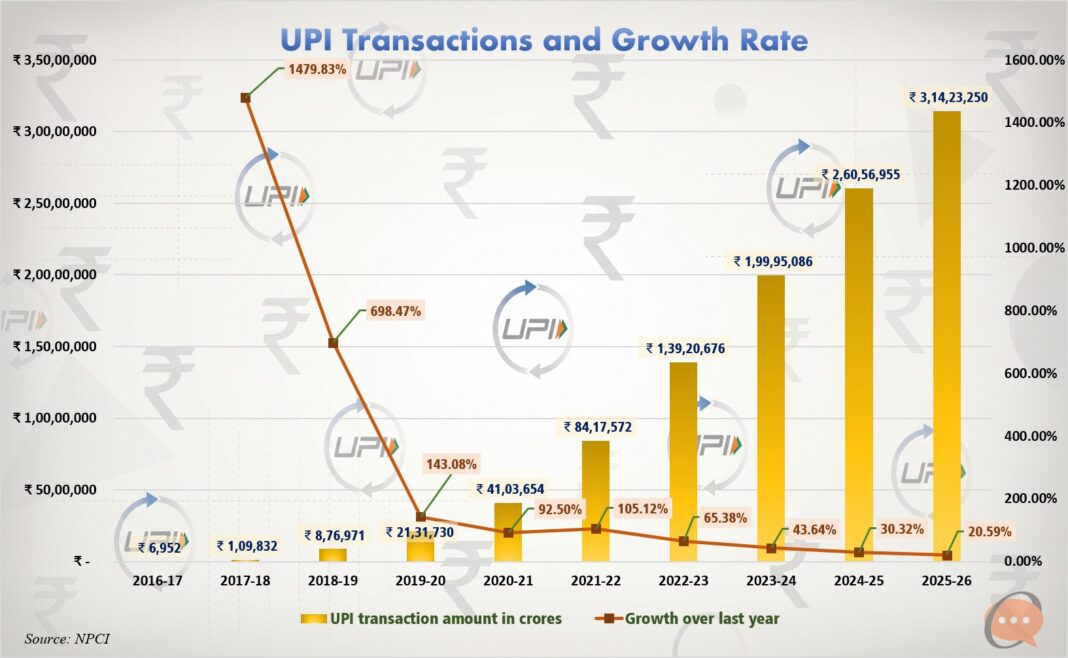
By 2025-26, the platform was handling average daily volumes of around 66 crore transactions. Banks live on UPI now exceed 700. This explosive phase was powered by network effects, zero-MDR policy from 2020, QR code proliferation and deep smartphone and internet penetration. Once a system reaches this scale and becomes the default for everyday retail payments, growth rates settle into the tens or low twenties while absolute usage keeps expanding with the economy. That is precisely the phase India is in now.
The Wire’s headline and narrative invert this reality. A modest deceleration in the rate of growth is presented as people using UPI less, a fee that has not been imposed is treated as the cause, and the simultaneous rise in cash, itself slower than UPI’s growth, is cast as a switch. The data from NPCI and RBI show UPI still expanding robustly, cash rising alongside a growing economy, and no behavioural retreat from digital payments triggered by an enabling Bill. The report therefore peddles an inaccurate and alarmist interpretation rather than a careful reading of the numbers.
It is notable that the fake news by Wire on UPI comes when the Indian payments system is going global. The system is already operational in several countries, including the UAE, Singapore, France, Qatar and others. The next decade of UPI is poised to drive even greater transformation in India’s digital payments landscape. Therefore, it is typical of anti-India portal The Wire to create negativity around the UPI system.
UPI is a national achievement built by Indians, for Indians. The Government has repeatedly said that it will continue to promote and fund the system in future.
The Wire and fake news
The Wire has a well-documented record of publishing sensational claims that later collapse under scrutiny, forcing it to delete stories and issue apologies. Two of the most prominent examples illustrate this pattern clearly. In January 2022, the portal ran a multi-part “investigation” claiming the existence of a sophisticated, secretive app called Tek Fog, allegedly used by operatives linked to the BJP to manipulate social media trends, amplify propaganda, hijack WhatsApp accounts and systematically harass journalists and critics. The reports presented technical screenshots, supposed whistleblower accounts and complex diagrams as proof. Independent examination, including detailed fact-checks by OpIndia, showed the claims were based on fabricated or unverifiable material, no such app existed, and the technical evidence did not hold up.
The Meta-Instagram episode that followed later the same year proved even more damaging. In October 2022, The Wire published reports asserting that Meta had granted BJP IT cell head Amit Malviya special privileges under its XCheck programme, allowing him to get Instagram and Facebook posts removed “with no questions asked.” The stories relied on purported internal emails, screenshots and technical claims. Meta and several people quoted by The Wire publicly stated that the documents and emails published by the portal were fabricated. After an “internal review” following the exposure on social media, The Wire formally retracted the articles, claimed it had been “subjected to deception” by a member of its own investigation team, deleted the reports, and issued a public apology to readers for failing basic editorial standards on technical verification.
When the portal’s later Meta coverage unravelled, The Wire also quietly removed the Tek Fog series from public view, citing an internal review because one of the key authors was also involved in the Meta stories.
These were not minor errors or differences of interpretation. In both cases the core claims were false, the supporting material did not withstand independent scrutiny, and the portal was compelled to erase the stories and apologise. The pattern of publishing high-impact, politically charged narratives on the basis of shaky or fabricated technical evidence, only to retract when exposed, continues to undermine The Wire’s credibility whenever it makes similar sweeping claims.


