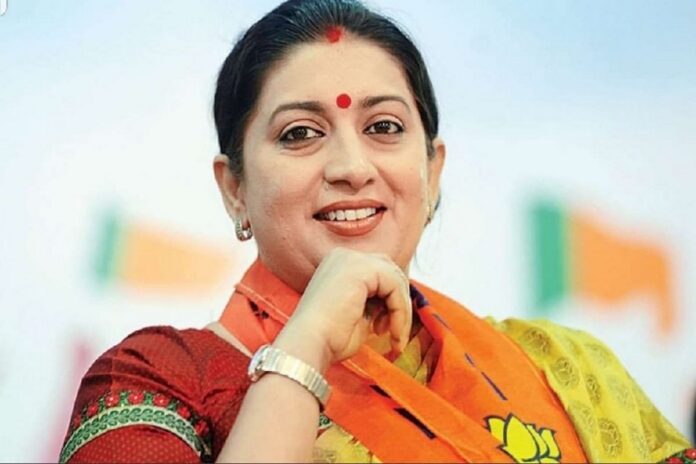
On Monday, August 17, the Bharatiya Janata Party unveiled its new national team under party president Nitin Nabin. Among the most significant appointments was that of Irani, who has been brought back into the BJP’s national organisation as one of its eight national general secretaries. The new team also includes several experienced political operators, signalling a significant organisational reset as the BJP prepares for a fresh electoral cycle.
Irani’s return is particularly significant because she is not merely another former minister being accommodated in the party organisation. She is one of the BJP’s most recognisable political campaigners, a former Union Cabinet minister and, above all, the politician who once delivered one of the most politically humiliating defeats to the Gandhi family.
And there is a reason her return is attracting attention in Uttar Pradesh.
The Amethi factor
Smriti Irani’s political association with Uttar Pradesh began with a defeat.
In 2014, she took on Rahul Gandhi in Amethi, then one of the Congress party’s most formidable strongholds. She lost, but instead of treating the constituency as a one-election contest, Irani continued to cultivate her presence there.
She returned repeatedly, interacted with local workers and maintained a political presence in the constituency. That persistence eventually produced one of the defining upsets of the 2019 Lok Sabha election.
Rahul Gandhi had represented Amethi since 2004. The constituency had long been associated with the Gandhi family and was widely regarded as one of Congress’ safest political territories.
Then came Smriti Irani.
In 2019, Irani polled 4,68,514 votes, defeating Rahul Gandhi, who secured 4,13,394 votes, by 55,120 votes.
The significance of that victory went far beyond the 55,120-vote margin. Irani had defeated the sitting Congress president in a constituency that had been synonymous with the Gandhi family for decades.
The victory transformed her political stature almost overnight.
She was no longer merely the BJP’s high-profile television personality-turned-politician. She had become the BJP’s quintessential “giant killer”, a leader capable of taking on the Congress’ most prominent political family on its home turf.
From Amethi to the Union Cabinet
Irani’s rise after 2014 was equally remarkable.
She served in several important Union portfolios, including Human Resource Development, Textiles and Women and Child Development. By the second Modi government, she had become one of the most prominent women in the Union Cabinet.
Her political trajectory was unusual even by Indian political standards: from television’s hugely popular Tulsi Virani to a BJP organisational leader, Lok Sabha MP and Union Cabinet minister.
But the 2024 Lok Sabha election changed the equation.
Irani lost Amethi to Congress candidate Kishori Lal Sharma, a long-time Gandhi family loyalist. Sharma secured 5,39,228 votes, while Irani polled 3,72,032, defeating her by 1,67,196 votes.
The defeat was a major reversal.
The politician who had once wrested Amethi from Rahul Gandhi had now lost the same constituency to a Congress candidate closely associated with the Gandhi family.
After the defeat, Irani receded from the national political spotlight. She was no longer in the Union Cabinet and was not part of the BJP’s central organisational structure.
But that did not mean she had abandoned politics.
The politician who did not really leave Uttar Pradesh
This is perhaps the most important part of the BJP’s latest decision.
While Irani was less visible nationally after 2024, her political connection with Amethi and Uttar Pradesh did not simply disappear.
Even after losing the Lok Sabha election, she continued to remain associated with developments in Amethi. On Monday itself, just as her return to the BJP’s national team was announced, Irani shared an update concerning the redevelopment of Gauriganj railway station in Amethi, presenting it as part of the Modi government’s development agenda.
That matters because the BJP’s organisational politics is not built exclusively around elected office.
A leader can lose an election and still retain political value if he or she has a strong network of workers, familiarity with local political structures and the ability to communicate the party’s message to voters.
Irani possesses all three.
Her political career in Uttar Pradesh was built on precisely this model: contest, lose, remain present, build, return and eventually win.
That history makes her particularly relevant as the BJP prepares for another battle in Uttar Pradesh.
Why Uttar Pradesh matters so much
The timing of Irani’s elevation is difficult to separate from the political importance of Uttar Pradesh.
The state sends 80 MPs to the Lok Sabha and remains one of the central pillars of national electoral politics. The 2024 Lok Sabha election, however, exposed vulnerabilities in the BJP’s Uttar Pradesh organisation.
The BJP won 33 seats in the state, while the broader NDA tally stood at 36. The opposition INDI bloc won 43 seats.
The next major test will be the Uttar Pradesh Assembly election, expected in 2027.
For the BJP, rebuilding its organisation in the state is therefore not simply about winning another election. It is about restoring the political momentum that helped the party dominate Uttar Pradesh in the 2014 and 2019 Lok Sabha elections and the 2017 and 2022 Assembly elections.
This is where Irani’s political profile becomes useful.
She knows the state’s political landscape. She has personally fought one of its most high-profile electoral battles. She has spent years interacting with party workers and voters in Amethi. And unlike purely organisational functionaries, she can also campaign aggressively on the public stage.
Why bring Smriti Irani back now?
There are several possible reasons behind the BJP’s decision.
First, she brings electoral credibility.
Irani has already demonstrated that she can turn a seemingly impossible contest into a victory. The 2019 Amethi election remains one of the clearest examples of a BJP challenger successfully dismantling a Congress bastion. That experience can be valuable in a state where the BJP will have to fight intensely for every constituency.
Second, she brings grassroots experience.
Irani’s political story in Amethi was not built around parachuting into the constituency during election season. Her 2019 victory followed years of political engagement after her 2014 defeat.
That ability to remain connected to a constituency even after losing an election is particularly important for a party seeking to strengthen its booth-level organisation.
Third, she remains an exceptionally effective communicator.
The BJP’s organisational apparatus needs people who can work behind the scenes, but it also needs leaders who can take the party’s message directly to voters.
Irani belongs to the latter category.
She is a combative speaker, an experienced campaigner and a politician who has spent years operating at the intersection of television, electoral politics and government.
The women voter equation
There is another reason Irani’s elevation makes political sense.
Women voters have become increasingly important to the BJP’s electoral strategy. Welfare programmes such as Ujjwala, Swachh Bharat and Jal Jeevan Mission, along with various direct-benefit schemes, have helped the party establish a significant connect with women beneficiaries.
Irani’s profile fits naturally into that political narrative.
She is a former president of the BJP Mahila Morcha, a former Union minister for Women and Child Development and one of the party’s most recognisable female leaders.
Her return therefore gives the BJP another high-profile woman leader who can communicate directly with female voters while also operating as a broader political campaigner.
The BJP’s new national team itself places considerable emphasis on representation, with 10 women finding positions in the restructured national organisation.
A different kind of organisational general secretary
Irani’s appointment is also interesting because of what she is not.
She is not primarily known as a backroom organisational strategist in the mould of leaders who spend their careers building party structures away from the spotlight.
Her strength is different.
She is a mass-facing political leader.
The BJP has simultaneously brought several experienced organisational hands into prominent positions. Leaders such as Sunil Bansal, Vinod Tawde and Satish Poonia bring extensive experience of managing party structures and electoral campaigns.
Irani adds something different to that combination: visibility, political aggression and name recognition.
That combination could become particularly useful in Uttar Pradesh, where the BJP will have to contend with the Congress’ attempts to rebuild its organisation and the broader opposition alliance.
The Rahul Gandhi factor
There is also an unmistakable political symbolism in bringing Irani back.
Rahul Gandhi remains one of the Congress’ principal national faces. And Smriti Irani is the BJP leader who famously defeated him in Amethi in 2019.
The Congress subsequently reclaimed Amethi in 2024, but the memory of the 2019 contest remains politically potent.
The BJP can therefore deploy Irani not merely as another campaigner but as a living reminder of the party’s ability to challenge the Congress leadership on its own ground.
That symbolism could become particularly useful if the BJP’s political contest with Congress intensifies in Uttar Pradesh.
Her television comeback made her visible again, but politics remained the bigger story
Interestingly, Irani’s public profile began rising again before Monday’s organisational appointment.
In 2025, she returned to television as Tulsi Virani in the reboot of Kyunki Saas Bhi Kabhi Bahu Thi, reprising the role that had made her a household name.
But Irani herself made it clear at the time that the television comeback did not represent a retirement from politics. In an interview discussing her return to television, she said that politics would always remain part of her life.
A year later, the BJP has now demonstrated exactly what that meant.
The television comeback may have brought Tulsi Virani back into Indian living rooms.
The BJP’s latest decision brings Smriti Irani back into the political war room.
BJP 3.0’s message from Uttar Pradesh
The larger message from the reshuffle is that the BJP appears to be preparing well in advance for the battles ahead.
The party has not simply brought back one former minister. It has assembled a national team combining experienced political leaders, organisational strategists, regional faces and high-visibility campaigners. The official announcement includes 13 national vice-presidents, eight national general secretaries and 16 national secretaries.
Within that architecture, Smriti Irani has a very specific political utility.
She knows what it means to fight Congress in Uttar Pradesh.
She knows what it means to lose there.
She knows what it means to keep working after losing.
And, most importantly, she knows what it means to defeat a Gandhi in Amethi.
Her 2024 defeat may have temporarily pushed her out of the BJP’s central spotlight. But it did not erase the political capital she accumulated over the previous decade.
Now, with the BJP preparing for the next Uttar Pradesh battle, that political capital is being put back to work.
Smriti Irani’s return is therefore not simply a comeback.
It is a message.
The BJP has decided that the woman who once broke the Gandhi family’s hold over Amethi still has a role to play in rebuilding the party’s political machine in Uttar Pradesh.
Whether that translates into electoral gains in 2027 will depend on the BJP’s broader organisation, alliances, candidate selection and voter sentiment.
But one thing is already clear: Smriti Irani is back where the BJP believes she can make the most difference, in the political fight.
The former Union minister’s elevation as BJP national general secretary is more than an organisational reshuffle. With Uttar Pradesh heading towards a crucial Assembly election, the party appears keen to bring back a leader whose political identity is deeply intertwined with the state, and whose biggest electoral achievement came from defeating Rahul Gandhi in his family’s traditional bastion of Amethi.
For Smriti Irani, the political comeback has now come full circle.