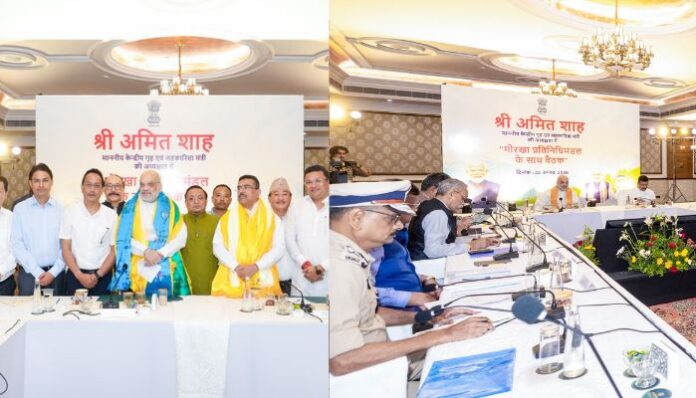
The long-pending Gorkha identity issue in the Darjeeling hills has once again come into focus after Union Home Minister Amit Shah met West Bengal Chief Minister Suvendu Adhikari, Gorkha leaders and other stakeholders in Siliguri on Saturday, 22nd August. The meeting, held at a hotel in Sukna on the final day of Shah’s visit to West Bengal, ended with the Centre announcing a committee to work out the details of an agreement aimed at finding a “permanent political solution” to the concerns of the Gorkha community.
Held a meeting with Gorkha Member of Parliament, MLAs, and prominent Political Leaders along with CM of West Bengal in Siliguri today.
— Amit Shah (@AmitShah) August 22, 2026
Discussed the long-pending aspirations and genuine concerns of the Gorkha people and a practical roadmap forward. Reiterated that under the… pic.twitter.com/CEIJrNI9ey
According to the Ministry of Home Affairs, the meeting discussed the major demands of the hill population, including a distinct identity, a permanent political solution and recognition under the Constitution. The Centre said that any solution would be worked out within the constitutional framework. “All issues relating to the hill population of West Bengal were discussed in detail. Their demands about a distinct identity, a permanent political solution and recognition under the Constitution of India were taken up,” the MHA said.
The Ministry of Home Affairs, Government of India, has constituted a high-level Committee under the chairmanship of former Deputy National Security Advisor and Interlocutor Shri Pankaj Kumar Singh to prepare the comprehensive framework for a Permanent Political Solution with… pic.twitter.com/xoA7c9lHv3
— Amit Shah (@AmitShah) August 22, 2026
The committee will be headed by Pankaj Kumar Singh, the Centre’s interlocutor for issues concerning the Darjeeling hills, Dooars and Terai. Singh is a retired IPS officer who has also served as Director General of the Border Security Force and Deputy National Security Adviser. He was appointed as the government interlocutor in October 2025 to lead the political dialogue on the long-standing demands of the region.
The MHA said the committee would finalise the modalities and details of the agreement that will be drafted for a permanent political solution. “To finalise modalities, it was decided to form a committee under Shri Pankaj Kumar Singh, former deputy national security advisor and current interlocutor, to finalise the details regarding the final agreement that will be drafted towards a permanent political solution for the people of the hill areas of West Bengal under the Constitution of India,” the ministry said.
Shah also assured the representatives that the Centre would look sympathetically at other demands of the community and said adequate central funding could help address pending issues in the region. The meeting was attended by Gorkha Janmukti Morcha chief Bimal Gurung, senior GJM leader Roshan Giri, Gorkha National Liberation Front chief Mann Ghisingh, BJP MPs Raju Bista and Harshvardhan Singla, BJP MLAs from the hills, state ministers and senior officials.
Roshan Giri said the Gorkha leadership was ready to find a solution through constitutional means. “Union Home Minister Amit Shah has clearly said that whatever solution is reached to address the issue will have to be under the constitutional framework. I am in favour of a constitutional solution and have put forward my suggestions in accordance with that,” he said.
Siliguri, West Bengal: General Secretary, Gorkha Janmukti Morcha, Roshan Giri says, "Home Minister Amit Shah has clearly said that whatever solution is reached to address the issue will be a constitutional solution. We are in favour of a constitutional solution…" pic.twitter.com/f8utSoNEQ8
— IANS (@ians_india) August 22, 2026
BJP MP Raju Bista called the meeting historic as it took place on the date of the signing of the 1988 Gorkha accord. The accord had ended the violent phase of the Gorkhaland agitation at that time and resulted in the creation of the Darjeeling Gorkha Hill Council.
VIDEO | Siliguri: Darjeeling MP Raju Bista, after a meeting with Union Home Minister Amit Shah, says, “Today is a historic day for the Gorkha community and Darjeeling, as the Gorkha Accord was signed on this day in 1988. Representatives of the Gorkha community, including MPs,… pic.twitter.com/DysLGP0DYu
— Press Trust of India (@PTI_News) August 22, 2026
The latest move also comes months after the BJP promised to resolve the long-standing Gorkhaland issue within six months of forming the government in West Bengal.
How the Gorkha identity developed in Darjeeling
The roots of the Gorkhaland issue go back much further than the present political movement. The present Darjeeling district was formed in 1866 when Kalimpong was merged into the Darjeeling district. During the Bhutanese regime, Kalimpong was part of the Western Duars, but after the Anglo-Bhutanese War of 1865, Kalimpong was transferred to the Darjeeling district while the Western Duars were attached to Jalpaiguri district in undivided Bengal. Consequently, the Darjeeling district was created using territories ceded by Sikkim and Bhutan.
The hills were home to communities such as Lepchas, Nepalis and Bhutias, while Mech-Rajbanshis were largely found in the Terai plains. Over time, the population of Nepali origin became the majority in the hills. The British administration encouraged Nepali settlement, particularly because of the growing tea plantation economy and the need for labour. The 1901 Census recorded that 61% of Darjeeling’s population belonged to the Nepali community.
The growth of the Nepali-speaking population also helped create a shared cultural identity. Different communities had their own languages and dialects, but interaction in tea gardens, markets and other public spaces helped the development of Khas-Kura or Gorkhali as a common language in the hills. This shared language gradually became an important part of Gorkha identity.
A new Gorkha middle class began to emerge around the 1930s. Organisations such as the Nepali Sahitya Sammelan encouraged people to take pride in their language and culture. In 1934, a social union was also established with the aim of creating greater fraternity among Lepchas, Bhutias and Nepalis and working for the development of hill communities.
At the same time, the identity of the Gorkhas remained complex. The term “Gorkha” was increasingly used as a marker of Indian Nepali identity, even though people belonging to the broader Gorkha community lived both in India and Nepal. This distinction later became important in the political demand for recognition and security of identity in India.
The first political demands
The political organisation of the hill people can be traced back to the early twentieth century. The Hillmen’s Association, formed in 1907, raised demands for maintaining the separate administrative character of the hills. It brought Nepali, Lepcha and Bhutia communities together under the idea that they shared a common hill identity.
The organisation also demanded a separate administrative unit consisting of Darjeeling and parts of the adjoining areas. However, its politics remained closely connected with the colonial administration, and its demand for keeping the hills separate from the plains also reflected linguistic, racial and geographical differences.
After Independence, the political demand gradually changed. The All India Gorkha League became an important organisation representing Gorkha interests. It raised issues such as recognition of the Nepali language, Indian citizenship for Gorkhas and separation of Darjeeling from Bengal. Over the years, different proposals were put forward, including making Darjeeling a separate administrative unit or combining Darjeeling and adjoining areas into a separate province.
The Nepali language movement also achieved an important success when Nepali was recognised as an official language in the Darjeeling hills in 1961. However, the broader demand for political autonomy remained unresolved.
The 1980s: Gorkhaland becomes a mass movement
The demand took a much more aggressive form in the 1980s under Subhash Ghisingh and the Gorkha National Liberation Front (GNLF). Several developments contributed to the revival of the movement. The creation of smaller states in other parts of India and ethnic movements in the Northeast encouraged similar aspirations in Darjeeling. The expulsion of Nepali people from Meghalaya in 1986 also created anxiety among Nepali-speaking people in Darjeeling.
The GNLF turned the demand for a separate state into a major mass movement. Protests, strikes and clashes with the state government became common. The movement increasingly adopted strong ethnic symbols, including the khukri, and attracted large numbers of young people.
The agitation continued for nearly two years and caused widespread disruption. Around 2,000 people were arrested under anti-terror laws, while violence and counter-violence continued. The prolonged shutdowns also affected food supplies, fuel, tourism and the local economy.
Eventually, both sides were pushed towards a settlement. On 22nd August, 1988, the Centre, the West Bengal government and the GNLF signed a tripartite agreement. The accord resulted in the creation of the Darjeeling Gorkha Hill Council (DGHC). Gorkha agreed to drop the demand for a separate Gorkhaland state.
However, the Hill Council could not provide the lasting political and developmental solution that many people in the hills expected. Discontent continued to grow over governance, development and the limited nature of political autonomy.
From DGHC to GTA
The DGHC experiment failed to bring lasting peace or development. The developmental authority transferred to the council suffered from administrative inefficiency and fiscal mismanagement. To pacify rising discontent, Ghisingh demanded Sixth Schedule status under Articles 244(2) and 275(1) of the Constitution. A tripartite agreement was signed between Chief Minister Buddhadeb Bhattacharjee, Union Home Minister Shivraj Patil, and Ghisingh to grant special tribal council status, but the move lacked demographic backing and triggered severe public backlash.
This dissatisfaction, combined with the popular surge of support for hill singer Prashant Tamang in a reality show, created space for Bimal Gurung, a former close associate of Ghisingh, to form the Gorkha Janmukti Morcha (GJM) in 2007. Gurung reignited the demand for full statehood, enforcing indefinite strikes and blockading National Highway 31A, the primary economic lifeline of neighbouring Sikkim.
Unlike previous movements, GJM expanded its Territorial claims to include Siliguri and the entire Duars belt. This created tensions with Bengali and Adivasi communities living in those areas. Protests and counter-protests affected places such as Siliguri, Naxalbari, Bagdogra and parts of the Dooars. Meanwhile, internal hill politics grew increasingly tense, marked by the tragic assassination of AIGL leader Madan Tamang.
Several rounds of talks were held between the Centre, the West Bengal government and GJM, but no agreement on a separate state could be reached. Finally, another political arrangement emerged in 2011 with the creation of the Gorkhaland Territorial Administration, or GTA.
The tripartite agreement was signed on 18th July 2011 in the presence of Union Home Minister P. Chidambaram, West Bengal Chief Minister Mamata Banerjee and Bimal Gurung, creating the Gorkhaland Territorial Administration (GTA). Upon signing, Gurung reiterated that the GTA was merely an interim setup, stating that “our main objective will be achieved in Gorkhaland.” The GTA was intended to provide greater administrative powers to the hills, but it did not end the demand for Gorkhaland.
Why the issue remains complicated
The Gorkhaland question is not simply about the creation of another state. At its core, it combines questions of identity, political representation, development, language, culture and constitutional recognition. Over the years, different groups within the hills have also developed their own demands.
The idea of a single Gorkha identity has increasingly faced challenges from various indigenous communities. Groups such as Rai, Gurung, Bhujel, Thami, Sunuwar, Jogi, Khas, Magar and Newar have sought recognition of their separate ethnic identities and, in some cases, Scheduled Tribe status and development boards.
This has made the political situation in the hills more complex. While the broader Gorkha identity has historically been used to unite different communities, many groups now want their individual cultures, traditions and political interests to be recognised as well.
The latest meeting between Amit Shah, Suvendu Adhikari and Gorkha representatives therefore comes against the background of more than a century of political mobilisation. The Centre’s decision to create a committee under Pankaj Kumar Singh does not itself announce the creation of Gorkhaland. Instead, it begins a new process to work out a “permanent political solution” within the Constitution.