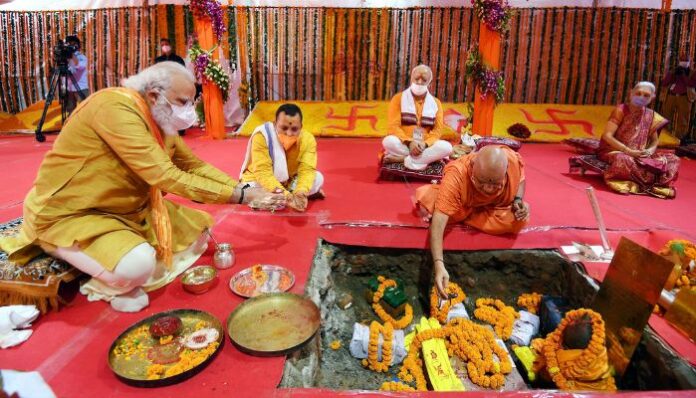
Legal reporting website Live Law recently published an opinion piece that attempted a “Constitutional examination of Bhumi Pujan ceremonies”. The Live Law article published on 23rd August 2026, lamented that the participation of constitutional functionaries, including the Prime Minister, in Bhumi Pujan, Havan, Vedic chanting, coconut-breaking and other Hindu rituals before inauguration or stone-laying of public infrastructure has become common even though Constitutionally, India is ‘Secular’ country.
The Live Law article headlined, “Can ‘Culture’ Justify Religious Rituals At State Functions? Constitutional Examination Of Bhumi Pujan Ceremonies” essentially frames Havan, Bhumi Pujan, coconut-breaking, and other such rituals at state events as ‘unconstitutional endorsement of Hinduism, that somehow violates the secularism, freedom of conscience, equality and democratic neutrality.
“…But, when viewed from the lens of constitutional law, secularism, equality, freedom of conscience, and democratic legitimacy, a pertinent question arises whether the State, acting through public officials and public institutions, can formally associate itself with rituals rooted in one particular religious tradition while claiming to remain secular and neutral toward all faiths and non-faith positions,” the article reads.
“Despite the differentiation, a fundamental principle that remains cogent is that the State itself has no religion. Therefore, the question arises when state and public institutions, through official ceremonies, appear to recognize and identify themselves with the symbols, rituals, and theological assumptions of a particular faith,” it adds.
The article conflates the American/French model of secularism with the Indian, though it admits that unlike the foreign models, the Indian interpretation of secularism was never about creating a wall of separation between religion and the State. Indian idea of secularism is more about principled engagement with all faiths rather than banishment of religion altogether from public life.
Further, the article mentions the 1994 S.R. Bommai v. Union of India case, and the 2005 Gopalakrishnan Nair vs State of Kerala case.
The Bommai case, however, actually endorses the accommodative model of principled engagement with all faiths. It does not hold that any single ritual performed by a government or constitutional official establishes theocracy. The problem would have been only when there was systemic favouritism, and the governments or those holding constitutional offices were using state machinery to propagate their religion or suppress others. There is no real constitutional or societal harm in an official partaking in a Bhumi Pujan or Havan ceremony before a ribbon-cutting.
The S.R. Bommai case was about dismissal of state governments for complicity in communal violence after the Babri Masjid demolition in Uttar Pradesh’s Ayodhya. In the Gopalakrishnan Nair case, the Supreme Court held that the management of a temple’s properties, finances, educational institutions, and administration are all secular activities, and different from spiritual and ritualistic guidance, which remains with the temple Thanthri.
Yash Mittal, the author of the Live Law article, asks that if the State has no religion, why should a government building, a court complex, a public hospital, or a highway project formally commence with rituals invoking Hindu deities or religious blessings? He further asks whether the performance of such rituals at State events amounts to the State identifying with the Hindu religious faith. The author also asks, “Does it not discriminate against citizens following other religious faiths or no faith (atheists or agnostics)? Does it not amount to the creation of a theocratic state?”
Bhumi Pujan threatens secularism, Iftar doesn’t?
The author is not content with the various court interpretations of the term ‘secularism’ and invocation of the idea of ‘Vasudhaiv Kutumbakam’, and highlights the 1986 Bijoe Emmanuel case wherein the Supreme Court protected Jehovah’s Witness Christian students who refused to sing the national anthem due to religious beliefs, emphasising freedom of conscience under Article 25.
The article describes the Andhra Pradesh High Court decision in Atheist Society of India v. Govt. of Andhra Pradesh and the Gujarat High Court’s decision in Rajesh Himmatlal Solanki v. Union of India, as merely “strengthening” the position of those opining that performance of Hindu rituals at public infrastructure inauguration or state events are religious but not non-secular acts.
However, there is more to these court interpretations than a ‘convenient rationalisation’. Their reasoning tracks the Indian constitutional practice in other contexts. For example, India’s national motto is “Satyamev Jayate”. This motto is lifted from the Mundaka Upanishad, a Hindu scripture. The state emblem, the Ashok Chakra has Buddhist provenance, even the Indian Judiciary’s motto, “Yato Dharmastato Jayaḥ” has been taken from the Hindu epic, Mahabharat and finds repeated mentions in the Shrimad Bhagwat Gita.
And yet the Indian State and Indian Judiciary remain secular. Has the judiciary turned away a Muslim or Christian or any non-Hindu petitioner because its motto is taken from Mahabharat or Shrimad Bhagwat Gita?
Has the participation of state and constitutional officials in Bhumi Pujan, including Prime Minister, Judges, Governors, Collectors, etc, ever resulted in hinderance of religious practice of non-Hindus? If a highway has been inaugurated with the Hindu tradition of coconut-breaking, does that mean the highway will exclusively be used by Hindus?
More than etymology, intent and impact matter. Regarding the Bijoe Emmanuel case, it was about more about compelled participation; the Christian students were disciplined for not singing the national anthem. However, nobody is disciplined, penalised, jailed, or denied service for not partaking in Bhumi Pujan or skipping a religious ritual at any event involving the presence of State or Constitutional officials.
This whole freedom of conscience against forced quasi-religious observance argument applies to forced individual participation. If a government or constitutional officials are not tolerant enough to passively witness a Bhumi Pujan or any such rituals, their own practice of secularism should come under question.
If we begin advocating such strict implementation of ‘secularism’ in all spheres, why should governments provide financial aid to Madarsas? Why should there be ‘minorities’ departments in state and Central governments? Why should governments at all be involved in the management of Hindu temples? Why should governments grant holidays on religious festivals? Why should the government provide Haj subsidy? Why do ministers holding constitutional office organise Iftar parties? The “whys” would be endless, and answers would compulsorily involve deviation from the very idea of secularism the Live Law article wants strictly implemented.
Author Yash Mittal also raises a ridiculous “why not the public events of stone laying ceremony, whose operational cost is borne from the public purses, be distanced from an unauthorised religious performance of a particular faith?”
Performance of a Havan, Bhumi Pujan, or coconut-breaking ceremony does not require expenditure of crores of rupees of taxpayers’ money. If the State can spend hundreds of crores on Haj subsidy, a few coconuts or a priest’s honorarium would not cost much. In fact, such expenses in most cases are not dealt with through the State treasury.
Constitutionally speaking, Article 27 restricts compulsion to pay taxes specifically appropriated for propagation or maintenance of a particular religion. The negligible costs of a religious-cultural ceremonial segment within a larger public-works event do not meet that threshold.
Live Law never raised the ‘scientific temper’ argument when states fund Madarsas imparting Islamic education, but invokes it to question Bhumi Pujan
The Live Law op-ed throws a situation wherein a Muslim, Christian, Sikh, Buddhist, Jain, Parsi or Jewish citizen attends the inauguration of a government hospital, school, court building or public infrastructure project, but the official ceremony begins with the invocation of Hindu deities. In this context, the author argues that the non-Hindu attendees would ask: “Is this a ceremony of the State, or a religious ceremony being conducted by the State?”
Why would a truly secular and tolerant non-Hindu ask such a question? Does the mere attendance, not participation, of a foundation ceremony wherein Vedic mantras are being chanted, result in the conversion of the State into a religious actor?
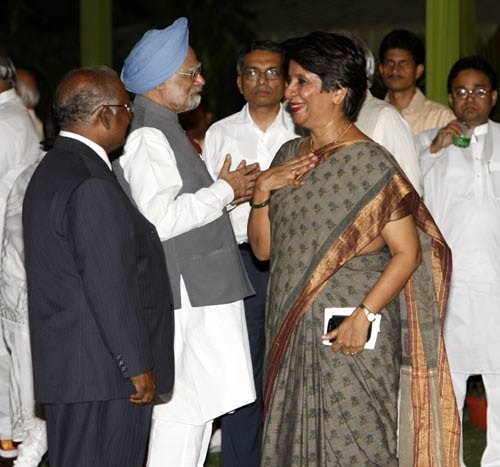
Under the UPA government, Iftar Parties were all the rage. They were organised at the Rashtrapati Bhavan and PM’s residence too. These Iftars were attended by several notable dignitaries, including the then CJI of India. However, no raked up ‘democracy in danger’, ‘separation of state and church [read religion]’ argument then? How exactly do Iftars promote scientific temper?
Back in February 2024, former Justice Joseph Kurian asked CJI Chandrachud to drop the Supreme Court’s motto “Yato Dharmastato Jaya” (Where there is Dharma, there is Victory), taken from the Hindu epic Mahabharat. Speaking at an event organised by left-liberals and the controversial portal TheWire, former Justice Joseph suggested that the Supreme Court’s motto diverges from the national motto and, by implication, the national ethos. Back in 2018, Joseph equated the Catholic Church to the Preamble of India, but no one cried ‘secularism khatre mein hai’.
In India, the principle of separation of powers ensures that the three branches of government—executive, legislative, and judicial—function independently, but it does not preclude social or cultural contact between them. Scientific temper comes under Directive Principles, and coexists with cultural symbolism.
Hindu religious-cultural practices sans any imposition on non-Hindus, in a Hindu-majority country, are not equivalent to State establishment any more than Christian cultural references or ceremonies in Western democracies amount to violation of secularism or neutrality.
The article concludes with former Supreme Court Justice Abhay S. Oka’s suggestion that people should adopt a new practice of bowing down to the Preamble of the Constitution instead of performing religious “poojas and archanas”. The remarks are offered in the article as a final settlement or solution to the supposed debacle. However, would this practice not amount to deification of the Constitution and, by extension, its author(s)?
India does not need to blindly copy-paste or replicate the Western supposed maximalist reading of secularism and impose cultural deracination of public life. India owes its secular character to the Hindu majority. India has already lost a significant portion of its land to Islamic intolerance and exclusionary intransigence in 1947. The world’s only Hindu-majority country cannot afford to sever its Hindu civilisational roots and consciousness in the pathological pursuit of becoming as ‘secular’ as possible.