

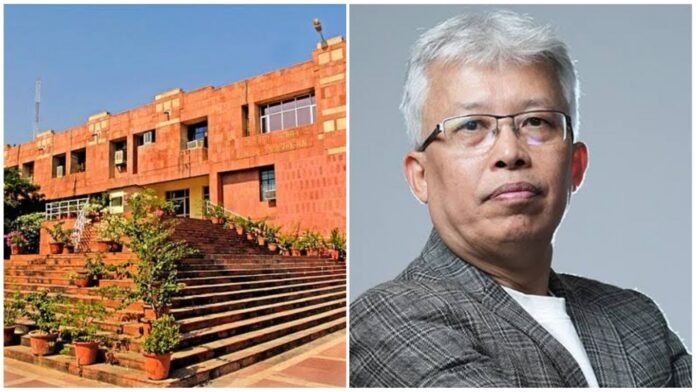
Jawaharlal Nehru University (JNU) has long been a campus where protests over politics, ideology and academic freedom can erupt within hours. But when 11 women students approach the university’s Internal Complaints Committee with allegations of sexual harassment against a professor who also happens to be a sitting Congress MP, the question is no longer merely political; it is about whether the institution’s own mechanisms work when the accused is politically influential.
The Akhil Bharatiya Vidyarthi Parishad (ABVP) took to the streets outside JNU’s School of Social Sciences on September 9, demanding action against Congress Lok Sabha MP and JNU professor Angomcha Bimol Akoijam. The organisation also questioned why the complaints, reportedly filed in May, have still not reached a conclusion.
That four-month delay is now at the heart of the controversy.
11 students came forward, but the questions remain unanswered
According to reports, the allegations stem from viva examinations conducted in the first week of May. One student’s account was subsequently shared in a students-only WhatsApp group, following which several other women students reportedly came forward with similar allegations. The complaints were then submitted to JNU’s Internal Complaints Committee in May.
The allegations reportedly include inappropriate, sexually suggestive remarks and claims that students were offered higher marks in exchange for sexual favours.
These are allegations, not facts, and the outcome of the Internal Committee’s proceedings will determine what actually happened. But precisely because the allegations are serious, the inquiry cannot be allowed to disappear into bureaucratic limbo.
ABVP’s contention is straightforward: if an ordinary professor were facing allegations from 11 students, would the university permit the matter to remain unresolved for months?
And if the answer is no, why should the identity or political standing of the accused change the urgency with which the complaint is handled?
The uncomfortable political question
Akoijam is not merely a JNU professor.
He is a Congress MP representing Inner Manipur in the Lok Sabha, and his political profile has grown considerably since he entered electoral politics in 2024. He won the Inner Manipur seat in his first Lok Sabha election and became one of Congress’ prominent voices on the Manipur crisis.
That makes the ABVP’s question about political influence particularly significant.
The organisation has accused JNU’s administration and Internal Committee of failing to ensure a transparent and time-bound process. It has also questioned the silence of Congress, NSUI and Left student organisations that routinely position themselves as champions of women’s rights and student welfare.
This is where the controversy acquires a distinctly political dimension.
Women’s safety cannot become a principle that applies only when the accused belongs to the political camp one dislikes.
If the allegations are false, Akoijam deserves a fair and credible process that clears his name. If they are substantiated, appropriate action must follow. What cannot serve anyone, not the complainants, not the accused, and certainly not JNU, is an inquiry that drags on without clarity.
90-day rule raises serious questions over delay
The delay in the inquiry becomes particularly significant when viewed against JNU’s own rules governing sexual harassment complaints. The university’s Internal Complaints Committee guidelines state that an inquiry “has to be completed within a period of ninety days from the receipt of the complaint.” The inquiry report is then required to be submitted within 10 days of completion.
If the first complaint was received in May, the prescribed 90-day period had already become a critical benchmark by August. This raises an obvious question: why has the inquiry still not been concluded?
Is inquiry against #JNU sexual exploitation scandal already compromised?
— Harshil (હર્ષિલ) (@MehHarshil) September 10, 2026
As per rules, inquiry must be concluded within 90 days of complaint.
– First complaint was received in May, much before 90 days. Why this delay happened?
– How JNU will protect victims from influence? pic.twitter.com/zHzQeu6Jhh
The issue is not about declaring anyone guilty before the inquiry is complete. It is about whether the institutional process is functioning within its own prescribed timeline. When 11 women students have reportedly approached the mechanism with allegations against a professor who is also a sitting Congress MP, JNU must explain the delay rather than allow questions about institutional independence to grow.
The more uncomfortable question is whether the complainants have been adequately protected from possible political or institutional influence. If JNU’s Internal Committee is genuinely independent, the university should have little difficulty demonstrating that the proceedings are being conducted impartially, without favour or pressure.
The central questions now are: Is the inquiry into the JNU sexual-harassment allegations already facing an institutional credibility crisis? Why was the 90-day deadline apparently not met? And, most importantly, what safeguards has JNU put in place to ensure that the complainants are not subjected to influence or intimidation while the accused is a politically influential public figure?
Who is Bimol Akoijam?
Akoijam is an academic-turned-politician whose career before electoral politics was rooted in JNU.
JNU’s official profile identifies him as a professor at the Centre for the Study of Social Systems, School of Social Sciences. His academic interests include social and political psychology, identity politics, conflict, nation-state and minorities, intergroup and gender relations, popular culture and politics of knowledge. The university lists an M.A./Ph.D. qualification and 16 years of experience.
His academic work has extensively dealt with Manipur, conflict and identity politics. He has written on subjects including the Armed Forces (Special Powers) Act and the political history of Manipur. JNU’s profile also records the Young Psychologist Award conferred on him by the National Academy of Psychology.
His transition into electoral politics came against the backdrop of the 2023 Manipur violence. Congress fielded him from Inner Manipur in the 2024 Lok Sabha elections, where he defeated the BJP’s Thounaojam Basanta Kumar Singh by more than one lakh votes.
He is currently serving his first term as an MP. PRS records his parliamentary attendance at 81%, with 15 debates and 60 questions listed on his profile.
A professor, a parliamentarian and now the centre of a campus controversy
The Internal Committee exists precisely to provide an institutional mechanism for such complaints. Its credibility depends on being seen as independent, impartial and capable of reaching conclusions within the applicable framework. But the fact that the first complaint was filed in May raises serious questions on whether the committee was compromised from the start itself.
ABVP has now put JNU in an uncomfortable position: if the university believes the complaints are being handled properly, it should explain the timeline and process. If there has been a delay, it should explain why.
The same principle should apply to political parties and student organisations.
Congress, NSUI and Left student groups cannot credibly demand accountability in cases involving political opponents while treating allegations involving someone within their own political ecosystem as an inconvenient subject best avoided.
The test of a commitment to women’s rights is not whether the accused is politically convenient to condemn. It is whether the same standard is applied when the accused is politically inconvenient.
For now, the allegations remain unproven. But the questions surrounding how the complaints were handled are very real. JNU owes the 11 complainants, and Akoijam himself, a process that is swift, independent, transparent and capable of producing an answer.
Anything less will only deepen the suspicion that, at JNU, political influence can sometimes make an institution move more slowly than it otherwise would.


