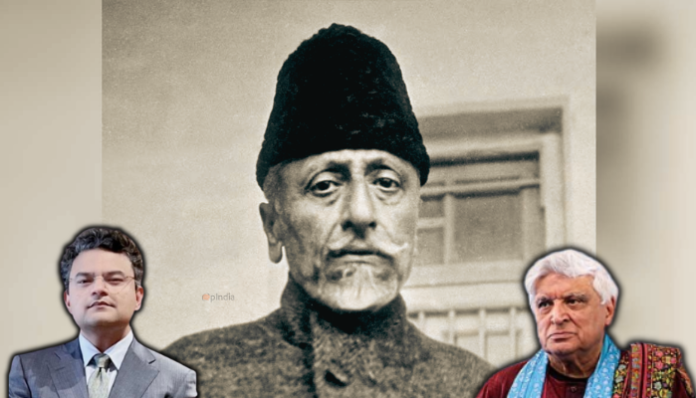
In Indian political parlance, keeping the dead alive in rhetoric is a necessity. However, this ritual of necessity becomes problematic when the invoked figure is glorified, and their utterly bigoted proclivities are downplayed. This results in the creation of a perception that the invoked figure was unquestionably unproblematic. A query by Bollywood lyricist Javed Akhtar to scientist and political commentator Dr Anand Ranganathan about ‘be extremely hard against Kafirs’ remarks by Independent India’s first Education Minister Maulana Abul Kalam Azad exemplifies this perfectly.
On 14th September, Javed Akhtar expressed shock over a reel in which Anand Ranganathan spoke about Maulana Abul Kalam Azad urging Muslims to be extremely hard against Kafirs but extremely sympathetic among Muslims. Akhtar said that the quoted statement was attributed to Maulana Azad.
Taking to X, Javed Akhtar requested Anand Ranganathan to share the source of this information.
“Dear Mr Anand Ranganathan . Recently In one of your reels you have read a paragraph and attributed it to Maulana Azad . I honestly found it quite unlike his life long sociopolitical stances . Could you please tell me the source of your information , is it a part of any of his article or speech . please let me know the when and where of it . I” ll be really thankful . Warmly , Javed,” Akhtar wrote.
Dear Mr Anand Ranganathan . Recently In one of your reels you have read a paragraph and attributed it to Maulana Azad . I honestly found it quite unlike his life long sociopolitical stances . Could you please tell me the source of your information , is it a part of any of his…
— Javed Akhtar (@Javedakhtarjadu) September 14, 2026
Responding to Javed Akhtar’s query, Anand Ranganathan said that the quote is from the 1914 speech of Maulana Abul Kalam Azad in Calcutta. This speech was published in Khutbat-e-Azad.
“The Maulana is exhorting the Indian Muslims to unite with Muslims around the world and save the Caliphate. He begins by stating that all relationships in the world can break down, father can turn against son, brother against brother, mother can shun her child but the relationship of a Muslim with a Muslim can never be severed,” Ranganathan wrote.
Ranganathan further quoted Maulana Azad’s speech and wrote, “The Maulana then continues: if even a grain of the soul of Islam is still alive in its followers, then if a thorn enters the foot of a Turk on the field of battle, I swear by Allah that no Muslim of Hindustan is a Muslim until he feels that prick in his own heart. For the Millat of Islam is one body, and Muslims, wherever they are, are its limbs. If a finger of the hand is cut, the rest of the body cannot remain at peace until it has felt the blow. This is not rhetoric. It is the plain meaning of the well-known hadith which Imam Ahmad related: the Messenger of God, peace and blessings be upon him, said that the likeness of the believers in their mutual love, mercy and compassion is that of one body: when one limb complains, the whole body responds with sleeplessness and fever. And there is the other hadith, related by Abu Musa al-Ash‘ari: The believer to the believer is like a building; each part supports the other. This is the first and last distinguishing mark of the people of Islam, to which the Qur’an itself has pointed.”
He also highlighted Azad’s commentary after quoting the Quranic verse 48:29, and wrote, “Whatever hardness they have is for falsehood and unbelief; whatever love and tenderness they have is for truth, sincerity, Islam and Tawhid. So be extremely hard against disbelievers but extremely sympathetic and kind among ourselves; take heed, then, and do not pass over this as if you had not heard it.”
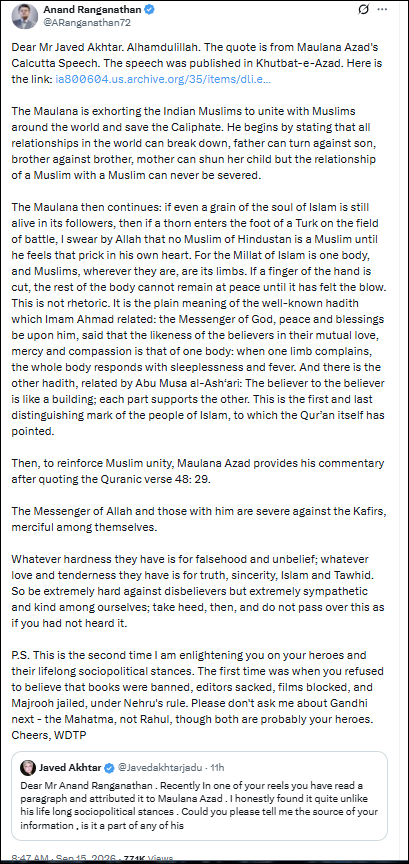
Dr Ranganathan further stated that this is the second time he is “enlightening” Akhtar on his heroes and their supposed lifelong sociopolitical stances.
“This is the second time I am enlightening you on your heroes and their lifelong sociopolitical stances. The first time was when you refused to believe that books were banned, editors sacked, films blocked, and Majrooh jailed, under Nehru’s rule. Please don’t ask me about Gandhi next – the Mahatma, not Rahul, though both are probably your heroes,” he wrote.
This is the video Javed sir is referring to. pic.twitter.com/45um8qYAvf
— P (@s__pacific) September 14, 2026
Did Maulana Azad really urge Muslims to be extremely hard against Kafirs?
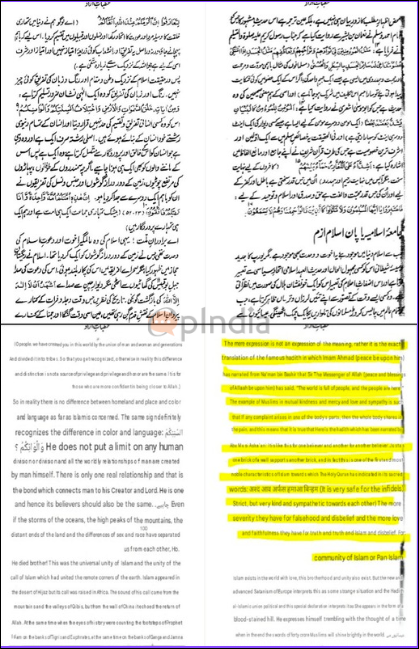
OpIndia searched through the source cited by Dr Anand Ranganathan, Khutbat-e-Azad. Originally published in Urdu, we found and translated the relevant text into English.
The quote Ranganathan attributed to Maulana Azad is factually correct. It is found in Maulana Abul Kalam Azad’s speech of 27th October 2026. This speech’s theme was ‘Ittehad-e-Islami’.
Further, Azad emphasised how Muslims across the world should stand united and described the Turks as the last sword of the Islamic world.
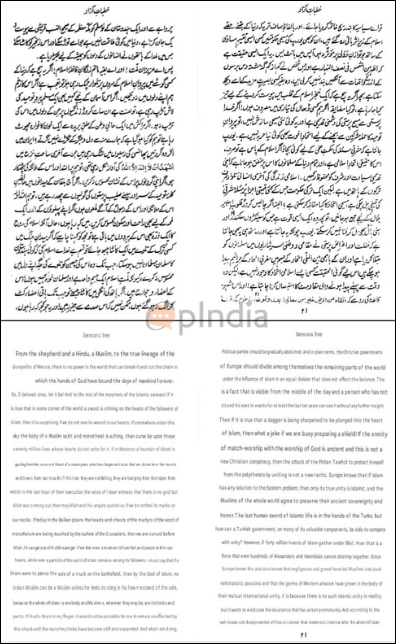
Maulana Abul Kalam Azad, who went on to become Independent India’s first Education Minister, delivered this well-thought-out speech at a time when the Ottoman Caliphate in Turkey was looking at its collapse. Maulana Azad, who has in recent decades been portrayed as a liberal progressive Muslim, had in a 1914 speech essentially advocated for global Islamism.
He alleged that Europe invented ‘bogus’ terms like ‘Pan-Islamism’ and the ‘Eastern Problem’, describing it as “an extreme Satanic strategy” devised to divide Muslims across the world.
Maulana Azad, one of Javed Akhtar’s ‘secular’ heroes, said that there was nothing wrong in attacking the polytheists.
“Then, if it is true that a sword is being sharpened to strike in the heart of Islam, then what hesitation that we be engaged in developing a shield. If the worship of Jesus has ancient enmity against the worship of God, and this is not a new Christian conspiracy, then the unity of brotherhood is not a new tactic of the followers of Tawheed (Islamic monotheism) to defend against the attack of polytheists,” Maulana Azad said in the same speech.
Azad’s speech advocated Islamism, Ummah unity and Tawhid, and contributed to motivating Muslims of undivided India to leave their country and join Jihad in Turkey during the Gandhi-backed Khilafat Movement.
So much for Azad’s liberal and progressive image, that he had blasted liberal Muslims who did not support his call to back the Ottoman Caliphate. Maulana Azad said that the time had come to “discriminate between faith (Iman) and Kufr (disbelief), declaring liberal Muslims of that time as ‘Munafiqeen’.
Maulana Azad also urged Muslims to engage in Jihad fi-Sabeelillah (Jihad in the name of Allah).
Interestingly, decades later, the military of Pakistan, a country carved out of India on Islamic lines, adopted Jihad fi-Sabeelillah as its motto.
Maulana Azad oversaw the whitewashing of Mughal tyrants and obfuscation of Hindu history during his tenure as Education Minister
Maulana Abul Kalam Azad was India’s Education Minister from 1947 till his death in 1958. While India observes National Education Day on 11th November to commemorate his birth anniversary, Maulana Azad presided not over India’s educational development but over the negationist process targeting Indian history to cover up the horrific crimes of Islamic invaders and tyrants.
During his 11-year tenure, Maulana Azad recruited individuals who were either members of the same community or adhered to the Leftist ideology. Humayun Kabir, MC Chagla, and Fakhruddin Ali Ahmed were among them. All of them combined to present the Mughals as “messiahs of the oppressed Hindu masses” and, in the worst case, as ‘benevolent dictators.’
Reports indicate that Maulana Azad allowed a deliberate cover-up of loot, slaughter, destruction of temples, Jizya tax, forced conversions, forcing widows of dead soldiers into harems, sale of captured children in the slave bazaars of Baghdad, burning of libraries and appropriation of defeated peoples’ properties to constitute waqfs for the welfare of Muslims, and other crimes by Muslim invaders and tyrants in the medieval era.
Maulana Azad was home-tutored in Quran-Hadith to protect him from ‘corruption’ by English education
Maulana Azad may have been supposedly sophisticated in his approach and outlook; his allegiance lay only with Islam and Islamism. In fact, Maulana Abul Kalam’s ancestry did not fit in as secular India’s Education Minister. He was born into the family of an Islamic Ulema who travelled to Bharat from Herat in Afghanistan during Mughal emperor Babur’s regime.
Maulana Khairuddin did not value English education and wished for his sons to succeed him as Pirs (Muslim saints). Azad and his brother’s schooling was mostly controlled by their father, who was adamant that his sons carry on the family legacy of commitment to, learning of, and propagation of Islam.
His father sent him to the world-renowned Islamic University of Al-Azhar in Cairo, Egypt for two years in 1905. Later, Azad travelled to Mecca, and then to Kolkata, spending most of his time studying and singing the Quran. Starting with Maulana Azad, the practice of whitewashing Islamic tyrants continued as leftist historians like Romila Thapar gained prominence.