

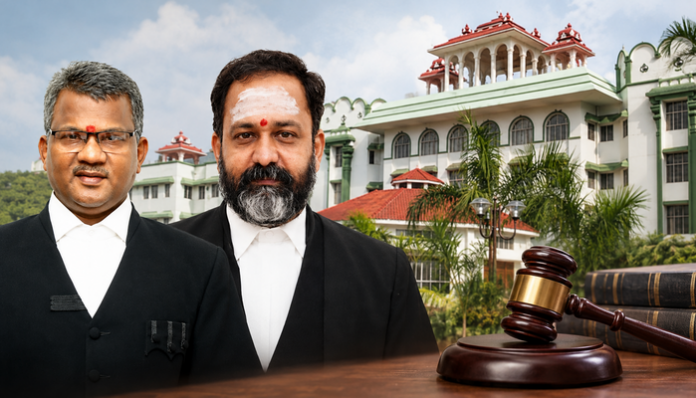
The Madras High Court on Friday (October 23, 2026) delivered a strongly worded judgment, reiterating that non-Hindus cannot enter Hindu Agamic temples without signing a temple-prescribed undertaking to show reverence to the temple deity.
A Division Bench of Justices G.R. Swaminathan and Dr P. Murugan allowed a petition, holding that the entry of non-Hindus into Hindu temples in breach of temple customs would violate their sanctity. The decision was passed on a petition seeking a writ of mandamus issuing directions to the respondents to ensure adherence to Agamic traditions regarding entry into Agamic temples.
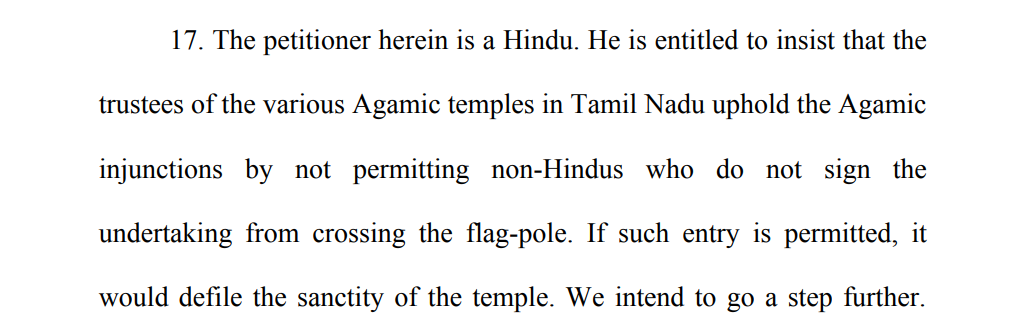
The Madurai Bench of the High Court held that entry of non-Hindus into Agamic temples, in violation of temple rules, amounts to defiling the sanctity of the temple. “He (petitioner) is entitled to insist that the trustees of the various Agamic temples in Tamil Nadu uphold the Agamic injunctions by not permitting non-Hindus who do not sign the undertaking from crossing the flag-pole. If such entry is permitted, it would defile the sanctity of the temple,” the court held.
Non-Hindus wearing their religious markers cannot enter temples
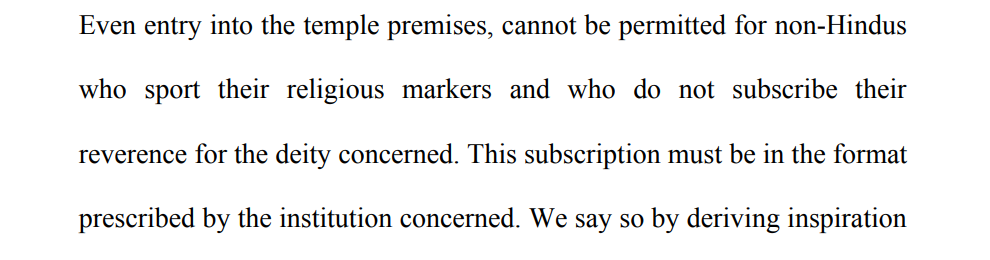
The High Court went a step further and stated that non-Hindus, who sport their religious markers and do not subscribe reverence to the temple deity, should not be allowed to enter temple premises. “Even entry into the temple premises cannot be permitted for non-Hindus who sport their religious markers and who do not subscribe to their reverence for the deity concerned. This subscription must be in the format prescribed by the institution concerned,” the court said.
Screenshot from the judgment
The High Court expressed concern over disregard for temple entry rules by non-Hindus, particularly those in public life such as politicians and legislators, blatantly disrespecting its traditions and setting a wrong example for their followers. The Court clearly stated that temple customs and usage cannot be flouted for political optics and displays of Chamchagiri (political sycophancy). “We hold that usages and customs of temple cannot kneel down before such display of Chamchagiri and optics,” the Court said.
Non-Hindu politicians and skull-cap-wearing people entering temples
The High Court came down heavily on non-Hindu politicians engaging in “egregious breaches” of temple rules and entering into Hindu temples without signing the necessary undertaking. The Court cited the example of Badrudeen Mustafa, an MLA representing the Madurai Central Constituency. Pointing out an irony, the Court noted that the politician who called for the eradication of Sanatan Dharma entered the Meenakshi temple soon after his election, in the name of inspection.
The Court pointed out another instance where a minister who is a Christian by faith entered the Thiruchendur temple without giving the undertaking required of non-Hindus. It further recalled a viral video on social media showing persons wearing skull caps pushing their way through the Thiruvannamalai Arunachaleswarar temple despite protests from devotees, while HR&CE staff stood by “as mute spectators”.
Politicians’ acts are mimicked by their “Chamchas”
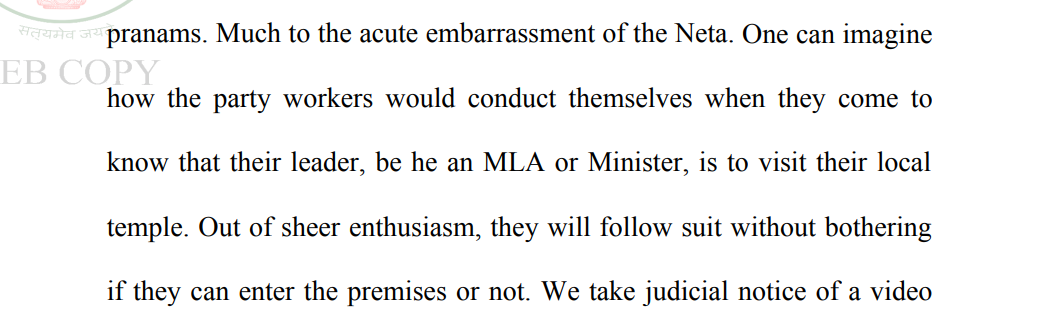
Condemning the politicians who enter Hindu temples for optics, in complete disregard for temple rules, the High Court cautioned that this behaviour is mimicked by their blind followers. “One can imagine how the party workers would conduct themselves when they come to know that their leader, be he an MLA or Minister, is to visit their local temple. Out of sheer enthusiasm, they will follow suit without bothering if they can enter the premises or not,” the court cautioned.
To drive home the point, the Court cited an amusing instance where a politician, who was enjoying his time in a spa, was mobbed by his followers inside the spa as soon as the word spread about his presence therein. “‘Chamchagiri’ is endemic to our political culture. The party workers, as a mark of sycophancy, hang around their leader. They tend to make a beeline for him. Whether the occasion is appropriate is beside the point,” the High Court humorously commented.
The Court observed that such temple visits by politicians have nothing to do with faith and are only meant for optics to impress voters. It mentioned an example of a non-Hindu politician, without mentioning the name, who was a fundamentalist but visited temples and wore a mark on his forehead to “play to the gallery”.
“Not only Chamchagiri but also optics matter in a democracy. We know of one political leader who is a fundamentalist subscribing to a non-Hindu faith. But he would make it a point to visit the temple and also prominently display the religious mark on his forehead. This was to play to the gallery. The vote value of such a display is obvious,” the Court highlighted.
What the petitioner prayed
The petitioner, Thangam Venkatesh, prayed before the Court to direct the respondents to strictly enforce the statutory provisions of the Tamil Nadu Temple Entry Authorisation Act, 1947 and the Tamil Nadu HR and CE Act, 1959, “by forming necessary enquiry committees as well as a complaints section to prevent individuals bearing other religious symbols and non-adherents from entering restricted temple sanctums and mandapam”.
He also sought a direction to the respondents to conduct an enquiry against the violators of the Tamil Nadu Temple Entry Authorisation Act, 1947 and the rules framed thereunder based on a complaint filed by him on October 17, 2026. The respondents in the case were the State of Tamil Nadu (through the Principal Secretary, HR&CE Department), the HR&CE Commissioner, the Additional Commissioner (Administration) and the Additional Commissioner (Inquiries).
The High Court noted that two Single-judge Benches had already addressed the issues, but proceeded to make an authoritative pronouncement in light of some recent developments.


