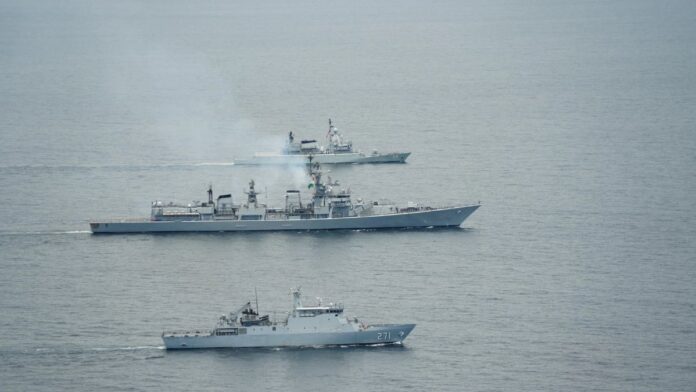
Pakistan Navy’s PNS Hunain has returned to harbour after sustaining severe damage following a collision with an Indian Navy warship in the North Arabian Sea, in an incident that has now triggered a formal diplomatic protest from New Delhi.
The Pakistani vessel came dangerously close to an Indian frontline warship on the evening of September 15 while the Indian vessel was on a routine surveillance mission. The Pakistani ship approached at high speed and manoeuvred in an unsafe and unprofessional manner before the two vessels collided. The Pakistani vessel was identified as PNS Hunain, a Yarmook-class corvette.
The incident took place in international waters, around 220 kilometres east of Oman, according to reports citing defence sources.
PNS Hunain subsequently headed back to harbour after suffering severe damage. On the other hand, India’s Ministry of External Affairs has officially said that the incident did not cause any major damage to India’s vessel.
But the damage to the ship is only one part of the story.
The more serious issue for New Delhi is how the Pakistani naval vessel came close enough to an Indian warship to cause a collision in the first place.
And buried in a 35-year-old India-Pakistan agreement is a provision that appears almost tailor-made for this very situation.
The High-Seas encounter
According to Indian sources, the Indian warship was conducting a routine surveillance mission in the North Arabian Sea when the Pakistani naval vessel approached it at high speed.
The Pakistani vessel manoeuvred in an “unprofessional and unsafe manner”, eventually resulting in the collision. The seas were rough at the time, making close-quarters manoeuvring between two military vessels even more hazardous.
What makes the episode particularly significant is the account of what happened aboard the Indian warship.
According to Indian authorities, despite “extreme provocation” from the Pakistani side, the Indian Navy captain exercised “extreme restraint” and took measures to prevent a severe accident that could have resulted in serious loss of life and damage.
That account, if borne out by the full operational reconstruction, suggests that the collision was not viewed by the Indian side as an innocuous brush between two ships.
It was a situation in which the commanding officer had to act to prevent a potentially much more serious outcome.
The three-nautical-mile rule Pakistan violated
At the centre of India’s protest is Article 10 of the 1991 Agreement between India and Pakistan on Advance Notice of Military Exercises, Manoeuvres and Troops Movements.
And its wording is remarkably specific.
Article 10 states:
“The Naval ships and submarines belonging to the other country are not to come closer than three Nautical Miles (NM) to each other to avoid any accident while operating in international waters.”
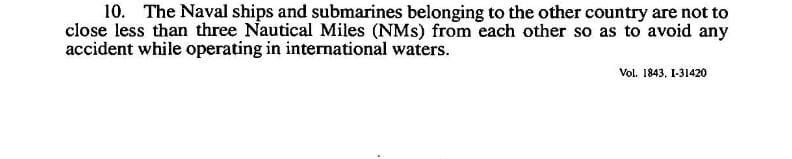
The provision requires Indian and Pakistani naval ships and submarines operating in international waters to maintain a separation of at least three nautical miles, approximately 5.6 kilometres, specifically to prevent accidents. The text is part of the agreement deposited with the UN Treaty Series.
Pakistani naval ship’s conduct was in direct contravention of Article 10. That makes the provision central to understanding the diplomatic escalation.
This was not simply a case of two ships accidentally finding themselves in the same patch of ocean. The two countries had already agreed upon a specific safety distance for precisely this reason.
The irony is difficult to miss: the agreement explicitly says the three-nautical-mile separation exists “to avoid any accident”; Pakistan violated that provision and the result was a collision.
The precise navigational data, the ships’ positions, speeds, courses and communications immediately before the incident, has not been publicly released. Those details will ultimately be necessary to establish how the Pakistani vessel deliberately tried to ram into the Indian Navy unit.
But New Delhi’s position is already clear.
New Delhi sends a diplomatic message to Islamabad
On September 16, India summoned Pakistan’s Chargé d’Affaires in New Delhi and lodged a strong protest over what the MEA called the “unacceptable and unprofessional conduct” of Pakistani naval units.
The Pakistani diplomat was asked to convey to the concerned authorities in Islamabad that all military units must exercise due care and comply with the relevant bilateral agreements to prevent a repeat of the incident.
India has also instructed its Chargé d’Affaires in Islamabad to lodge a similar protest with Pakistan’s Ministry of Foreign Affairs.
The diplomatic response is significant because New Delhi has not treated the collision merely as a navigational mishap.
It has tied the incident directly to an existing fraught relationship between India and Pakistan, which took a further hit after Pakistani terrorists killed tourists in Pahalgam after identifying them as Hindus.
The message is essentially this: international waters may be open to naval operations, but they are not a free-for-all where military vessels can ignore agreed safety distances.
Not the first India-Pakistan Naval close call
The latest incident also brings back memories of a similar episode in 2011, when Pakistan Navy’s PNS Babur and India’s INS Godavari were involved in a maritime incident in the Gulf of Aden.
That episode generated competing allegations over the conduct of the two vessels, with both sides lodging protests.
The 2011 incident is relevant because Article 10 of the same 1991 agreement was also part of the dispute. Contemporary accounts recorded allegations that the two ships came dangerously close and made contact.
More than a decade later, the same bilateral provision has returned to the centre of another India-Pakistan naval incident.
Why this incident matters
The Indian and Pakistani navies routinely operate in the Arabian Sea. Their ships can encounter one another in international waters.
That, by itself, is not extraordinary.
What is extraordinary is a close-quarters encounter that ends with the two vessels colliding, particularly when the two countries already have a written agreement requiring their naval ships and submarines to remain three nautical miles apart.
The 1991 agreement was designed as a confidence-building measure to prevent military movements and manoeuvres from being misunderstood and to reduce the possibility of accidents. The naval provision is unusually direct: maintain distance to avoid an accident.
That safeguard is now being invoked by India after the very accident it was meant to prevent.
And the timing makes the episode even more sensitive.
India-Pakistan relations remain deeply strained following the April 2025 Pahalgam terror attack and India’s subsequent military action during Operation Sindoor. A direct encounter between the two countries’ military assets therefore could result in a greater calamity for a cash-strapped Pakistan, which is struggling financially.
For now, India’s official position is unequivocal: a Pakistani naval unit engaged in unacceptable and unprofessional conduct; the incident violated Article 10 of the 1991 agreement; and the Indian commander exercised restraint to prevent a potentially far more serious accident. Any misadventure, whether deliberate or otherwise, could cause severe consequences, one that Pakistan witnessed in the aftermath of the Pahalgam massacre in April 2025.