

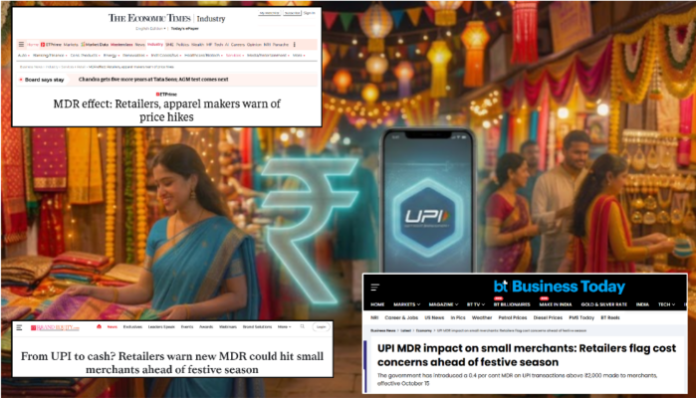
On 15th September (Tuesday), National Payments Corporation (NPCI) of India announced that transactions exceeding Rs 2,000 will be subject to a 0.4% Merchant Discount Rate (MDR). This is going to come into effect from 15th October but will not apply to person-to-person transactions, which will continue to remain free. Moreover, the MDR would be limited to Rs 300 for each transaction totalling Rs 75,000 or more.
MDR constitutes a fee that merchants must bear upon accepting payment transactions via credit or debit card instruments, which is computed as a percentage of the transaction value and is subtracted from the total payment by the bank before the remaining amount is received.
Since the development, an attempt appears to be underway to stoke panic, particularly among the business community and consumers, with the festival season approaching. Their concerns should certainly be heard and addressed, but turning the decision into a story of impending economic doom without weighing the facts only fuels unnecessary alarm and sensationalism.
The Economic Times carried a report titled, “MDR effect: Retailers, apparel makers warn of price hikes,” which read, “There is a palpable consensus among retailers and clothing manufacturers that consumer prices are bound to increase with the 0.4% merchant discount rate (MDR) levy on high-value UPI deals ahead of festive season, despite the government’s notification that clearly prevents retailers from directly passing on the MDR charges to consumers.”
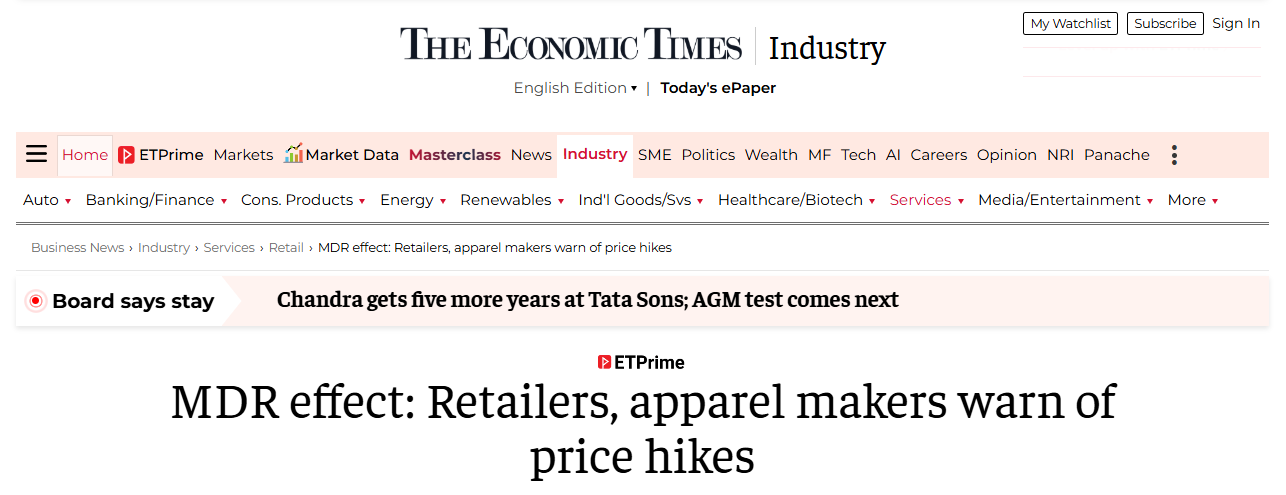
It featured statements regarding their current struggle with inflation and elevated logistics expenditures stemming from the geopolitical tensions present in West Asia. The article stated that the decision was reached during an exceptionally hard period for merchants, retailers and consumer-oriented enterprises, “many of whom are already working hard to revive demand and improve margins.”
It claimed that MDR could impose more strain on smaller retail operations functioning with limited profit margins, and potentially redirect transactions toward cash payments rather than digital channels.
However, The Economic Times was far from alone. Other media outlets such as Business Today, Brand Equity and NDTV also published similar pieces, following the same narrative, arguing that the rules could hurt small merchants, particularly with the upcoming festivitives are expected to bring a surge in business.
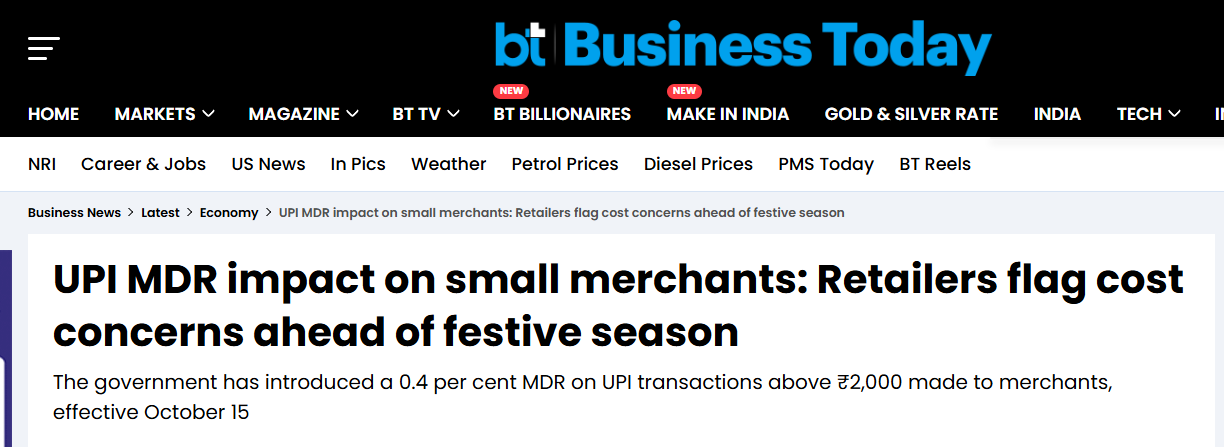
It was also alleged that customers could shift back to cash, abandoning digital payments at a time when India’s digital payment ecosystem has become an integral part of everyday transactions. This would also reduce the digital trail tied to the sales.

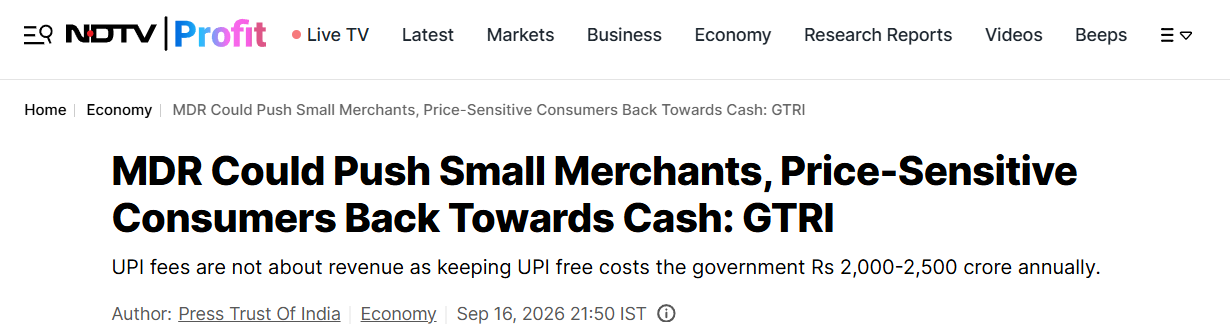
NDTV Profit’s article included a comment from Global Trade Research Initiative (GTRI) founder Ajay Srivastava, who expressed, “MDR could push small merchants and price-sensitive consumers back towards cash.” He further implied that influence from the United States was instrumental in the decision, an unfounded accusation also raised by the opposition and firmly rejected by the centre.
“Brazil refused to weaken Pix, its UPI-like public payment system, despite US pressure and an additional 25% tariff. India should have shown similar resolve. The government can easily afford free UPI, weakening it would impose far greater economic and strategic costs on India. And the US may soon press for restrictions on the RuPay card and withdrawal of NPCI’s proposed 30% market-share cap,” stressed on social media.
UPI Fees Are Not About Revenue
— Ajay Srivastava (@ajaydgft) September 16, 2026
Keeping UPI free costs the government an estimated ₹2,000–2,500 crore annually.
This is tiny compared with subsidies of ₹2.03 lakh crore for food, ₹1.68 lakh crore for fertilisers, ₹22,800 crore for agricultural credit and ₹12,500 crore for…
He even drew a comparison between the “tiny” UPI subsidy and the portion dedicated to food, fertilisers, agricultural credit, petroleum and Liquefied Petroleum Gas (LPG), implying that the government could similarly spend more to support the digital payments sector.
Beyond the headlines: Taking a closer look at the claims
It is important to highlight that India is not the only nation to introduce these charges. In fact, merchant fees within Brazil’s PIX framework average 0.33% despite the misleading assertions, while those in China are approximately 0.40%. The NPCI highlighted, “Most global payment systems (including Digital Public Infrastructures) have economic models that support infrastructure and innovation. India’s approach continues to prioritise accessibility, scale and inclusion.”

It further clarified, “UPI is a home-grown payment system, and its charges are much lower than other payment instruments such as credit cards, debit cards, wallets, etc.” The official release added that the pricing structure has been deliberately maintained at modest levels to guarantee that UPI continues to serve as the most economical payment acceptance method available.
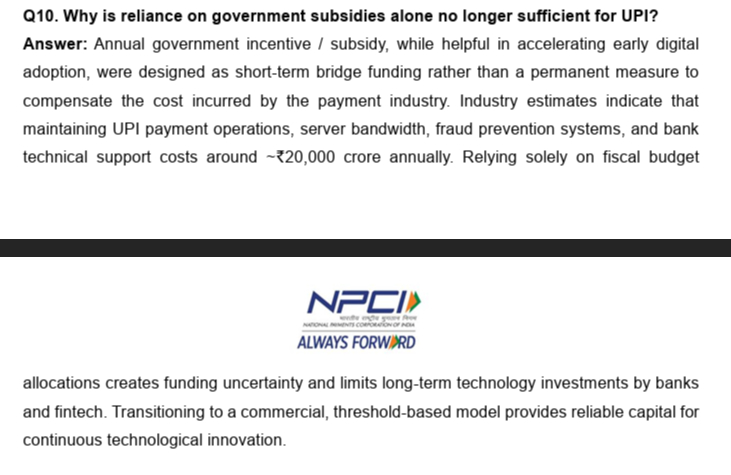
It was also emphasised that depending merely on government subsidies proves inadequate for UPI, and consequently the objective of this initiative has been to identify a viable solution to overcome this obstacle. NPCI outlined, “Annual government incentive/subsidy, while helpful in accelerating early digital adoption, was designed as short-term bridge funding rather than a permanent measure to compensate the cost incurred by the payment industry.”
It conveyed, “Industry estimates indicate that maintaining UPI payment operations, server bandwidth, fraud prevention systems, and bank technical support costs around ~ Rs 20,000 crore annually. Relying solely on fiscal budget allocations creates funding uncertainty and limits long-term technology investments by banks and fintech (financial technology). Transitioning to a commercial, threshold-based model provides reliable capital for continuous technological innovation.”
Contrary to the claims of a downfall of the digital economy, the NPCI noted that the move will encourage new fintech startups and tech firms to enter the digital payments market by creating a sustainable business structure.
Underscoring the fundamental reasoning behind this strategic action, the statement mentioned that only well-capitalised IT conglomerates can afford to sustain long-term operational losses when payment processing is conducted under zero-MDR conditions.
It stated, “A predictable commercial revenue model levels the playing field, allowing smaller, innovative startups to compete, build specialised payment software, and expand financial access. Increased market competition ultimately leads to better services, improved app reliability, and greater choice for consumers.”
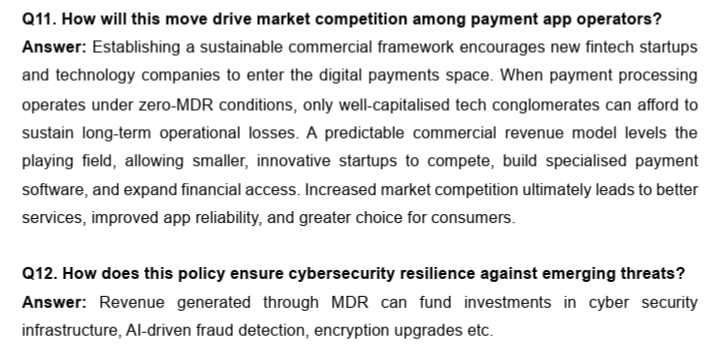
“Revenue generated through MDR can fund investments in cyber security infrastructure, AI-driven fraud detection, encryption upgrades, etc.,” the statement highlighted.
The truth is that even with the implementation of a 0.4% MDR, UPI stands as the most economical payment channel, specifically in comparison with conventional credit and debit card options. The impact on small vendors and retailers would be negligible, as their transaction amounts generally remain within the prescribed boundaries.
The Reserve Bank of India, which founded the NPCI and oversees MDR rates, likewise stressed the significance of this decision in “strengthening the long-term sustainability of India’s digital payments ecosystem.”
“It will help UPI in continuing to scale, innovate and serve consumers and businesses across the country. A fair and appropriate distribution of MDR across ecosystem participants will support continued investment in technology, infrastructure and acceptance networks. This, in turn, can enable wider UPI acceptance, deepen the customer base and support sustained growth in transaction volumes,” the central bank wrote.
The introduction of MDR on large-value UPI transactions (i.e., above ₹2,000) is an important step towards strengthening the long-term sustainability of India’s digital payments ecosystem. It will help UPI in continuing to scale, innovate and serve consumers and businesses across…
— ReserveBankOfIndia (@RBI) September 15, 2026
Conclusion
The fundamental reality is that MDR has maintained a zero per cent rate for UPI and RuPay debit card transactions since 2020, reflecting the government’s commitment to advancing digital payment adoption. Nevertheless, it is equally evident that supporting UPI independently through government funding has become impractical given its broad expansion, ambitious future objectives and the need to attract engagement from more companies.
More importantly, over 95% of all UPI P2M (person-to-merchant) transactions are of small value, up to Rs 2,000 for all merchants, which will not witness any change. The P2PM (person-to-person merchant) category supports small vendors to receive Rs 1 lakh monthly through UPI QR payments straight into their bank accounts, acting as an anchor between digital payments and the unorganised retail sector.
Furthermore, comparing the subsidy for UPI with spending on food, fertilisers or fuel misses the larger picture. As India expands its digital footprint, these sectors remain tied to basic necessities and the everyday lives of a far larger section of the population. It is therefore only natural that they command greater priority and command a much larger share of government allocations.
However, the usual detractors are already searching for “signs” of external pressure and conspiracy theories to attack the move, as they often do with every government decision. Of course, genuine concerns and problems brought forth by those affected should certainly be heard and addressed, but using them as a pretext for fear-mongering while ignoring the facts only hurts their cause.
However, those solely invested in pushing an agenda are unlikely to concern themselves with inconvenient details like truth is quite evident in the current scenario as well.


