

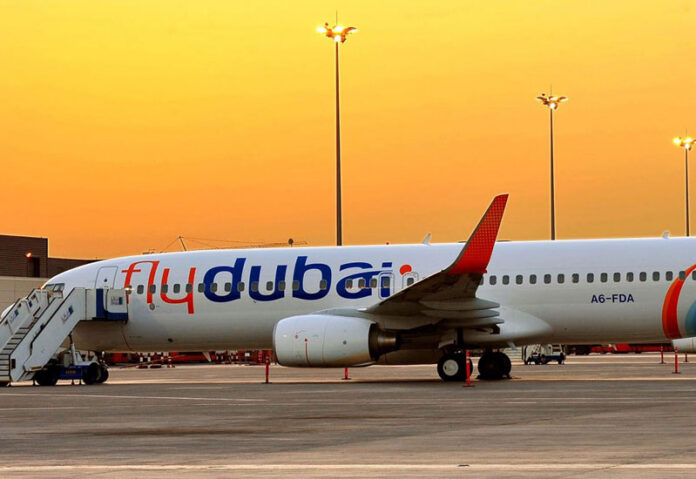
A routine Flydubai flight from Dubai to Tel Aviv turned into a major security scare on Wednesday after an altercation between the two pilots inside the cockpit triggered emergency signals, briefly raising fears that the aircraft had been hijacked.
The flight, carrying 174 passengers, including 27 children, was eventually diverted to Saudi Arabia and landed safely. Flydubai confirmed that the diversion was prompted by an altercation between the pilots.
The Boeing aircraft had departed Dubai at around 7:05 am and was scheduled to arrive at Ben Gurion Airport near Tel Aviv at approximately 9:30 am.
About 90 minutes into the journey, while the aircraft was flying through Jordanian airspace, it first transmitted squawk code 7700, the international transponder code used to indicate a general emergency.
The situation became considerably more alarming when the aircraft subsequently transmitted 7500, a code indicating unlawful interference with an aircraft and widely associated with a hijacking.
The aircraft then changed course, turned back towards Saudi Arabia and began descending to a lower altitude while flying over the kingdom. After initially heading south, it later turned west and continued over Saudi airspace.
The unusual sequence of events triggered an immediate security response in Israel. Israeli Air Force fighter jets were scrambled as authorities tried to establish what was happening aboard the aircraft.
At the time, officials had no confirmation that the aircraft had actually been hijacked. However, concerns intensified after authorities reportedly struggled to establish communication with the pilot.
“There is no definitive information about a hijacking. The pilot activated a distress signal,” an Israeli security official said during the initial response. “We are unable to establish contact with the pilot, and that is concerning.”
The incident prompted an emergency security consultation involving Prime Minister Benjamin Netanyahu and Defence Minister Israel Katz. The Israel Police Operations Division also ordered the creation of a joint command centre involving multiple security agencies.
Police Commissioner Danny Levy conducted a situation assessment as authorities prepared for various possibilities.
“We are preparing for every scenario,” Levy said while the circumstances aboard the aircraft remained unclear.
The Israel Defence Forces also moved to assess the situation. IDF Chief of Staff Lt Gen Eyal Zamir held a situational assessment with the commander of the Israeli Air Force, the head of the Operations Directorate, the head of Military Intelligence and other senior commanders.
As authorities gathered more information, however, the hijacking theory began to recede.
The emergency signals were ultimately understood to have been triggered by a physical altercation between the pilots in the cockpit, rather than an attempt by passengers or an outside party to seize control of the aircraft.
The aircraft was diverted to Saudi Arabia, where it continued at a lower altitude before making a safe landing with all passengers aboard.
What initially appeared to be a potential hijacking had therefore triggered a substantial military and security response, including the scrambling of fighter jets, before authorities determined that the unusual emergency was apparently the result of a confrontation between the people flying the aircraft.
