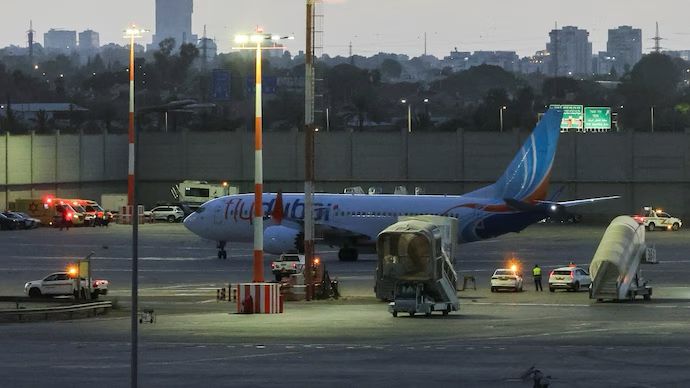
The passengers of Flydubai Flight FZ1073 are safely back in Israel. The aircraft that plunged thousands of feet after a violent struggle inside its cockpit has landed after a failed attempt to replicate a 9/11-style attack on Israel; the injured Indian captain is receiving treatment, and the attacker, an Omani national, is in Saudi custody.
But one of the biggest questions arising from the extraordinary incident has little to do with what happened inside the cockpit.
It is this:
How was an Omani national serving as a pilot on a commercial flight to Israel in the first place?
The question has assumed significance because Oman does not have diplomatic relations with Israel, while reports have emerged that Flydubai’s agreement to operate flights to Israel contains a requirement concerning the nationality of pilots. At the same time, the publicly available 2020 air-services agreement between Israel and the United Arab Emirates does not appear to contain a blanket prohibition on crew members based on nationality.
That distinction could prove crucial.
What happened aboard Flydubai Flight FZ1073?
On September 30, Flydubai Flight FZ1073 was operating from Dubai to Tel Aviv with 174 people aboard, most of them Israeli passengers.
According to Israeli officials and passengers, the flight descended rapidly after an altercation erupted in the cockpit. The co-pilot, identified in reports as an Omani national, attacked the Indian captain, Smit Machchhar, with a bladed weapon.
The identity of the Omani national is kept under wraps. But his colleague described him as a religious zealot who prayed throughout the day and refused to shake hands with women.
The aircraft lost roughly 14,000 feet in less than 30 seconds before the situation was brought under control. The injured captain managed to open the cockpit door, allowing passengers and crew members to intervene and restrain the attacker. The aircraft was subsequently diverted to Saudi Arabia and landed safely in Tabuk.
The passengers were later flown back to Israel.
The motive remains under investigation. Israeli officials have examined the possibility of a terrorist attack, while Flydubai has cautioned against drawing premature conclusions. Reuters reported on October 1 that Israeli officials’ initial assessment was that the co-pilot appeared to have acted alone, although the investigation was continuing.
But another investigation is now taking shape: how did the Omani pilot get assigned to this particular route?
Oman does not have diplomatic relations with Israel
Israel and the UAE established diplomatic relations in 2020 under the Abraham Accords. Flydubai subsequently launched its first scheduled service between Dubai and Tel Aviv in November 2020. Israel’s Foreign Ministry records the inaugural Flydubai flight as arriving at Ben Gurion Airport on November 26, 2020.
Oman, however, has not normalised diplomatic relations with Israel.
That does not automatically mean an Omani citizen cannot work for an international airline or even operate an aircraft that enters Israeli airspace or lands in Israel. Nationality and diplomatic recognition are not, by themselves, the same thing as aviation operating rights.
And this is where the details of the agreements become important.
Did Flydubai have a rule barring Omani pilots?
The Jerusalem Post reported that Flydubai’s agreement to operate in Israel contains an explicit clause stating that pilots flying to Israel must come from countries that have normalised relations with Israel.
Oman does not fall into that category.
Following the incident, Israeli Transportation Minister Miri Regev sought the suspension of Flydubai flights to Israel and asked authorities to investigate whether the airline had violated the terms under which it was permitted to operate. The Jerusalem Post reported that Israeli authorities were also examining how the Omani national had been assigned to the route.
That would make the nationality question highly consequential.
If such a requirement genuinely exists in a binding agreement between Flydubai and the Israeli authorities, investigators would need to establish why an Omani national was assigned to a Tel Aviv-bound flight.
Was there an exemption?
Was the requirement interpreted differently?
Was the rule contained in a separate operating arrangement rather than the bilateral treaty?
Or was there simply a compliance failure?
Those are very different possibilities.
But there is an important complication: the public UAE-Israel aviation agreement
The publicly available UAE-Israel Air Services Agreement does not appear to say that pilots must be nationals of countries maintaining diplomatic relations with Israel.
The agreement grants designated airlines from each country rights to operate international air services on specified routes. It also contains provisions dealing with aviation security, the application of laws and regulations, and airline personnel.
Most importantly, the agreement’s personnel provisions are broad.
Article 13 deals with commercial activities and permits designated airlines to bring their own managerial, commercial, operational, sales, technical and other personnel into the territory of the other party. It states that such personnel requirements may be met by the airline’s own personnel “of any nationality.”
That wording matters.
If the publicly available bilateral agreement is the only governing instrument, there is no obvious nationality-based prohibition on an Omani member of an Emirati airline’s crew.
In other words, the bilateral agreement itself does not appear to establish a simple rule saying that only Israelis, Emiratis or nationals of countries recognising Israel can serve as crew.
That is why the reported Flydubai-specific clause needs to be examined separately.
So can an Omani national legally fly a UAE airline to Israel?
Based on the publicly available bilateral agreement, there does not appear to be a blanket prohibition based solely on Omani nationality.
But that is not the same as saying that an Omani pilot was unquestionably authorised to operate Flight FZ1073.
There could be additional conditions in:
- Flydubai’s operating agreement with Israel;
- security arrangements governing flights to and from Ben Gurion Airport;
- Israeli aviation-security requirements;
- crew-clearance procedures;
- airline-specific employment or route restrictions; or
- subsequent agreements or directives not contained in the publicly available treaty text.
This distinction is essential.
The 2020 bilateral agreement and a separate operating or security arrangement are not necessarily the same document.
Therefore, the central question for investigators is not simply “Is Oman recognised by Israel?”
It is:
“What precise rule governed the nationality and clearance of pilots operating Flydubai flights to Israel on September 30, 2026?”
Why does the distinction matter?
There is a major difference between an airline employing an Omani pilot and an Omani pilot being specifically cleared to operate a flight into Israel.
An international airline can have pilots from dozens of nationalities. A pilot does not ordinarily need his or her country to maintain diplomatic relations with every destination served by the airline.
But countries can impose additional security requirements on specific routes.
Israel, in particular, maintains extensive aviation-security procedures. Airlines operating to Ben Gurion Airport are subject to Israeli security requirements and regulatory oversight.
Therefore, if Israel had imposed a specific nationality restriction on pilots operating a particular route, compliance with that restriction would become a matter for the airline and the relevant authorities.
And if no such restriction existed, then the mere fact that the pilot was Omani would not, by itself, establish a regulatory violation.
What exactly did the agreement say?
This is where the public record becomes particularly interesting.
The UAE-Israel Air Services Agreement contains provisions requiring crews and airlines to comply with the host country’s laws and regulations. It also contains aviation-security provisions incorporating international obligations concerning unlawful interference with civil aviation.
But the publicly available text does not appear to contain the reported rule that every pilot operating to Israel must hold a passport from a country that has normalised relations with Israel.
That means one of two things could ultimately emerge.
Either there is a separate Flydubai-Israel arrangement containing the reported nationality requirement, in which case investigators will have to determine why it was apparently breached.
Or the reported requirement has been misunderstood, inaccurately described, or applies under circumstances different from those currently being reported.
Until the actual document is made public, it would be premature to declare that the UAE breached the bilateral aviation agreement.
What happens to Emirates and other UAE carriers?
The issue could also extend beyond Flydubai.
The UAE operates multiple airlines with services to Israel, including Emirates, which launched its Dubai-Tel Aviv service in 2022. Israel’s Foreign Ministry records the inauguration of Emirates’ flights to Tel Aviv in June 2022.
If the nationality requirement exists only in Flydubai’s specific operating arrangement, it may not automatically apply to Emirates.
But if the restriction is actually contained in the bilateral framework between Israel and the UAE, then authorities would have to clarify whether it applies to every UAE-designated carrier.
That distinction is particularly important because the publicly available treaty language appears broader than the reported Flydubai-specific restriction.
Then there is the security question
The nationality issue is only one part of the puzzle.
The more immediate aviation-security question is how the attacker obtained access to a weapon inside the cockpit.
Israeli aviation security is known for extensive screening procedures, and the cockpit itself is among the most secure areas of a commercial aircraft.
If the weapon was brought aboard by the pilot, investigators will have to establish how it passed through security procedures and whether it was concealed or otherwise permitted.
Alternatively, if it was an authorised aircraft or cockpit item, investigators will need to establish exactly what object was used and under what circumstances.
The fact that the attacker was a member of the flight crew fundamentally changes the security question.
The aviation system is designed to prevent outsiders from entering the cockpit.
But what happens when the threat is already inside?
Who will investigate?
The case also presents an unusual jurisdictional puzzle.
The aircraft belonged to a UAE airline.
The flight departed from Dubai.
It was bound for Israel.
The attacker was Omani.
The captain was Indian.
Most passengers were Israeli.
And the aircraft ultimately landed in Saudi Arabia, where the suspect was detained.
Saudi authorities therefore have direct custody of the suspect and control over the initial criminal investigation. The UAE has an obvious interest because Flydubai is a UAE carrier. Israel has a major security interest because the aircraft was bound for its territory and most passengers were Israeli.
Israeli authorities have already been examining the incident, while Saudi and UAE authorities are also involved. Reuters reported that the investigation into the motive remained ongoing on October 1.
The resulting investigation is therefore likely to involve several jurisdictions and multiple layers of aviation, criminal and national-security law.
The bigger question: was the route itself improperly staffed?
That may ultimately become one of the most important questions arising from FZ1073.
The dramatic story is of a cockpit struggle at altitude, an injured captain, passengers storming the flight deck and an aircraft making an emergency landing in Saudi Arabia.
But once the immediate crisis is over, aviation regulators will have to look at the paperwork.
Who approved the crew?
What nationality restrictions applied to the route?
Who verified the pilot’s eligibility?
Was the Omani pilot properly cleared to operate into Israel?
And if there was a restriction, at what stage did the system fail?
The answers could determine whether the presence of an Omani pilot on the flight was perfectly lawful, an administrative violation, or evidence of a more serious security lapse.
For now, one thing is clear: the fact that the co-pilot was Omani does not, by itself, prove that he was legally barred from flying to Israel.
The publicly available UAE-Israel air-services agreement does not appear to impose such a blanket nationality ban. At the same time, credible Israeli reporting says a separate Flydubai operating arrangement may contain precisely such a restriction.
Until that document is produced and its legal status established, the question remains open.
And that may be the most intriguing unanswered question from Flight FZ1073: not merely who was allowed into the cockpit, but who was authorised to fly the aircraft into Israel in the first place?