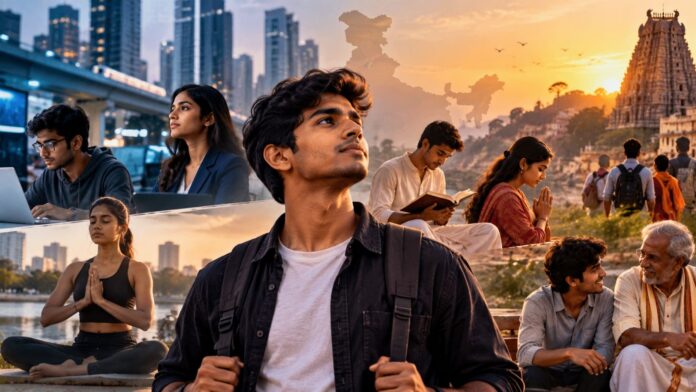
What if the biggest mistake we are making about India’s youth is not misunderstanding what they are saying, but giving them the wrong name?
Today, whenever a group of young people gathers at a protest site, raises slogans outside a university, or expresses anger on social media, a familiar phrase quickly appears in public discourse: “Gen Z has spoken.” A local grievance becomes a generational revolt. A few hundred young people become representatives of millions. A particular style of protest is presented as the defining character of an entire generation.
But can the character of a civilisation of more than a billion people really be explained by the year in which its young people were born? Can a demographic label created in a very different social and cultural environment tell us what an Indian youth believes, values or hopes to become?
This is not merely a question of terminology. It is a question of how we see ourselves.
The term “Gen Z” may be useful as a broad demographic description. But the moment it begins to be treated as a complete description of Indian youth, we enter troubled territory. An Indian youth is not merely a person born within a particular set of calendar years. He or she is also a child of a family, a product of a culture, a bearer of memory, a participant in society and, potentially, a trustee of the civilisation that preceded them.
A demographic label cannot explain a civilisation
The familiar sequence of Generation X, Millennials, Generation Z and Generation Alpha emerged from modern Western demographic and social research. These categories were developed to describe broad changes in populations, consumption patterns, social behaviour and attitudes across particular periods. Even the naming of Generation Alpha was a relatively recent exercise in classification rather than the discovery of some eternal law of human behaviour.
There is nothing inherently wrong with such classifications when they are used for what they are: broad demographic shorthand. The problem begins when a demographic category is turned into a psychological identity and then projected onto an entire civilisation.
India is not merely another market in which people happen to belong to different age groups. It has a social structure in which generations have traditionally existed in continuity with one another. This is why the language of generational conflict often feels strangely inadequate in the Indian context.
In India, generations are not meant to replace one another
The Indian family was never designed as a collection of isolated age groups. The grandfather carries memory. The parent carries responsibility. The young carry energy and new possibilities. These roles overlap, change and influence one another.
The child may teach the grandfather how to use a smartphone. The grandfather may teach the child the story behind a verse from the Gita. One generation brings technological confidence. Another brings lived experience. One knows how to navigate the newest digital world. Another knows why a particular tradition exists in the first place. This is not a hierarchy of generations. It is a circulation of knowledge.
Even where urbanisation has changed the physical structure of Indian households, the emotional and cultural relationship between generations has not simply disappeared. To understand Indian youth only through the year in which they were born is therefore to miss something fundamental. An Indian individual has traditionally been understood not in isolation, but through relationships, responsibilities and duties.
That is why the Indian youth cannot be reduced to a four-character label.
The India beyond the protest site
There is another India that rarely receives the same attention. It is the young person waking up before sunrise to train for a marathon, the young woman practising yoga after work, the student preparing for an examination while also reading the Bhagavad Gita, the young professional travelling to a pilgrimage centre, or the young Indian learning Sanskrit, classical music or traditional art while working in technology.
It is also the youth choosing discipline over addiction, fitness over excess and meditation over constant distraction. This India exists quietly, without always producing a headline.
Across the country, many young Indians are rediscovering pilgrimage, yoga, meditation, traditional practices and spiritual literature. This is not necessarily a rejection of modernity. For many, it is an attempt to find balance within modernity.
A young Indian can build software, work in artificial intelligence, run a business or participate in the global economy and still bow before his elders, participate in family rituals and seek the blessings of his ancestors. Modernity and tradition need not be enemies. Perhaps this is precisely what our borrowed categories fail to capture.
Rights matter. But what about duty?
There is another dimension to the discussion that is often missing. Young people today are increasingly conscious of their rights. That awareness is not a problem. A healthy society requires citizens who know their rights and are willing to question institutions when something is wrong.
But Indian thought has never treated rights as the whole of human existence. Alongside rights stands kartavya, duty.
The Bhagavad Gita does not teach Arjuna merely to ask what he is entitled to receive from life. It asks him to recognise what he is required to do. This distinction is important. A society cannot remain healthy if every conversation begins with “What are my rights?” and ends there.
What is my responsibility towards my family? What is my responsibility towards society? What do I owe my nation? What do I owe to truth? What do I owe to my own potential? These questions are not anti-modern. They are what prevent freedom from becoming irresponsibility.
A young person has every right to question authority. But questioning authority does not remove the responsibility to distinguish truth from falsehood. The right to protest does not automatically legitimise violence. Freedom of expression does not eliminate the need for restraint. And disagreement with an institution does not require contempt for the entire social order.
The deeper Indian idea is not obedience without thought. It is freedom guided by viveka.
The Indian tradition has never been afraid of questions
There is an irony in the claim that returning to Indian tradition makes young people less questioning. The opposite is closer to the truth.
The Indian intellectual tradition is full of questions. The Upanishads are full of seekers asking difficult questions. Teachers are questioned. Answers are examined. Ideas are challenged. Philosophical schools debate one another.
Shastrartha was not a performance of agreement. It was a disciplined search for truth through dialogue and intellectual contestation. India’s tradition does not ask the young to stop questioning. It asks them to develop the capacity to question intelligently.
That distinction has become particularly important in the age of the smartphone. A young person today can access more information in a few minutes than earlier generations could encounter in months. But access to information is not the same as access to wisdom.
The real question is not whether our youth have information. It is whether they have the viveka to decide what deserves to be believed.
When the smartphone becomes louder than the mind
There is a simple question worth asking: do we use our smartphones, or have our smartphones begun to use us?
The digital world rewards speed. Anger travels faster than reflection. Outrage attracts more attention than nuance. A short video can create an impression before a person has had time to understand the facts behind it.
This does not mean that every online movement is artificial or every protest is manufactured. Genuine grievances exist, and genuine young people do speak out. But the digital environment can magnify a particular emotion until it appears to represent an entire generation.
That is why caution is necessary before declaring that “Gen Z has spoken.” Perhaps a few people have spoken. Perhaps a particular group has spoken. Perhaps an important grievance has been raised. But a civilisation of more than a billion people cannot be understood through a trending video.
The louder voice is not necessarily the deeper voice.
The real crisis may be one of direction
The greatest challenge before Indian youth may not be anger. It may be direction. A young person can be technologically sophisticated and still be internally confused. He can have thousands of followers and no sense of purpose. He can be connected to the entire world and disconnected from himself.
This is where the spiritual dimension becomes relevant. Dharma is not merely a religious label. At a deeper level, it is about that which sustains and gives right direction to life. Swadharma asks a person to understand his own responsibility and place in the larger order. Sadhana creates discipline, viveka creates discernment, and seva takes the individual beyond the narrow boundaries of the self.
These are not ideas belonging only to another age. They address precisely the problems of distraction, comparison, anxiety and purposelessness that modern youth encounter. The answer to a distracted mind is not necessarily more information. Sometimes it is silence, sometimes discipline, sometimes service, and sometimes a return to the question: What am I here to become?
So, what should we call Indian youth?
Perhaps we should stop trying so hard to give India’s youth a borrowed identity. The question should not be, “What does Gen Z want?” The more important question is, “What does India’s rising generation want to become?”
Do we want a generation defined by its consumption habits, online vocabulary and ability to generate outrage? Or do we want a generation that can combine technological ability with civilisational confidence? A generation that can enter the world’s finest laboratories without feeling ashamed of its temples, build global businesses without losing its connection with family, question its elders without despising them, demand its rights while remembering its duties, and use the smartphone without allowing the smartphone to dictate its mind?
That is a very different vision of youth.
India does not need to reject modernity to remain rooted. Nor does it need to abandon its roots to become modern. Its civilisational strength has always been its ability to absorb, question, adapt and renew without losing its essential identity. Our youth can do the same.
Perhaps, therefore, the time has come to look beyond borrowed alphabets. The Indian youth is not simply a demographic cohort waiting to be named. It is the next link in a civilisationalchain. Its true identity will not be decided by the year in which it was born, the slogans it shouts, or the trends it follows. It will be decided by the values it chooses to live by.
The future of India will not merely belong to a “Gen Z”. It will belong to a generation that can unite Sadhana with Srijan, Viveka with Vikas, and individual aspiration with Rashtrabodh.
That is the Indian youth worth understanding.