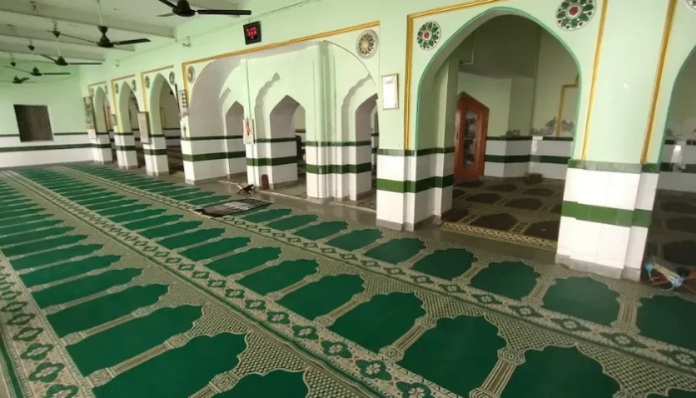
The controversy surrounding Delhi’s Race Course Mosque has once again triggered political and religious outrage, with Muslim leaders portraying the proposed eviction as a threat to religious rights. Yet, amid the competing claims over the mosque’s heritage status and Waqf registration, a crucial question risks getting buried under the noise: does a religious structure’s existence automatically confer a right to occupy government land?
On Monday, October 19, the Land and Development Office (L&DO) issued an eviction notice to the mosque’s representatives, giving them six days to vacate the premises because the structure stands on government land and is unauthorised.
The mosque’s representatives have disputed the action, citing its registration as a Waqf property in the 1977 Delhi Gazette and its inclusion in heritage records. Muslim religious leaders and political figures have since demanded government intervention, warning of the possible demolition of a historic place of worship.
However, the controversy cannot be reduced to a simplistic narrative of the government targeting a mosque. The dispute involves land ownership, authorisation, heritage regulations and the alleged failure of the very institution entrusted with protecting Waqf properties. An OpIndia ground report has also revealed that the proposed clearance extends beyond the mosque, with two temples and residential properties occupied by both Hindus and Muslims reportedly affected.
Waqf registration is not a magic wand to claim government land
At the heart of the dispute is a fundamental distinction that much of the political commentary appears eager to overlook: recognition as a religious property and proof of a lawful right to occupy a particular parcel of land are not necessarily the same thing.
The L&DO’s position is that the land belongs to the government and that the occupation is unauthorised. The mosque’s representatives, meanwhile, cite its status as a gazetted Waqf property since 1977.
But a Waqf registration, by itself, does not conclusively settle a competing claim over land ownership. The relevant questions include who holds title to the land, whether a lawful allotment or lease exists, whether any protected rights apply and what the applicable statutory provisions establish.
A religious structure may have existed for decades without its age alone determining the legality of its occupation. Equally, a government claim cannot be treated as conclusively established merely because an eviction notice has been issued. The competing claims must be assessed against the relevant records and legal procedures.
If the mosque’s representatives possess documents establishing ownership, a lawful lease or another legally protected right to occupy the property, those documents would be central to the dispute. The public material cited in the controversy does not, by itself, establish that such a right overrides the L&DO’s claim.
The question, therefore, is not whether the mosque is old or whether it has religious significance. It is whether the occupation is legally authorised and whether the proposed eviction complies with the applicable law.
Heritage status: a regulatory tool, not a title
The mosque is said to be listed in the NDMC heritage register and referenced in the 1977 Delhi Gazette. Heritage listing regulates conservation and modification. It does not confer ownership. A listed heritage building on private land can still be sold by its owner.
A listed heritage building on government land that is occupied without authorisation does not become the property of the occupant. Heritage status may require a particular process before demolition, but it does not create an absolute immunity from eviction.
If heritage status were legally decisive, the mosque’s representatives could have sought an injunction from a court. The reported response was to approach ministers instead. That choice does not resolve the legal question. It indicates that the heritage argument has been used in public debate more than in litigation.
The Waqf Board’s role
The Delhi Waqf Board is the institution with statutory responsibility for protecting Waqf properties. According to a statement by the imam of the mosque, it did not challenge the demolition order and did not make effective efforts to resolve the issue.
In an X post, AIMIM leader Asaduddin Owaisi has stated that the Waqf Board did not challenge the order and that it has not been fully constituted since 2023. The mosque’s imam, Maulana Mohammed Haroon, has said that he sought the Board’s help for months, and that the Board neither went to court nor allowed him to go to court.
The race course masjid case needs @KirenRijiju’s urgent intervention. 1. Despite the masjid being a gazetted waqf property since 1977, the waqf board did not challenge the demolition order. Neither did it make any effort to resolve the issue 2. Even the Waqf Amendment Act protects the masjid since it’s ‘waqf by user.’ And all such properties registered in the past continue to be protected. But still no effort was made. 3. It’s the Minister’s job to resolve the matter since the Delhi Waqf Board hasn’t been constituted since 2023 but the CEO of the Board could have intervened, that also did not happen.
— Asaduddin Owaisi (@asadowaisi) October 20, 2026
These statements are significant because they concern the institution that was expected to defend the mosque’s legal interests. The Board did not litigate, did not negotiate a resolution, did not produce ownership documents, and did not seek a stay.
When the eviction notice became public, criticism was directed mainly at the L&DO rather than at the Board’s conduct. If the mosque is a valued Waqf property, the Board’s failure to act is a central part of the case.
The political response
The reaction from Muslim religious & political figures has followed a predictable whining script. Asaduddin Owaisi sought the “urgent intervention” of the Union Minister for Minority Affairs. Jamiat Ulama-i-Hind sent a delegation and submitted memoranda.
#Jamiat Ulama-i-Hind Delegation Meets Union #Minority Affairs Minister over #Race Course #Mosque in Delhi* *Memorandum seeks restoration of electricity, water supply and namaz, and protection of the mosque from demolition* New Delhi, October 19, 2026: A delegation of Jamiat Ulama-i-Hind, led by its General Secretary, Maulana Muhammad Hakimuddin Qasmi, met Union Minister for Minority Affairs Kiren Rijiju to raise concerns over the protection of the historic Race Course Mosque and the adjoining graveyard, located behind Safdarjung Tomb in New Delhi. During the meeting, the delegation submitted a detailed memorandum to the minister on behalf of Jamiat Ulama-i-Hind president Maulana Mahmood Asad Madani, urging immediate intervention to safeguard the religious, historical and legal status of the mosque and the graveyard. The memorandum highlighted documentary evidence of the mosque’s historical significance in official records. These include its listing at serial number 22 in the heritage list of the New Delhi Municipal Council (NDMC), its mention at serial number 18 in the Delhi Gazette of 1977, and its inclusion, along with a property identification number, in the revised list available on the website of the Union Ministry of Minority Affairs. Expressing serious concern over the prevailing situation, the memorandum pointed to restrictions on the movement of worshippers, the disconnection of water and electricity supplies, and the apprehension that the mosque could be demolished. It stressed that immediate measures were necessary to protect the religious properties and ensure that worshippers could access the mosque and offer namaz without obstruction. Jamiat Ulama-i-Hind urged the Union Minister for Minority Affairs to take immediate cognisance of the matter and seek a detailed report from the concerned authorities, particularly the Delhi Waqf Board and the NDMC. The memorandum further called for a comprehensive examination of official records, verification of the legal status of the properties, and strict compliance with applicable laws and judicial orders before any action involving the demolition of the mosque or the graveyard is undertaken. It cautioned against any step that could result in irreversible damage and sought the restoration of access for worshippers and essential facilities, including water and electricity. The organisation also affirmed its commitment to pursuing all available legal remedies and other lawful means to protect the mosque and the adjoining graveyard, preserving their religious and historical significance as well as their legal status. After hearing the delegation’s concerns and demands, Minister Kiren Rijiju assured the representatives that he would make every possible effort on his part in the matter.
— Jamiat Ulama-i-Hind (@JamiatUlama_in) October 19, 2026
AAP MLA Amanatullah Khan says in an X post, “This is the Masjid Race Course, located in New Delhi. The mosque’s imam, Maulana Haroon Sahib, told me that the central government’s L&SO department is going to demolish this mosque in the coming week. This mosque dates back to the pre-independence era and is also included in the NDMC’s heritage list. I will visit the site myself tomorrow.”
Several Kashmiri clerics also commented on the event. Mirwaiz Umer Farooq wrote in an X post, “Deeply disturbing that Delhi’s historic Race Course Mosque, a gazetted Waqf property since 1977 and a listed heritage site, faces eviction within six days. Equally alarming is the reported failure of the Waqf authorities to defend it.”
He further said, “Is this becoming the new normal for Muslim places of worship? This is precisely why we strongly opposed the Waqf amendments and increased government control through appointed nominees over Muslim religious endowments. If even a legally recognised mosque cannot be protected, what safeguards remain for others?”
Deeply disturbing that Delhi’s historic Race Course Mosque, a gazetted Waqf property since 1977 and a listed heritage site, faces eviction within six days. Equally alarming is the reported failure of the Waqf authorities to defend it. Is this becoming the new normal for Muslim places of worship? This is precisely why we strongly opposed the Waqf amendments and increased government control through appointed nominees over Muslim religious endowments. If even a legally recognised mosque cannot be protected, what safeguards remain for others?
— Mirwaiz Umar Farooq (@MirwaizKashmir) October 20, 2026
Nasir Ul Islam, grand mufti of Jammu and Kashmir, stated that the development is “deeply alarming” and reinforces ongoing community concerns regarding the security of Muslim religious properties and the accountability of the institutions meant to protect them. He warned that if these institutions fail to defend such properties, the trust of the community will inevitably be shaken.
Why demolition is defensible
First, it upholds the rule of law. The government cannot allow unauthorised occupation of public land to continue indefinitely, regardless of the religious nature of the structure. The law must take its course at all costs. Selectively exempting structures based on religious identity can create a dangerous precedent and undermine equality before the law.
Second, it avoids a culture of administrative paralysis. The belief that a religious label can permanently shield an unauthorised occupation from state action makes enforcement difficult and inconsistent. The government’s duty is to protect public property and apply the law uniformly.
Third, it separates religion from illegality. The removal of an unauthorised structure that happens to be a mosque is not the same as targeting a place of worship. The government’s stated action concerns land ownership. Once the structure is removed, the community can build a mosque on land it lawfully owns, with the rights and protections that apply to such property.
OpIndia ground report
OpIndia reached the ground and spoke with the locals. According to them, around 100 acres near Race Course Road, close to the Prime Minister’s residence, are being cleared strictly for security reasons. Two temples and one unauthorised mosque have received eviction notices, and homes of both Hindus and Muslims are being vacated in the area.
Around 100 acres near Race Course Road by the PM’s residence are being cleared strictly for security reasons. Two temples and one unauthorized mosque received eviction notices, yet the Left-Islamist ecosystem peddles outrage by selectively naming only the mosque. Homes of both Hindus and Muslims are being vacated, watch the ground report by @Cawnpore_Journo
— OpIndia.com (@OpIndia_com) October 21, 2026
Talking to a reporter, one local woman said that evicted people are both Hindus and Muslims. They got the flats from the government and are happy. Yet the controversy is being framed by some as if only the mosque is affected, with selective outrage naming just the mosque while ignoring the temples and residential evictions.
Conclusion
The public debate has presented the Race Course Mosque issue as a conflict between faith and the state. The available record suggests a narrower dispute about land ownership, authorisation, and institutional responsibility. The L&DO has a legal duty to protect government land.
The Waqf Board had a legal duty to defend the mosque’s interests and, according to public statements, did not do so effectively. The political class has an interest in prolonging the controversy. In this context, the appropriate course is to let the legal process determine ownership and authorisation.
If the mosque’s defenders have documents establishing a lawful right, they should produce them in court. If they do not, demolition after due process is the legally defensible outcome.