

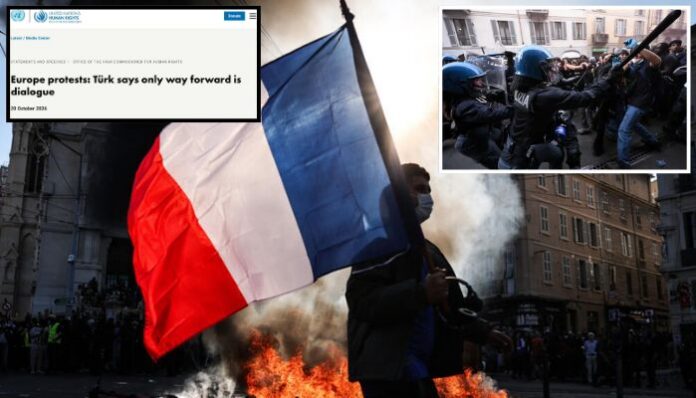
The United Nations Human Rights Office has finally noticed the massive unrest tearing through major European nations and decided to speak up. However, the timing, tone, and stark contrast of its response reveal a glaring double standard. Back on 10th October, during the Cockroach Janata Party’s (CJP) planned unrest in India, the UN was quick off the mark, raising instant concerns about so-called ‘mass detentions’ on the very day of the event.
Fast forward to 20th October, and UN High Commissioner for Human Rights Volker Türk finally condemned the widespread violence and vandalism sweeping France and other European countries, gently appealing to rioters to renounce aggression.
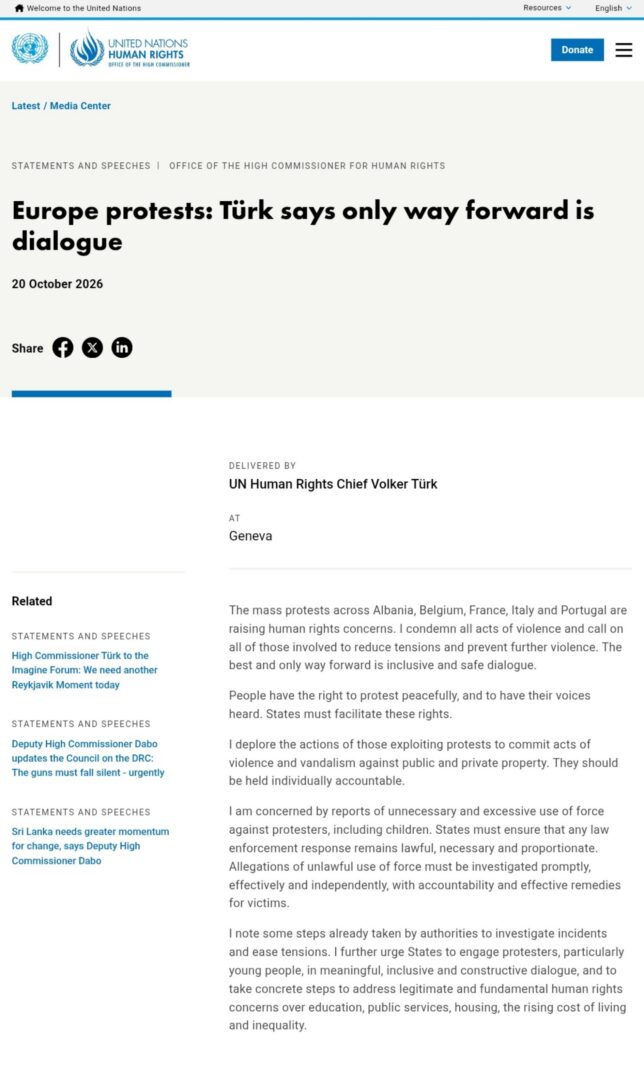
The UN official’s statement came out on Tuesday, 20th October, after weeks of chaotic footage, police clashes, and arson from Europe went viral across global social media platforms. Interestingly, the UN official’s statement chose a surprisingly soft headline: “Europe protests: Türk says only way forward is dialogue.”
UN Human Rights Chief @volker_turk says the mass protests across Albania, Belgium, France, Italy and Portugal are raising human rights concerns. "I condemn all acts of violence, and call on all of those involved to reduce tensions and prevent further violence. The best and only way forward is inclusive and safe dialogue." https://t.co/AmTxwSsRPH
— UN Human Rights (@UNHumanRights) October 20, 2026
Fire in European streets met with calls for ‘Dialogue’
French cities have been burning, and the Albanian Supreme Court, along with key government offices, were set ablaze. Yet, for the United Nations, the ideal solution remains a safe, gentle dialogue, casually categorising these destructive riots as mere “mass protests” across France and neighbouring European nations. Weeks of rampant, unchecked violent demonstrations, arson, looting, heavy clashes with police, and thousands of arrests across the continent were met with nothing more than a passive appeal for engagement.
In its official release, the UN noted that, “The best and only way forward is inclusive and safe dialogue.”
Blind eye to European detentions and police Action
What stands out most in the UN’s October 20th release is what was omitted. The UN did not bother to explicitly mention detentions in European nations, particularly in France, where local authorities have arrested over 2,500 people to date.
Instead, the statement merely expressed mild concern over “reports” of unnecessary and excessive police force against protesters, including children, and asked for independent investigations into unlawful acts by security forces. By framing real, verifiable police crackdowns as mere “reports,” the UN essentially turned a blind eye to vivid social media visuals showing law enforcement aggressively tackling demonstrators in European streets.
French POLICE VIOLENCE PILES UP as officers BEAT protesters & strike ‘medics’ treating the wounded — Human Rights lawyers like abuses to CONFLICT ZONES amid week 5 of student uprising Police also seen FORCIBLY dragging woman out & disguising as protesters to ATTACK demonstrators before retreating behind POLICE LINES
— Michael Ashura (@MichaelAshura) October 21, 2026
Furthermore, the UN urged European governments to address underlying social grievances like education, housing, public services, economic inequality, and the rising cost of living, framing constructive engagement as the key to ending the chaos.
By the time the UN chose to intervene, several European nations had already suffered severe destruction far beyond routine street demonstrations. In France, what initially portrayed as students’ protests over education and public services quickly spiralled into chaos over living costs, culminating in approximately 2,500 arrests alongside rampant looting, arson, and damage to historical public monuments.
🚨 FRANCE IN CHAOS: Businesses looted, police attacked, fires set, and government buildings targeted as protests turn violent. This has escalated far beyond student demonstrations. Peaceful protest is a right. Looting and destruction are crimes. https://t.co/EQprjqsmNe
— Greg 🇺🇸 ✭ (@GregB_TX) October 17, 2026
Police reported 271 arrests following two straight days of violent disturbances in Milan, Italy.
The ‘student protests’ have spread to Italy, where Muslim rioters are rampaging outside Milan Cathedral (the Duomo) and trying to set it on fire. This is a religious war of conquest against Europe, Christianity, and Western civilization as a whole. https://t.co/qx1JLnQyqc
— Dr. Maalouf (@realMaalouf) October 17, 2026
Demonstrators faced heavy tear gas and water cannons in Belgium.
In Albania, Violent clashes left hundreds injured, including police personnel, and saw the Supreme Court building set on fire.
The Supreme Court burns to the ground in Albania, Parliament and the Department of Education has been stormed, the Prime Minister is in hiding and the country is effectively in the hands of the rebels. Albania rejects blatant corruption and their country being sold. https://t.co/EH22FBySId
— BladeoftheSun (@BladeoftheS) October 18, 2026
The Instant attack on India’s preventive security measures
The UN’s hypocrisy and double standards became glaringly obvious when looking back at its stance on India’s unpermitted CJP demonstrations.
On 10th October, the United Nations Human Rights Office raised alarms over what they called the “mass detentions” in India on the exact day protesters tried to assemble in Delhi. Compare that to its 20th October statement on European chaos, which took weeks to produce and led with a soft plea for dialogue despite arson and violence spreading across five countries.
The double standard is plain as day just by looking at the official headlines chosen by the UN Human Rights Office. The 10th October statement concerning India was titled “India: Concerns over mass detentions before and during protests”, while the 20th October statement concerning Albania, Belgium, France, Italy and Portugal carried the headline “Europe protests: Türk says only way forward is dialogue”.
#India: We are concerned by reports of mass detentions of demonstrators, protest leaders, members of civil society organisations, lawyers and journalists, before and during today’s large-scale demonstrations in Delhi. We call on the authorities to ensure that the right to peaceful assembly is fully respected and fulfilled. https://t.co/tqrQyZoXBJ
— UN Human Rights (@UNHumanRights) October 10, 2026
For India, the UN expressed immediate alarm over preventive security detentions. But for five different European nations (Albania, Belgium, France, Italy, and Portugal), the UN wrapped up weeks of continent-wide burning and looting into a single combined statement, casually remarking that dialogue was the only path forward.
In the statement addressing India, UN Human Rights spokesperson Thameen Al-Kheetan actively highlighted concerns over reports of detentions involving demonstrators, protest leaders, civil society figures, lawyers, and journalists in Delhi. Meanwhile, in the European release, the word “detention” wasn’t even mentioned once, even though far more people were locked up in France alone than in India!
The UN’s Indian statement went a step further, demanding the immediate and unconditional release of anyone arbitrarily detained, completely bypassing any independent legal assessment regarding why those individuals were picked up in the first place.
The lawful security precautions taken by Indian law enforcement to maintain public order in the National Capital were immediately framed as unlawful detentions. On the other hand, reports showing thousands of arrests across Europe were brushed under the rug by an anti-India UN apparatus.
The bias is also evident in the specific wording of the mandates. For European states, the UN stated, “States must ensure that any law enforcement response remains lawful, necessary and proportionate.” For Indian authorities, however, it said, “The Indian authorities should also ensure law enforcement forces exercise utmost restraint in response to peaceful protesters.”
The UN rushed to judge India while events were actively unfolding on the ground, without waiting for local authorities to conclude their response or allowing Indian courts to examine the legal validity of the detentions.
India slams UN’s “Extreme selectivity” and Double standards
India firmly rejected the UN’s unwarranted interference. Through its Permanent Mission in Geneva and the Ministry of External Affairs (MEA), India highlighted that the country possesses robust constitutional safeguards for peaceful assembly and proper judicial remedies for anyone challenging police action.
We have seen the OHCHR’s remarks about today’s events in New Delhi. India is the world’s largest democracy, where the right to peaceful assembly is guaranteed by our Constitution and safeguarded by robust institutions, an independent judiciary and a free media. As in every democracy, Indian citizens exercise this right subject to reasonable restrictions in the interest of public order. The authorities, for their part, act in accordance with the law, and our courts remain available to all for redressal of any grievances. The OHCHR’s concerns are therefore misplaced and constitute an unwarranted interference in the internal affairs of India. In this context, OHCHR would also do well to devote comparable attention to large-scale protests elsewhere, consistent with its mandate of impartiality and non-selectivity. @MEAIndia @IndianDiplomacy @PMOIndia @DrSJaishankar @abagchimea
— India at UN, Geneva (@IndiaUNGeneva) October 10, 2026
On 11th October, the Ministry of External Affairs went further, calling out the UN Human Rights Office for its “extreme selectivity” in public statements. The MEA openly questioned why violent responses to protests in neighbouring countries and aggressive law enforcement actions taking place right near the UN’s own headquarters never received comparable public outrage. The ministry warned that such blatant double standards severely damage the credibility of international institutions and destroy global trust in multilateralism.
Unverified claims and India’s firm rebuttal at the UN
The UN’s anti-India bias didn’t stop with press statements on street protests. On Tuesday, 20th October, over 20 UN experts in Geneva claimed to be concerned about a “repeatedly heavy-handed police response” against youth demonstrators in Delhi, demanding justice for alleged human rights abuses.
#India: UN experts alarmed by heavy-handed police response to peaceful youth-led demonstrations. “Despite the non-violent nature of the assemblies, law enforcement has deployed force against unarmed students” https://t.co/2IWZzG8BFx https://t.co/6AYK9ny2T2
— UN Special Procedures (@UN_SPExperts) October 20, 2026
India responded decisively to dismantle these baseless assertions. On the same day, during a discussion on the Working Group on Enforced Disappearances at the UN General Assembly’s Third Committee, India called out attempts to use unfounded accusations and incomplete data to build a negative narrative against the world’s largest democracy.
Deputy Secretary in the Ministry of External Affairs, Barkha Tamrakar, made it clear that human rights mechanisms should never be weaponised for political pressure or selective targeting. While rejecting attempts to treat unverified claims as proven facts, she noted that India remains open to clarifying specific, properly documented cases through proper channels. Tamrakar stated, “India firmly opposes any attempt to convert unverified allegations, incomplete statistics or a report that contains no India country (specific) observation into a negative characterisation of the world’s largest democracy. India remains prepared to clarify specific, properly documented cases through established channels.”
She added: “India engages with international human rights mechanisms, but such engagement must be based on dialogue, consultation, cooperation with non-selectivity and transparency as guiding principles.”
Foreign media’s hypocritical coverage: Softening European riots, glorifying agitators in India
This hypocrisy isn’t limited to the UN; OpIndia earlier reported the same editorial double standards of international news outlets while framing the protests.
When French cities experienced widespread destruction, with masked rioters looting businesses, setting fire to historic buildings, and clashing with security forces, outlets like the BBC, France 24, and The New York Times routinely softened their language. Rather than calling out the violence on European streets, prominent international news outlets repeatedly framed chaotic rioting as “mostly peaceful” demonstrations and focused heavily on criticising law enforcement responses.
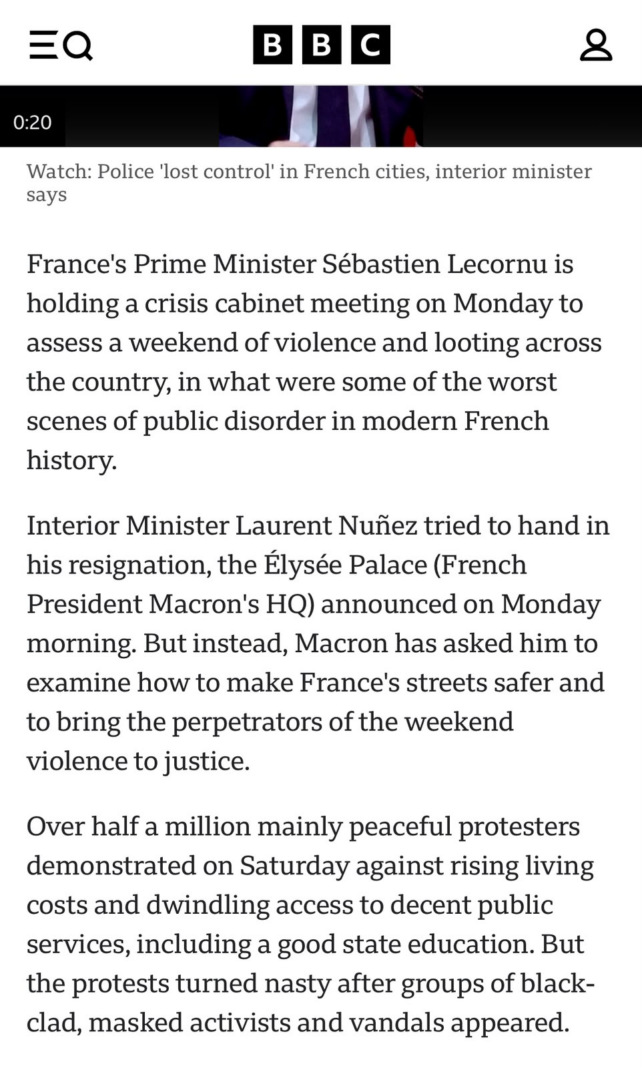
In contrast, Western news outlets adopted a completely different, celebratory tone when reporting on the Cockroach Janata Party (CJP) demonstrations in India. While French protesters were depicted as being “manipulated” by political forces ahead of elections, Indian agitators, such as far-left activist Neha Bora, were romanticised as “feisty Gen-Z” heroes taking on the government.
Similarly, state-funded outlets like France 24 and publications like NYT eagerly glorified Indian political disruptors and framed routine law enforcement precautions in Delhi as “rough treatment,” while systematically ignoring or downplaying far worse violence, property damage, and arrests taking place in European countries.


