

In October 2026, the Supreme Court of India became the staging ground for a decisive constitutional confrontation over the command architecture of the country’s internal security apparatus. A Special Bench is currently examining the statutory validity of the Central Armed Police Forces (General Administration) Act, 2026. The legislation, enacted in March 2026 by the Union government, represents a direct legislative counter-measure to judicial directives aimed at reforming paramilitary leadership.
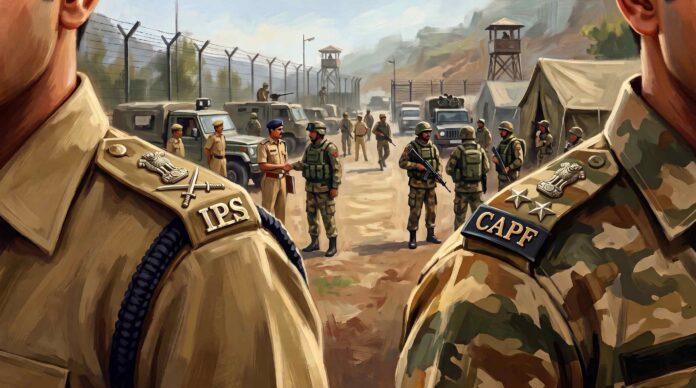
At the core of the dispute lies the historic friction between native CAPF cadre officers and Indian Police Service (IPS) officers arriving on central deputation to occupy apex command roles. The new law empowers the Centre to frame definitive rules across the CRPF, BSF, CISF, ITBP, and SSB. Significantly, the Act features a robust non-obstante clause designed specifically to insulate executive policy from judicial intervention, explicitly stating its provisions will prevail over any inconsistent court orders.
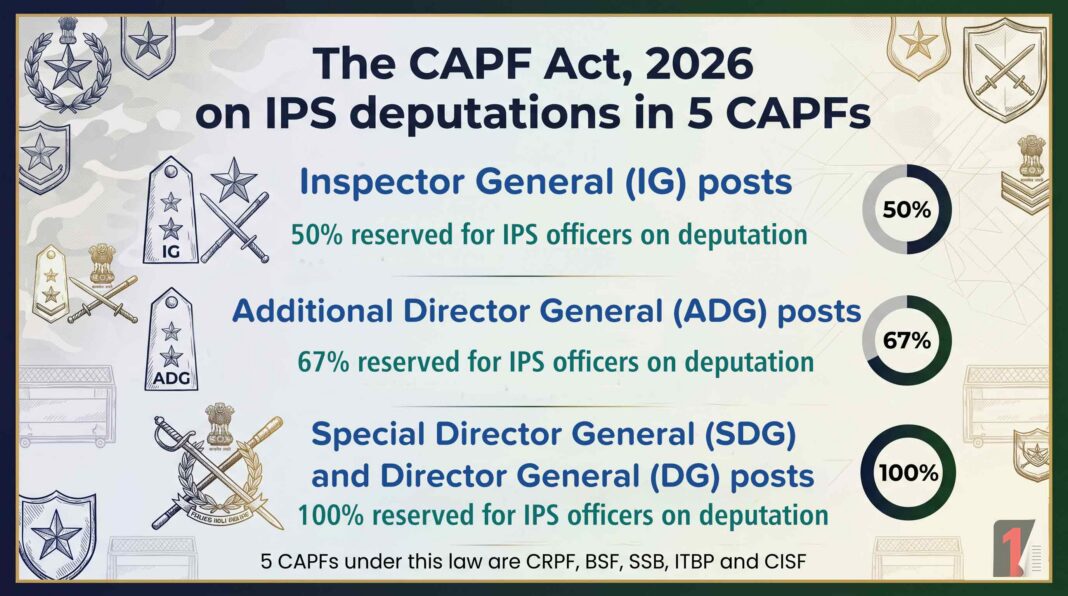
Rather than adhering to the judicial push to clear promotional pathways for native officers, the 2026 legislation statutorily locked in expansive quotas for IPS officers. The Act reserves 50 percent of Inspector General (IG) posts, 67 percent of Additional Director General (ADG) posts, and 100 percent of Director General (DG) posts exclusively for IPS officers on deputations.
These quotas translate into harsh operational realities for native cadre officers. A native officer who spends decades commanding battalions in high-altitude terrain or anti-Naxal grids can legally never rise to head their own force. While the government previously granted Non-Functional Financial Upgradation (NFFU) to address financial disparity, it entirely failed to resolve the core issue of command authority and career dignity.
Despite intense opposition, the Union Ministry of Home Affairs maintains a robust defence of the IPS deputation model. The government argues that managing the command structure of national security forces requires complex inter-agency coordination with state police and intelligence units. Because IPS officers typically serve in state cadres, they bring a vital ecosystem of state-level coordination when they assume CAPF command roles.
In a 77-page counter-affidavit submitted in October 2026, the Centre aggressively asserted its absolute legislative competence to alter the legal foundation of previous court rulings. The government maintained that the fixed deputation quotas are a non-negotiable operational necessity, arguing that Parliament was exercising its legitimate constitutional authority to define the governance of armed forces.
The ongoing litigation features a dual-pronged attack from the CAPF ranks. Officers have filed aggressive contempt petitions against the Home Ministry for failing to comply with a May 2025 Supreme Court mandate to progressively reduce IPS deputations. Simultaneously, they have mounted a comprehensive constitutional challenge against the 2026 Act itself, arguing it violates equality guarantees and attempts an unconstitutional statutory override.
Ultimately, the resolution of this standoff will establish an enduring precedent for India’s institutional architecture. If the 2026 Act is upheld, the IPS leadership model will be permanently cemented into statutory law. Conversely, if the Supreme Court strikes down the deputation quotas, it will trigger an unprecedented restructuring of India’s internal security leadership grid.
Read the full article on Chapter 1 Magazine.


