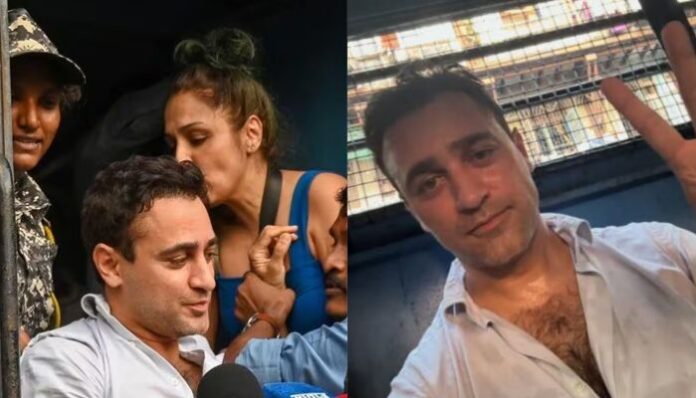
On 2nd November (Monday), actor Imran Khan tendered an unconditional apology before the Bombay High Court for joining the Cockroach Janta Party (CJP) protest against the Chief Election Commissioner Gyanesh Kumar in early October despite not being an Indian citizen. The Bombay High Court stated that Overseas Citizen of India (OCI) cardholders are not Indian citizens. However, the court granted interim relief to the actor on the Leave India notice issued by the Foreigners Registration Regional Office (FRRO).
After challenging the Leave India notice, Imran Khan tendered an unconditional apology for participating in the CJP protest
In his apology, Imran Khan said that he has no association with the organisers of the 10th of October protest and was not aware of the consequences of his participation in the protest.
The 42-year-old actor submitted that he will not participate in any political protests in India in future.
The apology came after Justice Mahesh Chandra Tripathi and Justice Advait Sethna directed Khan to submit an unconditional apology while hearing his challenge to the Leave India notice issued by the Foreigners Registration Regional Office (FRRO) after the actor’s detention in October 2026.
As Imran Khan, who is an American citizen, tendered an unconditional apology, the Bombay High Court division bench directed the FRRO to extend the Leave India notice issued against the actor.
What the Bombay High Court said
During the Monday hearing, the Bombay High Court bench observed that Imran Khan had no business joining the protest against CEC Gyanesh Kumar and Special Intensive Revision of electoral rolls, given he is an OCI cardholder and has no voting rights, let alone any supposed discrepancy in the SIR exercise affecting him.
The bench reminded the petitioner that an OCI cardholder cannot partake in protests in India and their rights are not on par with Indian citizens. It also declared that such behaviour by OCI cardholders will not be tolerated.
“Suppose you have participated inadvertently, etc then you need to apologise; without such unconditional apology we will not accept your undertaking… Because you are not even remotely affected by SIR… You have no business there… You need to understand that you as an OCI cardholder aren’t at par with Indian citizens…,” the court orally observed.
“In our order, we will say that you will give him some time to file his response… He will file his undertaking and unconditional apology etc. because (at) some point of time you will show magnanimity and say this man must live here… Considering the fact that he has been living in our country for all these years and has worked here and got recognition from here, then you must show a big heart,” the court said.
“Also, we may clarify that an OCI Cardholder cannot criticise or venture into all this by living here…this will not be tolerated…. Go to the USA and participate in protests there and you can even go and cast your vote, but you protesting anything here won’t be tolerated”
The court questioned Khan’s motive behind his presence at the anti-SIR protests in Maharashtra on 10th October. It asked Khan to make clear whether he voluntarily joined the protest or was there for some work unrelated to the protest.
“What for were you there? There’s a complete difference between the rights of citizens and OCI Cardholders… You need to clarify whether you were there for protests or for some other work? You will have to categorically make a statement that you had no association with the protests, etc. Because the agitation was with regard to SIR, with which you have no concern at all,” the court said.
Khan’s representative advocate Venkatesh Dhond stressed that his client has no association with the organisers of the 10th of October protest and went to the protest site in Mumbai ‘out of curiosity’.
However, Additional Solicitor General (ASG) Anil Singh, who represented the Centre, contended that while Imran Khan made ‘curiosity’ claims, on social media, he had “instigated people”.
The court also drew a parallel with how an Indian citizen would be treated if they joined a protest in the US.
“Imagine if an Indian citizen does such protests in any other country, take, for example, your country – the US. That Indian citizen would have been sent back to the country on the next immediate flight,” the court stated.
Moreover, the court also questioned why, if Imran Khan lived in India for most of his life, worked and married here, and even became a noted Bollywood actor here, he did not accept Indian citizenship.
“Since your childhood you have been here. Why don’t you accept Indian citizenship? You have become a Bollywood star here,” it remarked.
After hearing arguments of both sides, the court decided that the suspension of Leave India notice shall continue till the FRRO decides the matter after allowing Imran Khan an opportunity to respond to the notice.
Pertinently, the Bombay High Court reiterated that OCI cardholders have no right to participate in political protests in the same way as Indian citizens. It stated that an apology and undertaking not to participate in any protests in future should not be construed as a green signal to indulge in similar activities.
The next hearing in the matter will take place on 7th December 2026.
Imran Khan was detained and booked for participating in the CJP protest
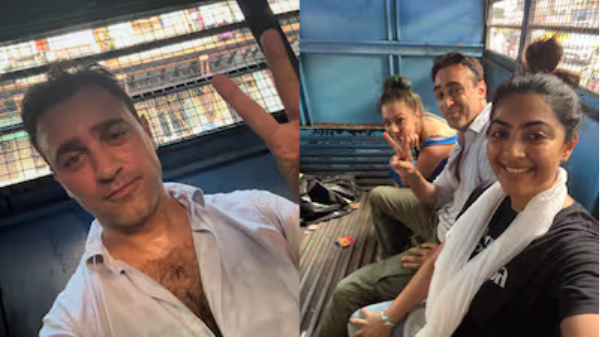
Actor Imran Khan, an American citizen who holds an Overseas Citizen of India (OCI) card, was issued a notice to leave India following his participation in the CJP protest in Mumbai’s August Kranti Maidan. His partner, actor Lekha Washington, and his cousin Zayne Marie Khan also participated in the protest.
Khan’s pictures waving a victory sign inside a police van after detention had gone viral online, suggesting that contrary to his submission in court, the actor’s presence at the protest was not out of curiosity.
Sharing the photograph of himself inside a police van on social media, accompanied by the caption: “Apparently I’m going for a drive”.
The notice, issued by Mumbai Police, invoked provisions of the Immigration and Foreigners Act, 2025, which empowers the government to regulate the entry, stay, movement and departure of foreign nationals in India.
Notably, Section 7 of the Act empowers the Central Government to issue directions governing the entry, departure, presence and movement of foreigners in the country. Section 29 specifically deals with the removal of foreign nationals from India.
Under Section 29, the Central Government can order the removal of a foreigner for violating the Act or rules and orders made under it, or based on an adverse security report. Government officers are also empowered to take reasonable measures to enforce such directions.
OCI scheme
The Overseas Citizen of India scheme was introduced in 2005. It allows eligible people of Indian origin who hold foreign citizenship to register for OCI status.
Despite its name, an OCI card does not grant Indian citizenship. OCI cardholders remain foreign nationals, although they enjoy certain privileges, including a lifelong, multiple-entry visa to India, subject to applicable rules. They are also entitled to specified benefits relating to education, property ownership and certain professional activities.
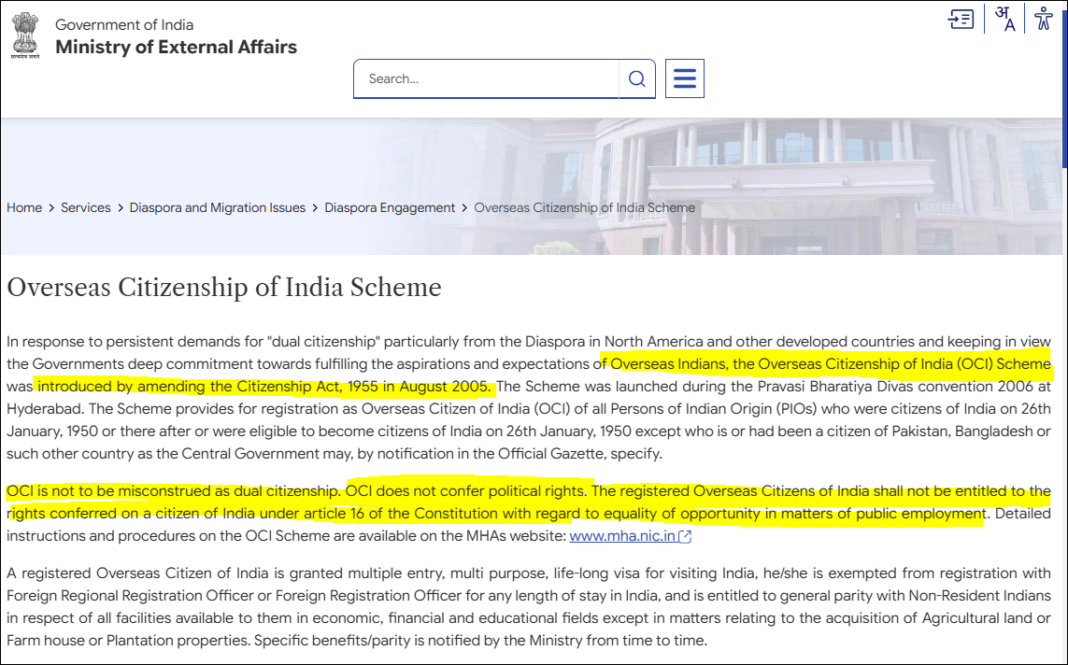
“OCI is not to be misconstrued as dual citizenship. OCI does not confer political rights. The registered Overseas Citizens of India shall not be entitled to the rights conferred on a citizen of India under Article 16 of the Constitution with regard to equality of opportunity in matters of public employment,” the Central government states.