

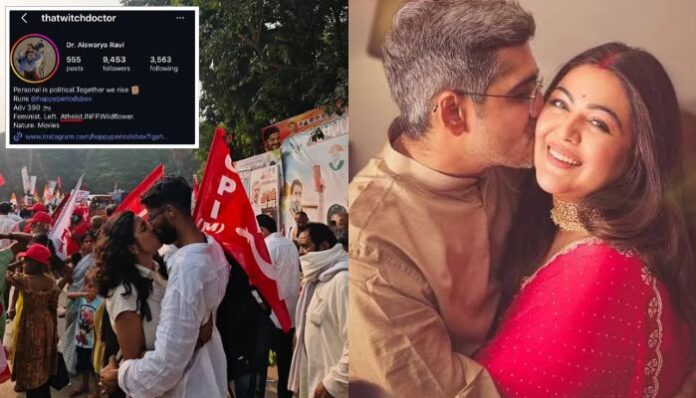
The definition of ‘revolution’ and ‘rebellion’ seems to change depending on the religious identities of the people involved, at least in the narratives promoted by leftists. A photograph of a girl kissing a Muslim man at the ‘Chalo Dilli’ rally organised at Ramlila Maidan in Delhi on Sunday, 1st November, has gone viral on social media. The photograph was soon portrayed as a symbol of ‘revolutionary love’ by leftists.
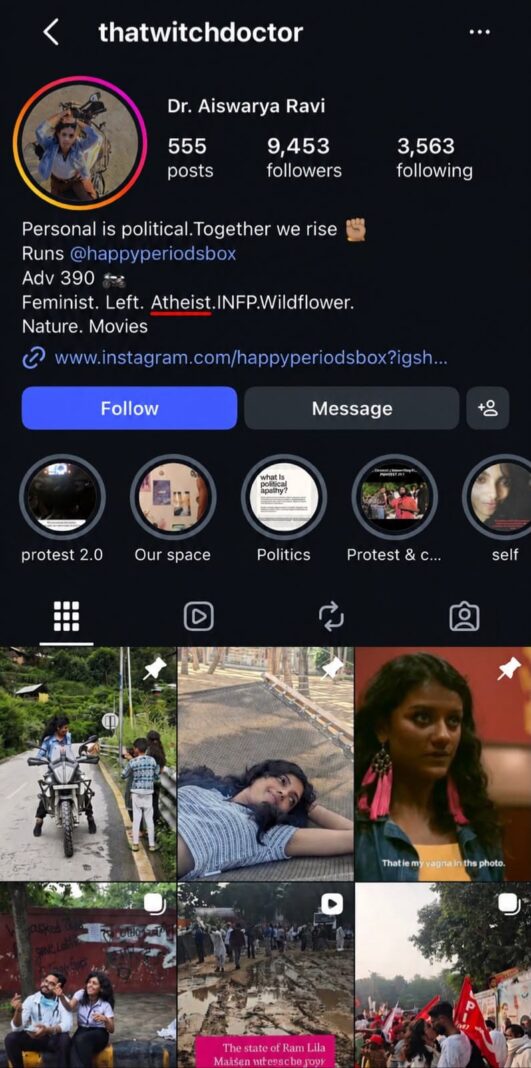
What made the incident particularly strange was the way the woman’s religious identity was repeatedly highlighted in these posts. Several users described her as a Hindu girl kissing a Muslim boy, even though the woman identifies herself as an atheist on her Instagram profile.
Atheist doctor calls herself a Hindu girl to present a kiss as ‘revolution’
The viral image was first posted on Instagram by the girl in the pic, who identified as Dr Aiswariya Ravi. She shared the photograph on her Instagram account with username @thatwitchdoctor on Sunday, 1st November, tagging the man, identified as Sabid Kabir, a CPI(M) member. Despite prominently identifying as an atheist on her profile, she deliberately framed the public act around traditional religious identities to drive home a political point.
In her caption, she wrote: “A Hindu girl kissing a Muslim guy can cause an uproar in this empire they have built. They have politicised the love we hold. They have politicised the food we eat and the way we dress. They dictate what is right and wrong and the in-betweens. And yet, here we are. Holding the same red flag they have always been against, 🚩🚩 standing for everything they are not, amid a sea of humans who call each other comrades. Love is political. Personal is political. Sanghis who come and cry ‘love jihad under our posts, please see this as a tribute to your hate. Long live rebellion. Viva Revolution.”
The photograph and the caption soon attracted attention on social media, with several leftists sharing the image and describing the kiss as an act of revolution against the RSS, BJP and what they called the politics of hatred.
One such X user, @RahulSeeker, shared the picture with a well-framed caption, “The strongest picture of today’s protest – LOVE. A Hindu girl kissing a Muslim boy in public and posting it on social media. What can be more radical than LOVE in today’s India? For the last 12 years, those RSS Sanghis dictated what to do, what to eat, whom to love. Now all that is crumbling apart. This is revolutionary. This is rebellion. Long live Revolution.”
The strongest picture of today’s protest – LOVE ❤️🔥. A Hindu girl kissing a Muslim boy in public and posting it on social media. What can be more radical than LOVE in today’s India? For the last 12 yrs those RSS Sanghis dictated what to do, what to eat, whom to love. Now all that is crumbling apart. This is revolutionary. This is rebellion. Long live Revolution. ✊🏾 Photo credit : @anaghhaanil Dr. Aishwarya Ravi
— RAHUL (@RahulSeeker) November 1, 2026
The wave of amplification continued as another X account, “Liberal and Atheist Abhilasha,” shared the image to echo the same narrative, framing the public kiss as a direct defeat of political groups, “A Hindu girl is kissing a random Muslim guy at this event, symbolising the win of love over the hate-filled politics of RSS/BJP/Bajrang Dal/VHP, etc.”
A Hindu girl is kissing a random Muslim guy at this event, symbolizing the win of love over the hate-filled politics of RSS/BJP/Bajrang Dal/VHP, etc. https://t.co/amNIxZ29jf
— Liberal & Atheist Abhilasha 🌈 (@LibAbhilasha) November 2, 2026
Similarly, another X user @Hafsa_fatimah reposted the photograph while using informal vernacular to further highlight the religious identity aspect of the pairing, “Sabid Kabeer with his Hindu Baddie.”
Sabid Kabeer ☪️ with his Hindu Baddie 🕉️. why all beautiful Hindu girls date Muslim boys? Why can’t they date Hindus? Now even Hindu girls are trapping our Muslim brothers in Bhagwa Love Trap. https://t.co/eYMTn5rKZl
— Hafsa Fatimah 🇵🇸 (@Hafsa_fatimah) November 1, 2026
Atheism for the bio, Hindu for the propaganda
A notable aspect of this viral phenomenon lies in how personal identity was conveniently adapted to build a specific political narrative. On her personal social media profile, Dr Aiswariya explicitly identifies herself as an atheist. Yet, when crafting the social media post, she deliberately shed her non-religious identity and adopted the label of a “Hindu girl.”
By doing so, both she and leftists who amplified the post converted it into propaganda. The act of public affection was celebrated as a grand act of defiance specifically because it was presented as a Hindu woman pairing with a Muslim man. This reveals a clear paradox: personal beliefs like atheism are shelved whenever taking up a traditional religious identity offers a more potent weapon for political messaging.
This selective framing exposes a broader hypocrisy within activist spaces. The idea of personal liberty and revolutionary love is passionately defended, but only when it follows a specific, politically useful direction. When the religious identities in an interfaith relationship are flipped, the loud enthusiasm for rebellion and freedom of choice suddenly turns into abuse, violence and hostility.
When a Muslim girl celebrates a Hindu festival, the ‘love is political’ slogan disappears
The public enthusiasm for breaking cultural boundaries of these leftist and so-called seculars disappears remarkably fast when a Muslim woman decides to embrace Hindu traditions or date a Hindu man. In these scenarios, the progressive commentary that usually preaches personal liberty falls silent, leaving women exposed to intense religious fundamentalism and online abuse.
A clear example of this dynamic played out on Monday, November 2nd, when television actor Shafaq Naaz was forced to publicly address a wave of online harassment. The controversy started after she posted photos of her Karwa Chauth celebrations alongside her husband, Mumbai-based businessman Zeeshan Pewekar. Dressed in a traditional red saree with sindoor and bangles, she had captioned her post, “All dressed up for the man who has seen me at my absolute worst. Happy Karva Chauth.”
Even though both Shafaq and her husband are practising Muslims, the simple act of observing a Hindu festival triggered immediate, widespread abuse from online fundamentalists who accused her of betraying her faith.
Disturbed by the hostility and abuse from Islamists, Shafaq released a video message to directly challenge the intolerance: “Honestly, it’s sad that we’re even having to discuss something like this. And this isn’t about one religion or one community. It goes for everyone. A little more respect, a little more understanding and a little less hate.”
In her video statement, she called out the extreme fragility of those attacking her personal choices and questioned the logic behind such religious gatekeeping: “How does wearing sindoor change your religion? Is your religion so fragile that celebrating another culture or its festival can shake your faith completely? What kind of logic is that? No one has any right to dictate how another person should practice their faith.”
The fact that Shafaq had to repeatedly explain that her husband was also Muslim highlights how quickly personal freedom is condemned when a Muslim woman crosses traditional boundaries. Where was the left ecosystem celebration of cultural harmony here? The silence from self-proclaimed progressives during her ordeal made it clear that their support for personal choice depends entirely on who is making that choice.
Neha Fathima’s relationship with a Hindu contestant becomes a family controversy on Bigg Boss Malayalam.
This aggressive policing of Muslim women is not limited to social media comments; it actively spills over into mainstream media and public life. A striking instance occurred recently during Season 8 of Bigg Boss Malayalam, where contestant Neha Fathima confessed her feelings for her Hindu co-contestant, Tashi Raj (alias Santhosh).
Rather than allowing her to navigate her personal life independently, the show took an unusual intervention. Neha’s parents made an unexpected visit to the stage ahead of the standard ‘Family Week’ specifically to pressure her into quitting the show.
During a confrontation broadcast to millions, her mother emotionally targeted her decision to open up on camera and asked, “Neha, do you remember us? We don’t think you do. Everyone in the house is playing games, but you’re just hanging on to your emotions. You’re being used by others for their own purposes… We’re the ones who are feeling 100 per cent of the pain.” The episode brought Neha’s relationship with Tashi and her family’s objections into the spotlight.
Comment Your Opinion on This ‼️‼️‼️‼️🤐 https://t.co/tiqwpYNTni
— Kerala Box Office (@KeralaBxOffce) November 1, 2026
Sara Ali Khan faces a fatwa over her visit to Kedarnath Temple
The issue of religious freedom becomes even more evident in the case of Bollywood actor Sara Ali Khan, who has repeatedly faced criticism from Muslims for visiting Kedarnath Temple and participating in Hindu religious festivities.
Recently, Maulana Mufti Shahabuddin Razvi Barelvi, national president of the All India Muslim Jamaat, issued a fatwa against her for visiting the Kedarnath Temple. The cleric publicly condemned her prayers as a grave sin under Sharia law, stating, “For any Muslim, whether a man or a woman, to participate in the faith of another religion, offering prayers and performing religious rituals, is considered impermissible (najayaz). Such actions are not allowed.”
#WATCH | Bareilly, Uttar Pradesh: All India Muslim Jamaat National President Maulana Shahabuddin Razvi Barelvi says, "I have received information, and many young Muslims have also asked me regarding actress Sara Ali Khan visiting the Kedarnath Temple and offering prayers. Is this permissible in light of Sharia, and does Sharia allow for such actions? Regarding this, I would like to clarify the perspective of Islamic Sharia and what its ruling is on this matter. For any Muslim, whether a man or a woman, to participate in the faith of another religion, offering prayers and performing religious rituals, is considered impermissible (najayaz) under Sharia. Such actions are not permitted… Therefore, if Sara Ali Khan performed these acts—visiting the Kedarnath Temple, offering prayers, and seeking blessings—of her own free will and volition, then she has committed a sin—an act that is haram…"
— ANI (@ANI) October 30, 2026
This is not the first time Sara has faced criticism for visiting Hindu temples. In 2023, her visit to a Shiva temple in Lucknow with actor Vicky Kaushal and her pilgrimage to Kedarnath attracted hostile reactions from Islamist social media users. Some accused her of committing ‘shirk’, while others questioned her religious identity and asked her to read the Quran.
In 2024, her Ganesh Chaturthi greetings also attracted derogatory comments, abusive remarks and demands for her excommunication from Islam.
Sara Khan faces backlash for marrying Hindu actor Krish Pathak
Another example of online hostility towards Muslim women exercising their personal choices emerged last year when television actor Sara Khan, known for her role in Sapna Babul Ka… Bidaai, faced trolling after marrying Hindu actor Krish Pathak.
Trolls flooded her social media with threats and insults for marrying a Hindu man. In a courageous video response, Sara Khan stood up to the Islamists by emphasising mutual respect: “Krish and I belong to different cultures, but we believe both our religions taught us love. Our families taught us to respect others first and not to hurt anyone… Please learn that any religion does not teach you to put down any other religion or beliefs or disrespect anyone… Any relation with My God is mine, completely mine.”
Hindu men assaulted for being seen with Muslim women
The double standard reaches its most dangerous level on the ground, where Hindu men face severe physical violence, mob harassment, and false accusations simply for being seen in public with Muslim women. While leftists quickly label any Hindu opposition to interfaith relationships as oppression, they consistently turn a blind eye when violent Islamist mobs enforce their own strict religious segregation.
A terrifying example occurred in December 2023 in Davanagere, Karnataka, when a 26-year-old Dalit man named Srinivas gave a lift to a 17-year-old Muslim classmate wearing a hijab. A mob of nearly twenty Islamists intercepted them, dragged Srinivas away, locked him in a banquet hall, and beat him within an inch of his life before dumping his unconscious body in a secluded field. A viral video recorded by the attackers showed them physically intimidating the teenage girl, attempting to forcibly strip off her hijab, and demanding her family’s contact details while violently assaulting Srinivas.
BIG: A young Dalit Hindu man, Srinivas mob lynched by 18-20 radical Islamists for riding a bike with a Muslim girl in Congress led Karnataka The Islamists also molested the girl, they were seen forcefully removing the Burqa in the video Islamists took the Dalit man to Shadi Mahal in Davanagere & brutally assaulted him throughout the night. The next morning, they transported him in a car and left him in an unconscious state in a secluded place Srinivas is undergoing treatment in a critical condition. The police have registered a case under IPC section 143 (unlawful assembly), 147 (rioting), 323 (voluntarily hurt), 307 (attempt to murder) of IPC, and the SC/ST Act against the accused The police have detained one and identified other accused Meanwhile, the girl’s mother filed a case of gang-rape & POCSO against Srinivas at Women’s police station Further investigation is ongoing. The case pertains to Basavanapura police station area of Karnataka (Join me on Telegram 👇 as well for the news updates. https://t.co/quAcafbrNA )
— Ashwini Shrivastava (@AshwiniSahaya) December 14, 2023
A similar violent confrontation took place in May 2023 at an eatery called Gopika Chaats in Chikkaballapur, Karnataka. A young Hindu man was publicly thrashed by an Islamist mob simply for sitting down to share snacks with his Muslim classmate. Even though the Muslim woman bravely tried to protect him and explained to the crowd that they were just friends, the mob refused to stop the violence and later pressured her family into forcing her to issue a public apology.
Karnataka: A group of Muslim men allegedly harass a woman for an outing with a male friend from the Hindu community in Chikkaballapur "The woman confronted them & even approached the police but was later forced by her family to issue an apology," @NehaHebbs reports. https://t.co/kTlXZnssmZ
— TIMES NOW (@TimesNow) May 26, 2023
This pattern of street-level intimidation is widespread. Near the Bareilly Junction railway station in Uttar Pradesh, a mob barged into a hotel room to interrogate and harass a Hindu man simply because he was staying in the same establishment as a Muslim woman.
In another viral video shared by radical accounts online, a Muslim mob surrounded a Hindu man riding a motorcycle, forcibly pulled off his helmet, and intimidated the burqa-clad woman riding with him while hurling religious slurs at the man.
Conclusion
The photograph of Dr Aiswariya Ravi and Sabid Kabir has once again brought the selective use of religious identity for narrative building and spreading propaganda. The hypocrisy of the left’s definition of “revolutionary love” becomes impossible to ignore. When an atheist woman uses a Hindu label to post a picture with a Muslim man, the leftists label it as a brilliant act of secular defiance and rebellion.
However, the moment a Muslim woman exercises the same freedom of choice, whether by observing Karwa Chauth, visiting a Hindu temple, marrying a Hindu partner, or simply sharing a ride with a Hindu friend, the rhetoric around “freedom” completely vanishes. In those moments, progressive voices go silent, leaving conservative mobs and Islamists to enforce their rules through harassment and violence. This selective outrage proves that for these activists, love is not actually about individual liberty; it is merely a political tool to be praised when convenient and ignored when it breaks their narrative.


