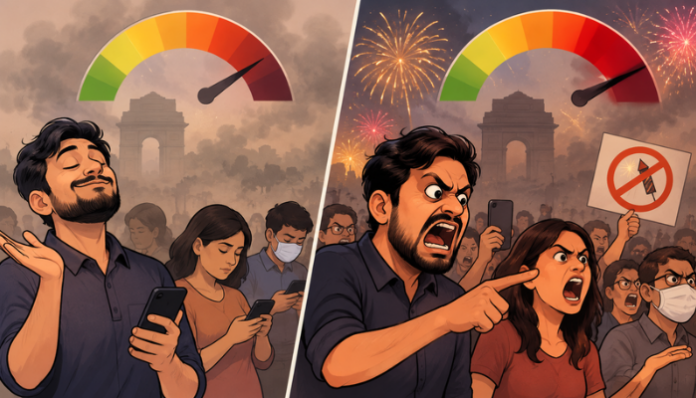
Diwali night has barely passed, and the familiar post-Diwali ritual has begun. A chorus of left liberal commentators, environmental ‘activists’, and opposition politicians has taken to social media to blame firecrackers for Delhi’s hazardous air. But a closer look at the data from the days leading up to the festival reveals an inconvenient truth for this annual outrage industry.
Delhi’s air was already in the “very poor” category, with an Air Quality Index (AQI) above 300. Days before, not a single lamp was lit, nor was a single cracker burst. The selective fury over Diwali is not environmentalism; it is hypocrisy dressed up as concern.
The Pre-Diwali data that cannot be ignored
The narrative that Diwali alone pushed Delhi into a pollution emergency collapses under the weight of official data for 2026. Diwali this year fell on Sunday, 8 November, because of Adhik Maas. But the air quality had already begun its precipitous decline in the first week of November.
On Monday (2nd November), six full days before the festival, Delhi’s AQI crossed the 300 mark for the first time in the post-monsoon season, reaching 307 at 7:05 am, according to real-time data from the Central Pollution Control Board (CPCB). By 9 am, it had climbed to 312, and by 10 am, it stood at 314.
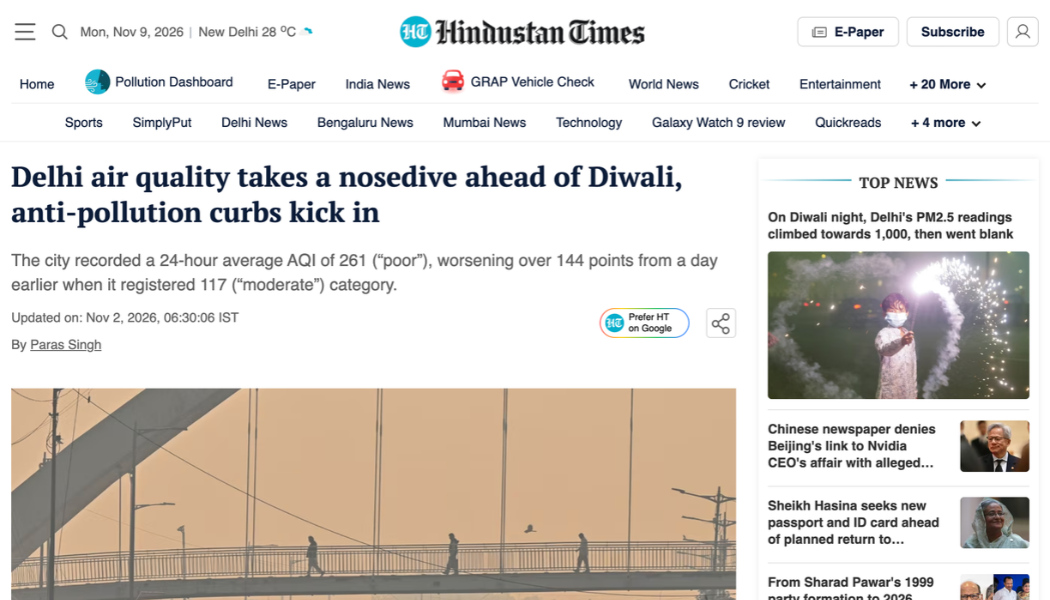
India Today reported that Jahangirpuri recorded an AQI of 420, placing it in the ‘severe’ category, while Rohini and Punjabi Bagh reported 399 each. Of the 58 monitoring stations across Delhi, 36 were already in the ‘very poor’ range on that single morning. The Hindustan Times noted that the city had recorded a 24-hour average AQI of 261 (‘poor’) on Sunday 1 November, worsening over 144 points from a day earlier, with forecasts warning of further deterioration into the ‘very poor’ category in the second half of the week.
The situation did not improve. By Friday, 6 November, two days before Diwali, Delhi’s air quality had plunged to near-severe levels, with the 24-hour average AQI hitting 382. It is the worst pre-festive air quality crisis in eight years. The Indian Express reported that PM 2.5 concentrations peaked at around 280 µg/m³ in the 30 to 45 hours leading up to Diwali, the highest pre-festival particulate baseline recorded since 2019.
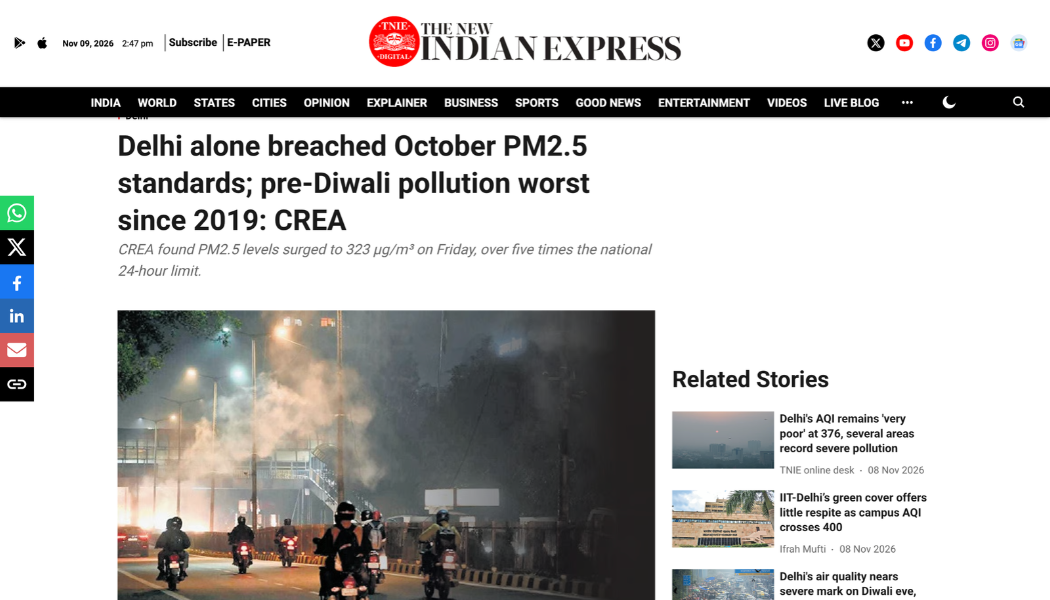
Previous years typically saw fine particulate levels drop to 50-150 µg/m³ during this corresponding window. The New Indian Express, citing an analysis by the Centre for Research on Energy and Clean Air (CREA), reported that PM2.5 levels surged to 323 µg/m³ on Friday, 6 November, over five times the national 24-hour limit. The analysis found that Delhi’s AQI had remained in the ‘very poor’ category for four consecutive days, standing at 369 on Thursday, marginally better than Wednesday’s 377, and 350 on Tuesday. By Saturday, 7 November, the day before Diwali, the city’s average AQI was 369, with several monitoring stations recording readings above 400.
The IIT-Delhi station recorded an AQI of 452, Punjabi Bagh 439, and Jahangirpuri 428. The Urban Acres reported that this was the worst Diwali-eve AQI in a decade, higher than every year since CPCB began measuring the index in 2015, except 2016. Even on Diwali day itself, the CPCB recorded Delhi’s average AQI at 376, placing the city in the ‘very poor’ category.
The usual selective outrage
Despite this overwhelming evidence, the post-Diwali period has become a season of performative outrage. psudo Liberal commentators and environmental activists suddenly discover a passion for clean air. Most of them are silent for the other 360 days of the year. According to them, if only Hindus would stop bursting crackers, Delhi’s air would be pristine.
In an X post, Pseudo-liberal journalist Rajdeep Sardesai wrote, ” SOS! WAKE UP CALL! Day after Diwali, AQI in South Delhi has breached the ‘SEVERE’ category in several parts of the city. A top ENT surgeon warns that living in Delhi could be taking 10 years off your life!
As crackers burst through the night in brazen violation of court orders, with enforcement conspicuous by its absence, the question is: DO WE CARE ENOUGH? IS ANYONE ACCOUNTABLE?”
SOS! WAKE UP CALL! Day after Diwali, AQI in South Delhi has breached the ‘SEVERE’ category in several parts of the city. A top ENT surgeon warns that living in Delhi could be taking 10 years off your life! As crackers burst through the night in brazen violation of court orders, with enforcement conspicuous by its absence, the question is: DO WE CARE ENOUGH? IS ANYONE ACCOUNTABLE? And let’s be clear: protecting public health is NOT an intervention in a Hindu festival. Celebrating Diwali and enforcing pollution norms are NOT mutually exclusive. Why should the right to celebrate come at the cost of the right to breathe?😡
— Rajdeep Sardesai (@sardesairajdeep) November 9, 2026
Targeting Hindu festivals, He further wrote, “Let’s be clear: protecting public health is NOT an intervention in a Hindu festival. Celebrating Diwali and enforcing pollution norms are NOT mutually exclusive. Why should the right to celebrate come at the cost of the right to breathe?”
Before blaming Hindus and Diwali for the pollution. Rajdeep should read his own organisation, the New Indian Express‘ article titled “Delhi alone breached October PM2.5 standards; pre-Diwali pollution worst since 2019.” In which the indian express have stated that the situation in Delhi was already poor even before Diwali.
In the series of hypocritical meltdowns, Aam Aadmi Party politician Dr Shelly Oberoi comes next. In a post on X, in which he posed before the camera with an oxygen cylinder in an overly dramatic manner, she wrote, ” Poison has dissolved in the air of Delhi. AQI has reached dangerous levels and the threat to people’s health is increasing with every breath. After all, for how long will the people of Delhi be forced to breathe this poisonous air?”
At Present दिल्ली की हवा में ज़हर घुल चुका है। AQI खतरनाक स्तर पर पहुँच चुका है और हर साँस के साथ लोगों की सेहत पर खतरा बढ़ रहा है। आखिर दिल्ली की जनता कब तक इस जहरीली हवा में साँस लेने को मजबूर रहेगी? BJP सरकार को जवाब देना होगा। सिर्फ बयानबाज़ी नहीं, प्रदूषण पर ठोस कार्रवाई चाहिए। दिल्ली को साफ हवा चाहिए, खोखले दावे नहीं! सोचो बच्चों और बुज़ोर्गो का क्या हाल हो रहा होगा!
— Dr. Shelly Oberoi (@OberoiShelly) November 8, 2026
According to her, the BJP government must provide an answer to pollution. She posted a screenshot of an AQI of 1702, which is bizarrely insane. If you check Delhi’s current AQI, it will be between 300 and 350, which is equivalent to pre-Diwali. She forgets that she was the mayor of MCD during the AAP government and was unable to counter pollution during her tenure.
AAP politician Saurabh Bharadwaj made a bizarre claim on X that the AQI of Delhi has crossed 3000, which is total nonsense. One Twitter handle by the name @CA_AKASH_PAL has called out Saurabh for his fake claim. The user wrote ” I also live in Delhi you liar. Still you don’t understand why we have thrown you idiots out from Delhi. Don’t worry same fate will follow in PUNJAB and rest of India. You are corrupt bakchods who just lie all the time instead of working.”
AQI 3000 paar. Full credit to these brothers who raised pollution beyond 3000. https://t.co/iN7EeEaSrd
— Saurabh Bharadwaj (@Saurabh_MLAgk) November 8, 2026
A user named @caleb_friesen wrote on X, targeting Diwali: ” Post-Diwali AQI in Aizawl, Mizoram is 56 right now. Didn’t hear a single cracker or firework last night. My wife, two kids and two dogs slept peacefully. Our lungs are happy. But he forgets that during New Year, Chapchar Kut and Christmas, Mizos do burst crackers. The only reason Aizawl’s AQI is clean because it does not have any industrial factories. Apart from that, due to its geographical location, Aizawl experiences rainfall throughout the year, which helps in reducing pollution.
Post-Diwali AQI in Aizawl, Mizoram is 56 right now. Didn’t hear a single cracker or firework last night. My wife, two kids and two dogs slept peacefully. Our lungs are happy. https://t.co/CObbyFEVxY
— Caleb (@caleb_friesen) November 9, 2026
This narrative is not just misleading; it is deeply hypocritical. The same voices that demand a ban on Diwali firecrackers rarely, if ever, call for restrictions on the vehicles that contribute nearly 20 per cent of Delhi’s pollution, or on the industrial units and construction sites that operate with impunity year-round, or on the stubble burning that, according to CREA, contributed up to 16 per cent of Delhi’s PM2.5 on 4 November, even before the festival. They do not march against the systemic failures that keep Delhi’s air toxic from October to February. They march against a Hindu festival.
The hypocrisy of the “Green” elite
There is a deeper hypocrisy at play. Many of the loudest critics of Diwali firecrackers are urban. They are the very people whose lifestyles contribute disproportionately to Delhi’s pollution. They drive diesel-guzzling SUVs, live in air-conditioned homes powered by coal-fired electricity, and jet off for weekend getaways. Yet they lecture the poor and middle classes about the environmental cost of a few hours of celebration. “Happy Diwali, but no fireworks” has become a “classic urban (diesel-guzzling), secular-liberal hypocrisy”.
This is not to deny that firecrackers contribute to air pollution. But to frame firecrackers as the primary cause of Delhi’s air crisis is a deliberate distortion. The air was already “very poor” on 4,5 and 6 November. The festival did not create the crisis. The so-called environmentalists ignore the vehicles, the industry, the construction dust, and the stubble burning and engage in a form of environmentalism that is more about signalling virtue than solving problems.
The annual post-Diwali pile-on is not environmental journalism. It is a cultural reflex. The same commentariat that finds structural explanations for every other pollution source suddenly discovers moral clarity when Hindus light diyas. The same commentators who can write learned essays on vehicular emissions and construction dust reduce the entire crisis to firecrackers once the festival is over. This is not concern for public health. It is selective outrage against Hindus dressed up as environmentalism.
The evidence of their hypocrisy is not in the AQI data alone; it is in the timing of the outrage. If the concern were genuinely about air, the protests would have begun on 2 November, when the AQI was already 307. If the concern were genuinely about health, the commentary would focus on the 21 days in October when PM2.5 exceeded national standards. If the concern were genuinely about systemic change, the critics would be demanding action on stubble burning, vehicular emissions and construction dust all year round. Instead, the outrage arrives on cue after Diwali, targets a Hindu festival, and disappears once the headlines fade.