

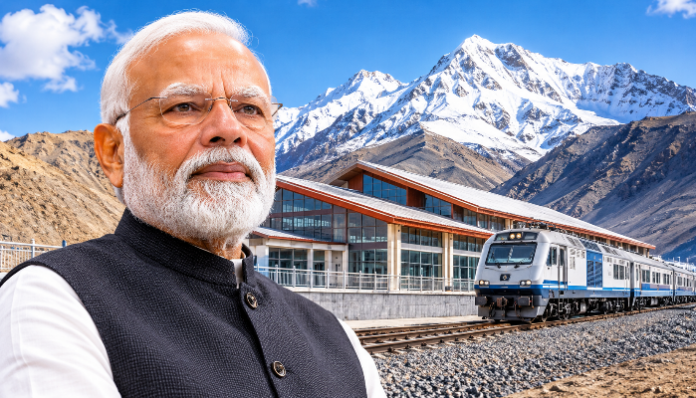
India is poised to create a railway marvel that could stand in a league of its own and set a global benchmark. The Modi government’s ambitious goal to expand railway connectivity to Ladakh could put the nation on the world railway map, reported The Times of India.
The Ministry of Defence has designated the proposed Bilaspur-Manali-Leh railway line as a vital project which will connect Himachal Pradesh with Ladakh via some of the most arduous Himalayan terrain. At a height of over 5,200 metres above sea level, it will become the highest railway station in the world, surpassing Tanggula in China, if things move ahead as planned.
The 489-kilometre broad-gauge line is going to traverse key locations such as Bilaspur, Sundernagar, Mandi, Manali, Sissu, Darcha, Keylong, Sarchu, Pang, Rumtse, Upshi, and Kharu before ending in Leh. The railway ministry stated that the initiative’s Detailed Project Report (DPR), which pegged the estimated cost at around Rs 1.31 lakh crore, has been put together and the survey has concluded.
The envisioned railway station beneath the Tanglang La pass is one of the most notable aspects of the suggested corridor. The station will exceed China’s Tanggula railroad station on the Qinghai-Tibet Railroad, which presently holds the record at about 5,068 metres, by almost 188 metres, with an elevation of nearly 5,256 metres or 17,244 feet above sea level.
Tanglang La, one of the highest motorable mountain passes in India, is situated on the Manali-Leh highway in Ladakh. However, the technical challenges of building railway infrastructure in this area are very different from those of building a road.
It is believed that the railway line will have 270 kilometres of tunnels. This implies that over half of the route would pass through the Himalayan mountain range underground. The path will have to navigate tough geological formations, steep grades, high-altitude terrain, and severe weather. The Himalayan stretch’s geological uncertainty and construction difficulties have been brought to light by the railway ministry itself.
The effort would offer an alternate railway communication corridor to Ladakh, an area crucial to India’s security infrastructure, making it strategically significant as well. Road and air connectivity is the primary means of reaching Leh from the rest of the country. Although the Manali-Leh highway is an important road, weather and high-altitude sections can make travel difficult, especially in the winter.
For passengers, cargo, and logistical needs, a railway connection could serve as an extra mode of transportation. The potential to enhance the flow of equipment and supplies into the area is another factor contributing to its strategic relevance. It will greatly cut the expense of delivering food supplies, building materials, and daily necessities into Ladakh’s frigid desert. It will also contribute to local economies and job generation and provide stable, reasonably priced travel to isolated sections of Himachal Pradesh and Ladakh.
On the other hand, the line will reportedly enable timely, large-scale delivery of troops, weapons, fuel, and heavy military equipment to the 14th Corps headquarters and advanced locations in Ladakh. The alignment could include military loop wires at route stations to improve deployment and emergency response capabilities.
This project is a 489-km, broad-gauge strategic infrastructure project in India designed to connect the plains of Punjab and Himachal Pradesh directly to Leh in Ladakh. Current road routes like the Manali-Leh highway and air supply lines face severe disruptions during winter due to heavy snowfall, avalanches, and extreme weather. The railway provides a reliable, year-round corridor for sensitive border regions. Air and road transport cannot match the volume of a heavy rail corridor. The line also will facilitate the rapid, high-capacity transport of heavy military equipment, fuel, weapons, and troops to the 14th Corps headquarters and forward areas in Ladakh. The alignment incorporates dedicated military loop lines at route stations to streamline deployment and emergency response capabilities. Identified as a strategic corridor by the Ministry of Defence, it cements logistical independence along sensitive northern borders and features plans for a station near Tanglang La (approx. 5,256 to 5,359 meters) that will surpass China’s Tanggula station as the world’s highest railway station. It drastically lowers the cost of moving essential daily commodities, food supplies, and construction materials into the cold desert region of Ladakh. It opens up remote parts of Himachal Pradesh (such as Sundernagar, Mandi, Manali, Keylong, and Sissu) and Ladakh to affordable, steady passenger travel, boosting local economies and job creation. Spanning 489 km with nearly 270 km of tunnels across fragile Himalayan and seismic zones (IV and V), it marks a transformative leap in high-altitude civil engineering for India. While the Detailed Project Report (DPR) and Final Location Survey are complete at an estimated cost of ₹1.31 lakh crore, the project still awaits final institutional sanctions and faces regional land-acquisition challenges. #IndianRailways #projects
— Ananth Rupanagudi (@AnanthOnTrack) November 6, 2026
However, requisite construction approval has not yet been obtained. There is no set completion date for the corridor either, which will command substantial financial commitment, thorough evaluations, and clearances.
How the Modi government transformed India’s railway connectivity
Railway connectivity in India has undergone a critical transformation since the Modi government came to power, with sustained efforts to strengthen the railway network and take it to every corner of the country, including remote, hilly, border and previously underserved regions.
This development has brought distant communities closer to major cities, improved access to education, healthcare and employment opportunities, and made travel more accessible for people even living in far-flung areas.
The scale of this growth is reflected in the commissioning of 34,428 kilometres of new railway tracks between 2014 and 2025, more than twice the 7,599 kilometres added between 2009 and 2014. The railway network has also reached previously neglected parts through landmark projects such as the Udhampur-Srinagar-Baramulla railway line in Jammu and Kashmir and the Bairabi-Sairang railway line in Mizoram.
54,600 kilometres of railway rails were renewed between 2014 and 2026, and by February there were over 85,000 kilometres (more than 80% of the network) of track that could accommodate speeds of 110 kmph and higher, up from 31,445 km (40% of the network) in 2014, making train operations faster and more efficient.
In 2019, the Modi government also introduced the Vande Bharat Express, India’s first semi-high-speed train, which was manufactured domestically to mark a key step toward modern, comfortable, and technologically advanced rail travel under the “Make in India” program. The service gradually made its way to different parts of the country and brought a new dimension to railway connectivity, making journeys quicker and more convenient for the people.
This progress in railway infrastructure has opened up new possibilities for regions such as Jammu and Kashmir and the Northeast, which once faced formidable geographical and other barriers that long hindered rail links with the rest of the nation. However, these obstacles have now been overcome, ushering in an unprecedented fresh chapter in railway connectivity under the Modi government.
Sikkim, which had remained outside India’s railway network, is also set to gain rail connectivity through the Sevoke-Rangpo railway line under the Modi government. Similarly, Kashmir Valley was linked to India through the railway network last year. In fact, the Modi government even declared a railway link between India and Bhutan, reflecting the broader connectivity aspirations, which are also being used to foster diplomatic ties.
Meanwhile, nearly 99.6% of the broad-gauge network has been electrified, marking another pivotal milestone in railway modernisation. Only around 20% of India’s railroads were electrified prior to 2014, which reduced operational effectiveness and escalated the demand for diesel fuel. India also achieved the distinction of becoming the only country to have a fully electrified Dedicated Freight Corridor (DFC).
Prime Minister Narendra Modi dedicated the final three sections of the Western Dedicated Freight Corridor (WDFC) to the country in September, approximately twenty years after India approved the endeavour.
The Indian National Congress-led United Progressive Alliance (UPA)-I government, headed by late Prime Minister Manmohan Singh, sanctioned the two corridors in 2006, and the Dedicated Freight Corridor Corporation of India Limited (DFCCIL) was awarded the responsibility to carry them out.
However, the project, which remained plagued by repeated delays brought on by issues with land acquisition, contract problems, and construction difficulties, was only completed after the Modi government took office.
PM Modi also emphasised that the push to electrify the railway network has contributed to a decrease in oil consumption and reliance on imports, particularly during turbulent times like the current US-Iran dispute, which sparked uncertainty in global energy supply chains. He made the statement while addressing the Lok Sabha in March. He conveyed that India’s energy security has become more secure because of structural changes implemented during the previous ten years.
India’s energy sector has benefited measurably from the switch to electric traction. In 2024–2025, railway electrification lowered the need for crude oil imports and saved about 180 crore gallons of diesel. In comparison to diesel traction, electric traction is roughly 70% more cost-effective and environmentally friendly. Diesel consumption has been progressively declining, which has saved Rs 6,000 crore.
Conclusion
India is already home to the world’s highest railway arch bridge, the Chenab Rail Bridge, built over the Chenab River in Jammu and Kashmir. Standing 1,178 feet above the river, the bridge is approximately 35 metres taller than the iconic Eiffel Tower in Paris. It was inaugurated by PM Modi last year and exemplifies India’s engineering prowess along with its resolve to take railway infrastructure to untouched heights.
The successful completion of the highly anticipated Bilaspur-Manali-Leh railway line would add another remarkable feat to this record, taking a major leap in connectivity while adding another historic achievement to the legacy of Indian Railways and leaving an indelible mark on the history of global railway infrastructure.


