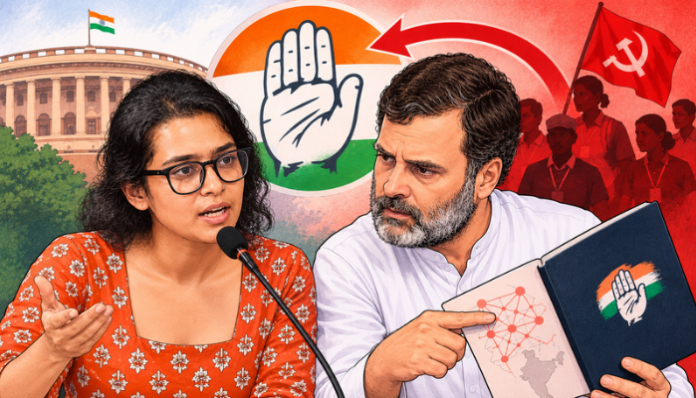
The recent visibility of AISA leader Neha Bora alongside Rahul Gandhi, and the Congress’s decision to give former CPI-linked student leader Kanhaiya Kumar a role in the NSUI, have revived a long-running debate inside and outside the party: why does the Congress repeatedly promote Left-background figures while its own student organisation, the NSUI, appears to be sidelined?
The debate intensified when Neha Bora emerged as a prominent face during the recent CJP protests. Bora is the national president of the All India Students’ Association (AISA), which is associated with CPI(M-L). Yet, she appeared on a Congress platform with Rahul and Priyanka Gandhi. Kanhiya Kumar, formerly associated with the CPI’s AISA, joined the Congress. He was made in charge of the National Students’ Union of India (NSUI), the student wing of the Congress. Many NSUI workers are uncomfortable with the move and ask why outside Left leaders are being given space instead of strengthening the party’s own student wing.
The Kumaramangalam thesis
Congress’s history suggests that the relationship between the Congress and the Left is neither new nor one-sided. It dates back to the freedom movement and has recurred through several phases: the Nehru era, the 1969 Congress split, the Emergency, the 2004 UPA government and the present day.
The most cited document in this context is “Communists in Congress: Kumaramangalam’s Thesis“, published in 1973. It was based on a confidential document prepared in 1964 by Mohan Kumaramangalam. He was a CPI leader who later joined Indira Gandhi’s Congress and became a Cabinet minister for steel and mines. He died in a plane crash in 1973.
Kumaramangalam’s argument was that the Congress had a mass base while communists had ideology. If communists entered the Congress and sharpened its pro-poor slogans, they could turn the party leftward from within. The thesis described communists as a “Trojan horse” inside the Congress, entering the party, borrowing its radical language and capturing it from within. The account notes that this strategy was not a conspiracy theory but a documented part of the CPI’s thinking.
The broader history begins in the 1930s, when communists tried to shape the Congress as an “anti-imperialist people’s front.” CPI documents praised Jawaharlal Nehru because he was influenced by the Soviet model. Nehru himself wrote in his autobiography that he was drawn to socialism and communism. Yet when in power, Nehru used the Army to crush the communist armed struggle in Telangana and dismissed the elected communist government in Kerala in 1959. The account describes this as a dual approach: attraction to the Left, but also control over it.
The 1969 Congress Split and the Emergency
The 1969 Congress split is presented as the clearest example of the pattern. The “Syndicate,” including leaders such as K. Kamaraj, Morarji Desai and S. Nijalingappa, sought to control Indira Gandhi.
Indira allied with the Young Turks and the Left, splitting the party into two. She nationalised banks and abolished privy purses. The CPI backed her through its “unity and struggle” line. Kamaraj, who had helped make Lal Bahadur Shastri prime minister in 1964 and Indira prime minister in 1966, was later sidelined along with Morarji Desai. Desai later became prime minister under the Janata Party, but the Congress never brought him back.
During the Emergency from 1975 to 1977, the CPI supported Indira Gandhi. The account states that the CPI was the only major opposition party whose leaders were not jailed, and that a common joke at the time was “Dange(r) for the Congress,” referring to CPI founder S.A. Dange. The CPI later admitted it had made a mistake, but its support at the time was full.
During the Emergency from 1975 to 1977, the CPI supported Indira Gandhi. Soviet Union called it the “crackdown against the right wing”. Later, the CPI admitted it had made a mistake, but its support was full at the time.
Sidelining internal leaders
The account also recalls the case of Sardar Vallabhbhai Patel. In 1946, Patel had more support in the Provincial Congress Committees, but Mahatma Gandhi chose Nehru. Patel served as deputy prime minister and home minister, but differences remained with Nehru on economic policy, Kashmir and China. Patel was pragmatic and warned of the China threat in 1950, which Nehru dismissed. Patel nevertheless remained a Congress leader.
Congress’s pattern has been to sideline strong internal leaders who are not from the Left or the family line. They give space to those who come from the Left or speak its language. This pattern continues today.
The example includes Jyotiraditya Scindia, a strong Madhya Pradesh leader who helped the Congress win the 2018 Assembly elections. But he was sidelined, and the party high command preferred Kamal Nath. Scindia left the Congress in 2020 and joined the BJP.
Himanta Biswa Sarma was one of the Congress’s most powerful leaders in Assam. He left in 2015 after feeling ignored by the high command and later became the BJP’s most effective face in the Northeast. Himanta was not a leftist either. He possessed an excellent ability to manage an organisation and had a deep understanding of regional politics. Instead of bringing him along, the Congress party prioritised central control.
Sachin Pilot, a young face in Rajasthan who contributed to the 2018 victory, clashed with Ashok Gehlot. But the high command backed Gehlot. Pilot rebelled but did not fully leave the party. It is an open secret that he remained in the Congress out of necessity. Leaving the party would have jeopardised their political future, or perhaps long-standing ties, both personal and organisational, held him back. Yet, within the Congress system, such leaders are repeatedly required to prove their loyalty to the family.
Jitin Prasad and R.P.N. Singh also left. They were not supporters of any communist or socialist ideology. They were pragmatic leaders who were focused on regional or organisational matters. Instead of accommodating them, the Congress party either prioritised the Gandhi family loyalists or provided a platform to new faces with a leftist background.
The 2004 UPA government and present-day parallels
The 2004 UPA government is another example. Left parties supported the Congress-led government. They defeated Atal Bihari Vajpayee. At the time, the Congress did not have a strong national leader. But they formed a government with Left support. The Left later withdrew support over the nuclear deal, but by then the pattern was clear: the Congress needed the Left’s support to gain power.
The conclusion is that both sides used each other. Communists knew the Indian public would not directly elect a communist party, so they sought entry into a large party like the Congress. The Congress gave them space because it needed Left language and support to win elections. In the process, the Congress lost capable internal leaders such as Patel, Kamaraj and Desai.
As the Congress again looks towards Left student leaders, the question raised by the account remains: is this repeated pattern strengthening the party or weakening it? History, it says, has already answered. The question is whether the Congress is willing to listen.