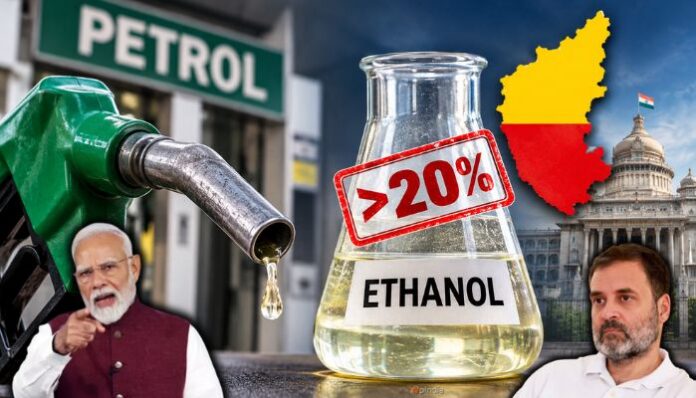
Days after the Congress government in Karnataka alleged high ethanol levels in petrol samples, citing third-party test results on samples collected by the state’s Legal Metrology Department, the Keralam government has started collecting petrol samples for an ‘ethanol test’.
Keralam initiates collection of petrol samples across the state to test ethanol content levels
On 9th November, Keralam Civil Supplies Minister Anoop Jacob said that six samples from nine petrol pumps across the state, Thiruvananthapuram, Ernakulam, Kozhikode and Kannur, were collected in the presence of representatives from oil marketing companies (OMCs).
The minister claimed that PESO-approved bottles and trained officials were used in the sample collection process.
Further, Anoop Jacob declared that more such ethanol tests would be conducted, and if excess blending is found, the state government will initiate prosecution.
Congress government in Karnataka initiated ethanol content tests
On 6th November 2026, Karnataka Food, Civil Supplies and Consumer Affairs Minister Rizwan Arshad announced results from tests on petrol samples collected by the state’s Legal Metrology Department.
The Congress government claimed that it collected 63 samples from the outlets of Indian Oil Corporation Limited (IOCL), Bharat Petroleum Corporation Limited (BPCL), Shell, Nayara Energy and other OMCs across seven districts: Bengaluru Urban/Rural, Kolar, Chikkaballapura, Tumakuru, Ramanagara, Dakshina Kannada/Mangaluru.
The samples were tested at the NABL-accredited, ISO-certified Shriram Research Institute in Bengaluru, using gas chromatography.
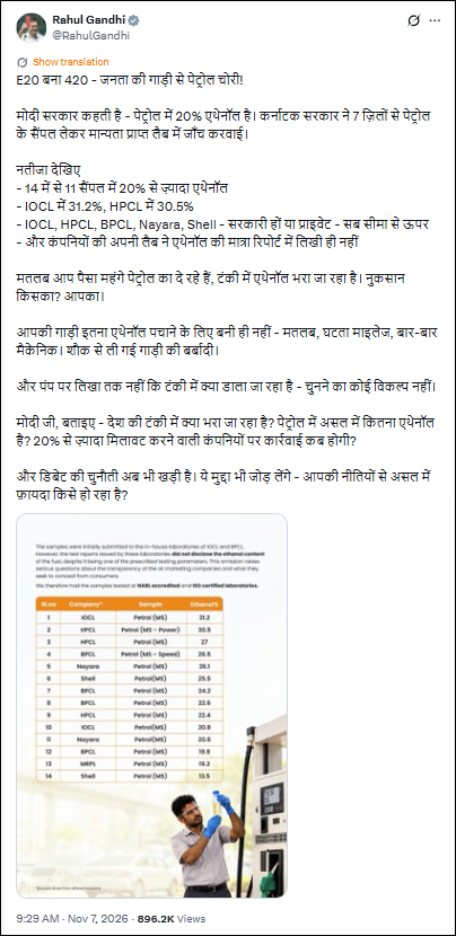
The Karnataka government highlighted test results from a subset of 14 samples. It claimed that ethanol content ranged from 13.5% to 31.2%, with 11 of 14 exceeding the 20% E20 limit.
The specific high readings cited by the government included IOCL at 31.2% (and another at 20.8%), HPCL at 30.5% and 27%, BPCL Speed at 26.5% (others 24.2%/22.6%), Nayara at 26.1%, and Shell at 25.5%.
Minister Rizwan Arshad described the test results as proof of “petrol chori”, framing it as a transparency and consumer-rights issue. The Karnataka government stressed that most vehicles are not designed for blends above E20 benchmark, potential mileage loss, higher maintenance costs and the lack of consumer choice.
The Congress government demanded action against OMCs, compensation for consumers, mandatory disclosure of ethanol content at petrol pumps, and options like E10.
Congress leader Rahul Gandhi amplified the test results and alleged that E20 has turned into 420, implying fraud.
” E20 turned into 420 – stealing petrol from the public’s cars! The Modi government says – petrol contains 20% ethanol. The Karnataka government collected petrol samples from 7 districts and had them tested at an accredited lab. Look at the results – 11 out of 14 samples contained more than 20% ethanol – 31.2% at IOCL, 30.5% at HPCL – IOCL, HPCL, BPCL, Nayara, Shell – whether government-owned or private – all exceeded the limit – And the companies’ own labs didn’t even report the ethanol content In other words, you’re paying for expensive petrol, but ethanol is being pumped into your tank. Who loses out? You,” Gandhi posted on X 0n 7th November.
“Your car wasn’t built to handle that much ethanol – meaning, lower mileage, repeated trips to the mechanic. A car you bought with such enthusiasm is being ruined. And there’s not even a sign at the pump telling you what’s being put in your tank – no choice at all. Mr. Modi, tell us – what’s being put in the country’s tank? How much ethanol is actually in the petrol? When will action be taken against companies mixing in more than 20%? And the challenge to debate still stands. We’ll add this issue too – who is actually benefiting from your policies?” Gandhi added.
Questionable methodology, non-participation of OMC representatives and denial of access to results: OMCs reject Karnataka Congress government’s ‘petrol chori’ claims and ethanol test results
Amid Karnataka Congress’s weaponisation of the results of an ethanol test conducted by a private lab on a limited subset of the 63 samples, to launch political attacks against the Modi government in the Centre, IOCL, BPCL, HPCL and other OMCs rejected the test results in a joint statement.
In a statement issued on 6th November, public sector OMCs dismissed the Karnataka Congress government’s claim that petrol sold at some retail outlets in the state contained more than 20% ethanol.
The OMCs stated that the testing conducted by the private lab was not in accordance with statutory and technical procedures.
In the statement, the OMCs said that the E20 petrol supplied by them across various states, including Karnataka, conformed to IS 17021, the Bureau of Indian Standards specification for ethanol-blended motor gasoline.
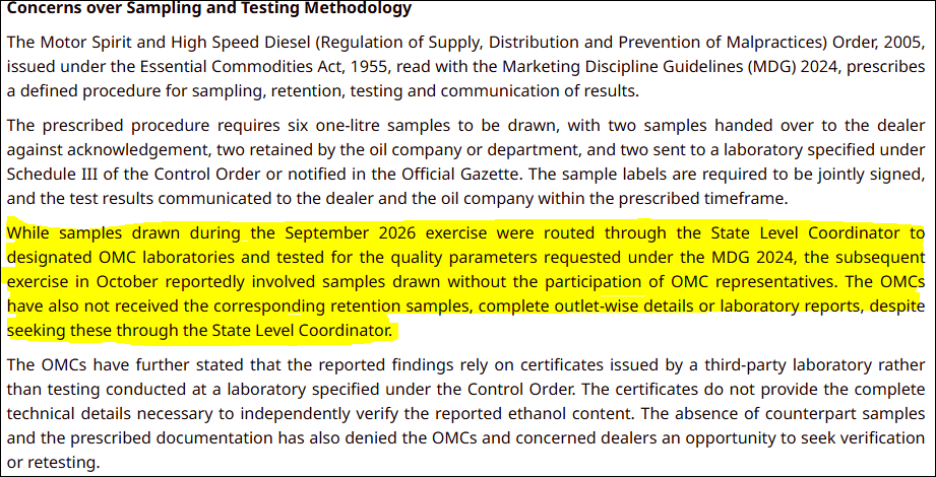
“The Motor Spirit and High Speed Diesel (Regulation of Supply, Distribution and Prevention of Malpractices) Order, 2005 (the Control Order), issued under the Essential Commodities Act, 1955, read with the Marketing Discipline Guidelines (MDG) 2024, prescribes a defined procedure for sampling, retention, testing and communication of results,” the OMCs said.
They highlighted that under the prescribed procedure, six one-litre samples need to be drawn, two provided to the dealer against acknowledgement, two to the oil company, and two to a testing lab specified under Schedule III of the Control Order or notified in the Official Gazette.
The sample labels have to be jointly signed. Most importantly, the results of the test must be communicated to the dealer and the oil company within the prescribed period.
The OMCs stated that while during the September ethanol tests, samples were routed through the State Level Coordinator to designated OMC laboratories and tested for the quality parameters sought under the MDG 2024, during the October exercise, samples were drawn without the participation of OMC representatives.
Moreover, despite OMC representatives seeking retention samples, full outlet-wise details and lab reports, the State Level Coordinator did not provide any of these.
“The reported findings rely on certificates issued by a third-party laboratory rather than testing conducted at a laboratory specified under the Control Order. The certificates do not provide the complete technical details necessary to independently verify the reported ethanol content. The absence of counterpart samples and the prescribed documentation had also denied the OMCs and the dealers concerned an opportunity to seek verification or retesting,” the OMCs stated.
Raising questions over the methodology used by the private lab, the public sector OMCs stated that under IS 17021:2018, ethanol content in E20 fuel is required to be determined through prescribed methods, namely Fourier Transform Infrared Spectroscopy (FTIR) under ASTM D5845, water extraction under Annex C, or Gas Chromatography under ASTM D4815/D6839.
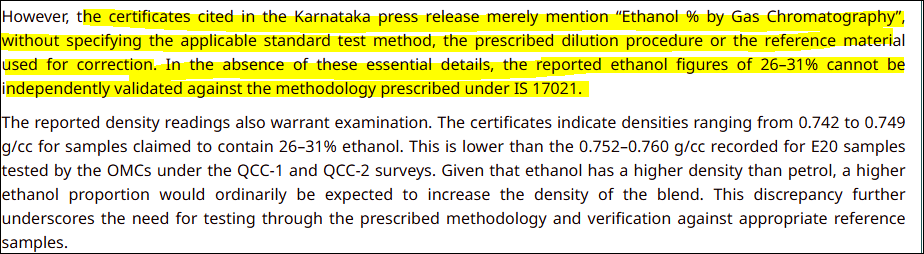
Regarding Gas Chromatography, the method claimed to have been used by the private lab for ethanol testing, the OMCs stated that when Gas Chromatography is used under ASTM D4815/D6839, the sample must first be diluted in a 1:1 ratio with oxygenate-free petrol, and the result corrected against an E10 certified reference material.
“The certificates cited in the Karnataka press release merely mention “Ethanol % by Gas Chromatography”, without specifying the applicable standard test method, the prescribed dilution procedure or the reference material used for correction. In the absence of these essential details, the reported ethanol figures of 26–31% cannot be independently validated against the methodology prescribed under IS 17021,” the public sector OMCs stated.
The public sector OMCs said that Karnataka laboratory certificates do not specify which ATSM method was used, whether the required 1:1 dilution was performed, and whether the E10 certified reference material was used for correction.
Overall, the OMCs highlighted improper sample collection, testing at a third-party laboratory instead of the lab prescribed under the applicable regulatory framework, and that a mere mention of Gas Chromatography on a lab certificate does not essentially establish that the prescribed BIS testing procedure was properly followed.
For maximum transparency, the OMCs requested joint sampling and independent testing in the presence of representatives from both sides.
The CHT Quality Coordination Cell exercise nationwide found ethanol content in petrol within the 19-21% range
Unlike the third-party lab testing in Karnataka, the Centre for High Technology (CHT), under the Ministry of Petroleum and Natural Gas, monitors and tests ethanol blending and fuel quality across OMC retail outlets in all the States and Union Territories based on prescribed scientific methodologies.
In the latest OMC/CHT Quality Coordination Cell (QCC) exercise, 893 E20 samples were drawn from IOCL (330), BPCL (280), and HPCL (283) depots and retail outlets across 27 States and Union Territories.
These samples were tested for ethanol content as per IS 17021, Annex C, at refinery and OMC quality-control laboratories.
All 893 samples were found within the prescribed ethanol content range of 19–21%.
Pertinently, the OMCs said that in all 56 samples collected from different outlets and all three OMCs in Karnataka, and tested, “conformed to the prescribed specifications, recording ethanol content between 19% and 20%, with an average of 19.30%.”
The findings of the QCC exercise, the OMCs said, “are inconsistent with the substantially higher ethanol levels reported in the Karnataka press release and reinforce the need for a transparent, technically sound and jointly verifiable testing exercise.”
Notably, while Karnataka’s certificates recorded densities of 0.742–0.749 grams per cubic centimetre for samples, it claimed to contain 26- 31% ethanol; OMC tests of E20 samples recorded densities of 0.752–0.760 grams per cubic centimetre.
Facts matter. Scientific testing builds confidence. All 893 E20 petrol samples tested across 27 States & UTs, including 56 from Karnataka, met the prescribed ethanol-content specifications. Verified through prescribed testing. Backed by facts. #IndianOil #E20 #FactCheck @HardeepSPuri @PetroleumMin @Secretary_MoPNG @neerajmittalias @ChairmanIOCL @sahneyas
— Indian Oil Corp Ltd (@IndianOilcl) November 7, 2026
This difference is crucial. Increasing the ethanol content in an otherwise comparable petrol blend should increase its overall density. However, the Karnataka lab certificates recorded higher ethanol proportions but lower density readings.
This difference suggests that the Central government is right when it says that there is a need for further prescribed testing and comparison with reference samples.
The OMCs also debunked the claims that ethanol blending is resulting in an estimated annual consumer mileage loss of approximately ₹62,000 crore and vehicle-repair costs of approximately ₹39,000 crore, aggregating around ₹1.01 lakh crore.
The public sector OMCs said that over 30 crore two-wheelers and 4 crore four-wheelers have been running on E20 fuel for over three years. Around 6 crore people visit petrol pumps for vehicle refuelling. If E20 fuel quality had been a major issue, there would have been large-scale vehicle breakdowns across this vehicle base.
Karnataka minister Rizwan Arshad launches fresh attacks on OMCs and the Centre over ethanol blending, his weapon? Alarmist rhetoric and half-truths
During the press conference on 9th November, Minister Rizwan Arshad expanded the scope of his allegations, suggesting that OMCs were pressured into withdrawing warnings about E20. He invoked insurance companies and Supreme Court proceedings and went on to claim that consumers have suffered collective losses exceeding ₹1 lakh crore.
#WATCH | Bengaluru: Speaking on Oil Marketing Companies’ statement on the state’s E20 fuel testing, Karnataka Minister Rizwan Arshad says, "Whenever any agency comes out and points out any flaw, any wrongdoing of the Central Govt, the BJP and its ecosystem tries to discredit everybody. The same thing they are trying to do with us also…Do you think ordinary vehicles used by middle class, upper middle class, working class, their two-wheelers are compatible with E20, E30 fuel? We are a Govt of people. We will keep asking questions…"
— ANI (@ANI) November 9, 2026
The Congress leader claimed that the Karnataka government initially sent 63 samples to laboratories of public sector OMCs IOCL, BPCL, and HPCL. But none of the reports mentioned ethanol percentages. Arshad used this to question the transparency of the oil companies.
However, until the Karnataka government publish the original testing requisitions, laboratory acknowledgements and complete reports, it cannot be established that the state government sought a separate ethanol-content determination on all 63 samples.
While Minister Arshad’s argument about the use of inexpensive hydrometer kits makes sense, given that this only measures the density of a liquid and not directly ethanol concentration, it does not automatically mean that the state’s gas chromatography results are indisputable. The state government has yet to answer whether the private lab followed prescribed ATSM procedure and calibration requirements.
Furthermore, the minister cited a communication by insurance company ACKO to a customer regarding the exclusion of engine damage caused by incorrect fuel usage from insurance coverage. The minister claimed that ACKO had later withdrawn this statement.
Minister Rizwan Arshad, however, did not detail the specifics of the matter.
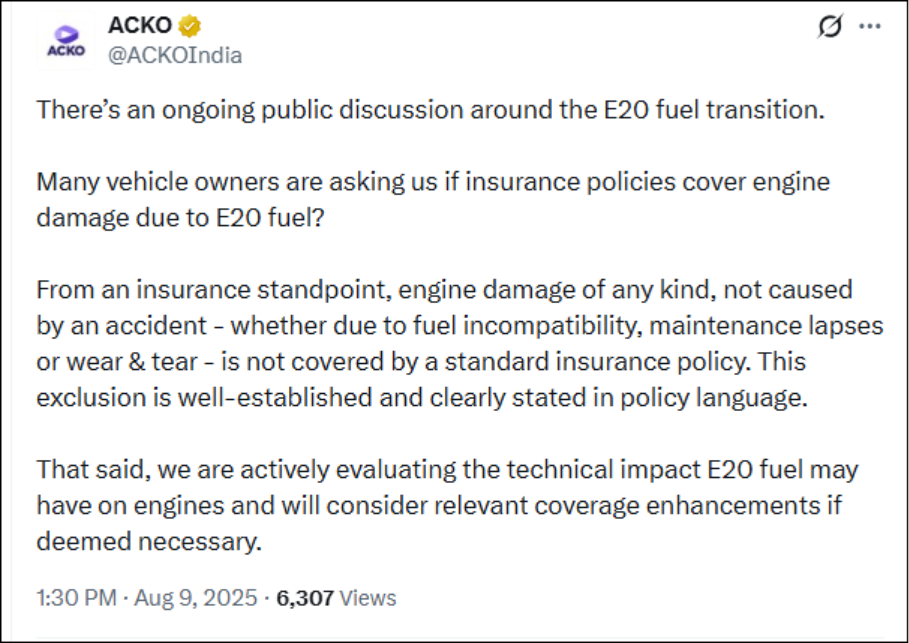
It must be recalled in August 2025, ACKO had published an X post addressing the question that if insurance policies cover engine damage due to E20 fuel.
The insurance company had said, “From an insurance standpoint, engine damage of any kind, not caused by an accident – whether due to fuel incompatibility, maintenance lapses or wear & tear – is not covered by a standard insurance policy. This exclusion is well-established and clearly stated in policy language.”
The minister further claimed that Hyundai, Toyota and other automobile manufacturers initially warned that using fuel other than E10 could void warranties, although they softened their manuals later.
However, manuals mentioning E10 do not automatically mean that E20 will damage or destroy the vehicle.
Warnings by manufacturers that fuel containing more than 20% ethanol can damage vehicles are not the same as a warning against E20 itself.
In fact, the Central government’s own FAQ distinguishes between older vehicles and new vehicles calibrated for E20. It says that an E10 mention in an older manual does not automatically establish that E20 is not safe.
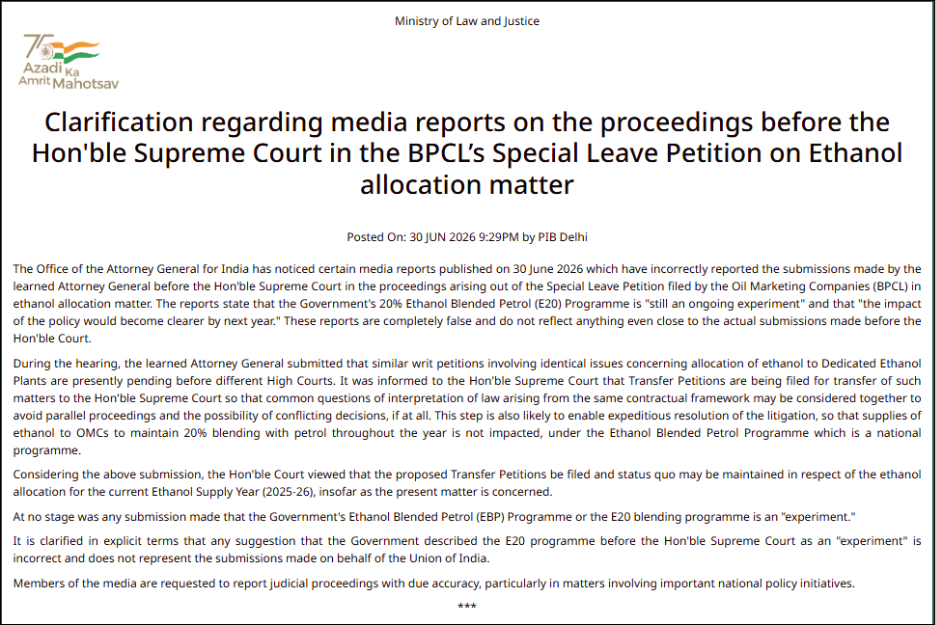
Moreover, Minister Arshad claimed that the Attorney General R Venkataramani told the Supreme Court that E20 was still an ‘experiment’.
On 30th June, the Union Government clarified that its 20% Ethanol Blended Petrol programme is a national policy initiative and was never described before the Supreme Court as an “ongoing experiment”. The clarification came after media reports published on 29th June claimed that Attorney General R Venkataramani had told the apex court that the impact of E20 blending would become clear only by next year.
Addressing the press conference, the Congress leader mixed up the E20 blending issue with fuel contamination concerns and claimed that in July this year, the Society of Indian Automobile Manufacturers (SIAM) had written a letter to the Union Ministry of Petroleum, flagging the presence of chloride and sulphur in E20 fuel and stating that these could damage vehicle engines.
Arshad claimed that this letter was later withdrawn due to ‘pressure’.
However, in early August, SIAM had issued an official statement in which it said that the communication in question was “part of routine and ongoing technical deliberations that take place between various stakeholders, including industry bodies, oil marketing companies, auto OEMs and testing agencies.”
“Some numbers quoted in the communication need authentication through collection of elaborate data from various regions across the country followed by a comprehensive consultation with our member OEMs,” the SIAM clarified back then.
Rahul Gandhi alleges ‘petrol chori’, Keralam Congress government following Karnataka’s footsteps: Is ethanol becoming fuel for political attacks?
On 7th November, the Keralam Congress government announced that it would conduct inspections and collect petrol samples from Thiruvananthapuram, Ernakulam, Kozhikode, and Kannur.
Civil Supplies Minister Anoop Jacob stated that the decision to conduct ethanol testing was taken following the claims that emerged in Karnataka and complaints received by the department.
The minister, however, admitted that no instance of excess ethanol blending had been reported in Keralam at the time inspection was ordered.
Unlike the testing in Karnataka, in Keralam, sample collection was done in the presence of OMC representatives.
While a state government inspecting petrol pumps, collecting samples and investigating whether the proportion of ethanol in petrol is within the E20 benchmark or not is appropriate, suggesting that an excess ethanol-driven vehicle damage problem exists across the state without having test results indicates that ethanol tests are less about fuel quality and more about political utility.
Rahul Gandhi and the Congress party’s portrayal of alleged excess ethanol blending as “petrol chori” from consumers contributes to triggering hysteria, and by extension fuelling public anger against the Modi government even though the factual premise has yet to be established.
Apparently, the Congress party knew that to establish the narrative that somehow consumers are being systematically cheated, they would need data. Thus, the private lab test came up without ensuring the presence of representatives from the public sector OMCs and the implementation of complete standard methodologies.
It is ironic that the Karnataka government demands petrol pumps to disclose the exact ethanol content of petrol, while the government itself floats specific 31.3% figures without publishing the complete technical documentation. Congress is not applying the same standards of transparency it expects from the Centre to its own claims.
Now that the OMCs have called out the anomalies in the Karnataka certificates, Keralam government has ensured participation of OMC representatives during collection of samples.
There are many genuine concerns about ethanol blending; however, the rush demonstrated by Congress governments in Karnataka and Keralam suggests that there is a fear campaign at play by converting an allegation based on questionable test results into a political verdict.
From Karnataka to Kerala, and nationwide amplification by Rahul Gandhi, suggests that the Congress party is manufacturing consumer panic under the pretext of advocating consumer protection.
From ‘vote chori’ to ‘petrol chori’, making sensational claims, triggering mass hysteria using dubious reports and data, repeating the same claims in a Goebbelsian fashion to establish them as truth, and hitting the streets appears to be the modus operandi.