

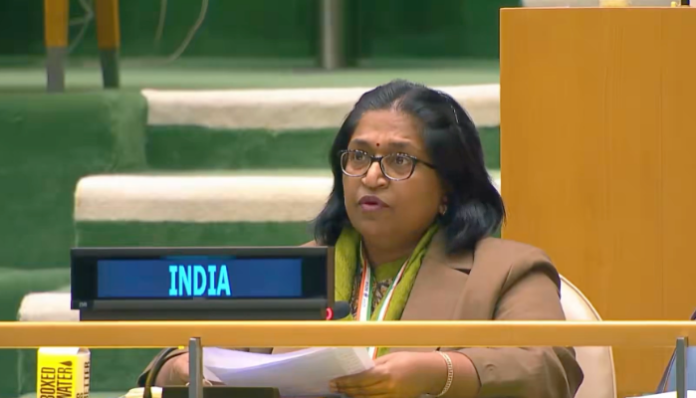
India has hit out at Turkey for its “blatant and intentional” action against New Delhi and other member countries, describing it as “contrary to the UNGA’s (United Nations General Assembly) principles of inclusivity and transparency.” The response came after their exclusion from consultations on a draft resolution concerning cooperation between the UN and OIC (Organisation of Islamic Cooperation) by Ankara.
On 16th November (Monday), the General Assembly passed the draft resolution with 112 votes in favour, 6 against, and 39 abstentions. India, Cyprus, Greece, Israel, Armenia, and the United States voted against it. The resolution was introduced by Iraq and facilitated by Turkey.
India’s Deputy Permanent Representative at the UN, Ambassador Yojna Patel, lashed out at the decision, conveying, “My delegation has voted against this resolution not only because of its substantive aspects but also for an even more concerning matter regarding the working methods adopted by the facilitator who convened negotiations on the same. It is unfortunate that there are member states who publicly profess commitment to multilateralism and completely turn a blind eye to its core guiding principles.”
She pointed out that the UN was built on the tenets of multilateral cooperation, inclusion, and sovereign equality and differences in opinions among member states are a natural part of multilateral diplomacy. This cannot be used as an excuse for deliberate and flagrant exclusion from consultations on issues before the august house.
She added that established General Assembly practice focuses on the value of open, transparent, and inclusive international negotiations, emphasising that maintaining the validity, credibility, and consensus-based nature of the Assembly’s work requires meaningful consultations, especially with delegations that hold different opinions.
#IndiaAtUN DPR @PatelYojna delivered the Explanation of Vote (EoV) on 🇮🇳’s vote against the resolution on cooperation between the @UN and the OIC. She: ➡️ Highlighted 🇮🇳’s objection to the exclusion of several delegations from consultations, contrary to the UNGA’s principles of inclusivity and transparency. Meaningful consultations, including with delegations holding divergent views, are essential to preserving the legitimacy, credibility and consensus-based character of the Assembly’s work. ➡️ Noted that the resolution’s claim to foster solutions to “other conflicts” is unclear. OIC is not a regional organization under Chapter VIII of the UN Charter and rejected unwarranted references to 🇮🇳, stressing that the OIC has no locus standi on 🇮🇳’s internal affairs. ➡️ Underlined that 🇮🇳, a secular, democratic and diverse nation, does not accept that only co-religionists can protect the interests of adherents of their faith. @MEAIndia @IndianDiplomacy @airnewsalerts @DDNewslive
— India at UN, NY (@IndiaUNNewYork) November 17, 2026
Patel highlighted, “Therefore, my delegation expresses its deep dismay that the Permanent Observer Mission of the OIC chose to exclude not only my delegation but a number of other countries when circulating successive drafts of the resolution. This is not only shocking but also sets a bad precedent of delegations excluding specific member states to enable their agendas. Despite some delegations registering their objections in subsequent rounds, the facilitators still chose to not include select countries. Furthermore, basic procedures such as acknowledging inputs or breaking of silence by some delegations were blatantly disregarded, indicating that it was done by design rather than by mistake.”
She stated that India “strongly objected” to such tactics that try to deceive excluded delegations into assuming that this was merely a “technical update,” requesting an investigation to prevent a recurrence in future. She also inquired that while “resolution has been claiming to foster solutions to other conflicts,” the rationale for wanting to broaden the function of the OIC in this manner remained unclear because it is not a “regional organisation,” questioning both substance and motive.
The diplomat also called out its anti-India propaganda, outlining, “The resolution contains references to documents and statements that have unwarranted and factually incorrect references to my country. Such documents unfortunately reflect the continued misuse of the OIC platform for narrow political ends. The OIC has no locus standi to comment on India’s internal affairs.”
She conveyed that India has “expressed concern at the references to the 9th session of the OIC Ministerial Conference on Women held in July 2026. India rejects the declaration and the omnibus resolution adopted therein. We regret that the OIC has once again allowed itself to be systematically misused by one member state to weaponise OIC resolutions and declarations against India through false and baseless allegations,” alluding to Pakistan.
India urged the OIC to uphold the values of impartiality, constructive discourse, and respect for one another, as well as to make sure that its outcomes are not used to promote specific political objectives. “My country, a secular, democratic, and the most diverse nation on this planet, believes that sovereign member states take care of the interests of their citizens regardless of their faith. We do not recognise that only coreligionists can protect the interests of adherents of their faith. Such regressive views have no place in today’s world and especially at this forum,” Patel concluded.
