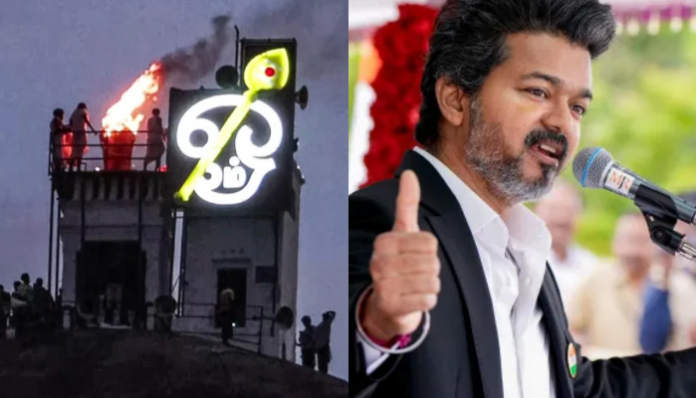
On 25th November (Wednesday), the Tamilaga Vettri Kazhagam (TVK) government of Tamil Nadu apologised in the Supreme Court after it lit the Karthigai Deepam lamp at the traditional Uchipillayar Deepa Mandapam rather than the Deepathoon stone pillar atop Thiruparankundram hill, in violation of its order.
Notably, the government was instructed to use the stone pillar for the ceremonial lamp ceremony by both the Supreme Court and the Madras High Court. Now, the apex court has stated that it will review the state government’s status report on the issue alongside considering the contempt plea presented by the petitioners.
Senior Advocate Gopal Sankaranarayanan initially brought up the matter on behalf of the authorities, before a bench of Justices Aravind Kumar and Vipul M. Pancholi, conveying, “As the Collector, I was supposed to file a status report on what took place. We have just had that filed. We have a number. I think Your Lordships may take it up because unfortunately the lamp didn’t get lit. So I, as a Collector, have traced out all the steps that I was supposed to comply with.”
The state claimed that the order was not executed because of the Board of Trustees. It alleged, “I sincerely apologise for the lamp not being lit at the Deepathoon. The district administration made every effort to secure the authorisation of the Devasthanam and the lighting of the lamp at the Deepathoon. However, the Board of Trustees, by its resolution dated 24th November, resolved to light the lamp at the customary place. I will submit an additional status report with all supporting documents along with the same.”
The state argued that “every arrangement was complete and every possible difficulty had been offered an immediate solution” by the district administration, adding, “The only step remaining was the authorisation of the team by the Devasthanam. The time for the ceremony was fixed at 6.00 pm to 6:30 pm as proposed by the Executive Officer herself. No team authorised by the Devasthanam came forward within that time, and no request for any extension of time was received. At 7:32 pm, the temple’s press release was received.”
Afterwards, the Executive Officer asserted that she could not intervene because of a resolution passed by the trustees.
#BREAKING Madurai District Collector tells #SupremeCourt that all arrangements were made by the District Administration to light the Kartigai Deepam at the Thiruparankundram Deepathoon. However, it could not be lit there as the Board of Trustees of the Temple Devasthanam did not authorise the lighting of the lamp at the Deepathoon, as they took the stance that it can be lit only where it was being customarily done at the Uchaipillaiyar Mandapam.
— Live Law (@LiveLawIndia) November 25, 2026
Petitioners expose the government’s dubious conduct
The Senior Advocate Guru Krishna Kumar, who represented the Hindu petitioners, called out the deceptive tactics of the government and charged, “This is like anticipatory breach, anticipatory mentioning. Most unfortunate, My Lords. State tells the High Court some prohibitory orders were. They use the Board of Trustees, and I say this, to say the custom does not permit it, and the sthanikars have said it cannot be done.”
He further stated that the government and the devasthanam joined hands to defend the breach of the verdict and mentioned, “In the evening, later, sthanikars say that ‘no, we didn’t make any such statement; no opinion was sought from us.’ Deliberate attempt at not complying with the order, and they’ve succeeded by stratagem and devices. Most unfortunate. There is a complete infraction of the rule of law. This is the majesty of the law that we are looking at.”
The petitioners demanded to start suo motu contempt proceedings, and direct that the flame currently burning at the conventional location be moved to the Deepathoon. They also highlighted how the state government consistently promised the High Court that it would implement the ruling, right up until the last moment, only to willfully fail to carry it out under the guise of trustees. “You file the necessary plea. You take the steps. We will consider,” responded Justice Aravind Kumar.
No lengths too far for Muslim appeasement
The measure to brazenly disregard court orders did not originate from any independent decision by the Devasthanam or its trustees, who function under the Tamil Nadu Hindu Religious and Charitable Endowments (HR&CE) Department, which has long faced allegations of exploiting temple funds, undermining Hindu traditions and interfering in religious affairs.
The institution being made a scapegoat in this case is not an independent body but one that operates under the state government’s control. As the petitioners had already pointed out, this was nothing more than a collusive effort by the two sides to create a smoke-and-mirrors show.
The glaring truth that the government is attempting to obscure through its absurd explanations is that the TVK, much like its predecessor, the Dravida Munnetra Kazhagam (DMK), which wanted to eradicate Sanatan Dharma, is following the same old playbook of “secularism” centred on pandering to Muslims.
The latter invoked the purported need to “preserve law and order” and “prevent communal tensions” to justify flouting the High Court judgement and preventing Hindu devotees from lighting the lamp at the stone pillar last year. The more things have changed, the more they visibly stayed the same.
The TVK government is pursuing the route set by its predecessor, willing to compromise not only Hindu religious rights and faith but also showing little regard for even the courts of the country. Moreover, coalition partners including Indian National Congress, Viduthalai Chiruthaigal Katchi (VCK), Communist Party of India (Marxist), Communist Party of India (CPI) and Indian Union Muslim League (IUML) put tremendous pressure to disobey the judicial mandate.
The action has already faced fierce opposition from the Bharatiya Janata Party (BJP) and Hindu groups for its vote bank motive. A similar instance of this was observed earlier this month, when the Joseph Vijay-led government in Tamil Nadu decided to regularise encroachments by issuing pattas to thousands of mosques, churches and dargahs. According to A M Shah Jahan, Minister for Minorities Welfare, the government was working to regularise religious institutions that lack ownership documentation.
He informed that minority groups petitioned the government for pattas for unlawful houses of worship that had been on government property for 25-50 years. Hence, a decision was made to comply with the demands of Christians and Muslims, and the required paperwork would be completed shortly.
To cater to its vote bank, the government has even given the green light to illegal occupation, setting a deeply troubling and equally dangerous precedent. The current development is yet another step in the same direction, prioritising the consolidation of its minority, particularly Muslim, vote bank above all else.
In this political calculus, Hindus, along with their rights and religious beliefs, are turned into soft targets by these self-proclaimed secularists, while the authority of the courts is rendered virtually meaningless. It would not be wrong to call this yet another low point, shameful but hardly surprising, in India’s brand of “secular politics,” where even the judiciary is sacrificed at the altar of Muslim appeasement.
The comrades in the media have commenced the whitewashing, carefully steering clear of any mention of a possible link between the government’s breach of court orders and its vote-bank interests. The News Minute has already been consistently accusing Hindus of disturbing the supposed communal harmony by refusing to look the other way when their religious beliefs and practices go for a toss.
The question is how far these political parties are prepared to go in pursuit of their demented agenda, trampling upon everything from Hindus to the judiciary. It also remains to be seen whether the courts will hold them accountable for such conduct or allow them a free run. Meanwhile, nothing has changed for the majority community, which continues to be forced to struggle for even its most basic religious rights, from Ayodhya to Thiruparankundram hill.