Home Blog Page 1477

Ankit Saxena murder case: Muslim girlfriend’s parents to be sentenced on January 15 for slitting Ankit’s throat publicly over inter-faith relationship

The Tis Hazari Court in Delhi will announce the sentencing of convicts in the Ankit Saxena murder case on 15th January. The court had earlier pronounced his girlfriend’s parents and maternal uncle guilty of the murder case that shocked West Delhi’s Raghubir Nagar area. 

In its verdict, the court had said that Delhi Police was successful in proving that the reason behind the murder of 23-year-old Ankit Saxena, a photographer by profession, was his love affair with a girl who belonged to the Muslim community. The girl’s family was vehemently opposed to the inter-faith relationship. 

It was established that on the day of the brutal murder, the girl (Ankit’s girlfriend) had left the house. This angered her family. Her father Akbar Ali, mother Shahnaz Begum, and maternal uncle Mohammad Salim then went on to murder Ankit Saxena by slitting his throat in the middle of the road in Raghubir Nagar in February 2018. 

The court had held all three accused guilty of committing the crime with a common intention of murder. Additionally, it also convicted the girl’s mother for assaulting Ankit’s mother. The girl’s minor brother, who is also an accused in this case, is facing trial in the Juvenile Justice Board.

The Tis Hazari Court has directed both the prosecution and defense to submit affidavits in this case. Delhi Police will also submit a report detailing the expenses incurred during the legal proceedings and the compensation intended for the victim’s family. Legal experts note that the law provides for a maximum penalty of death sentence and a minimum of life imprisonment for individuals convicted of murder.

Ankit’s girlfriend was sent to Nari Niketan when she claimed that her life was in danger. 

In media interactions, Ankit’s girlfriend had stated that her family members are responsible for the honour killing of her lover Ankit, and she is scared of them. 

She had said, ‘When I came to know about (the family’s plan regarding Ankit), I was going to meet him. My family has killed him. My uncle did this.” The girl had told India Today that she and Ankit were going to get married. 

Police investigation revealed that the weapon used in the crime belonged to Shehzadi’s father, who is a butcher by profession.

According to the police, the girl’s younger brother, mother, father, and maternal uncle had stopped Ankit on the way. Ankit denied his love affair fearing for his life when he saw knife in their hands. After an altercation, they slit his throat in broad daylight. 

The details of the grisly murder case

A Hindu boy named Ankit Saxena was brutally murdered in Delhi, in February 2018, for being in a relationship with a girl named Shehzadi from the Muslim community. The murderers were relatives, including parents, of the girl. Ankit had been under pressure to break his relationship with the girl. Since he did not comply, he was murdered and his throat was slit.

It was revealed that the girl’s family was vehemently against their daughter being in love with a Hindu boy and proceeded to kill him in a pre-planned manner after engineering a road rage incident. 

According to eyewitness accounts, Shehzadi’s mother wore a helmet and rode her scooter to the traffic intersection where they knew Ankit was present. She then rammed her scooter into Ankit’s vehicle so that Ankit would be forced to step out to help. As she was wearing a helmet, Ankit could not identify her and stepped out to help.

The woman then confronted Ankit and soon she was joined by her other family members. They all began to heckle and abuse Ankit blaming him that he had influenced Shehzadi to leave the house. A shop owner in the area had stated that when confronted by Shehzadi’s family, Ankit denied being in a relationship with her so that he was left alone. Another resident of the area had stated that Ankit even requested to call the police or be taken to the police station, but the girl’s family just kept beating him.

Neighbours alerted Ankit’s parents of the incident and they had rushed to the spot. But Shehzadi’s mother began attacking Ankit’s mother too who fell down. When Ankit bent down to help his mother get up, the girl’s uncle and brother then caught him by his hair and pulled him up. At that moment, while the two of them held Ankit’s arms from behind, the girl’s father slit his throat using his butchering knife.

However, media reports water downed the grisly murder case and it failed to inspire any outrage as Hindi and English media reports on the incident carefully tried to hide the religion of the accused. 

Meanwhile, Ankit Saxena’s father, Yashpal Saxena had become the face of communal harmony after he appealed to everyone not to communalise his son’s murder at the hands of his Muslim girlfriend’s family who disapproved of their inter-religious relationship. He had even organised an inter-faith iftar party in 2018 during Ramzan which was attended by various ‘social activists’. 
Ramcharitmanas burning: Allahabad High Court upholds NSA against two accused

0

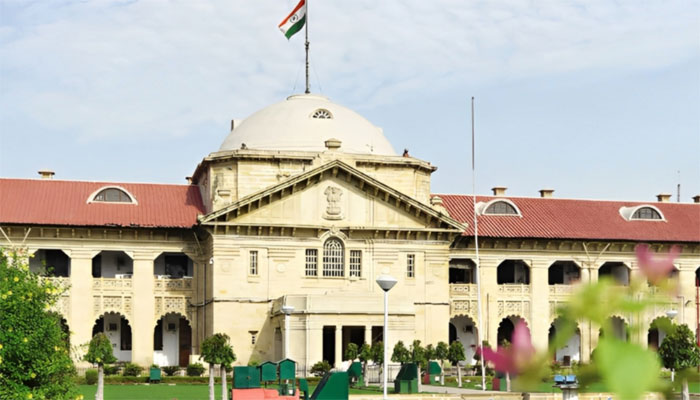
On 5th January, the Lucknow bench of the Allahabad High Court dismissed the plea submitted by two accused of burning copies of Ramcharitmanas. The accused, identified as Devendra Pratap Yadav and Suresh Singh Yadav, were arrested under the National Security Act (NSA). They filed a plea in the court to quash the detention order.

A division bench comprising Justice Narendra Kumar Johri and Justice Sangeeta Johri dismissed the petitions. In its order, the court said that the petitioners and their associates insulted the religious text Ramcharitmanas, related to the life events of Bhagwan Ram, who is worshipped by a significant section of society. The court added that the anger generated due to their actions was natural, hence invoking the NSA was justified.

Furthermore, the court said that in such a situation where the accused were detained given impending danger, it could not be considered an unjustified and illegal restriction on the personal freedom of the accused.

Burning of Ramcharitmanas

On 29th January 2023, Akhil Bharatiya OBC Mahasabha members burnt pages of Ramcharitmanas in the Vrindavan area. An FIR was registered against ten people, including Swami Prasad Maurya, MLC of Samajwadi Party. Following the incident, NSA was invoked against Mohammad Salim, Satyendra Kushwaha, Yashpal Singh, Devendra Yadav and Suresh Yadav and were arrested.

They were booked under Sections 295, 153A, and 506 of the Indian Penal Code (IPC). Additionally, Maurya was booked under Section 120B of the IPC. The FIR was registered against the accused on the complaint of Bharatiya Janata Party (BJP) leader Satnam Singh Lavi.

The 29th January incident took place during a protest organised to show support for Maurya, who had said in a statement that Ramcharitmanas contained passages discriminatory to Dalits, tribals, people from the backward community and women.

Amidst continuous air pollution in Delhi, ₹23 crore smog tower shut down again, this time by workers for non-payment of salaries

0

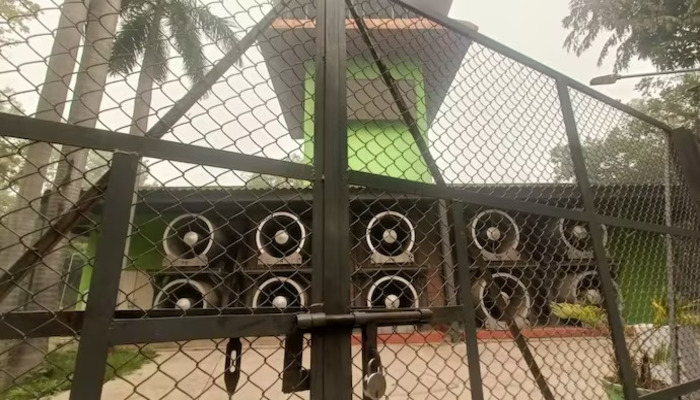
The smog tower, inaugurated by Chief Minister Arvind Kejriwal in 2021 amid much fanfare, is ‘locked up’ again as Delhi continues to be engulfed in smog. Even though the national capital and surrounding areas have hazardous air quality levels, the Rs 23 crore smog tower in Connaught Place is not operational. The smog tower has been shut down after the employees in charge of its operations ‘locked it’ due to nonpayment of their December 2023 salary. The personnel claimed that they had not received a written ‘job guarantee’ from the Delhi government.

It is to be noted that the task of running the smog tower was assigned to a 13-member team from a private company called Vibgyour Consulting. The smog tower was shut down for a long time earlier, before it was opened on the orders of the Supreme Court in November 2023.

“This tower is under Delhi Pollution Control Committee (DPCC) and National Buildings Construction Corporation (NBCC), and our company, Vibgyour Consulting, was operating this tower,” Mahipal Bisht, one of the staff members, told India Today. 

“But in April 2023, operations of the tower were stopped. But after the Supreme Court rebuked the Delhi government in November (2023) to start this tower, we were called by DPCC and on November 8, again the tower was operationalised, but later we were not paid our salary on time and our December salary was not paid yet and above this our company has not got any job confirmation from Delhi government. Finally, we only had one option to lock the smog tower,” Bisht added.

Staff members also mentioned a lack of basic amenities, such as drinking water and an accessible toilet.

“Even basic tools like pliers and screwdrivers are not available, and we are not provided with any safety gear,” Vivek Uniyal, an electrician on the team in charge of running the smog tower said.

Moreover, several staffers also mentioned that the smog tower was not operating at full capacity. “The majority of the 5000 filters installed in the tower are old and need to be replaced,” one of the members told India Today.

Back in August 2021, Delhi Chief Minister Arvind Kejriwal had inaugurated the smog tower boating to be the country’s “first” to curb pollution. CM Kejriwal had said that this smog tower in Connaught Place made with American technology would reduce pollution in the air.

However, the smog tower Kejriwal boasted as a weapon in the “war” against pollution has largely been unused or inoperational. It is worth mentioning that during the peak pollution time in Delhi last year, two smog towers in the national capital were inoperative. Consequently, in November last year, the Supreme Court summoned DPCC chairman Ashwani Kumar to shut down the smog towers and directed him to ensure its operation. Hearing air pollution petitions at the time, a bench of Justices Sanjay Kishan Kaul and Sudhanshu Dhulia said Delhi cannot be made to go through this year after year.

Maldives: Former presidents Mohamed Nasheed and Ibrahim Mohamed Solih condemn derogatory remarks by ministers against India

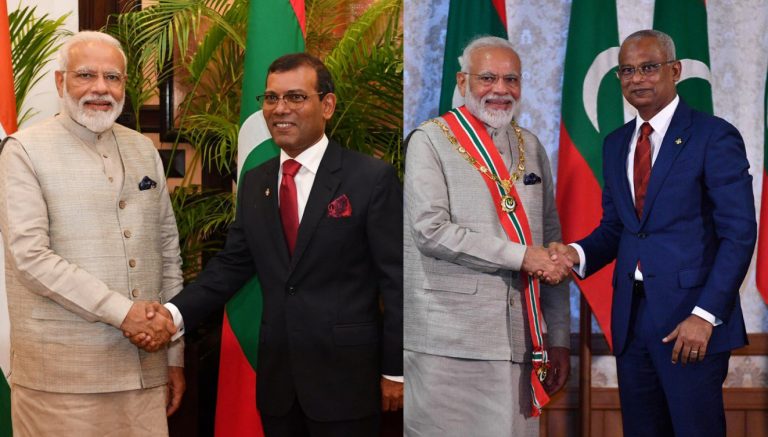
On Sunday, January 7, former Maldives Presidents Mohamed Nasheed and Ibrahim Mohamed Solih condemned the derogatory language used by some of the country’s officials against India and PM Narendra Modi. The former presidents issued the condemnations after Mariyam Shiuna, Deputy Minister of Youth Empowerment, Information and Arts, recently made insulting remarks against PM Modi.

Mohamed Nasheed said that the language used by the minister Mariyam Shiuna was “appalling” and said India is a “key ally” for the security and prosperity of Maldives. Nasheed is the the first democratically elected president of the Maldives who served from 2008 to 2012.

Nasheed posted, “What appalling language by Maldives Government official @Shiuna_M towards the leader of a key ally, that is instrumental for Maldives’ security and prosperity.”

The former President further asked the current President Mohamed Muizzu and his government to distance itself from these comments and give clear assurance to India they do not reflect govt policy.

Ibrahim Mohamed Solih, the seventh president of Maldives who served from 2018 to 2023, also condemned hateful messages against India by Maldives ministers and officials. He tweeted, “I condemn the use of hateful language against #India by Maldivian government officials on social media. India has always been a good friend to Maldives and we must not allow such callous remarks to negatively impact the age old friendship between our two countries.”

Notably, minister Shiuna earlier posted, “What a clown. The puppet of Israel Mr Narendra diver with a life jacket #VisitMaldives,” while trying to insult the Indian PM.

The post was deleted after backlash on X, formerly known as Twitter, where Indian social media users slammed the Maldives government officials, including Shiuna, for their crass remarks against the Indian Prime Minister for sharing pictures of his visit from the Lakshadweep Island. It is worth noting that PM Modi did not mention the Maldives anywhere in his tweets.

Similarly, other ministers, officials and prominent personalities too have taken to social media, making obnoxious remarks against India and Indians. Deputy Minister Mahzoom Majid in a tweet said that India’s culture is bad, and India can’t compete with Maldives in tourism. Another deputy minister Malsha Shareef also made deragotary comments against India and PM Modi. The three deputy ministers have now been suspended for their hate comments against India and PM Modi.

On Friday, January 5, Zahid Rameez, a Council member of the ruling Progressive Party of Maldives (PPM) took to the microblogging site X to mock Indians. The PPM member’s highly racist remark against Indians came in response to a post by popular X user Mr Sinha, where he shared pictures of PM Narendra Modi’s recent visit to Lakshadweep and hailed the islands as a viable option to Maldives.

On January 4, PM Narendra Modi shared some pictures of his recent visit to Lakshadweep as he exhorted people to explore the scenic island in what could be seen as a push to his ‘vocal for local’ slogan, and an effort to give a boost to tourism in the island.

Following PM Modi’s tweet posting stunning vistas from the Lakshadweep Islands, several social media users in India called for Indians to visit the place over foreign destinations, including the Maldives, which shares similar geographical characteristics as the Lakshadweep Islands. That touched off bitter reactions from Maldivian counterparts, including governmental functionaries and prominent citizens, many of whom resorted to making churlish remarks against India, Indians, and the Indian PM.

AIIMS Delhi: 5-year-old girl becomes youngest in the world to undergo awake brain tumour surgery, identifies PM Modi’s picture during operation

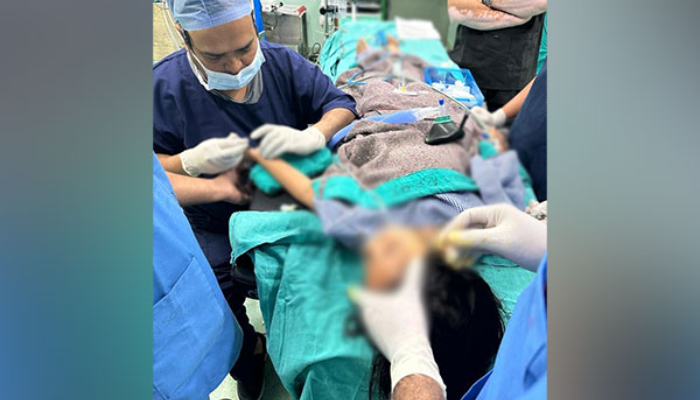
A five-year-old girl became the youngest patient in the world to have a brain tumour surgically removed by doctors at All India Institute Of Medical Science (AIIMS) in Delhi while she remained in a conscious state during the procedure. On 4th January, AIIMS revealed in a statement that the operation known as an “awake craniotomy” (conscious sedation technique) surgery for a left perisylvian intraaxial brain tumour was carried out.

The girl had a history of seizures and magnetic resonance imaging (MRI) of her brain detected a tumour next to the speech and language centre on the left side of the brain, according to the statement. Her local anaesthetic was administered by neuro anaesthetists during the three-hour procedure. She was aware during the entire procedure which involved a team of neurosurgeons effectively eliminating the cancer.

It further read, “Technological adjuncts viz preoperative functional MRI brain, intraoperative ultrasonography, neuronavigation were used to localise tumour precisely during resection while mapping of functional areas was being carried out under awake conditions. Ice-cold saline was used for the brain surface to prevent any seizures during the procedure. The child is doing well and will be sent home on Monday.”

The decision to proceed with the surgery was made after a lengthy discussion involving the youngster, her family and the team of doctors. It stated that they received thorough counselling on the processes involved in the course of action. Before surgery, she completed certain exercises for linguistic and sensorimotor tests, viewed familiar objects and animals and had these activities replicated during the surgical procedure. According to the statement, the first-standard student recognised the photo of Prime Minister Narendra Modi during the procedure with ease.

“Awake surgeries for brain tumours are done for maximising tumour removals and minimising neurological deficits usually. During awake craniotomy, patients should feel a minimum level of pain while being completely able to cooperate in neurological tests,” the statement mentioned.

Professor of Neurosurgery Dr Deepak Gupta remarked, “Although this method is called an awake craniotomy, this method requires even more collaboration in perfect harmony of the surgical and anaesthesia teams than other operations under general anaesthesia.” He executed the operation assisted by Dr Gyanendra Pal Singh and Dr Mihir Pandia of the neuro anaesthesia team. He added, “Akshita happens to be the youngest child in the world to undergo successful brain tumour surgery under awake conditions at this age at AIIMS, Delhi.”

Physicians observed that kids as young as eight years old have undergone comparable procedures in other countries. Rakesh Yadav, Akshita Yadav’s father and a software engineer expressed appreciation for AIIMS’s assistance. He described the difficulties he and his family had endured since his daughter’s brain tumour was discovered in 2020 as a result of her repeated convulsions prompting medical attention. “Since her tumour was in the speech area, we were advised to go for an awake craniotomy as the entire tumour cannot be removed in normal surgery. We decided to take the risk and prepared our daughter. The doctors at AIIMS supported us and ensured good results.”

He unveiled, “She fell down while walking with me. She was taken to a local doctor but he didn’t identify the reason and sent her back after prescribing some medicines. This episode was repeated several times. Then we took her to a hospital and got to know about the brain tumour,” and added that she sometimes had 3-4 episodes of seizures in a week.

It was surprising, according to Prof. Mihir Prakash Pandia of the neuro-anesthesia department to have such cooperation from a tiny child. He reported that her brain tumour was  21.7*21.7*24.4 mm in size. “Nearly 16-18 injections were given to the patient to block the nerves,” he conveyed and noted that the surgery took three hours total, involving the time needed for the child to get local anaesthetic from neuro anaesthetists. The surgical team comprised seven physicians, paramedics and technicians.

“I will go to school in two weeks. Doctor uncle has advised me to take rest till then,” Akshita Yadav stated in an interview. She informed that she experienced no fear during the surgical procedure and expressed her excitement for her 22nd March birthday celebration.

A very sophisticated form of brain surgery known as an awake craniotomy allows the patient to remain conscious and responsive during the whole procedure. With the help of this innovative technique, surgeons can effectively explore the intricate workings of the brain, safeguarding vital processes like speech and movement in real time. The ability to carefully monitor essential brain functions while conscious lowers the possibility of complications following surgery.

This surgical technique is extremely important for treating tumours or epileptic areas close to important brain structures. Awake craniotomy is useful in identifying and maintaining particular brain functions associated with movement, language, and sensory perception. This methodical approach greatly reduces the likelihood of post-surgical deficits and guarantees optimal preservation of normal brain tissue.

AIIMS highlighted the incredible application of state-of-the-art technology used in the procedure, including neuronavigation, intraoperative ultrasonography and functional MRI. These cutting-edge instruments were essential for accurately identifying the tumour and imaging every functioning region of the brain.

This extraordinary procedure is a mirror image of the successful awake craniotomy that AIIMS conducted on Yukti Agarwal three years ago during a similar brain tumour surgery. She chanted Hanuman Chalisa during the operation and is reportedly doing well at present.

Pilgrimage of 8000 km from Rameshwaram to Ayodhya: The incredible story of Srinivasa Shastri carrying Lord Ram’s gold-plated Charan Padukas on his head

As the auspicious day of the consecration ceremony at the Ram Mandir in Ayodhya draws near on 22nd January, the entire nation is gripped in fervent devotion and anticipation.

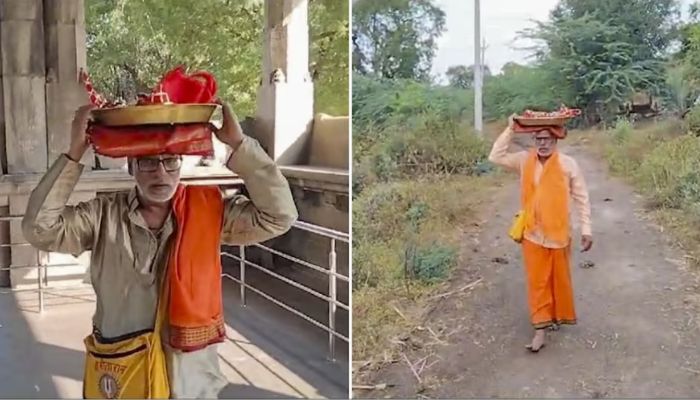
Among the many acts of faith and reverence, the journey of Hyderabad’s Challa Srinivasa Shastri, a 64-year-old devout follower of Lord Ram, stands out.

He embarked on a remarkable 8000-kilometre foot march to Ayodhya, carrying gold-plated Charan Padukas of Lord Ram, valued at approximately 64 lakh rupees, atop his head.

Srinivasa Shastri’s journey, which is the reverse of the route taken by Lord Ram during his exile, began on 20th July. He plans to visit various holy sites like Puri, Trimbakeshwar, Dwarka, and especially the significant locations where Lord Ram installed Shivalingas.

His path also includes stops at Chitrakoot, 272 km from Ayodhya, Prayagraj, and finally culminating in Ayodhya for the consecration ceremony. The devout pilgrim, also the founder of the Ayodhya Bhagyanagar Sitaram Foundation, carries with him a profound personal devotion.

“My father had participated in ‘Karseva’ in Ayodhya. He was a great devotee of Lord Hanuman. He wanted a Ram temple to be built in Ayodhya. He is no more, so I decided to fulfil his wish,” stated Shastri, echoing a deep-seated spiritual commitment passed down through generations.

This journey isn’t just a personal pilgrimage for Shastri; it symbolizes the collective spirit of millions of devotees. Shastri plans to donate the Charan Padukas to Uttar Pradesh Chief Minister Yogi Adityanath upon his arrival.

His journey had a brief pause due to a trip to the UK but resumed with the same zeal soon after his return. The upcoming event at the Ram Mandir has stirred a wave of enthusiasm across India. Villages, towns, and cities are preparing to celebrate this historic moment in their local temples, reflecting a nationwide spiritual awakening.

Shastri’s unique journey, laden with historical and cultural significance, encapsulates the deep-rooted devotion and reverence for Lord Ram, a central figure in the country’s spiritual ethos.

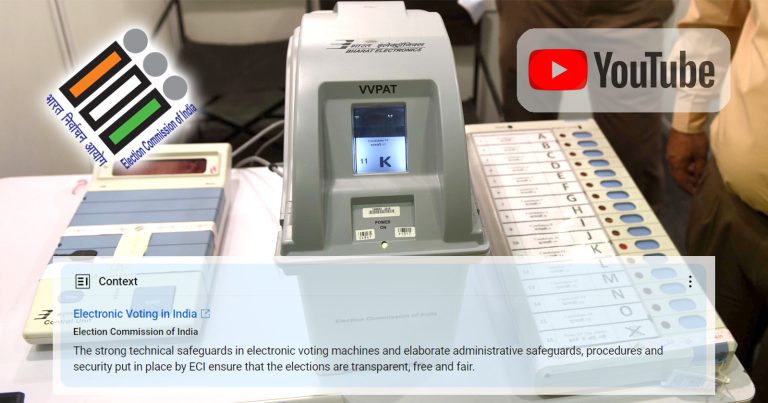
YouTube adds ‘Context’ information panel with ECI disclaimer and link to FAQs to videos raising doubts about EVM and VVPAT

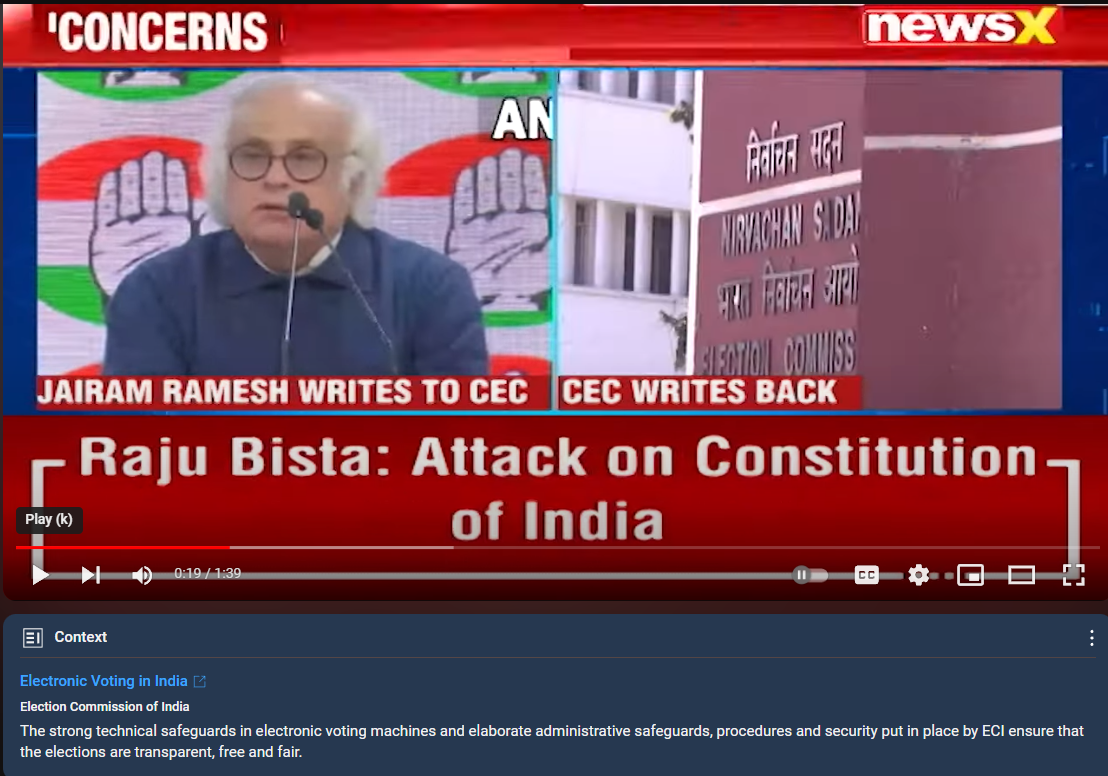
YouTube started introducing a “Context” information panel earlier this week to videos that cast doubt on Electronic Voting Machines (EVMs) amid the opposition’s regular and scathing attacks on the device ahead of the Lok Sabha elections. It functions as an Election Commission of India (ECI) disclaimer. The information panel directly below the video highlights the “safeguards” put in place to guarantee “free and fair” elections. It also includes a link to the ECI’s Frequently Asked Questions (FAQs) webpage about EVMs and VVPAT (Voter Verifiable Paper Audit Trail) devices.

Screenshot from Newsx Live YouTube channel

“The strong technical safeguards in electronic voting machines and elaborate administrative safeguards, procedures and security put in place by ECI ensure that the elections are transparent, free and fair,” read the information panel, titled ‘Electronic Voting in India, Election Commission of India.’ The development transpired a few days after the poll panel sent a letter to YouTube and asked for the information to be introduced. The EC also provided a list of seventy videos along with it. The action was taken in response to concerns over the application of VVPATs and EVMs. YouTube search results for “EVM” have also begun to show the same information box.

Screenshot from YouTube

The opposition I.N.D.I. Alliance has written to the EC multiple times voicing reservations regarding EVMs and VVPAT machines barely months before the Lok Sabha elections scheduled to take place in April and May of this year. Responding to one such letter written by Jairam Ramesh, EC said that no new allegations have been made, and all the concerns raised by the opposition have been comprehensively addressed by the poll panel. The Election Commission has said that it has full faith in the use of EVMs in elections.

According to sources, additional content regarding EVMs will in the future include the information panel and a link to the FAQs. Furthermore, the EC is contacting X (Twitter) and Meta (Facebook) to request that disclaimers be incorporated into content pertaining to EVMs.

A report this week about veteran congress leader Jairam Ramesh writing to the EC to ask for a meeting to discuss VVPATs, a four-year-old interview of a former Indian Administrative Service (IAS) officer Kannan Gopinathan expressing worries about the use of VVPATs and a 2022 news report by a local TV channel in the United States city of Detroit about voting machines in Georgia are among the videos where the information panel has already been displayed.

According to the Georgia report, a professor of cyber security at the University of Michigan is involved in a legal dispute over claims that voting machines are vulnerable. The footage contains the same information panel even though it has nothing to do with India’s EVMs. This is because the film alludes to purported voting machine fraud, according to EC sources. Indian viewers can see the disclaimers.

Videos on subjects that are “prone to misinformation” are anticipated to have the “Context” panel, as per YouTube. “When you search or watch videos related to topics that are prone to misinformation, such as the moon landing, you may see an information panel at the top of your search results or under a video that you’re watching. Information panels show basic background info, sourced from independent, third-party partners, to give more context on a topic. These information panels will be shown regardless of what opinions or perspectives are expressed in a video,” mentions the platform’s ‘Why am I seeing this’ button on the information panel.

Chief Election Commissioner Rajiv Kumar had requested social media corporations to deploy artificial intelligence and algorithms to identify deepfakes when he spoke at an international conference in January of last year. According to him, the dissemination of “deepfake narratives” has become a global phenomenon during election seasons.

The opposition coalition had stated that EVMs appeared to be “susceptible to manipulation” in a memo sent to the European Commission on 9th August of last year. On 23rd August, the EC amended its “FAQs” webpage in reaction to providing answers to some of the queries.

The opposition has repeatedly asked for a meeting with the EC, most recently through Jairam Ramesh on 30th December. “On October 2, 2023, a follow-up representation was sent by us through counsel. The representation raised specific concerns which remained unaddressed in the ECI’s clarification of August 23, 2023. No response was received on the same. On December 20, 2023, we again requested an appointment with the ECI to ‘discuss and provide suggestions on the use of VVPATs’ based on a resolution passed at a meeting of leaders of INDIA parties held the previous day,” claimed the letter.

The voting panel reacted to the head of the Congress by stating that it had “full faith” in the EVM and that it and VVPAT comply with the laws that have been reinforced over the last forty years by successive Union administrations. The EC noted that the poll panel website’s “FAQ” section answered questions about EVM and VVPAT. The opposition was not satisfied with the reply they have received. The parties also approved a resolution last month calling for 100% counting of VVPAT slips rather than the existing 2% verification.

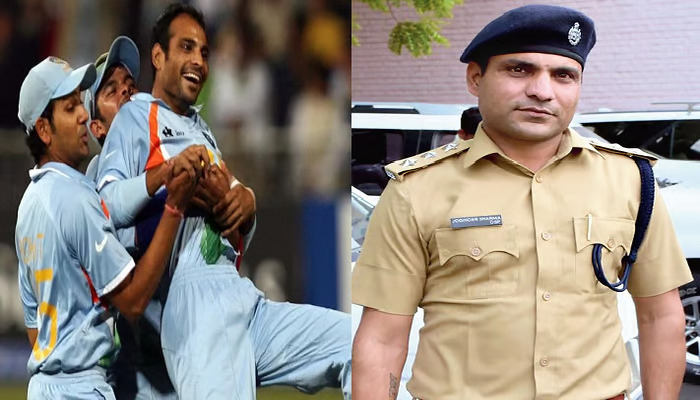
Hero of 2007 T20 World Cup final Joginder Sharma moves High Court over not being included in IPS elevation list

0

Former international cricketer and 2007 World Cup star Joginder Sharma, who has been serving as a DSP in Haryana Police under the sports quota, has petitioned the Punjab and Haryana High Court. Sharma too this decision after his name was not included in the list of those being considered for elevation to the Indian Police Service (IPS) cadre. Sharma said that the state government is considering elevating 12 state police officers to IPS, with the majority of the DSPs on the list joining state police in 2009.

Despite joining on October 5, 2007, and completing probation before at least 11 DSPs on the list, his name was not included. Joginder Sharma alleged that the state authorities illegally stated in the letter that the petitioner’s service was confirmed upon completion of training. He claims that this condition is illegal because it violates the appointment letter and applicable rules.

In his plea. Joginder Sharma submitted that the appointment based on sports achievement is offered to promote sports and citizens’ interest in sports so that the country can excel in the field internationally.

“A bare reading of Rule 10 makes it amply clear that an entrant in service is not an intern and is inducted in service as a full-fledged employee. Thus, the period of service of the petitioner before completion of training cannot be excluded for the purpose of completion of probation period for the sake of confirmation,” the plea stated as per the TOI report.

Sharma’s plea stated that he joined as a DSP in Haryana Police on October 5, 2007 and that it was explicitly stated in the appointment letter dated September 4, 2007, that he would be on probation for two years, including the period of training. However, he was confirmed on January 9, 2014, six years and three months later, according to orders dated November 23 and 29, 2023.

Bangladesh: Masked man sets 150-year-old Buddhist monastery on fire, ruling Hasina govt accuses Opposition BNP of orchestrating the attack

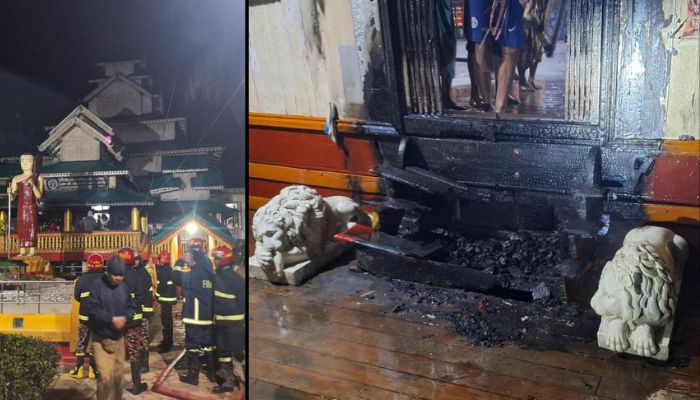
On Friday (5th January) night, a fire broke out at the entrance of an ancient Buddhist monastery in the Cheranghata area in Ramu upazila in Cox’s Bazar district of Bangladesh.

According to the officer-in-charge of Ramu police station Abu Taher Dewan, the incident took place at 2 a.m. when the priests of the 150-year-old monastery were asleep.

Dewan said that after the priests shouted for help, the locals came to the rescue and doused the fire. “After receiving the information, Ramu Fire Service reached the spot and brought the fire under control. A wooden staircase inside the Buddhist monastery premises was gutted in the fire incident,” he added.

“However, there was no other major damage as the fire was extinguished immediately,” informed the Officer-in-Charge of Ramu police station. The fire that broke out at the 150-year-old monastery completely gutted the stairs.

It must be mentioned that the holy shrine is sacred to the Rakhine community of Cheranghata. A large contingent of police was deployed in the area in the aftermath of the incident.

The cops began investigating the matter and analysing CCTV footage in the area. They were trying to determine whether the incident was an accident or an act of sabotage.

It later emerged that a ‘masked man’ scaled the wall of the monastery, poured kerosene on the staircase and set it on fire. The development was confirmed by Rapid Action Battalion-5 spokesperson Jamilul Haque.

“Everything will be clear once we identify the youth in the CCTV footage and the person who called the Fire Service,” remarked Officer-in-charge of Ramu police station Abu Taher Dewan.

While tweeting about the incident, the Sheikh Hasina-led-Awami League party accused the Opposition Bangladesh Nationalist Party (BNP) cadres of orchestrating the arson attack. The incident took place two days before the general election in the Islamic Republic.

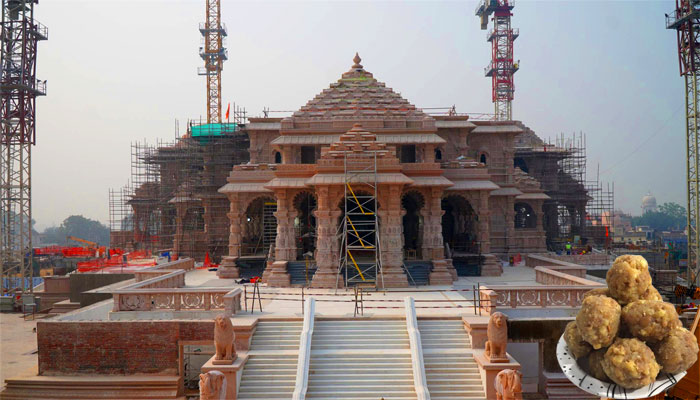
Tirupati laddoo Parasadam for Bhagwan Shri Ram devotees for Ram Lalla’s Pran Pratishtha ceremony in Ayodhya

0

One lakh laddoos are being prepared in Andhra Pradesh for the Pran Pratishtha ceremony of Bhagwan Ram in Ayodhya. The ceremony is scheduled for 22nd January 2024. Prime Minister Narendra Modi, Uttar Pradesh Chief Minister Yogi Adityanath, RSS Chief Mohan Bhagwat, saints and devotees have been invited to the mega event. As per reports, ‘Srivari laddu’, a Prasadam that is offered to Bhagwan Venkateswara in Tirupati, Andhra Pradesh, is being prepared for the devotees of Bhagwan Ram for the auspicious day.

The Tirumala Tirupati Devasthanams are preparing the laddoos. TTD executive officer AV Dharm Reddy said in a statement on 6th January, “We have decided to distribute 1.25 lakh laddoos as a gesture of goodwill to devotees and VIPs attending the consecration ceremony.” Calling it a historic moment for all followers of Sanatan Dharma, he said, “TTD’s primary objective is to promote and propagate Hinduism, culture, and values, so we feel honoured to participate in the Ram Janmabhoomi Puja.”

Each laddoo will weigh around 25 grams. Typically, Tirupati laddoo weighs approximately 170 grams. The laddoos will be transported to Ayodhya via road and will reach the destination a day before the ceremony. The laddoos will have a shelf life of five days.

Furthermore, Tirupati Trust is waiting for a nod from the UP government to allocate land for the Bhagwan Venkateswara temple replica in Ayodhya. TTD plans to construct Balaji Temple in every state and UT across the country. It has already built such temples in New Delhi, Jammu, Kurukshetra, Maharashtra, Tamil Nadu, Telangana, and Karnataka.