Home Blog Page 5521

Gujarat: Members of the transgender community distribute ration in Godhra amidst coronavirus outbreak. Watch video

0

Amidst the outbreak of the Wuhan Coronavirus and a nationwide lockdown, a heart-warming video of members of the transgender community distributing ration to villagers in Godhra, Gujarat have come to light.

Two women were seen pulling a cart carrying food grains such as rice and wheat in packages. The transgender women were seen handing out the packages along with money to the people. The person recording the video could be heard urging the villagers to stay indoors. When a young girl, clad in burkha, approached the transgenders, she was advised to read Namaaz along with her brother every day such that the virus goes away.

This is not the first time when people came forward to help others in society amidst the coronavirus pandemic. Earlier, a 42-year-old man by the name of Krishna Mahanta who hails from Kaliabor area in Nagaon district of Assam has pledged to donate 4 acres or 10 bighas of land to the Government for building a Coronavirus treatment hospital. He has written a letter to the Kaliabor Sub-Divisional Officer making the offer and the same has been forwarded to the Assam government.

Mahanta said, “Money is not everything, money will come, but in this moment of crisis everyone has a duty. I am not doing this for publicity. Our health minister is doing so much, in front of that this is nothing.”

Viral video shows Maulvi refusing to close mosque in coronavirus lockdown, says ‘house of Allah’ can’t be closed

While a large number of Indians are complying with the government strictures of lockdown in the wake of coronavirus outbreak, there are many individuals who have disregarded the government order even as the cases of COVID-19 continue to rise in the country.

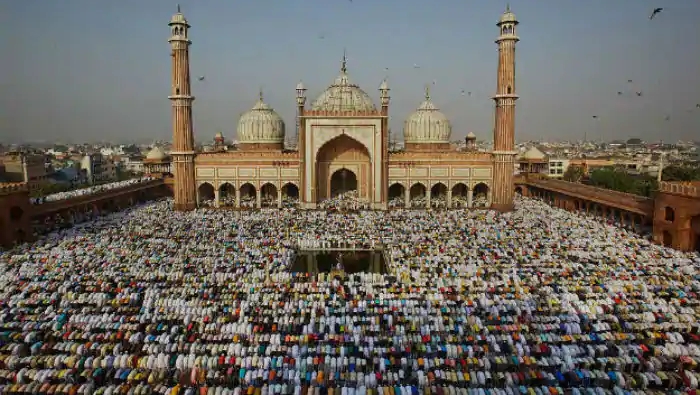
Recently, an unrelenting Maulvi was seen turning down the law enforcement officials’ request to disallow large gatherings in the mosque against the backdrop of rising coronavirus cases in the country. In a video that has now gone viral, a defiant Maulvi can be seen stubbornly refusing to the police entreaties of officially making an announcement through the mosque, requesting the people in the area to desist from visiting the mosque for namaz amidst extensive restrictions imposed to curb the spread of coronavirus.

As can be seen in the video, the police officials request the Maulvi of a mosque to discourage worshippers in the neighbourhood from congregating at the mosque and expose themselves to the risk of acquiring the highly contagious coronavirus. However, the Maulvi refuses to help, contending if police officials can roam around in groups of 15 to create awareness about coronavirus in public, then they should also allow 15-20 members to offer their namaz prayers in the mosque.

“We are asking people to abide by the rules to the extent we deem appropriate. My question to is why are you roaming in the groups of 15 if you are prohibiting others from forming groups? If coronavirus is not going to affect you, be rest assured, it won’t affect us as well,” the Maulvi responded when police officials asked him to announce through mosque requesting people to adhere to the lockdown restrictions.

He further adds, “You are asking us to close ‘House of Allah’ and worship him in our houses. What if we close his house and he closes our house?” Maulvi said while declining the police request of asking worshippers to abstain from visiting and crowding the mosque.

The number of coronavirus cases in the country has soared past 1100-mark. With the number of COVID-19 patients increasing, there is a high probability that the spread of the contagion may enter into the third stage which is characterised by community transmission. In order to prevent such a scenario, the administration officials and police officers are exhorting people to stay indoors and follow the instructions, failing which India could descend into Italy-like chaos where an irrepressible surge in coronavirus cases overran the public health system, resulting in deaths of about 10,000 people so far.

Delhi: Dozens of coronavirus cases across the country traced to Tablighi Jamat Mosque in Nizamuddin, hundreds in hospital, 2000 quarantined, area sealed off

0

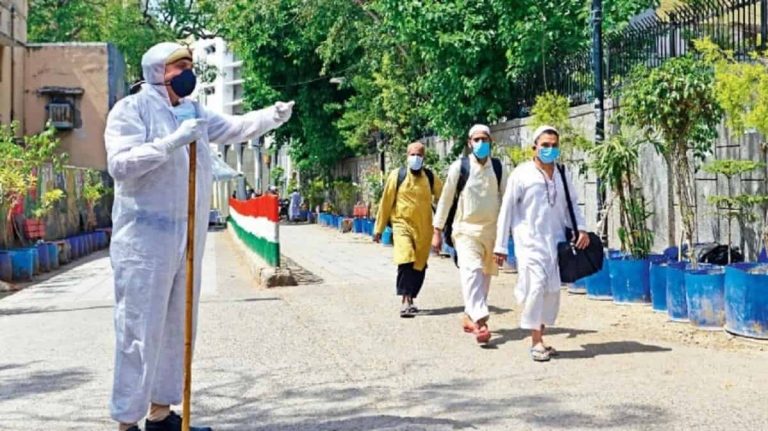
Around 200 people from the Nizamuddin Dargah and surrounding areas were taken to various hospitals in Delhi on Monday after they showed suspected coronavirus symptoms. As per reports, the area around the Nizamuddin Dargah and the Mosque near it has been cordoned off by Delhi police.

Earlier this month, several hundred people from across India and abroad had attended the Islamic religious conference by the “Tableeghi Jamaat” preachers at the Banglewali Masjid, the Mosque near the Hazrat Nizamuddin Dargah. Many cases of coronavirus deaths have now been traced to the Muslim event at the Banglewali Mosque which had seen a large gathering. The Mosque is the It is the global centre for the Tablighi network and the origin of the Tablighi Jamaat, as per Wikipedia.

The Mosque reportedly regularly hosts Islamic followers and preachers from all over India and from many nations in the world. From here, preachers are sent to Mosques all over India.

The event also saw visitors from Indonesia, Malaysia, Saudi Arabia and Kyrgyzstan. On Thursday, a 65-year-old man had died of COVID-19 in Srinagar. He had also attended the same event. The man had reportedly first travelled to the Deoband seminary in UP before going back to Srinagar.

Many of the other attendees had also travelled to all over India to their respective home towns. After the event, people had reportedly left the premises in groups of 20-30 people in buses. While an Indonesian and 6 Saudi Arabian citizens were sent to their home countries, over 1200 people were still staying inside the Mosque, as per reports.

On Friday, 6 persons were tested positive for coronavirus in Andaman and Nicobar Islands. All of them had attended the religious event in Delhi and had returned via Kolkata.

Other confirmed cases who had attended the event at the Banglewali Mosque include a 52-year-old man from Guntur and a man from Tamil Nadu who also died of the disease.

On 19 March, 7 Indonesian nationals who had travelled from Delhi to Karimnagar for an Islamic event had tested positive for coronavirus. They all had travelled in the same coach.

On Sunday, 4 members of the same family tested positive for the coronavirus in Tamil Nadu, taking the total number of infected persons to 50 in the state. The 4 were reportedly contacts of the two Thai nationals who had tested positive earlier. Both Thai nationals were a part of the religious event in Delhi. As per a report in The Week, Islamic preachers had fanned out from Delhi after the event and had travelled to many states, visiting Mosques and homes of Muslims. In Tamil Nadu alone, 819 people were listed as ‘suspected cases’ after they had attended the event in Delhi.

The total number of cases in Tamil Nadu is now 67. TN government has stated that over 1000 people form Tamil Nadu alone had attended the Islamic event in Nizamuddin, Delhi.

A medical camp has been set up in the area and samples are being tested. Drones have been deployed to maintain strict vigilance over movements. As per reports, over 2000 people in the area are under quarantine.

As per reports, the people from the Mosque are the largest group of people in India being tested for coronavirus. Contact tracing has already been started to identify people who may have been exposed in Delhi and Deoband.

The sheer number of gatherers at the religious event among coronavirus suspected cases is a cause of worry because not only have they travelled across Indian before the lockdown kicked in, but also the larger possibility of contact transmission all over India.

The urgency of Nationwide lockdown and how it differs​ from a curfew: A legal study

In the last six years of his tenure, our Prime Minister has addressed the nation six times, out of which two times was about the Wuhan Coronavirus. This shows the urgency of the situation. In his second address to the nation over COVID-19, PM Modi announced complete lockdown across the country for 3 weeks from midnight 24th March 2020 till the 14th April 2020. The importance of this lockdown is that it is a uniform lockdown. Before this, there were partial lockdowns in different states and the State Governments had the discretion to regulate it accordingly. But this time it is across India. Other countries like Italy and Iran have tried partial lockdown and have miserably failed.

There are certain legal points that will be discussed in this article. Questions like, what empowered the central government to take such an extreme step without declaring emergency? or what is the difference between curfew and lockdown? or What is Section 144, CrPC? Or something as trivial as whether only use of vehicles is banned?

To answer the first question, it pertinent to note that until the 24th march, it was the Indian Epidemic Disease Act, 1897 which granted both the State and Central governments to take any temporary measure for controlling and preventing the outbreak of a disease. The Act also states that whoever contravenes any order or regulation made under the Epidemic Disease Act, he/she shall be punished as per section 188 of IPC. The Act also gives the power for inspection, segregation and temporary accommodation of persons suspected by the inspecting officer of being infected with any such disease. 

This Act, however, is quite limited. It does not have provisions to enforce mandatory quarantines or social distancing, to provide for quick release of money, or to take over the government or private buildings to provide relief etc. It gives powers to health officials but very little to the law enforcement agencies, which are now implementing complete lockdown. That is the reason why the Central Government took course of Disaster Management Act, 2005. The penalties given under the Disaster Management Act (DMA) is much stricter than those given under the India Penal Code. It provides powers to the enforcement agencies to whatever it takes to stop the disaster.

The range of DMA is wider than the Epidemic Act in more ways than one-it provides for detention of any person for defying government orders including government officials and directors of the private companies. The jail term prescribed is one year for the first offence and two years for the second. The officials notified as nodal officers (district magistrates in this case) can summon anyone to perform duties for disaster mitigation and relief. A department head could be held responsible for any dereliction of duty by the personnel reporting to him etc.

Section 144, CrPC, Curfew and Lockdown

In simple terms, these three are the degrees of the measure taken by the State to control a particular situation. So, the fundamental difference lies in the degree of severity. The first step is Section 144- despite that if situation is not under control Government can announce Lockdown; if Lockdown too can’t control the situation then state can opt for curfew as a last resort. Curfew is the most severe. 

Where Section 144 empowers Executive Magistrate (District Magistrate or SDM)to pass an order (prohibitory order) in public interest, Lockdown or Curfew can only be passed by the District magistrate. Secondly, even though the nature of all three provisions might be different, their grounds are the same, i.e. danger to human life, riot, Affray, Public tranquility. So, if there is riot or anything that apprehends danger to public health, then any of the above measures can be taken. Thirdly, it is to be noted that where Section 144 prohibits only unlawful assembly(five or more than five people coming together) or arms(sale or purchase of arms), Lockdown may prohibit some more things along with ‘prohibiting unlawful assembly’ and ‘arms’. Like, it can shut down flights, trains and all sorts of public transport. Both u/s 144 and lockdown, essential services remain open- though it depends upon the discretion of each state to decide what all to include in the list of ‘essential services. The scope of essential services is further restricted in Curfew. What might be allowed in a lockdown might not be allowed under a Curfew- like banks, petrol pumps might be opened in a lockdown but suspended in a curfew situation. Where the objective of lockdown is to restrict the movement, the object of curfew is to confine people in their homes. During curfew, if someone wants to come out of his/her residence, he/she has to take prior permission of the police. It is however to be noted that whether it is S.144 or Lockdown or Curfew, government has the authority to ban the internet services.

In the light of the present situation, there are certain provisions under Indian Penal code that are very important to be discussed. Section 188punishes those who disobeys the order of public servant with an imprisonment up to 1 month or fine of 200 rupees or both, and if such disobedience causes danger to human life, health or safety the imprisonment may extent to 6 months or fine up to 1000 rupees or both. The offence is cognizable, that means police can arrest without warrant. This is the same provision the reference of which is given under Indian Epidemic Act.

Section 269punishes those who negligently or unlawfully do any act that they know would spread the infection of any disease dangerous to life. It has punishment that extends to 6 months or fine or both. Section 270is a graver form of S.269 and it punishes those who malignantly do something that would spread infection; here criminal intent is to be seen. The imprisonment may extend up to 2years or fine or both.Section 271is particularly relevant as it talks about quarantine situation. It states that whoever knowingly disobeys any rule made by the Government for putting people in a state of quarantine, anyone who disobeys the order shall be punishable with the imprisonment for 6 months or fine or both.

Therefore, it is important to stay at home, avoid panic. The world is not coming to an end, it is slowing down for a while though. There are a number of services that will stay open, like Hospitals, nursing homes, police, fire stations, ATMs, shops dealing with food, groceries, fruits, vegetable, dairy, meat, fish, animal fodder etc. Banks, insurance offices, print and electronic media, E-commerce delivery of essential goods like food, pharmaceuticals and medical equipment, Petrol pumps, LPG and gas retail outlets, Capital and debt markets notified by SEBI, Cold storage and warehouse, Telecom, internet, broadcast and cable services will be available. Everything that is necessary for day to day activity will be provided. However, all transport services (air, rail and roadways) are suspended, industries that not involved in essential commodities, all hospitality services (hotels etc) shall be suspended except those accommodating stranded tourists and persons stranded due to lockdown.

All places of worship, social, political, sports, entertainment, cultural gatherings are barred; all educational, training and research institutions will be closed. The purpose is to avoid crowd gathering as much as possible. And since the enemy here is an invisible one, the situation in many aspects is graver than a war. Social distancing is the only option left. So, walking, driving, riding-everything that helps you move from one point to another is prohibited. The restriction is on your movement and not your vehicle. Therefore, instead of cribbing about the situation, let’s make it an opportunity to transform ourselves into a better generation.

Rana Ayyub, William Dalrymple share old picture of curfew defaulters being punished as that of migrant labourers

As India fights Wuhan coronavirus, propagandists masquerading as ‘journalists’ and ‘historians’ seem to have taken upon themselves to spread misinformation. ‘Journalist’ Rana Ayyub today took to Twitter to share an image of some men made to squat and hold their ears as punishment. The men were standing on side of a road in a line.

Rana Ayyub’s now-deleted tweet

In a now-deleted tweet, Ayyub claimed that the labourers were being punished for leaving the lockdown. However, the image is not of labourers being punished but is of those who broke the curfew last week. As pointed out by Twitter user @AttomeyBharti, the image is from 24th March, 2020 from Kanpur.

24th March, 2020 image shared by Rana Ayyub as recent

As per ABP News, the above men were punished by the Kanpur Police for flouting lockdown guidelines in wake of coronavirus pandemic on 24th March, 2020, Tuesday.

The same image was also shared by ‘historian’ and author William Dalrymple with similar claims.

Now deleted tweet of William Dalrymple.

Dalrymple, too, has now deleted the tweet.

However, even before Rana Ayyub and William Dalrymple tweeted the misleading image, it was shared by Jawaharlal Nehru University Students’ Union’s official Twitter account.

JNUSU tweet

The JNUSU tweet is still not deleted, though. An archived version of the same can be accessed here.

Nirbhaya and the Nation get closure, but the Death Penalty debate still rages on

The deliberations on death penalty gained significance in public discourse the day Nirbhaya’s mother, Asha Devi and her father Badrinath Singh began proceeding from one court to another in search of justice for their daughter, who India named Nirbhaya. 

“Today, you have received justice,” Asha Devi told her daughter’s picture, as she hugged it on the morning of March 20, 2020. 

5:30 am, at Delhi’s Tihar Jail, her daughter’s brutal killers had finally hung to death. The day commenced with full-day news coverage and people on the road holding banners, chanting slogans in celebration. 

But for Nirbhaya’s parents, this morning arrived after a prolonged night of seven years and three months. Like many, they were let down by the system on various occasions. 

The convicts’ counsels applied all delay tactics while exploiting legal loopholes to hold back this morning from Nirbhaya’s parents and the nation. A few women’s right organisations wrote letters to the president to stay the execution. Not far from the hanging, lawyer and activist Indira Jaising even “urged” Asha Devi to forgive her daughter’s criminals and emulate Sonia Gandhi, who forgave her husband’s assassins.

Asha Devi was disgusted at Jaising’s request and responded with allegations that it was because of people like her that rapists could manipulate the system. She accused human rights activists of snubbing the rights of victims to fund their business beneath the guise of activism. “I am no saint. I am a mother of a daughter, who has lost her life. I want justice. Even if God were to ask me to forgive them, I will not.” Asha Devi had stated.

The brutality of that wintery night sent a chill down the nation’s spine, stirring massive public outrage and demonstrations against a lack of security for women and the demand for capital punishment to Nirbhaya’s sadistic killers. Her case redefined India’s rape laws.  

The details are graphic, not nearly as horrific as what transpired that night, but a starting point in understanding why Asha Devi cannot forgive her daughter’s predators as some have suggested. 

On an ordinary night in New Delhi’s December, when Nirbhaya and her friend couldn’t get a single auto rickshaw to drop them home after a movie, they had to settle for a private bus with less than ten passengers. The bus with tinted glasses drove only a little ahead when someone switched off the lights. 

Six barbarians beat Nirbhaya’s friend with iron rods and dragged her to the rear of the bus raping her brutally in turns. She was bitten all over the body and subjected to unnatural sex. They did unspeakable things to her, but fatal was the iron rod which they forced inside her private organs till her intestines tore and came out. For an hour and over 30 kilometres, they ignored her calls for mercy.

Reduced to an object, Nirbhaya passed out. Assuming her dead, the six discarded her and her friend naked from the bus and onto the road, attempting to crush them to death. But Nirbhaya’s friend pulled them away in time. With a stroke of delayed luck, the two survived long enough to be discovered and driven to Safdarjung Hospital. Nirbhaya entered the hospital with her lips split, cuts and bruises over her body, drenched in blood with barely five per cent intestines left inside her. 

After surgery, she longed for even a drop of water which her critical condition did not allow, till whatever remained of her life. According to Asha Devi, she would always regret not fulfilling her daughter’s wish. 

The doctors had exhausted everything that could have saved her. She was flown to Singapore for multiple surgeries but was declared dead from sepsis and multiple organ failure on December 29, 2012. The doctors claimed Nirbhaya only lived this long when she should have died on the road that night because of her strong-will to survive. 

Justice was delayed but served, and the country shared collective relief. However, not everyone shared the sigh. UN secretary-general’s spokesperson–Stéphane Dujarric–reiterated UN’s stand against death sentences after the hanging, while Amnesty International India went as far as to call it a ‘dark stain‘ on India’s human rights record. 

Portals published articles singing justice from the perspectives of convicts and their kin. But it must not be assumed that since their criminals have hung, stories of Nirbhaya and the many victims should disappear. She was a victim. And death to her killers should mean neither the last word on the torture she endured nor spell for her parents, further misery.

Those against capital punishment in India share broadly these concerns: that the death penalty is state-sponsored murder and vengeance, making the state a criminal. It violates rights to equality and life even as no data supports its deterrence effect. It is an irreversible punishment pronounced by a fallible system. The social and psychiatric circumstances of criminals or the influencers behind their behaviour such as illiteracy, poverty etc. are overlooked. 

One of Nirbhaya’s rapists who allegedly committed suicide inside his cell became more aggressive after Nirbhaya bit him to protect herself. He was the one who inspired the juvenile with “Let’s go have some fun.” Their conspiracy stretched to the aftermath of the crime when they destroyed evidence to live the lives of innocents, dividing the loot from that hellish night among themselves, displaying no transgression. They pleaded not guilty

Asha Devi observed the convicts were unapologetic and even cracked jokesduring trials. A few years ago awaiting justice for Nirbhaya, she described her family passing each day in agony, dying a slow death. The banned documentary–India’s Daughter, which released three years after the horrific gang-rape, exposed how one convict remained unrepentant. He held Nirbhaya accountable for the “accident”, calling the night a lesson for her. 

Abolitionists insist we are obligated to reform and rehabilitate all criminals and analyse poverty as a foundation of that reasoning that leads to rape. But surely one can’t presume them all within the scope of recovery? Moreover, do the wealthy and high-profile never rape or kill? Nirbhaya’s rapists were poor. But so was she. A limit in extending reform is not unrealistic; neither is it to accept that some may be past it. 

Apropos deterrence, not the severity of the death sentence but its promptness and certainty(something lacking in our system) drives deterrence. A couple of months ago when asked if death penalties were a solution despite nothing changing in seven years, Asha Devi replied, “I want to ask you, has even one convict been executed for rape, in seven years even Nirbhaya’s rapists didn’t hang, how can we hope to examine if it brought about change or not?” 

So is data on capital punishment as an inefficient deterrent the closing word upon it? R Basant, Senior Advocate, arguesthat reliable empirical data on deterrence may never be found. How can one find the number of crimes notcommitted from fear of the death penalty? How do you record crimes that didn’t occur? He recommends comparing data from periods with and without a death penalty to expect fair results. 

But India has always had capital punishments since independence, and an escalation in capital offences could be from numerous unobservable and subjective factors influencing crime rates, hence such data may be an inaccurate indication on its own. 

Advocate Basant also shared a thought that Indira Gandhi would have been murdered much earlier if her bodyguards didn’t think they’d be killed for their crime, asserting that deterrence is perceptible subjectively, but difficult to determine empirically.

As J Sai Deepak, Advocate, putsit, it is a terrible logic to say hanging doesn’t reduce crimes as that approach questions the very existence of concepts of law and punishment and their utility as deterrents.

Obstacles in keeping reform open to allinclude repeat offenders and risks associated with granting bails, amidst recurring instances of out-on-bail criminals assaulting their victims and other citizens. Last year in Kota, a 36-year-old rape survivor along with her husband, was stabbed by a rapist. In Jharkhand, a gang-rape victim’s father was murdered by five accused men. This year two men accused of raping a minor were arrested for killingher mother. In February, a man from Gujarat raped and killed his 6-year-old niece. All of them were out on bail.

Activists rightly pinpoint that about 100 countries abolished capital punishment. Yet it is also true that South African citizens are demanding the death penalty back. A petition is up with more than 6 lakh signatures, demanding capital punishment for crimes against women. 

Philippines President Rodrigo Duterte expressed a similar view for return of the death penalty for drug traffickers. The USA recently restored the penalty for federal inmates. Russia, with a moratorium, has more people asking for a death sentence for hardened criminals in 2019 than two years before, with half the population now favouringno moratorium.

As per a YouGov poll, 58% Britons approved the death sentence for murders in terrorist acts, 57% for multiple murderers, 53% for the murders of children and 47% for murders of police officers. 

India is one of the retentionist countries keeping a death penalty, first constitutionally upheld by the Hon’ble Supreme Court, in Jagmohan vs State of Uttar Pradesh, AIR 1973 SC 947.

A constitutional bench in Bachan Singh vs State of Punjab,AIR 1980 SC 898,provided the doctrine of”rarest of rare” to be applied when alternatives are dismissed indubitably, i.e. onlywhen a murder is committed in an extremely brutal, grotesque, diabolical, revolting or dastardly manner so as to arouse intense and extreme indignation of the community.

In the Machhi Singh vs State of Punjab, AIR 1983 SC 957case, the supreme court ruled the criteria for cases to fall in “rarest of rare” ambit. These covered “manner of commission of murder, motive for commission for murder, socially abhorrent nature of the crime, magnitude of the crime and personality of victim of murder.” 

With these guidelines,inter alia, it is to be assessed whether something unusual about the crime makes life imprisonment insufficient and whether the death penalty is unavoidable despite due consideration to mitigating circumstances in the offender’s favour. 

The Indian judicial system further provides the accused with adequate opportunities through a hierarchy of courts from trial and conviction to curative and mercy petitions for them to commute their sentence and be spared gallows. As per National Crime Records Bureau, from 2328 convicts awarded capital punishment between 2001 to 2018, only four convicts faced execution. No rulings are furnished hurriedly. Besides, as seen in Nirbhaya’s case, the delay only serves the convicts. 

This inordinate delay in receiving justice, some contend, is why the public applauds encounters. The supreme court has recently agreed to examine the centre’s plea for ‘victim and society-centric’ directions in death penalty cases to confront this matter.

The UN condemns capital punishment. Nonetheless, as per Article 6(2) of International Covenant on Civil and Political Rights, countries which retain capital punishment are instructed to use it solely for grave crimes following the law in force after a competent court announces a judgement.As noted above, India strictly obeys the same, awarding capital punishment onlyas an exception in extreme cases while life imprisonment remains the rule. 

Responding to one of centre’s requests for an opinion on abolishing the death penalty, from 14 States and 5 Union Territories, 90% favoured to retain it. In 2018, the Punjab Government under Captain Amrinder Singh suggested the centre to consider the death penalty for drug smuggling. According to Singh, drug menace ruined generations in Punjab requiring exemplary punishment.

Defending the death penalty neither rejects the necessity of reforms in policing and vigilance nor supports indiscriminate use of the state’s monopoly on violence. Crimes must be fitted with proportionate punishments. And that is not an ‘eye for an eye’.

Crime and punishment morally differ; they are not one of the “two wrongs” which don’t make a right. To call the death penalty murder and violation of life is to call a jail-term kidnap and violation of personal liberty. Both rights are subject to the procedure established by law. Killings are not morally equitable either. You can’t equate Nirbhaya’s killing/murder with the killing/punishment sentenced to her murderers. 

Justice is impartial, rational and provides closure. It is detached and restricted with limits. Revenge is emotional, personal and retaliatory. No one in India is granted capital punishment without a thorough and fair trial first. Further, all improvements wanted in the legal system can be worked upon even with the penalty in force. 

One of the surgeons treating Nirbhaya said he had never witnessed a patient like her with cruel and incurable injuries inflicted by a human, in almost 40 years of his practice. If the gory, gut-wrenching details of how Nirbhaya was subjected to fatal gang-rape do not ace the tests of rarest of the rare, inviting the maximum punishment of death penalty, what will? 

COVID-19 Lockdown: How IIT-D students’ initiative to help on-campus rickshaw-pullers inspired the Institute to set up the ‘Benevolent Fund’

Days before Prime Minister Narendra Modi called for an extended nationwide lockdown, the Indian Institute of Technology- Delhi, realising the gravity of the situation amidst the coronavirus outbreak had already announced a 16-days suspension of the college starting March 15. The institute authorities had sent an email to the students on March 13, asking them to go home and informing them about the suspension of the classes till March 31 due to the threat posed by the novel covid-19.

The impact of the closure had a profound impact on the daily earnings of the rickshaw-pullers operating inside the campus. From earning Rs 500- Rs 600 per day, their daily incomes had drastically reduced to Rs 20-Rs 30, owing to the discontinuation of the classes. Alarmed by the fact that the temporary closure of the institute has dramatically affected the livelihood of rickshaw-pullers inside the campus, some enterprising students of the Indian Institute of Technology-Delhi took it upon themselves to provide financial assistance to the rickshaw pullers.

Spearheaded by Adarsh Kumar, a fourth-year Civil engineering student at the campus, an initiative to provide monetary aid to the rickshaw-pullers was launched under the aegis of An Initiative for National Advancement(AINA), a social service group of volunteers from IIT-D, working towards making a better India. Kumar, the overall-coordinator at AINA, along with other members such as Divyanshu Saxena from Computer Science branch took to Facebook, Whatsapp and other social media platforms to crowdsource money for the hapless rickshaw-pullers and alleviate their financial woes for the time being.

While talking to OpIndia, Kumar said that their initiative of pooling money for the rickshaw-pullers struck a chord with the faculty members as well the Institute’s Director V. Ramgopal Rao who also made monetary contributions towards the fund raised by AINA.

“After the suspension was announced by the college authorities, we saw that the rickshaw-pullers were really struggling to earn their daily livelihood. Their daily earning had staggeringly dropped from Rs500/700 to a paltry Rs 20 per day. It is then that we envisaged an idea of crowdsourcing funds to help the rickshaw-pullers tide over this difficult phase. Through AINA, we reached out to everyone willing to contribute to this cause. Faculty members also joined in. Our venerable Director V Rao Sir also made a contribution of Rs 5000 in this fund,” Kumar said.

Stressing the importance of transparency in such initiatives, Kumar said that whatever amount they had collected was disbursed to the rickshaw-pullers and the payment and contact details were uploaded on Google Drive link for anyone to verify to it. On March 26, Kumar uploaded a post on his Facebook page, announcing that they have almost reached their target amount and disbursed money to 17 rickshaw-pullers.

IIT-D student Adarsh Kumar’s post on Facebook informing about the disbursement of money to rickshaw-pullers

“There are 17 rickshaw-pullers in the Institute campus. Through our sustained efforts, we were able to pool Rs 120,000. We then dispersed Rs 7000 each to the rickshaw-pullers,” said Divyanshu Saxena, a fourth-year Computer Science student, who was also actively involved with Kumar in the initiative to provide financial support to the rickshaw-pullers.

Divyanshu mentions that their initiative kindled the College administration to institutionalise a “Benevolent Fund” to be better equipped in helping the underprivileged and daily-wage workers who depend upon the institution for their livelihood. Divyanshu was also a member of the committee along with various deans, faculty members and the Institute Director that created the “Benevolent Fund”.

The IIT-D Director V Ramgopal Rao sent an email to students, faculties, alumni and staff members to inform about the voluntary initiative taken up by the college students to provide living allowance to the rickshaw-pullers on the campus. He also added that the administration has decided to expand on the initiative and to “carry it beyond the present crisis” and a ‘Benevolent Fund’ has been established which would receive voluntary contributions from the donors in a formal and transparent manner for meeting the needs of the campus community members belonging to the lower rung of the economic ladder.

“A committee chaired by me would oversee the fund collection, disbursement and transparency of its operation. Prof. M.R Ravi of Department of Mechanical Engineering, who is vice-chairperson of the committee, would oversee the activities of the committee,” the mail sent by Director Rao read.

“It is the matter of honour and pride that your institution recognises your efforts and expands it to cover other underprivileged members of the community on campus. There are at least 1000 people on campus who would stand to benefit from this Benevolent Fund,” Adarsh said.

Ai Fen, doctor in Wuhan, who was first to raise alarm over Wuhan Coronavirus, disappears in China after criticizing authorities

Ai Fen, director of the emergency at Wuhan Central hospital, has disappeared after criticizing Chinese authorities over their handling of the Wuhan Coronavirus pandemic. She was the first person to raise the alarm over the virus. Her whereabouts remain unknown. She had alerted her superiors and colleagues of a SARS-like virus seen in patients in December, however, she was reprimanded. Eventually, after seeing so many people die, she criticized the authorities for suppressing early warnings of the outbreak in an interview. The Chinese government has subsequently been trying hard to get the interview off the internet.

It was only two weeks ago that Ai Fen had gone public with her story and spoken to a Chinese magazine, Renwu.

“If I had known what was to happen, I would not have cared about the reprimand. I would have fucking talked about it to whoever, where ever I could,” she said in the interview, as reported by The Guardian. On the 30th of December, Ai had received the lab test results of a patient suffering from flu-like symptoms and resistant to the usual treatment methods. It said ‘SARS Coronavirus’. She took a picture of the results and sent it to a former medical school classmate. By evening, the photo had spread across medical circles in Wuhan.

Read: As the world grapples with Wuhan Coronavirus, China engages in daylight robbery, theft and increased military activity: Read how

The same night, Ai Fen received a message from the authorities at her hospital saying that information about this new disease should not be released arbitrarily in order to avoid causing panic. Two days later, after being summoned by the head of the hospital’s disciplinary inspection committee, she was reprimanded for “spreading rumours” and “harming stability”. Subsequently, the staff was forbidden from passing messages or images related to the virus.

“We watched more and more patients come in as the radius of the spread of infection became larger,” Ai Fen said as the doctors began seeing patients with no connection to the epicentre of the pandemic in Wuhan, its wet market. “I knew there must be human to human transmission,” she said. Her observation was eventually confirmed by the Chinese authorities on the 21st of January when cases had already increased exponentially.

After this interview went public two weeks ago, President Xi ordered her interview erased from the internet. Dr Ai Fen herself has disappeared now, whereabouts unknown.

Read: WHO chief who shielded China in the wake of Wuhan Coronavirus had covered up other epidemics in the past: Here are the details

Ai Fen, however, denied that she is a whistleblower. “I am the one who provided the whistle,” she insisted. Nevertheless she has disappeared now, as so many dissidents in China often do, and her whereabouts are unknown. Dr Li Wenliang, the doctor who had tried to warn others about a SARS-like epidemic in Wuhan, had died on February 7, after days of treating coronavirus infected patients at a hospital in Wuhan. He was also one of the doctors who were warned by Wuhan authorities not to ‘spread rumours’. The Chinese authorities issued an apology to the family of the deceased doctor for the manner in which he was treated when he was alive.

Congress MP from Kerala’s Kasaragod, hotspot of coronavirus outbreak, moves Supreme Court seeking opening of Karnataka-Kerala border to ambulances, essential items

0

The Congress Member of Parliament from Kasaragod, Kerala, which is one of the hot-spots of the coronavirus outbreak in the country has approached the apex court seeking directions to the Karnataka government to open Karnataka-Kerala border for the movement of ambulances, other emergency vehicles and for the transport of other essential and non-essential items to Kerala.

The petition filed by Unnithan sought directions to Karnataka to allow the movement of ambulances, emergency vehicles, trucks and other vehicles carrying essential and non-essential items to Kerala. It also sought to put a stay on the blockade imposed by Karnataka with its border states. The petition said that the enforcement of a blockade at a critical time like this when the supply of commodities is scarce and when a medical emergency has plagued the entire country is a clear violation of Articles 21 and 19(d) of the Constitution.

“This blockade has also resulted in cutting off the essential lifeline of National Highways and State Highways and Major District Roads leading to the State of Kerala which has resulted in the shortage of supply of essential and non-essential items to the State of Kerala leading to shortage supply of food and medical supplies,” the plea said while seeking a stay on the blockade from the Supreme Court for the movement of ambulances and essential items between Kerala and Karnataka.

The number of coronavirus cases in the country is on a steady rise with Kerala being the worst-hit by the contagion and alone contributing 194 to the nationwide tally of 1071. Most of the cases registered in Kerala have a travel history to middle-east countries, particularly to the United Arab Emirates and Saudi Arabia.

It is noteworthy to mention that Kasaragod has emerged as one of the hotbeds of the coronavirus outbreak in the country. A couple of days back, 34 news cases of COVID-19 were registered in the town in a single day, surpassing the previous high of 28 cases, raising alarms for the state administration.

With the coronavirus cases soaring, state governments across the nation have mandated state-wide lockdown of cities, towns and villages, along with state borders, to curb the insidious spread of the deadly contagion that has so far affected 721,000 people globally and rendered about 25000 dead.

On similar lines, Karnataka has sealed its borders as the tally of coronavirus patients increases. Reacting to the alarming surge in the number of the cases of the enigmatic contagion in the neighbouring state of Kerala, Karnataka has fortified all the entry/exit points between Manguluru and Kasaragod, to prevent any influx of people from Kerala and stave off a crisis as faced by the Uttar Pradesh government after migrant workers in Delhi congregated at the Delhi-Uttar Pradesh border.

Street war in Kolkata during lockdown: Councillors Shams Iqbal and Rahmat Alam Ansari booked as their supporters throw bombs at each other

While the entire nation is under lockdown due to the coronavirus pandemic around the world, police personnel and health care professionals are burdened with not only keeping the disease at bay but are also struggling to prevent healthier people from violating curfew and create law and order situations.

In Kolkata late on Sunday night, a vicious street war had reportedly broken out in Ward No 134 and 137, allegedly between two rival Councillors and their supporters. As per a report in India Today, the street battle went on throughout the night, and locals were forced to inform the police.

The street-war occurred in the Kachhi Sadak area on Sunday night. Even police personnel were allegedly assaulted in the fight.

The report states that Kolkata police have informed that FIRs have been registered against the Councillors of the two Wards, namely Shams Iqbal and Rahmat Alam Ansari, for violating lockdown orders and rioting.

Locals have reportedly informed that supporters of the two Councillors were hurling bombs and abuses at each other. As per reports, 7 persons in total have so far been arrested by the police. The area is reportedly a minority-dominated locality which often sees violence, especially in the time of elections.