Journalism professor Margaret Simons in her submission to the Australian Competition and Consumer Petition, which was then preparing a report on social media platforms, flagged a rather pertinent issue. She said that “the current inquiry should not assume that Western digital platforms will be the only ones to gain a foothold in Australia.”
The concerns that Simons raised would resonate with Indians as well who have noticed how way tech giants such as Facebook and Google have played havoc with the privacy of its users. As bad as they are, they are still based in the USA and the current world order, which is a manifestation of Western hegemony, can still be negotiated with rationally to a certain extent.
Facebook and Google, especially, have come under intense scrutiny for their obscure and mala fide practices and pressure is mounting on them to act in the good interests of its users. However, there is another hegemony that is threatening to upend the current world order. In fact, its very goal is to undermine the current international order. The very success of its operations depends on the extent to which it will be able to alter the current dynamics of world politics.
I am, of course, referring to China. The Chinese are rather explicit in their goals and they make very little effort to hide it. As a country that is predisposed towards hostility towards India, China’s success could only be detrimental to us. Should they be successful in their efforts, it could mean disaster for India. Thus, we find ourselves in a situation where our interests ally with those of the USA and the great collaboration between the two countries that we see currently isn’t a mere coincidence or a consequence of the friendship between its leaders.
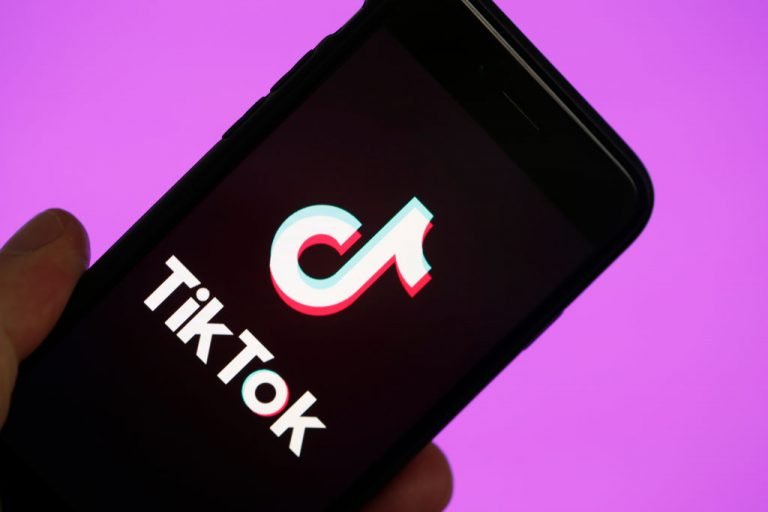
It is an open secret now that Google attempted to manipulate the results of the 2016 US Presidential elections due to the personal animosity of its employees towards Donald Trump. It is also quite well known that Facebook has been manipulating the political opinions of its users. Twitter is not alien to accusations of political bias and its with good reason that they have been accused of such. It is under this context that we need to view the meteoric rise of the Chinese video-sharing app TikTok.
Some of us may be prone to dismissing such concerns by assuming that TikTok is an app where stupid people go to showcase their stupidity. But it has much more far-reaching consequences than that. Recently, we witnessed the manner in which some TikTok ‘celebrities’ incited violence following the death of the thief Tabrez Ansari. The country witnessed significant violence following the incident and it’s unclear still the extent to which TikTok contributed to it.
TikTok is owned by a Chinese company called ByteDance which is often touted to be the world’s most valuable start-up. Digital media platforms are known to collect the personal data of users and TikTok is no different. In its privacy policy statement, it says that it collects “information when you create an account, and use the Platform, such as your contact details, content you create, your location, and credit card details. We also collect the information you share with us from third-party social network providers and technical and behavioural information about your use of the Platform. We also collect information contained in the messages you send through our Platform and your contacts if you allow us access to your phone book on your mobile device.”
It includes information that the user submits voluntarily on his or her own while registering for the site or linking it to other apps such as name, age, gender, address, email address, social media login details, telephone number and financial and credit card information and photographs as well as language selection. Furthermore, it includes the user’s customer profile, the comments made on the Platform (including any Virtual Items contributed to any user-generated content), account and billing details, including but not limited to, the user’s Apple, Google or Windows account, PayPal or other third-party payment channel account where required for the purpose of paying or withdrawing cash. It also includes user-generated content, photographs and video content that the user chooses to broadcast on the platform.
If the user chooses to link TikTok with their accounts on other social media platforms, then TikTok will be able to access information shared on these platforms including his contact list. It doesn’t stop here. TikTok also collects ‘technical information’ about the user that includes the user’s IP address, location-related data and other unique device identifiers, browsing history (including content viewed in the Platform), Cookies, the mobile carrier, time zone setting, mobile or device information including the model of the device, screen resolution, operating system and platform and information regarding the use of the Platform.
Moreover, if the user chooses to find their acquaintances through the contacts in their phonebook, then TikTok can collect information regarding their contacts as well including names, phone numbers, addresses and any other information that the user has stored in their phone regarding their contacts. If the user wishes to do the same through their Facebook accounts, then TikTok can collect the names and profiles of their Facebook contacts.
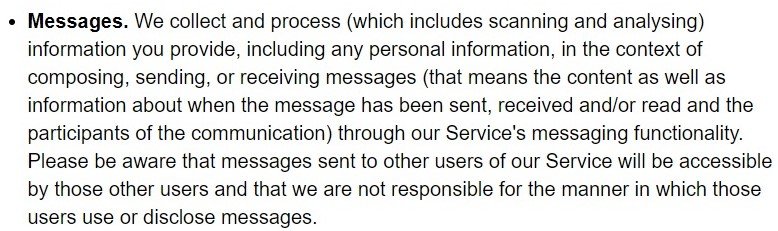
It only gets worse here onwards. TikTok collects and analyses the personal texts that users send to each other on their platform. It actually reads all the personal information that a user has revealed to their contacts on the platform assuming it to be private communication. Now, we can only speculate about the kind of information that people may choose to share in private messages but we can be fairly certain at least a certain extent of those can be extremely compromising for the user.
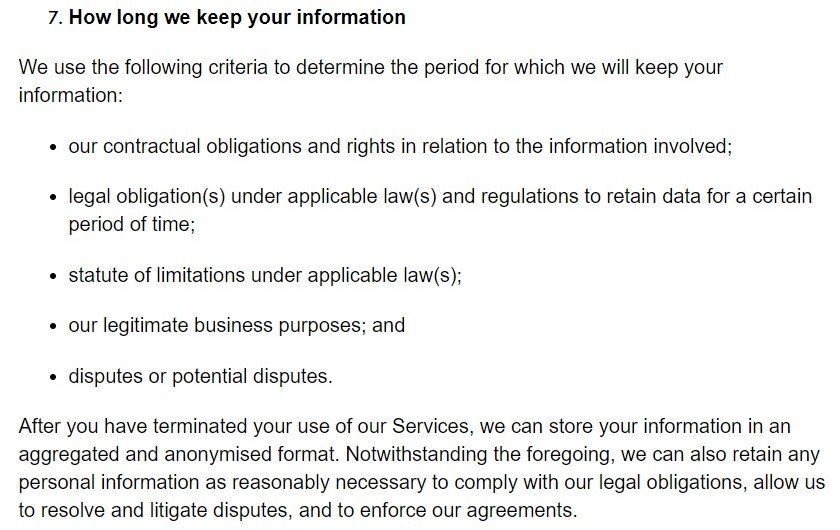
TikTok can also retain user data indefinitely, long after the user has deleted his or her account. It says so as much in their statement.
 The most concerning part, however, is the part of the document which discusses the entities with which it shares the information it collects from its users. Apart from business partners, advertisers and advertising networks, cloud service providers, analytics and search engine providers, and other such entities, TikTok also shares user information with law enforcement agencies and public authorities “if legally required to do so”.
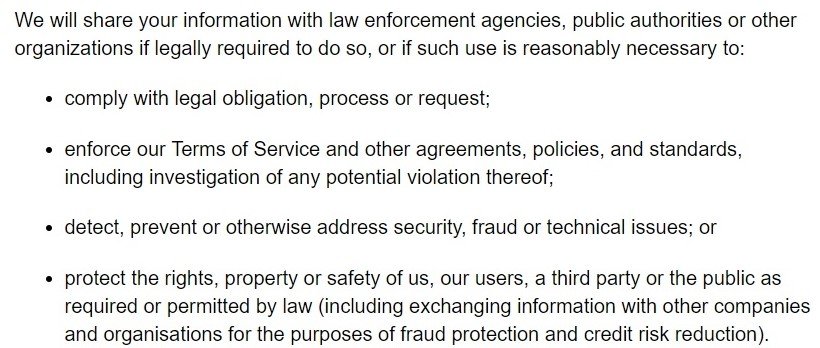
The problem here is, TikTok being a Chinese entity, is legally required to share its information with the Chinese government if such information is sought by it. Considering the nature of the Chinese regime, it appears obvious that the said information has been sought from TikTok and it doesn’t far-fetched to assume that TikTok has shared it with them given the fact that it is legally required to do so. Consider this for a moment, all the information that we have mentioned above in the article, including private texts between its users, is now quite possibly in possession of the Chinese government.
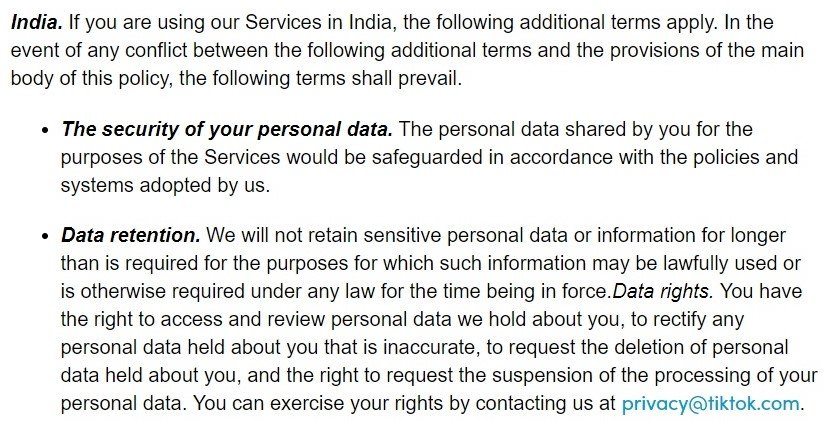
In addition to these, TikTok has a couple of India-specific regulations but that doesn’t subside the rising tide of apprehension.
Even more of a concern is the fact that TikTok has been rising in popularity across the world. Quoting from a report published by the Peterson Institute of Internation Economics published in January this year, “According to market research firm SensorTower, by October 2018 TikTok commanded around 30 percent of monthly downloads of social media platforms on iPhones in the United States, surpassing Facebook’s Instagram and Google’s YouTube. At the end of the year, it charted at number six in Google’s worldwide ranking of apps for the Android mobile operating system, ahead of Netflix and Amazon Shopping.”
The report further states, “Chinese authorities have ample leeway to request information from the private sector, on broadly defined public safety and security grounds, which include “stability maintenance”—another name for suppression of dissent. There have been multiple reports of dubiously motivated data access, some even involving Chinese operations of American companies. TikTok’s privacy policy for both the United States and the European Union states that data may be transferred to China. This transfer is legal, as long as users give their consent.”
In India, by May 2019, ByteDance had 300 million monthly active users across its three platforms: TikTok, Vigo Video, and Helo. These are astonishing numbers that should concern the Indian government. TikTok alone has over 120 million monthly active users.
Considering what we now know about the unimaginable power of tech giants like Facebook and Google and the vast breach of privacy that TikTok is capable of, and some would argue, have already pulled off, it is not difficult to imagine the numerous ways in which the video-sharing platform is a threat to Indian national interests.
It would be perfectly within TikTok’s powers to promote content on its site that could threaten communal harmony in India. Content generated by people has a life of its own and it is completely unpredictable the manner in which they might manifest themselves in the actual world. The recent TikTok controversy following Tabrez Ansari’s death provides a unique glimpse into it. What if TikTok altered their algorithms to promote such incendiary messages to promote social discord in our country at the behest of the Chinese government?
ByteDance has already bowed down to the Chinese government before. In April last year, the company was ordered to shut down Jinri Toutiao after the authorities decided the news stories featured on it were ‘opposed to morality’. Touitao is one of the largest news aggregators in China and it is owned by ByteDance. The company responded by pledging to increase its team of censors from 6,000 to 10,000, the job ads for which noted specifically that candidates with ‘strong political sensitivity’ would be preferred, and it vowed to pour even more resources into developing an Artificial Intelligence-powered automated censorship apparatus.
What’s the guarantee that ByteDance will now bow to the Chinese government again to further social discord in India? What if it already did so during the controversy following Tabrez Ansari’s death by promoting content that incited violence? We can only speculate but it’s not too far-fetched to assume such a scenario. It’s in the interests of the Chinese regime to foment instability in India and it’s not a secret that the regime uses Chinese private enterprises as weapons its war against the current international order.
As for altering algorithms to promote specific content on their platform, it’s an open secret as well. Grave accusations have been labeled against Google and Facebook in this context in the aftermath of the 2016 US Presidential elections and expose have been made as well. The Tech Giants do it, it’s not even a doubt anymore. Before long, we will have to put some thought into how to deal with the American tech giants but right now, it’s of paramount importance that we deal immediately with the menace of TikTok.
If its popularity continues to rise unabated, TikTok will be in a position to influence the outcomes of elections in our country and thereby, undermine the very basis of our sovereignty. Some people of a particular political dispensation might be wont to say, “Banning is not the solution!” Well, as of this moment, we don’t have any better.
Recently, the government had issued notices to TikTok and Helo over the apps being used for anti-national activities, both these apps are owned by ByteDance. The Ministry of Electronics and IT (MeitY) had also sought an assurance that the data of Indian users were not being transferred and will not be transferred in future also to any other foreign government or any third party or private entity. Earlier, a Tamil Nadu Minister had sought a ban on the app citing harm to Indian culture as the reason. The Madras High Court had also put an interim ban on the app after it was found hosting pornography.
The ban by the Madras High Court may have come for other reasons but it was a necessary step to thwart the rise of TikTok. A report by Sensor Tower estimated that TikTok could have added 15 million users, if not for the ban. May, the report adds, could have been TikTok’s best month, surpassing December 2018. In short, the ban worked. Considerable damage might already have been done but more can be prevented if the Indian government takes adequate measures to protect our sovereignty.