Home Blog Page 6984

Rahul Gandhi, try not to turn yourself into a joke if you want others to take you seriously

0

Dear Rahul Gandhi,

You have been in the public life for almost fifteen years now, of which the first decade your party was in power. The ten years of UPA government were clouded with various scams, most of which were responded with radio silence from your end. Since the past four years, you have been in the opposition, where under your leadership, Congress has failed to gain the lost ground in 2014. Despite that, you are still hailed as a hero by your party leaders and your party is pitching you as the prime ministerial candidate in the upcoming 2019 general elections.

I have been following your speeches and social media account for the last four years but when I am asked to list your achievements as an opposition leader I struggle to mention even one. Your hugs and winking spree, your inability to stand with the government when it was attacking the enemies, your address to the NRIs in Germany when Kerala was facing worst floods in the history followed by your visit to Kerala when the government had finished most of the restoration work comes to my mind.

A part of me wants to take you seriously but when I think of your actions I am unable to do so. There is no consistency in the message that you share as the leader of the opposition and as the President of Congress party, except, perhaps your soft Hindutva stand. During Gujarat election, saw you doing temple run in Gujarat and you visited Gujarat frequently for campaigning. So much so that your party leader had to come out and ‘clarify’ that not only are you ‘a Hindu, but a janeu dhaari Hindu‘.  On the same lines, we never saw you visiting or participating in any of the events organized by the Muslim community. Why did you alienate your core vote bank?

You recently went to Kailash Mansarovar and soon after your visit posters in MP presenting you as Shiva Bhakt emerged. I was starting to think that maybe you are genuinely concerned about Hindus but then your party served a shocker. I recently saw Randeep Surjewala saying that if Congress party comes to the power it will give reservation to the upper caste. Reminded me of the time you had promised Paditars will get reservations if Congress comes to power in Gujarat. What is worst is none of your party representatives including you ever explain to the public how will your party give reservation to Patidars and upper caste communities. You accuse the BJP of playing communal card and dividing society, while you and your party indulge in the same.

You bash Modi in India and on international platforms, I understand your agenda but then I never see you answering how you will change things when you come to power? You have been going on and on that Modi government failed in handling the Doklam crisis. However, when you were questioned how you would have handled it, you said how you were not aware of the details and hence could not answer. What, then, are you basing your allegations that the Modi government failed?

Rafale is another thing you have been consistently attacking the BJP government but even there I see no consistency in your attacks. How do you manage to quote different figures in your speech at different places? Why do you do that? Is it that hard to remember or does the number change and multiply automatically as the election is nearing?

If you are so confident on BJP government’s indulging in corruption what is stopping you from filing a case? Let the law take its due course? Why hasn’t congress party been able to go to the court with a proof? All these noise making should result in something, right?

You have talked about women empowerment at so many places then why did your own member of social media IT Cell had to struggle to get heard when she was abused by one of the co-workers? Why did the accuse have ‘full support of the Congress‘? Why did your IT head, Divya Spandana, indulge in blaming the victim?

And then your juvenile winking spree. From the floor of the parliament, to rally in Rajasthan, it is just bizarre to see someone who aspires to be the prime minister of world’s largest democracy indulge in such kiddish acts. It makes one feel that you are not serious about the issues you are talking about. And that ‘many facets of Rahul Gandhi‘ stunt your IT cell did in an attempt to make you appear cool, makes one wonder if you think running a country is like participating in a comedy show!

You are getting good traction on social media and I must applaud your social media team but there too your party goofs up way too often. National Herald, your mouthpiece accepted that Bofors was a scam. A self-goal indeed.

I wish you start taking yourself seriously and stop with the theatrics if you wish to be taken seriously as a worthy opposition. Because as of now the only thing that I can see is your and your party’s desperation to come to the power and that alone doesn’t suffice for an educated, thinking voter to vote for you.

World Bank lauds Swachh Bharat Mission as the world’s biggest sanitation movement

0

The government of India got yet another shot in the arm on Monday, October 1, 2018, when the World Bank heaped praise on Indian government’s Swachh Bharat Mission. The World Bank termed it the ‘biggest sanitation movement’ in the world. Giving full credit to PM Modi for spearheading the Swachh Bharat mission, the vice president of the World Bank South-East Asia region, Hartwig Schafer, said that it is not just a sanitation programme. “It is a growth mission,” he said.

These remarks from the World Bank came just a day before India commemorated Mahatma Gandhi’s 150th Birth anniversary. In order to give a boost to the Swachh Bharat mission, the Indian government ran a campaign ‘Swachhta Hi Seva’ from September 15th, 2018 to October 2nd, 2018 in order to intensify their efforts in improving sanitation coverage. The Indian government will now be looking towards paying a fitting tribute to Bapu by achieving 100% open defecation free(ODF) status by next Gandhi Jayanti.

Jean Gough, UNICEF regional director, while addressing a convention on sanitation, said, “When you see the progress we have made to reduce open defecation and ensure that everyone has access to improved sanitation, it is hard to believe that just a few years ago, the word open defecation was a taboo. But countries like India have broken that silence and made open defecation free (ODF) a political priority.”

Since the launch of Swachh Bharat Mission on 2nd October 2014, India has progressed leaps & bounds in providing access to sanitation. As per government reports, India housed more than 60% of the world’s total population that practised open defecation until 2014 & today the number has come down significantly as more than 9 crore households across the country have been provided with sanitation facilities. 25 states have been declared ODF whereas 100% sanitation coverage is achieved in 521 districts so far.  As of April 2018, Indian Railways had installed 1,25,000 bio-toilets as a part of the associated initiative to Swachh Bharat mission. However, UNICEF executive director, Henrietta H Fore, cautioned that building toilets aren’t enough, it is equally important to ensure that people are using those toilets.

World Bank is associated with the Mission, as it has extended a loan of $1,500 million for projects under Swachh Bharat Mission (Gramin) [(SBM(G)].

A few months back, World Health Organisation (WHO) had similar words of praise for Modi government for achieving 89% rural sanitation coverage which was able to prevent 3 lacs deaths caused by sanitation related issues between 2014 to 2018. Last year, in its assessment of the Indian Economy, International Monetary Fund (IMF) had acknowledged the contribution of Swachh Bharat mission in improving access to sanitation for raising gender equality in India.

The Mission has won accolades from Microsoft co-founder Bill Gates also. Gates congratulated Indian government for “shining a light on sanitation”, saying now India must build on the success of Swachh Bharat Mission by using innovations and technology to improve sewage processing capabilities and generate zero waste.

Fact Check: This viral image is not from the recent farmer’s protests

Thousands of farmers marched yesterday into Delhi as a part of Kisan Kranti Padyatra with Bharatiya Kisan Union chief Naresh Tikait, leading the agitation. Their demands were for the recommendations of the Farmer’s Commission to be implemented by the central government. A total of 7 policemen were injured during the agitation and all schools and colleges in Ghaziabad were closed.

Many took to Twitter to either support the farmers or ask legitimate questions regarding some of the agitations we have been seeing across the country. However, the rumours mills started working overnight, quite literally.

WhatsApp has become one of the greatest purveyors of fake news as many forward messages they receive without any form of verification. A similar message went viral on WhatsApp today that attributed a specific picture to yesterday’s farmer agitation.

The above message has been widely circulated on WhatsApp which attributes a photograph of a farmer holding a brick and a policeman holding a gun, that points towards the farmer. From the photograph, it seems as if the policeman is about to fire at the farmer, and the farmer, in self-defence, is getting ready to hurl a brick at the police officer.

However, our fact-check tells us that the picture forwarded and attributed to yesterday’s farmer protests is not a picture from yesterday at all.

According to archived reports, a large number of villagers, including several women carrying their children, had gathered in Khera village in Sarghana for the mahapanchayat to protest against the arrest and slapping of National Security Act on local BJP MLA Sangeet Singh Som in connection with the Muzaffarnagar violence, in 2013.

This was covered by the Indian Express:

The date of the above article published by Indian Express is 30th September 2013. Clearly, this photograph is not from yesterday’s farmer protests.

It was not only on WhatsApp that this photograph was shared widely.

Communist ‘activist’ Kavitha Krishnan too shared this picture yesterday and used it to allege that since the farmers protesting are not called ‘terrorists’ for hurling stones, the Kashmiri stone pelters shouldn’t be called terrorists either.


While Kavita Krishnan doesn’t specifically mention that this picture is from yesterday’s protest, her sharing this image while the country debated, discussed and watched thousands of farmers protesting does insinuate that there exists a connection between the photograph and the protests.

Kavita Krishnan’s potentially misleading tweet was also shared by self-proclaimed fact-checker, the co-founder of AltNews.com, which is funded by a habitual fake news peddler Arundhati Roy. Altnews.com, the self-proclaimed fact-checkers, have also been caught several times while spreading fake news.

In a country like India, fake news during turbulent protests could potentially spark trouble and spin out of control rather quickly. While asking the general population to fact check every WhatsApp forward they get is a tall ask, other ‘activists’ and ‘fact checkers’ should perhaps be a little more careful in adding fuel to fire, just to score political brownie points.

Madhya Pradesh: Madarsa teacher arrested for sexually assaulting a minor student

A local Madarsa teacher in Khajrana district, Indore, Madhya Pradesh was arrested on 30 September for allegedly sexually assaulting a 10-year-old student of the seminary.

The incident came to light when the family of the victim lodged an FIR at the Khajrana police station accusing Maulana Abdul Rauf, 52 years, of taking their minor daughter to a corner of the Islamic school and touching her inappropriately. The accused was arrested following the complaint and booked under section 354 (Assault or criminal force to woman with intent to outrage her modesty) of the IPC and under the Protection of Children from Sexual Offences (POCSO) Act.

In July this year, we had reported another outrageous incident amongst the long array of such heinous crimes where how 36 students from a Madarsa in Pune were rescued and the Maulana was arrested for sexually exploiting his students.

Apart from this, it was recently reported how a Madarsa teacher was arrested in Hyderabad for sexually abusing six minor children. In another such incident, a Maulvi was arrested for kidnapping and holding a minor girl captive in his Madarsa in Ghaziabad. 67-year-old Maulvi, Zakir Alam was also arrested for sexual assault on an 8-year-old child in a Madarsa at Narela, Delhi. This matter came to light after it was reported that a team of Uttar Pradesh Police had rescued 51 girls who were sexually assaulted at a Madarsa in Lucknow, UP.

In a similar incident which had left the family of a minor rape victim, who was reported to have been raped in a Madarsa, traumatised, was when it was reported that Islamist’s and a student leader of the Congress party had demanded to marry the victim off to her rapist.

Canada suspends, fines Islamic charity over alleged funding to Kashmir terrorists

0

The Canadian government taking a strong note on terror funding has decided to suspend a leading Canadian Muslim charity and has also fined it for allegedly funding terrorists and creating instability in the Kashmir region.

According to the reports, the Canadian Revenue Agency (CRA) has suspended Islamic Society of North America-Canada (ISNA- Canada) for funding $136,000 to a group allegedly linked to Islamic terrorists in Kashmir. The CRA has said that the Islamic charity organisation has been banned for a year from September 12 and has also ordered the charity to pay a fine of $550,000.

The Canadian government auditors have alleged ISNA-Canada had “failed to conduct any meaningful due diligence” when it transferred $136,000 to the Kashmir region, where the terrorist groups like Hizbul Muhajideen have been fighting Indian troops. The CRA said that the Islamic charity has acted as a ‘conduit’ for many organisations which supports terrorist activities in other countries.

“It is the CRA’s view that the society’s resources may have, directly or indirectly, been used the support the political efforts of Jamaat-e-Islami and/or its armed wing Hizbul Mujahideen,” according to CRA documents.

CRA audit documents reportedly allege that ISNA-Canada donated $90,000 to the Relief Organization for Kashmiri Muslims (ROKM) between 2007 and 2009. The audit documents also revealed that ISNA-Canada funded an additional $46,000 to the Kashmiri Relief Fund of Canada, which had also previously raised additional funds for the ROKM, according to the CRA.

According to CRA reports, the ROKM is considered to be the “charitable arm” of Jamaat-e-Islami, a Pakistani Islamist political party and it’s terror group Hizbul Mujahideen. However, the ISNA-Canada has denied all the allegations levelled against it by the CRA.

Debt ridden Pakistan cuts CPEC project investment by USD 2 billion

0

In the wake of the increasing debt burden on its economy, Pakistan has cut the ambitious Belt and Road Initiative (BRI) project by $2 billion in their land. Pakistan’s Railway Minister Sheikh Rasheed cited the country’s current debt levels as the foremost reason for the cut.

Islamabad is an integral part of the Chinese revamping of the colonial rail line. The $8.2 billion project is part of the bigger Belt and Road Initiative, stretching 1,872 km from Karachi to the city of Peshawar in the northwest. After the cut, the loan from China under CPEC for rail projects has dwindled to $6.2 billion. The CPEC that Pakistan loves to project as a ticket to economic growth and prosperity in their terror-infested land has long been predicted as potential debt trap for the country.

This is a fresh backlash for China, after its current trade war with the United States. US President Trump has accused China of maintaining an unjust wide made deficit with countries. To counter it, Trump administration has imposed $250 billion tariffs on Chinese imports.

The US and other economic watchdogs have also warned countries getting involved with China’s BRI, as being a China’s aim of spreading its neo-colonial tentacles.

Sri Lanka had to hand-over its strategic port of Hambantota on a 99-year lease to China after it found it difficult to repay loans taken under the former PM Rajapaksa. This also raised concerns for India, as Hambantota can be used by China to eye Southern Parts of our country.

A similar fate was witnessed by Greece after it handed one of their busiest Port Piraeus to China.

The European Union is also worried about China’s expansionist and ulterior motives after China made it mandatory for European companies to transfer its technology ideas to China if they desired to invest in the land. EU also had reprimanded Greece, for misusing its forum to raise pro-Chinese rants.

Pakistan is succeeding Maldives and countries like Zambia, who have now realized the dangerous game of debts played by China. The Malaysian President had caused huge embarrassment to China after the declaration of cancelling $22 billion Chinese gas pipelines project and also warned against militarisation of South China Sea by China.

India was the first and one of the only countries to openly reject the Belt and Road Initiative of China.

Bomb claims life of a seven year old boy in West Bengal, nine other injured

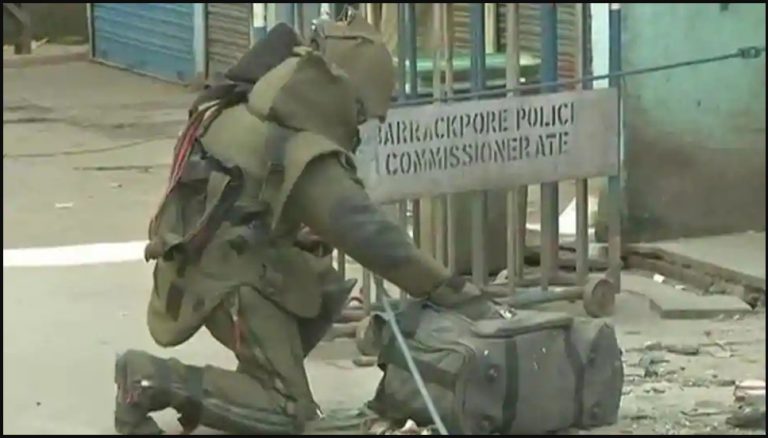
A blast rocked the Kazipara area of Dumdum Nager Bazar in Kolkata today at 9.30 a.m. Ten people in total were injured in the blast, with two of them suffering critical injuries.

The injured were taken to R. G. Kar Medical College and Hospital, SSKM Hospital and a local private hospital for treatments. Later, a seven-year-old boy named Bibhas Ghosh succumbed to his injuries at the SSKM hospital.

The blast took place just outside of a multi-storied building where the Chairperson of the North Dumdum municipality, Panchu Roy has an office. As per initial investigation, ammonium nitrate was used in carrying out the blast, where iron nails were also recovered. The forensic team and the bomb squad of CID are examining the blast spot.

According to a report by ABP Ananda, The blast was of such power that even the windows of the opposite building were shattered and it put a dent on a nearby shutter door of a shop. Speaking to ABP, Panchu Roy stated that he is of the opinion that this blast was intended to target the TMC cadres who usually gather around that very spot after their meeting with the chairperson.

Panchu Roy also stated that a bag filled with multiple bombs was also recovered from the spot by the police. The police, on the other hand, are yet to confirm the origin of the blast. The police stated that it was a ‘socket bomb’.

Initially, the police thought the blast was originated from a gas cylinder but later confirmed it was a bomb after further investigations.

Panchu Roy who considers himself to be the intended target of the bomb hinted at a political motive behind the blast and claimed that these political forces were plotting to kill him and his TMC workers. According to reports, West Bengal Minister Purnendu Basu has compared the blast in the Nager Bazar area with others carried out by ‘RSS elsewhere’. Although police have said that it is too early to determine anything, the TMC minister has alleged that RSS is behind the blast.

This is not the first time the Bengal government has tried to hinder its increasingly incompetent law and order state mechanism by blaming opposition parties. Earlier in the case of two schoolboys being shot dead by police, TMC had alleged that miscreants belonging to the BJP shot the two students, who were protesting against the appointment of Urdu teachers while they needed teachers of other subjects in Bengali medium and there were no Urdu students in the school.

During the last few years, bombs have been regularly recovered from TMC offices and houses of TMC leaders. There have been cases of accidental blasts of such stockpiles also.

Scores of women devotees of Lord Ayyappan take to the streets to #SaveSabarimala

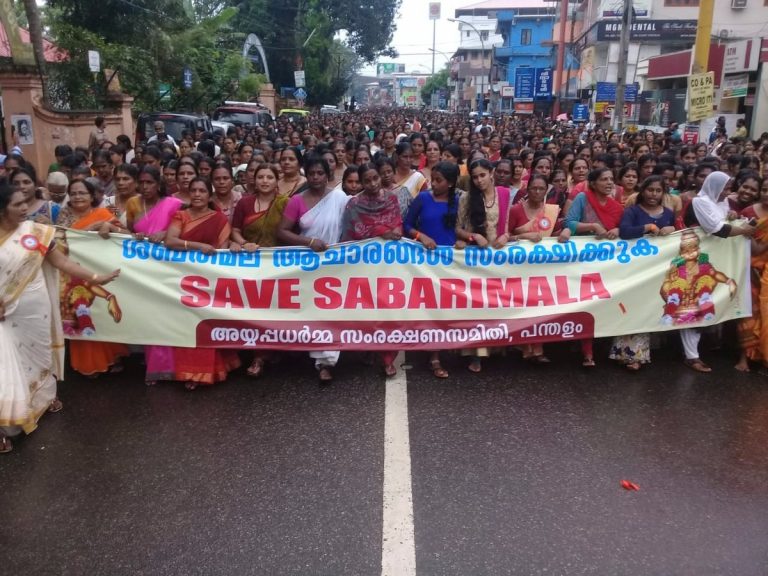
A protest was held today at Pandalam in Kerala against the Supreme Court verdict which permitted the entry of all women into the famous Sabarimala Temple. The protest is led by the Pandalam Royal Family which claim that the verdict will destroy the promise they made to Lord Ayyappan.


Various Hindu groups participated in the protests. Apart from the Pandalam royal family, members of the People for Dharma movement, members of the ‘Ready to Wait’ campaign, various members of Tanthri families and devotees of Lord Ayyappan were also part of the protest.


Scores of women have come forward demanding that an ordinance be issued against the Supreme Court verdict claiming that native traditions are being violated.


Public sentiment has been averse to the Supreme Court verdict and protests against it appear to be gaining momentum with every passing day. The following is a protest organized in previous days.


It is pertinent to remember that the only dissenter against the majority judgment of the Supreme Court was a woman, Justice Indu Malhotra, who asserted that the Court should not interfere with matters of deep religious sentiment. Although the protests are gaining momentum, it is still too early to say whether they will succeed in achieving their desired purpose.

All you need to know about what the Modi govt is doing to solve the NPA mess

Back in the 1980s, banks were institutions of trust and the branch managers were seen as powerful people. The sheer power of decision making on loan sanctioning, priority treatment to favourites and allocation of credit limit was delegated to branch managers and in absence of data analytics and technological tools, they were the most reliable source available. This made branch manager a much sought after position and banks, much like government offices of yesteryears.

As we understand, wherever loans related decisions are to be taken by individuals without credit exchange information and regulations and data based checks and balances, biases and favouritism creep in. The politically and socially powerful individuals encashed their relationships with the bank officials in the form of loans, that too at very low interest rates and against collaterals which didn’t carry much value. This led to rampant corruption and political influence in the decision making of banks eventually leading to a lot of wilful defaults.

Since the Modi government took charge in 2014, we are seeing a drastic change in the way we look at the banking system. The list of wilful defaulters has started being perused by media and the common man and defaulted loans (also known as Non Performing Assets, NPA) have become common discourse.  Defaulters like Vijay Mallya and cases of frauds by people like Nirav Modi have started surfacing in and it is to be credited to the Finance Minister Sh. Arun Jaitley under the able leadership of the Prime Minister Narendra Modi.

Thousand of crores of loans are unpaid by business tycoons who are now absconding, taking shelters abroad. The transparency due to effective measures of the government is exposing the nexus between the power brokers and these wilful defaulters. This has put a big question mark on the credibility of the ‘reputed’ financial institutions.

According to Raghuram Rajan – “Often, big borrowers are given a royal treatment by the banking system. Banks go out of their way to accommodate the borrowers’ failures. Retail borrowers don’t have the benefit of such overwhelming courtesy.”
Right from the Prime Lending Rate to Banks treating borrowers on the basis of loan size is one of the major obstacles in achieving total financial inclusion and also a reason for the rising NPA problem.

What are Non-Performing Assets? Any principal amount of a loan or interest on it or any instalments which remain unpaid to the banks for more than 90 days are categorized as Non-Performing Assets. Their classification is as follows-

  1. Till 90 days: Grace period
  2. 90 days to 12 months: Sub-standard asset
  3. Beyond 12 months: Doubtful asset

In his statement to the Estimates Committee of the Parliament, Raghuram Rajan, the ex-RBI Governor has held the previous government responsible for the NPA mess. He said that a larger number of bad loans originated in 2006-2008 when Economic growth was strong. The gross lending increased manifold. From 1947 to 2007, in 60 years, banks gave loans worth 18 Lakh Crores while from 2008 to 2014; loans of the same banks scaled up to 52 Lakh Crores. He also said that scams, delay in probes, poor decision making are the reasons behind increased NPA. Banks consortium did not perform the necessary background checks of the debtor leading to wrong decisions.

Vijay Mallya got a loan of 990 crores on collateral of the dead Kingfisher logo. Political bosses pressurized banks to lend to the near and dear ones, thus encouraging crony capitalism. Raghuram Rajan also said that restructuring leads to evergreening. Restructuring of loans means a new loan replaces the outstanding balance on an older loan and is paid over a longer period, usually with a lower instalment amount. It is a kind of settlement between banks and debtors so that debtors get more time to repay the loans. Banks preferred to evergreen bad loans through restructuring rather than declaring them as NPA. As a result, there was a cascading of bad loans over a period of time, since restructured loans of today are the unpaid loans of tomorrow. On top of this, policy paralysis of the then government, delay in environmental and land clearances, failure to stop money laundering and smaller provisions for bad loans led to the failure of commercial enterprises adding to the NPAs even more.

In 2008, private banks were leading the list of banks with highest NPAs. ICICI bank topped the list of top 10 scorers of NPA, followed by small & medium sized private sector banks. This reflects a moderate condition of NPAs in public sector banks. By 2011 country’s large public sender lenders like SBI and Central Bank of India saw a significant increase in NPA while those of private banks began dipping. This is a clear signage of political interference, as a result, public sector banks started topping the charts with the highest NPAs.

By 2014, nearly all the banks having high NPAs were public sector banks. The NPA scam started showing prominently in the statistics of 2014. But why are NPAs still increasing after Modi government took over in 2014? Till 2014, only 2.5 Lakh Crore NPAs were shown, but after the asset quality review of RBI in 2015-16, the real NPAs were discovered to be around 8.5 Lakh Crores. Naturally, the newly discovered NPAs began showing up in statistics. Even though the accumulated NPA belonged to the 2008-2014 period, the interest on the principal amount began piling up leading to an increase in outstanding liabilities.

What has Modi government done to resolve the NPA mess? Under Insolvency and Bankruptcy Code 2016, banks will approach Debt Recovery Tribunals for recovery of loans with respect to individuals and partnerships. For companies and corporates, the banks will approach the National Company Law Tribunal. (NCLT). These tribunals gave teeth to the earlier helpless bankers and effective tools to bankers for recovery. The RBI, with its increased powers under the Banking Regulation (Ordinance) Act 2017, notified 12 top defaulters totalling to 2.5 lakh crore NPA for resolution in the NCLT. That is 25% of the total NPAs defaulted by just 12 companies (Bhushan Steel, Essar Steel etc).

Apart from these 12 defaulters, a number of corporate resolutions have been initiated in the NCLT in 2017, as shown below. Please note the steady increase in the cases filed every quarter.

  1. January to March 2017: 36 corporates undergoing resolution
  2. April to June 2017: 151 corporates undergoing resolution
  3. July to September 2017: 353 corporates undergoing resolution

(Source: Insolvency and Bankruptcy Board of India, Quarterly Newsletter for July-September 2017)

One of the other ways of cheating banks was that promoters started buying buy their own company’s assets through other companies at discounted prices? To resolve this, the government amended the section 29A of the Insolvency and Bankruptcy Code Act prohibiting the existing promoters from buying the assets of their own companies under resolution thus ensuring that the same management doesn’t return back.

Capital infusion is important in banks because it serves two purposes- capital adequacy and credit availability. Since NPAs have resulted in a lesser credit for the banks, they lent fewer loans. Lesser loans mean lesser capital for industry leading to slow economic growth. Thus, recapitalization of banks was crucial for them for smooth functioning. In this effect, the government announced the highest ever recapitalization of 2.11 lakh crore rupees in 2017-18. In this context, it may be noted that capital infusion from 2008-2017 was a mere 1.18 Lakh Crore.

But how is this recapitalization different from recapitalisation by previous governments? Earlier, the capital infusion was ad-hoc and not linked to the bank’s performance. This time, RBI is keen on not considering the capital infusion as a dole. Out of total 2.11 lakh crores, only 76000 crores are direct budgetary support. Rest 1.35 lakh crores will be raised through Recapitalization Bonds issued by the government. Banks will invest in those bond i.e. give their capital to the government. The government will, in turn, use that capital to subscribe to the shares of the stressed PSBs, thus investing capital in stressed PSBs.

RBI will bring stressed banks under Prompt Corrective Action, PCA and put restrictions on some of their functions to prevent further deterioration. The banks are selected on basis of 3 parameters- Net NPA, Return on Assets (RoA) and Capital to Risk-weighted Assets Ratio (CRAR). The PCA imposes the following restrictions-

  • Ban on bank from entering new business
  • Ban from accessing costly credit
  • The cap on management fees paid to the management
  • Temporary non-payment of dividend to shareholders, followed by reforms and capital infusion.

Provisions are safety nets for any advance by the banks. For example, if a bank lends Rs. 100, it keeps Rs.15 extra aside as contingency if the Rs 100 are not repaid. Here, these provisions act as safety buffers. RBI has tightened the provisioning norms for the banks to ensure any future bad loans are made up for.

Apart from the fact that banks have reported collection of thousands of Crores in total by penalising small account holders for non maintenance of minimum balance, petty transactions, chequebook issue charges which is contradictory to the Modi Government’s focus on increase banking activities, transactions and inclusion of poor people in mainstream banking, it is heartening to see that now the strict provisions would not let the nexus of some corrupt businessmen, politicians and bank officials loot the hard earned money of citizens who once believed that their money is safe in banks.

Prime Minister Modi has shown zero tolerance on malpractices of banks and industrialists who are responsible for high NPAs. This is the major reason that NPAs have become a subject of public discourse and the public has suddenly started cursing these defaulters which were hidden for decades now. The government is not shying away in disclosing the names of NPAs despite short-term bad publicity in context of public perception as PM Modi is known to take tough decisions, keeping in mind, long-term benefits and larger interest of the nation.

Recently, the finance ministry has again opened the case of consolidation to bring in a reform in the public sector banks by merging some smaller banks with the bigger ones. This plan was put on the back burner after some banks complained of a spike in bad debts due to RBI’s provisioning norms.

In the recent past, people were worried about their money being safe in the Banks as there was an issue of trust. However, these effective actions by the Modi government has planted the seed of trust again and if the banks upgrade their credit and appraisal mechanism and make them robust for performing the assessment of the viability of projects then the banks will perform well and the NPAs will come down drastically. This is possible with the help of Machine Learning Techniques without human biases and favouritism. Modi government has shown strong will in this direction and it can be foreseen that the banks will again become those institutions of trust for people.

Remember the time when getting a house loan was much more difficult than to repay it and compare it with today when you can apply for a loan with just a click on your mobile. Time is changing and is so the economy. This take-off from Economy to Digital Economy has to be safeguarded from becoming Debtors Economy.

We just need to bear with the temporary inconvenience for a better tomorrow! As of now, the Modi government has decided to follow the truth and dared to challenge the norm of political interference and powerful lobbyists.

(The author is the OSD (Officer on Special Duty) – Chief Minister, Government of Chhattisgarh)

Baghpat: 20 members of a Muslim family become Hindus

0

20 members of a Muslim family have submitted an affidavit to SDM in Baghpat declaring that they are renouncing their current religion and accepting Hinduism. According to reports, after their affidavit, local Hindu groups have declared that they would perform sacred rituals for name changing and acceptance of Hindu practices for these people.

According to reports, the people belong to the Badrakha village in Chhaproli. The family of a man named Akhtar Ali have alleged that some Muslim goons had killed their elder son Gulshan Ali and had hanged his body from a pole near their garments shop. They have complained that despite complaints to police, the Muslim goons had kept harassing them and the police had declared Gulshan Ali’s death as a case of suicide. Tired of being harassed, 20 members of the extended family have decided to accept Hinduism.

The family members have alleged that they were unable to get justice for their son because the Muslim goons in their village were continuously harassing them and even threatening to kill them. Proper action has not been taken against the goons despite repeated complaints. They have alleged that 3000 Muslims were present when their son was murdered but nobody had come forward to help. The family has therefore decided that they will leave Islam and accept Hinduism because they believe they will not get justice as Muslims.

Following the submission of affidavits by these 20 people, workers of a local Hindu organisation named Hindu Yuva Sangathan had reportedly reached the SDM’s office and had welcomed the family members by embracing them. The organisation had reportedly today performed Hindu rituals to formally welcome the family members into the Hindu fold and change their names accordingly. As the news of this conversion spread, the district administration has reportedly formed an investigating committee to look into the matter. The family have confirmed to media that they are changing their religion on their own volition and not under any pressure.

Earlier, a family in Saharanpur, which had accepted Islam five years back, had come back to the Hindu fold.