Home Blog Page 7017

Leftist goons unleash violence during the JNU Students’ Union election, ABVP students hurt

0

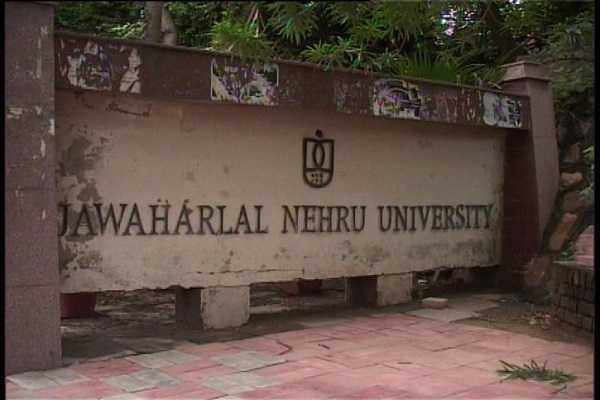
The Jawaharlal Nehru University Students’ Union election, the counting of which is underway, turned violent as leftist goons reportedly attacked Akhil Bharatiya Vidyarthi Parishad (ABVP)’s volunteers on campus. ABVP is the students wing of the Rashtriya Swayamsevak Sangh (RSS).


According to DU professor and JNU alumnus Abhinav Prakash, goons of Students’ Federation of India (SFI) and All India Students Association (AISA) even beat up girls and tore their clothes.


According to Prakash, the SFI and AISA, student wings of Communists Party of India (Marxist) and the Communist Party of India Liberation, respectively, were attempting vote counting fraud for the voting which concluded on Friday. He said they (SFI and AISA activists) were upset that they may lose out to ABVP.


He claimed that the Leftist goons had occupied the counting venue and were assaulting students who were opposing the same. He said that the violence is orchestrated to either carry out fraud in counting or getting the elections cancelled.

According to Sunil Ambekar, National Organising Secretary, ABVP, some ABVP students have been admitted to hospital after being attacked by the Leftist goons.


ABVP JNU President, Vijay Kumar has accused the Election Committee (EC) of not following proper election procedure.


The ABVP has also accused the EC of attempting to rig the elections as despite the rules which state that either the candidate or their voting agent is present in the room and sees every paper ballot, the EC broke the seal of ballot box and started counting Central Panel votes without ABVP representative present there.


ABVP even accused the EC of manhandling ABVP counting agents.


After being suspended for few hours, the counting has now resumed.

Communal clashes in Assam after Muslim man allegedly insults Lord Ram in Facebook: Reports

0

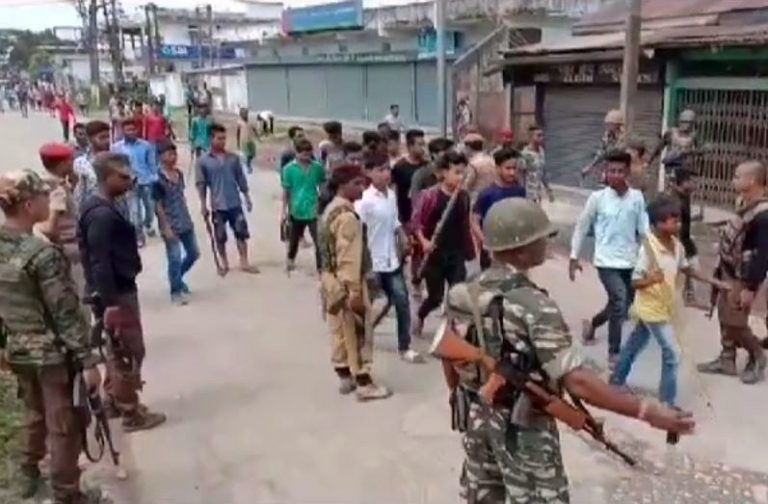
Curfew has been imposed at Doomdooma, Borapjan and Longsowal areas in Tinsukia district of Assam after communal clashes erupted between members Hindu and Muslim communities after an allegedly derogatory Facebook post insulting Hindu gods.

The comment about Lord Ram was made by one Aziz Khan, a resident of Doomdooma, in a Facebook post, after which local branch of Hindu Yuva Chatra Parishad (HYCP) filed an FIR with the Police on September 10 for hurting their religious sentiments. When no arrest was made even after four days of filing the FIR, HYCP activists decided to hold a protest in front of the Doomdooma police station.

Workers of Bajrang Dal and Vishwa Hindu Parishad also decided to join the protest. When the protests were assembling near the police station, some people from the Muslim community reportedly arrived at the scene and started attacking the protesters with sticks, rods, knives etc weapons. During this attack, several protesters were injured and 7 motorcycles belonging to them were damaged.

Soon police and CRPF personnel arrived to control the situation, but some people, according to reports, started pelting stones from the nearby railway track. Several members of the public including women were injured in this stone pelting. At last, police managed to control the situation by using tear gas and firing in the air, and prohibitory orders were imposed in the area by the district administration.

Before this clash, another incident happened involving both communities. On the night of 13th September, there was a conflict between the organisers of Ganesh Puja and Muharram in the area, over the subject of playing instruments at high volume. Although that conflict was controlled by police before turning worse, tensions were already high between them and that added as a catalyst for the incident the next day.

The officer-in-charge of the Tinsukia police station stated that Aziz Khan has been charged under the IT Act and he has been absconding. The police in Doomduma added that there were instances of stone pelting and clashes on Friday where a crowd of around 2000 people had gathered on the streets. The police officials have stated that the situation has been under control.

Deputy Commissioner of Tinsukia, Oinam Sanankumar Singh, told The New Indian Express, “The superintendent of police is personally monitoring the situation at the sites. Adequate police and CRPF personnel have been deployed to the areas. If need be, we will clamp curfew. However, we don’t want to unnecessarily create apprehension in the minds of people.” “We learnt that he (Aziz) is from Dibrugarh. We will nab him soon,” he added.

Meanwhile, several Hindu organizations have called for a shutdown on Saturday following the clashes on Friday. “Aziz Khan had posted a comment against our Hindu God Ram. Even after filing an FIR, the police has not been able to arrest him. To protest against his Facebook post, we took to the streets yesterday but the police lathi-charged on us,” said one protester.

Assam has been going through a tense phase ever since the publication of the complete draft of the NRC. The NRC, which is an attempt to weed out illegal immigrants from the state after a drastic demographic shift, is also being targeted by politicians with vested interests looking to stoke negative sentiments in the state. Security forces have been maintaining extra vigilance on communally sensitive situations in the region.

US report blaming Hindutva for ‘rising intolerance’ is disingenuous, biased and motivated

0

As per a report published by the Congressional Research Service (CRS), an independent bipartisan wing of the United States Congress, the secular nature of India is eroding due to the rise of Hindutva in the country. The report titled “India: Religious Freedom Issues”, which can be read here, states, “Religious freedom is explicitly protected under its constitution. Hindus account for a vast majority (nearly four-fifths) of the country’s populace. Hindu nationalism has been a rising political force in recent decades, by many accounts eroding India’s secular nature and leading to new assaults on the country’s religious freedoms.”

The report makes use of multiple US and Indian government resources, in addition to liberal media outlets which their own President calls ‘Fake News’ and quotes various Indians including senior Congress leader Shashi Tharoor, to further its narrative. The report only takes into account the opinions of liberals to reach its conclusions and a contrarian point of view finds no place in its pages. At a time when the US is itself so divided as a country, perhaps their Congress will be better advised to focus on the rise of Neo-Nazis and various political leaders and vast sections of their media openly supporting violent organizations like the Antifa.

Most conspicuously, the report cites S.M. Mushrif when it states, “In 2016, Maharashtra’s former senior-most police official reportedly called for banning the RSS as “the country’s largest terror organization.” Mushrif was one of the individuals who had attended the inauguration event of the book, ’26/11: RSS ki Saazish?’. Interestingly the book insinuates that the RSS conspired with CIA and Mossad to perpetuate the horror in Mumbai. It is interesting that the CRS accepts the assertions of a man as gospel truth who appears to have endorsed a book that blames the top US intelligence agency for the terror attacks in Mumbai in 2008.

The CRS also appears to harbour a special grudge against anti-conversion laws. Its report says, “According to USCIRF, although these laws have resulted in few arrests and no convictions, they “have created a hostile atmosphere for religious minorities, particularly Christians,” and “Christian communities have long reported harassment and violent attacks in the states that have adopted anti-conversion laws,” largely as reaction to perceive proselytizing activities.” It also cites the annual report of the United States Commission on International Religious Freedom (USCIRF) which states, “Advocate for the central Indian government to press states with anti-conversion and anti-cow slaughter laws to repeal or amend them to conform with international human rights standards.”

The CRS would be well reminded that every nation has a right to protect itself from demographic invasion and drastic demographic shifts cause great damage to the social fabric of a society, which are often irreparable. And Hinduism, unlike the Abrahamic faiths, does not have proselytizing as one of its integral tenets, thus making such provisions necessary to protect itself against such aggressive faith systems.

The report says of Citizenship (Amendment) Bill, 2016, which would grant citizenship rights to persecuted minorities from neighbouring countries, “If enacted, it thus could violate the Indian Constitution’s equal protection provisions.” Perhaps the CRS is not aware of Indian history and the Indian subcontinent. India was partitioned on the basis of religious faith, Pakistan and Bangladesh were formed as a consequence. We, as a country, do not owe citizenship rights to those whose ancestors participated in the partition of the Indian nation as they were granted a great chunk of land for themselves and the generations to come. And people of Indic faiths are persecuted in those countries to this day. Thus, it only makes sense that only persecuted minorities from Pakistan, Bangladesh and Afghanistan are given citizenship rights should they so desire.

The report also raises concerns about the crackdown on NGOs that receive foreign funds from the current administration. It says, “Human rights watchdogs have found their activities constrained under the Modi government, and they express concerns about Modi’s commitment to minority rights, his past willingness to tolerate suppression of free expression, and the vigour with which some of his supporters have quashed dissent.” The NDA government has shutdown thousand of NGOs for non-compliance with the FCRA laws.

As we have documented in our ‘Demystifying Civil Society’ series, NGOs that receive foreign contributions from abroad are often involved in political activism in the country and other such contentious issues of great social significance. Under such circumstances, it is of critical importance that the Indian government monitors such NGOs to ensure that foreign elements are not destabilizing Indian society. It is also crucial to mention that former Prime Minister Manmohan Singh had also blamed US-funded NGOs for the protests against the Koodankulam Nuclear Project.

The inherent biases of the report is revealed by the fact that Muslim intolerance is completely ignored. It is commonplace in India for Hindu festivals to be attacked and yet not a single account of Muslim atrocity against Hindus finds mention when it rakes up the issue of mob lynching. When the report raises the issue of cow vigilantism, it fails to appreciate the menace of cattle smuggling and how poor farmers are robbed of their livelihood by these criminals who often take up arms against law enforcement authorities. When it raises the issue of the campaign against ‘Love Jihad’, it fails to take into account the fact that there is strong evidence which suggests that radical Islamic organizations like the PFI are involved in a concerted campaign to brainwash Hindu women and convert them to Islam.

The response of the Indian government to such biased reports thus far has been, “India does not take cognizance of internal reports of a foreign country.” And it is the correct stance to adopt in response to an internal report of a country that prides itself in moralizing without holding itself to the same standards. More importantly, the report is a relic of the establishment that still occupies most corridors of power in the US despite Donald Trump’s election to power. President Trump has been a pleasant departure from the constant patronizing that came with Barack Obama.

With Parrikar in AIIMS Delhi, what will happen in Goa?

Former Defence Minister and current Goa CM Manohar Parrikar, is reportedly taking time off from his duties as Goa’s Chief Minister due to his treatment for an ongoing Pancreatic ailment. Over the past few months, Parrikar has travelled to the US for his treatment and has fulfilled his duties as Goa CM’s using technology. However, now it seems, he may have decided to let his treatment take a front seat.

There are 2 distinct possibilities here at play:

A. Parrikar continues as CM, albeit with no charge and all his portfolios are redistributed to ensure all ministries function.

B. Parrikar resigns as CM and a new face is appointed.

Whereas Option A seems easy, practically it might be a challenge to run a Government without a CM in the state, even though he has no real duties per se.

Option B is going to be something very difficult to manage for the BJP.

Going back to last year, when this coalition Government in Goa was formed, politically opposite parties like the Goa Forward Party (GFP) and the Maharashtrawadi Gomantak Party (MGP, along with independents, chose to ally with BJP with just 13 seats (as compared to Congress with 17), only on the condition that Manohar Parrikar be the CM. He was seen as the only acceptable face for a BJP led coalition, and hence he was sent to Goa from Delhi.

Now, the very face which enabled BJP to conquer Goa is in jeopardy. And as a corollary, the BJP led Government is also on a sticky wicket.

As things stand, Goa does not have a Deputy Chief Minister. This post was probably not filled to avoid controversy over who should be the Deputy CM: next in line BJP minister Francis D’Souza? MGP leader Sudin Dhavlikar? GFP leader Vijai Sardesai? Hence, when Parrikar was in the US for his treatment, instead of a single person, the above 3 people were drafted into a Cabinet Advisory Committee (CAC).

Now, as Parrikar is out of action. These 3 people come into focus by default. Unfortunately for BJP, D’Souza is not an option as he himself is in the US for treatment, and is not expected back anytime soon.

This has prompted MGP President Deepak Dhavlikar, to prop up his brother Sudin’s name. “It is high time Parrikar hands over the charge to the senior-most minister for [the] smooth functioning of the government” he is reported to have said, hinting at his brother.

This move but will not go down well with alliance partner GFP’s leader Sardesai who has said, “It is not necessary that the second senior most minister has to be made the CM”. Not only will it diminish Sardesai’s and GFP’s status (who have the same number of MLAs as MGP), MGP is also ideologically far away from GFP. Another alliance partner, and minister in the state Government, independent MLA Govind Gaude has also objected to this move by MGP. The reason for this is: Gaude is a bitter rival of the Dhavlikar brothers and had won in 2017, by defeating one of them.

There is also talk of getting MGP merged into the BJP, since the two are not too far on an ideological stance. This would pave the way for Sudin to become a BJP CM. This move though has been rejected by MGP leaders. Such a move would finish any sort of bargaining power MGP has in the future, by virtue of being kingmaker.

The BJP’s other options within are bleak. BJP’s Minister Pandurang Madkaikar is also sick after a brain stroke. Even a fit Madkarikar may not have been considered considering he has been a recent import into the BJP and is not seen as an efficient administrator. The other 2 ministers from BJP are Mauvin Godinho and Vishwajeet Rane. Both are Congressmen inducted into BJP recently, and they may go against them. In spite of this, Rane is said to have launched a bid for the CM’s post, which has irked other alliance partners.

Out of the other MLAs BJP has, most of them are considerably “junior” with little or no experience. None of them can be said to be a pan-Goa face, like Parrikar.

Sardesai for CM might be too much of a deviation for the BJP, from its core ideological stance, and as of now, he is not a contender at all. He will though have a major say in the developments, holding 3 MLAs, in a state which needs 21 MLAs to form a Government.

Now, the BJP may have to explore options such as its Lok Sabha MPs from Goa. First up is North Goa MP Sripad Naik. He is probably the second senior most BJP leader in Goa, after Parrikar. He has been Union Minister in both NDA Governments and can be considered to have a Pan-Goa appeal.

However, he is not seen as a shrewd politician who is able to handle the requirements of such a tricky alliance. Moreover, he was demoted in the Central ministry, from Tourism to AYUSH ministry, indicating that Modi doesn’t have much faith in him. He may have been retained as a minister, only due to seniority. Worse, he doesn’t enjoy a great relationship with Parrikar. It is believed that this strain stemmed from the repeated attempts by Naik to re-enter Goan politics, often causing embarrassment to Goa BJP and Parrikar. Most recently in August, Naik had told the press that Goa BJP leaders planned to meet BJP leadership in Delhi, over change in Goa’s CM. Eventually, the meet never happened as the other Goa BJP leaders returned to Goa after meeting Parrikar in a Mumbai hospital.

South Goa MP Narendra Sawaikar could emerge as the dark horse, at least from BJP’s stable. He is a first time MP but is fairly non-controversial. If he can be worked as the compromise candidate, he could fit the bill. He has an RSS background, hence would not be an issue for BJP. Convincing allies might be a different ball game though.

Finally, BJP may have the option of importing someone from Congress. Rumour mills were abuzz over past few weeks that former Congress CM Digambar Kamat may rejoin BJP, with some other Congress MLAs. Kamat was a senior BJP minister but jumped ship to Congress in 2005. Kamat’s biggest drawback is that he is synonymous with Goa’s mining scam. He continuously held the Mining portfolio across Congress and BJP Governments, when the scam was said to have peaked. One of Parrikar’s plank for 2012 elections, was to bring to book, the mining scam accused. How will that go on if Kamat becomes the CM?

If no solution is workable, what happens? The Congress has 16 MLAs and needs only 5 to form a Government. But the Congress is a divided house, with intra-party tensions often simmering onto the public forum. This lack of unity, was one of the main reasons why they failed to form the Government in 2017, although they were the single largest party with 17 MLAs. The allies refused to deal with such a divided party. Will they change now?

MGP (3 MLAs) has in the past allied with Congress and thus would probably have no major issues in rejoining Congress. GFP (3 MLAs), fought the elections on an anti-BJP plank, so Congress could be considered a more natural ally. However, GFP leader Sardesai is deeply suspicious of Congress, as its leadership thwarted him often when he was part of the Congress. The others include 1 NCP MLA and 3 independents, who on paper, may not be too averse to ally with Congress.

But can the Congress make it happen? A divided local unit, coupled with an uninspiring central leadership, versus the shrewd combination of Modi and Amit Shah. Sounds like a cliff-hanger. Only time will tell which direction Goa will head in.

Dear Hindus, ignoring a problem doesn’t make it go away. It’s time we discuss

“Houston we have a problem” is a very popular albeit slightly inaccurate quote that is attributed to the astronaut John “Jack” Swigert when he had contacted the NASA Mission Control Center in Houston during the Apollo 13 spaceflight.

I want to use this quote to start a conversation with a certain section among the online Non-Left Hindu movement today. My fellow Non-Left  Hindus, our society has some problems, they exist around us but for some odd reason, we are not talking about them with the zeal that is needed. A cursory glance across the social media profiles of many of the well established Non-Left internet Hindus that represent individuals, organisations and conclaves one tends to find a trend of a certain kind.

If I was living in that particular social media echo chamber and I follow and read the content produced by these particular social media handles representing these individuals and organisations I will come out with the conclusion that Hindu society has hardly got any problems. Jaativaad is a thing of the past, women are getting treated very well and there are no flaws in the claims made by any of the Hindu Scriptures. Cutting a long story short as they said in the famous song from the movie Three Idiots “All Izz Well”.

But is that the truth? Is all really well? Have we really gotten rid of jaativaad from our society to such a large extent that we can completely stop talking about it? Is every single article that gets published in newspapers across India almost daily that talks about atrocities committed under the garb of jaativaad all basically “Fake News”? Is all of this a grand conspiracy by the Left Wing Modi hating Mainstream Media that wants to paint India as a land of caste, cows and curry? Are they all basically twisting the truth to serve a particular agenda? Do you think a conspiracy of such a grand scale is humanly possible?

My fellow Non-Left Hindus, there is a strategic flaw in this online Hindu movement. The Non-Left Internet Hindus tend to practise a sort of soft denialism or have developed a convenient selective amnesia. Many amongst us have spun a web in their minds where it is assumed that the majority of news items that come out which talk about jaativaad have to be denied by default. They cannot be true. But I’ve got news for all of you, many, if not most of them are true. Jaativaad in India is a reality. It exists, it is part of our social reality that we need to talk about. Because if we don’t talk about it the left wing will. And guess what? They do talk about it. In fact, it seems by the google search results that they are the only ones that are talking about it on a regular basis. The search analysis shows that all the serious reports, papers, articles on the subject of jaativaad available online are either mainstream left-wing media outlets or left-wing think tanks.

One has to do some seriously time-consuming searches to even come across a critique of jaativaad by a Non-Left newspaper or think tank. Now I am willing to concede that there is an inherent bias in the Google search algorithms, but how bad is that inherent bias? Is this search algorithm bias so extreme that one can’t find any serious critique of Jaativaad from Non-Left organisations or media outlets?

Ignoring a problem does not make it go away. This soft denialism has basically ceded the space of all the activism for the downtrodden and the underprivileged of our society to the left wing. We may not like to admit this but the global perception is that when it comes to fighting for the underdog it is always the Left Wing that comes forward. Now I am willing to concede that in a country like India when it comes to fighting for the underprivileged at the ground level Hindu organisations have done a fantastic job.

But the story is not the same among the intelligentsia and the average educated Non-Left Hindu. There is a serious reluctance within us to take these issues head on, accept our fault lines and discuss them openly so that the “Left Wing Breaking India forces” do not hijack these issues and create further divides among Indians.

Is every problem in India fake? Why can’t our lit fests have panel discussions on jaativaad? Why can’t our portals and conclaves have serious discussions about how women are being ill-treated in many parts of India? I see a new trend rising on social media where some people have started rejecting feminism lock stock and barrel because it is a “western” concept. There are different types of feminism, what is wrong with equity feminism, for example? I get the aversion to 3rd wave feminism and all the nonsense stemming from that. But if someone wants to work towards equity feminism why is it so bad? Also, in a country like India, where I still feel we have a long way to go in terms of giving women their due don’t we sometimes do a disservice to the genuine well-intentioned feminists by tarring feminism in its entirety?

We have to take corrective measures and that too on an urgent basis. Perception matters a lot, and today the perception in the mind of the average English speaking urban citizen is that the left fights for the underprivileged and the others are just the privileged upper caste. Perceptions change when we showcase a body of work where the Hindu intelligentsia openly speaks about the ills in our society and accepts its fault lines.

So my appeal to you via this article is that if you happen to bump into these thought leaders online make sure you ask them some questions:

  1. When will they start talking about jaativaad as a social ill? When will there be a Non-Left conference where this issue will be discussed along with the future roadmap to deal with the issue theologically as well as economically? And who are the people amongst us who are experts in this subject?
  2. When will we discuss women’s issues in a Non-Left conclave? What solutions do they have to offer about the abysmally low rates of participation of Indian women in the workforce?
  3. When will a Non-Left conclave have a panel discussion on rising Abrahamic Atheism in India? What steps are being taken by the Hindu Samaaj to make sure that their next generation does not become Ex Hindus and stays within the Hindu fold?

I am not asking people to use idioms/terminologies of the West exclusively to tackle these problems. I am talking about admitting that we have a problem and doing something about it. Because if we won’t do something about them, the left-wing will. And when the left-wing tries to solve problems they do it through the lens of victimhood and oppression. Also, every fault line that is exposed using western idioms does not become null and void because it is being looked at from a “western” perspective.

It is time to admit that we have a problem in our society and we better start having open discussions about them. Whether it is jaativaad, whether it is ill-treatment of women, whether it is LGBT rights or whether it is scriptural issues within Hinduism. Because if we don’t, others will and the results of that will not be good for the nation. I want to end this appeal by stating that it is high time we the Non-Left Hindus of India do what is “right”. It is time to uphold our Dharma. As Sant Kabir had once said ” बुराजोदेखनमैंचला, बुरानमिलियाकोई।जोमनखोजाअपना, तोमुझसेबुरानकोई।।(I started searching for the devil but could not find anyone. When I searched inside me, realized, no one is more devilish then me.)

After constant criticism over Doklam, Shashi Tharoor led parliamentary panel which included Rahul Gandhi, praises govt’s handling of the standoff

0

A parliamentary panel headed by Congress MP Shashi Tharoor, in which Rahul Gandhi was also a member, has praised the government for its ‘overall handling’ of the Doklam crisis. According to reports, the parliamentary panel formed to study the Doklam standoff and Indo-China relations submitted its report to Lok Sabha Speaker Sumitra Mahajan on September 4.

The panel called the standing committee on external affairs, in its report, has also warned that the Chinese have built infrastructure ‘uncomfortably close’ to the tri-junction with Bhutan and the structures are yet to be dismantled. The panel, which also included Congress President Rahul Gandhi, has stated that the Indian government managed to send the necessary signals to China that India will not acquiesce its unilateral and forceful attempts to change the status quo at any of India’s territorial boundaries.

It is notable here that Tharoor was one of the very few leaders in opposition who had applauded the government’s successful efforts in handling the diplomatic and military crisis. He had congratulated the MEA and the government after the standoff ended in August last year.


The report has also asked the government to constantly engage with Bhutan on the subject of North Doklam so as to prevent the Chinese army from shifting the tri-junction point southwards in future. It has also cast doubts on China’s strategic intentions and cautioned the government that even though the PLA has withdrawn its troops, for the time being, they should not be taken casually. The report also calls for improvements of road infrastructure on the Indian side and suggested the government provide high-tech gear and equipment to the Indian troops stationed near the tri-junction.

The report has also stated that the Doklam region is very close to the narrow Siliguri corridor which is the only road link to North Eastern states and any change of status quo at Doklam is not a good news for India.

The Indian and Chinese troops were engaged in a tense, eyeball to eyeball standoff in Doklam for a period of 73 days starting from 16 June 2017 which managed to catch global attention. The standoff came to an end on August 28 last year with troops from both nations disengaging simultaneously.

After a political uproar in India over the government’s handling of the standoff, the parliamentary panel was tasked with studying the crisis. Over the months, government officials and diplomats, including former foreign secretary S Jaishankar have briefed the panel over the issues.

Rahul Gandhi, who has been very vocally critical of the government over the Doklam crisis was called out for expressing his total ignorance over the issue when asked how he would have handled the situation during his recent UK visit. Congress had even actively fanned media speculations over renewed Chinese aggression at the standoff site even after the government’s clarification of the unchanged status quo. Since the Congress President was a part of the parliamentary panel and eas even projected in the media for being the most inquisitive member, the final report hailing the government’s actions is bound to raise uncomfortable questions for him.

Demonetisation is a success and the naysayers have got their facts completely wrong

The Reserve Bank of India concluded the uphill task of currency verification and released its report recently. Immediately there were many voices that chimed in discrediting the exercise. In fact, demonetisation was branded as a massive scam. In our earlier articles, we had explained why any claim that demonetisation is a failure is wrong. Since then we have access to more data and many more factually incorrect claims hence clearing the air is important.

So let us again rewind the declared aims sought to be achieved and analyse each one independently.

  1. Track and tax “black money” in the system
  2. Bring more people into the formal economy and/or tax base
  3. Encourage digital payments leading to “less cash economy”

Claim 1: Track and tax black money (Offical Source)

When one delves into the data, some startling revelations come to the fore. Let us take the persons holding PAN and in the Business category for preliminary analysis. There are 2% corporates who have deposited 22.6% of cash and the average deposits in this category is at 1.37cr.

In the non-corporate and proprietor category, the average deposits stand at 42 lacs and approximately 16 lacs and together they account for an approximate 50% of the deposits in the overall category. During demonetisation, the deposits were backed via identity cards and later most of the bank accounts too, have been to Aadhaar. The last date to file the Income Tax return for the period 01/04/2016 to 31/03/2017 was 31/03/2018 which has surpassed. It won’t be a surprise if many cases of deposits during this period, which you can see above are way ahead of the Income Tax limits, will be picked up for scrutiny. In fact, that process has already started, the details of which, can be read here.

Salient points from the report are quoted for ease of understanding.

  1. Corporates which account for 2% of the reported PAN have a share of 22.6% in the reported cash transactions.
  2. Proprietors (individual running business) have a share of 41.5% in the reported cash transactions.
  3. Taxpayers doing business have a share of 78.4% in the reported cash transactions.
  4. 36.1% of the PAN holders in the reported cash transactions have not filed a return.

If not for demonetisation, how was the opposition planning to find an address to every currency that was circulating? Without exhausting the set time limits under the law, no Income tax proceeding could be started. People have shown an extreme amount of restlessness while judging demonetisation and when the facts and figures are analysed in totality, the cynicism doesn’t add up.

We analysed a second official source which is listed here

Based on preliminary findings 17.92 lakh persons for verification process were identified by the Income Tax Department. These people were sent notices. Nearly half of them have replied to the same. The notices usually asked them the source of their cash and reasons. Based on responses a tabulation was made which is presented below and is self-explanatory
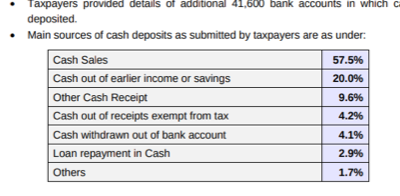
  1. 57% have claimed that the cash deposits were sales.
  2. Taxpayers have provided responses for 13.33 lakh accounts involving cash deposits of around Rs.2.89 lakh crore.
  3. Taxpayers provided details of additional 41,600 bank accounts in which cash was deposited.

The skeptics must answer, that if not for demonetisation, how could these details be unearthed?

Based on this analysis the IT department categorised taxpayers in various categories. It makes sense to first target the high-value evaders, then the medium and then low. The figures for each category are below

Notices for first 1 lac are already issued. Details  here

As time passes, other categories will be tracked. IT dept will also have staff issues etc.

Moving on, let’s see the second claim:

Claim 2: Bring more people into the formal economy and/or tax base

Following is an analysis of the numbers.
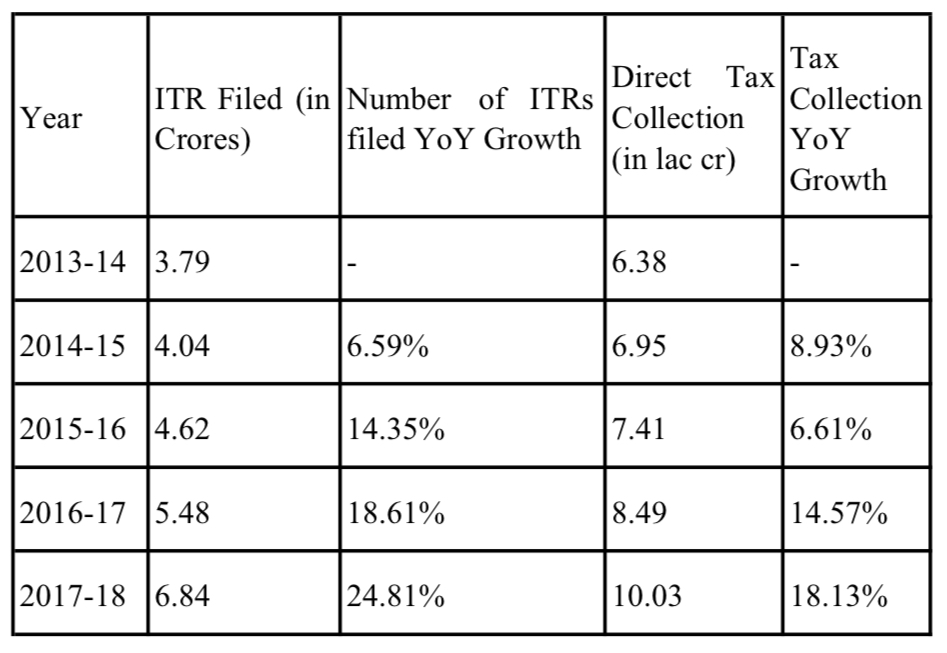
Highlights:

  • During FY 2017-18, 6.84 crore Income Tax Returns (ITRs) were filed with the Income Tax Department as compared to 5.48 crore ITRs filed during FY 2016-17, showing a growth of 24.81%.
  • As compared to 3.79 crores ITRs filed in F.Y. 2013-14, the number of ITRs filed during F.Y. 2017-18 (6.84 crores) has increased by 80.5%.
  • During FY 2017-18, the number of new ITR filers has also increased to 99.49 lakh (as on 30.03.2018) as compared to 85.51 lakh new ITR filers added during FY 2016-17, which translates into a growth of 16.3%.
  • For 2016-17 and 2017-18 the direct tax collections grew at 14.57% and 18.13% respectively and previous two years they were at 8.93% and 6.61% growth rates.

The steep increase in the number of ITRs filed as well as the amount of tax collected in 2016-17 and 2017-18 clearly shows that demonetisation has played a big role in both widening the tax base.

Claim 3: Encourage digital payments leading to “less cash economy”

There is no denying that digital payments have grown by leaps and bounds in the last two years. Data on digital payments shows that –

  • In the last two financial years (FY 2016-17 and FY 2017-18), retail digital payment methods saw 103% increase in volume and 111% increase in value (source – RBI annual report 2017-18)
  • Monthly usage of mobile wallets has grown by 311% in volume and 358% in value from Sept 2016 to June 2018 (source – RBI monthly bulletins December 2016 and August 2018)
  • Usage of UPI has exploded since demonetisation. Though it was launched in April 2016, well before demonetisation, UPI did not see widespread adoption until demonetisation. In Oct 2016, UPI saw just a little over 1 lakh transactions amounting Rs. 48.6 crores. In August 2018, UPI transactions volume rose to 31.2 crores, amounting Rs. 54,212.26 crore. This is a staggering 3,02,832% growth in volume and 54,11,506% growth in value in less than 2 years! The number of banks integrated with UPI has more than quadrupled in the same period. (source – NPCI website, UPI Product Statistics)

All these numbers prove that Demonetisation has greatly helped in the widespread adoption of digital payment methods.

On 30 August, veteran journalist and commentator R Jagannathan wrote an article titled “Why DeMo Misfired: Here Are Some Of The Lessons We Can Learn From Fiasco”. While Mr Jagannathan is a respected journalist and is fully entitled to have his own views about Demonetisation, we would like to counter some of his claims in the said article –

Mr Jagannathan says (emphasis added):

“When demonetisation was announced on 8 November 2016, the stated goals were to reduce the stock of black money, throttle counterfeiting, and strike at the roots of terror funding; two more goals were added as an after-thought when the inflows of the demonetised notes in November 2016 exceeded official expectations. These were a move towards a less-cash economy (through the promotion and adoption of digital modes of payment), and capture of more information about who held what amounts of cash.”

The assertion that two goals were added as an afterthought isn’t true. A digital transaction has a complete footprint from source to destination. More digital payments mean more ‘white’ transactions, i.e. less black money in the system. Secondly, capturing information about who held what amounts of cash is essential in reducing the stock of black money. Black money gets generated when people hide their income from tax authorities to evade tax. Due to demonetisation, all the black money hoarded by tax evaders in the form of high currency notes had to be either discarded or deposited in banks. Every deposit made in demonetised notes got tagged to a person.

The data of such crores of deposits is being analysed by tax officials and action against evaders is being taken, as explained earlier. In addition to penalizing tax evaders, demonetisation also discouraged large-scale cash hoarding. In fact, in one of his earlier articles, Mr Jagannathan also acknowledged this – “Belief in cash has taken a knock, not so much in terms of everyday transactions, but as a commodity hoardable in sackfuls.”

Next, Mr Jagannathan also claims in his article (emphasis added):

“Indirectly, it was suggested that the political goals of demonetisation included trapping large chunks of demonetised notes outside the system, which would have reduced the Reserve Bank’s liabilities, and the “savings” paid out as a special dividend to the government. This, in turn, would have allowed the Narendra Modi government to claim that it had confiscated the ill-gotten wealth of the rich and given it to the poor in some form. But with 99.3 per cent of the notes coming back to” the system, it is clear that this objective, though never stated openly, was a 99.3 per cent failure.

We tried to find an official communication by the government or RBI which claimed that reducing the liability of RBI was an objective of demonetisation but could not find any. Mr Jagannathan himself also says that so such objective was stated by the government. All the claims of RBI liability reduction as an objective of demonetisation were just media speculations. In fact, Mr Jagannathan had also made a similar speculation in one of his articles immediately after demonetisation.

Mr Jagannathan further says,

“The benefits claimed so far are an increase in tax compliance and revenues, higher digitisation levels in absolute terms, etc. But the problem is we can’t clearly state that these gains were due to demonetisation since the goods and services tax (GST) provided an added impetus to formalisation from 1 July 2017.”

The claim that the increase in tax compliance and revenues cannot be clearly attributed to demonetisation is not correct. Our analysis above shows that the sharp uptick in direct tax collection started in FY 2016-17 i.e. before the launch of GST. In FY 2017-18 too, CBDT saw a 19.1% increase in direct tax collection for Apr-Jul 2017 i.e. before the launch of GST. Moreover, tax buoyancy, which is the ratio of increase in GDP to the increase in tax revenues, improved significantly post demonetisation. This proves that demonetisation improved tax compliance.

Another sentence from the article reads (emphasis added):

“Going forward, most of the gains in eliminating black money and tax compliance will be the result of GST and the rising formalisation of the economy, not DeMo.”

It is unclear if this is Mr Jagannathan’s hunch or he derived the conclusion based on some data, but we disagree with the assertion. Once a person is in the tax net, he/she cannot get out of it easily. Tax evaders who are being caught due to demonetisation will be on Income Tax department’s radar in the future as well, thus creating a recurring tax revenue for the government. It is true that GST is causing further formalization of the economy and expansion of the tax net, but that does not belittle what demonetisation has achieved.

Mr Jagannathan further claims (emphasis added):

“Jan Dhan thus worked as a laundromat for the tax evader, and – as a byproduct – also helped the poor make some commissions in the bargain”

This claim is far from the truth. Data shows that between 9 November & 28 December 2016, Jan Dhan deposits saw a net increase of approximately Rs 25,000 crore. This amount is less than 2% of Rs.14 lakh crore in demonetised notes which were deposited in that period. So it is factually wrong to say that Jan Dhan accounts were used for large-scale money laundering during demonetisation.

In summary, a sharp upsurge in tax collection and widening of the tax net, action against shell companies and potential tax evaders, and a healthy growth in digital payments prove that demonetisation was certainly not a failure.

(This article has been co-authored by Shantanu and Ashutosh Muglikar)

Reliance sends legal notice to Assam Congress President: Stop making ‘false and defamatory’ statements on Rafale

0

Reliance Infrastructure Ltd, Reliance Defence Ltd and Reliance Aerostructure Ltd – belonging to Anil Ambani led Reliance Group of Companies have issued a “cease and desist notice” to Assam Pradesh Congress Committee President Ripun Bora, over his comments on the Reliance’s involvement in the Rafale fighter jet deal. The companies have asked him to stop making statements against the companies on the deal.

The Indian government has signed a deal with the Government of France for the purchase of 36 Rafale jets in a direct government to government transaction. As implementation of the deal comes closer, Congress party led by Rahul Gandhi has intensified its attack on the Modi government, alleging that the government is paying more for the 4.5 generation multirole fighter aircraft.

As a part of party’s nationwide protest against the deal, which is much needed for the depleting fleet of Indian Air Force, party workers in Assam also have been organising protests in the state. During these activities, the state Congress president Ripun Bora had repeated the comments made by its central leadership, alleging that Reliance group companies were given undue favour in the deal. Bora had also alleged that only Narendra Modi and Anil Ambani knew about the Rafale deal in advance.

Ripun Bora at Assam Congress press conference during the anti-Rafale protest

Bora has confirmed that he has received the notice on September 14, which is issued by Mulla & Mulla and Craigie Blunt & Caroe. The notice alleges that Congress party has been making “incorrect, false, frivolous, baseless, misleading, derogatory and defamatory statements” against Reliance in relation to the deal.

It may be noted that earlier the Reliance Group had sent similar notices to nine Congress leaders asking them to stop making “false and defamatory statements” against the group on the Rafale deal. The leaders that were served notices were Randeep Surjewala, Ashok Chavan, Sanjay Nirupam, Anurag Singh, Oommen Chandy, Shaktisinh Gohil, Abhishek Singh, Sunil Jakhar, Priyanka Chaturvedi.

The notice sent to Bora states, “As a cautionary measure, our clients strongly urge you to avoid, cease and desist from making any unverified, speculative, incorrect, false, frivolous, misleading, derogatory and defamatory statements against them on such a sensitive subject relating to national security. At the same time, our clients reserve their right to take recourse to all remedies available to them under the law for the protection of their name, brand, reputation and goodwill in case of any scurrilous statements being made against them.”

Ripun Bora said that they will not stop making such comments. He said, “I received the notice today (Friday). They cannot scare us with such notices. Reliance has illegally benefited from the deal. We will continue to raise the issue and will contest the case in court”. He also added that they will contest the notice in court and they have enough evidence to prove their claim.

Rahul Gandhi, despite his promises to help the poor, is yet to match Modicare : Medical journal Lancet

Prime Minister Narendra Modi’s ‘Ayushman Bharat‘, a National health protection scheme, which will cover over 10 crore poor and vulnerable families (approximately 50 crore beneficiaries) by providing coverage up to 5 lakh rupees per family per year for secondary and tertiary care hospitalization has got approval from The Lancet, the world’s most prestigious medical journal.

Lancet medical journal in its article mentions ‘Health’ as one of the most important issues in India’s upcoming general elections. Problems like Ischaemic heart disease, cardiovascular diseases, diabetes, chronic obstructive pulmonary disease, cancer along with several other mental illnesses has been growing consistently.

According to this prestigious medical journals editor-in-chief Richard Horton, Modi is the first Indian Prime Minister to prioritise universal health coverage as part of his political platform.

Though this aspect has long been neglected, the BJP Government has been prompt in recognising the hazards of public discontent about health. Under a new initiative called ‘Ayushman Bharat’, launched this year, Prime Minister Modi has implemented two new flagship programmes. First, the creation of 150 000 health and wellness centres across the country. These centres will provide a spine of primary care facilities to deliver universal health coverage. Second, the National Health Protection Mission (NHPM)—a system of health insurance that intends to cover 500 million people.

Together, these programmes should improve access to quality health services and reduce out-of-pocket health expenditures.

Horton in the same article goes on to criticise Congress President Rahul Gandhi by saying that, “Rahul Gandhi, despite his promises to help lower castes, tribal communities, and the rural poor, has yet to match Modicare”.

Rahul Gandhi, during his visit to the London School of Economics last month, reiterated that “There is a full-blown crisis in India.” By this, he meant- “jobs crisis”, said Horton in his article. But there is also a health crisis in India, as five papers published across three Lancet speciality journals—Lancet Oncology, Global Health, and Public Health—set out this week, which, undoubtedly, found no mention in the Congress President’s discourse.

While Rahul Gandhi has only been hogwashing about a “modernising impulse” in India and the possibility of “a transformation of 1·3 billion people”, PM Modi has been prompt in grasping the importance of health, not only as a natural right for India’s citizens, but also as a political device to meet the growing expectations of India’s emerging middle class.

The govt clamps down on Khalistani separatists, Whatsapp blocks account of their legal advisor

0

Popular messaging service WhatsApp has banned the account of Gurpatwant Singh Pannun, the legal advisor of the secessionist group Sikhs For Justice. According to a report in Indian Express, the ban comes after the government of India launched a clampdown on the secessionist group that is leading a referendum campaign for Khalistan. The Punjab government has also reportedly filed FIRs on Pannun and other workers of Sikhs For Justice on sedition charges.

Earlier, the government had ordered Twitter and Facebook to block the accounts of Pannun on their social media platforms. As per reports, the Twitter and Facebook accounts of Pannun were not accessible to anyone with an Indian IP address. As a response to this, Pannun had reportedly uploaded a video on another SFJ activist’s Facebook page and threatened home minister Rajnath Singh and Punjab CM Amarinder Singh. In the live video, Pannu had reportedly hurled insults at the Indian national flag and stated that the Indian government has also initiated action against WhatsApp groups that talk of Khalistan so he should be made the admin of all those groups.

In addition to Pannun, other activists like Paramjeet Singh Pamma had also issued threats to Punjab CM Amarinder Singh through facebook posts. Many Sikh leaders in the state are reportedly getting threats to support the ‘Khalistan referendum’ announced in London last month. The secessionist group Sikhs For Justice (SFJ) has also reportedly threatened to file lawsuits against the political leaders of Punjab. It is notable here that former Punjab CM Prakash Singh Badal was harassed with civil lawsuits filed against him in the USA when he visited the country in 2012. A report in Tribune India has quoted an Intelligence officer as saying that many Sikh political leaders are unable to visit North American countries in fear of such lawsuits by radical elements as they do not have diplomatic immunity in these countries.

It is notable here that Pannun had gained notoriety in Punjab for his numerous lawsuits against political leaders. In 2017, the Punjab Government had put a sedition case against him for putting up posters of the ‘referendum 2020’ supporting the Khalistan demand.

In 2014, American Justice Centre (AJC), another organisation Pannun is associated with, filed a lawsuit against PM Narendra Moid at a New York court in connection of 2002 riots. They also announced a cash reward of USD 10,000 for anyone who can serve the court summon to Modi.

The secessionist group SFJ was one of the main organisations behind the August 12 ‘referendum 2020’ event organised at London’s Trafalgar Square. The SFJ had called the event the London Declaration. It was also backed by Pakistani origin UK politician Nazir Ahmed who is believed to be supported by the ISI. Radical Sikh organisations in the UK had also planned to launch an anti-India campaign supported by ISI during PM Modi’s UK visit in April this year.