Home Blog Page 7025

‘Jesus will arrive to punish’ shouted a Christian pastor on the recent SC judgement decriminalising homosexuality

0

A Tamil Nadu based Christian pastor created a tense drama in a court on Monday, as he shouted slogans and claimed that the resent historic judgment of the Supreme Court to decriminalise homosexuality would lead to natural calamities.

Father Felix Jebasingh of Puliyakulam Church, who was present in the district court seemed unhappy over the recent apex court judgement. Terming the judgement as a “great sin”, the pastor shouted slogans urging the people not to support gay marriages. According to Father Felix, Jesus Christ will be arriving down to the earth to punish the ‘evil people’ who decriminalized consensual gay sex.

“Please do not support the court judgment on Section 377 (of the Indian Penal Code (IPC)). The Jesus Christ is arriving. His arrival is imminent. These type of marriages will lead to total destruction of the society,” the pastor shouted as the police escorted him out. He further said, “God has destroyed the cities of Sodom and Gomorrah using fire and sulphur because they allowed homosexuality… don’t support homosexuality”. The pastor was incidentally referring to the Sodom and Gomorrah, notoriously sinful cities in the biblical book of Genesis, destroyed by sulphur and fire.

Pastor Felix Jebasingh, 29-year-old belongs to of Periyar Nagar near Puliyakulam and is attached to Puliyakulam Church of Pentecostal mission. Reportedly, the pastor was arrested by the local police and taken to Race Course police station. A case has been registered against him under Section 75 of the Tamil Nadu City Police Act for creating a public nuisance.

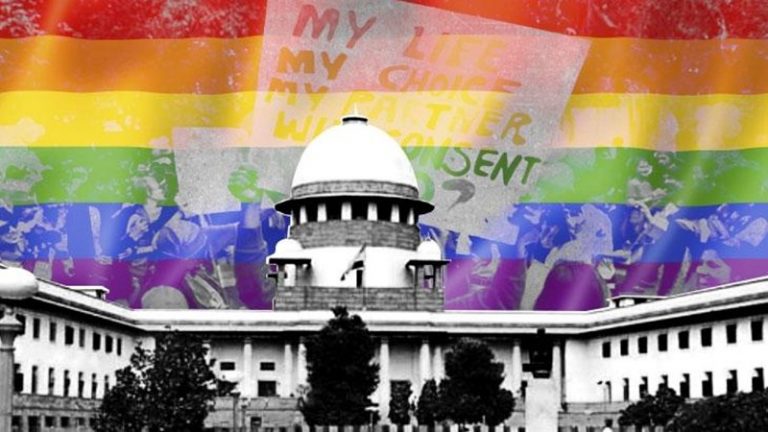
The Supreme Court of India in its historic verdict decriminalised homosexuality under section 377, making gay sex legal. A  five-member constitutional bench had delivered the judgement, announcing that consensual sexual relationships between adults of the same gender in private do not fall foul of section 377 of IPC.

The judgement of the Supreme Court was not well received by the certain sections of the society, particularly by the certain section of minorities. Similar to the above incident, a news source called ‘The Milli Gazette’, representing Indian Muslims had called for the scrapping of the judgement and called it ‘a step towards self-destruction’.

During the hearing of the case,  All India Muslim Personal Law Board (AIMPBL) and Christian intervenors had come out to oppose scrapping section 377. The AIMPLB had asserted that homosexuality is a ‘sin in all religions’.

Justice Gogoi says PILs are for the poor, turns down argument by Prashant Bhushan

0

The Supreme Court of India has on Monday stated that Public Interest litigations are there for people who cannot afford to approach the courts and dismissed a PIL filed by former Navy Chief Admiral Ramdas. According to reports, Justice Ranjan Gogoi, who is slated to be the CJI soon, stated during the hearing that the SC is there to address everyone’s fears, but PILs are for the poor.

Justice Gogoi was a part of the three-member bench including Justice Navin Sinha and justice KM Joseph, which was hearing the PIL filed by former navy chief Admiral Ramdas. The bench reportedly dismissed the PIL stating that it was a case for the vigilance commissioner.

Admiral Ramdas had reportedly filed a PIL against the appointment of IPS officer Sharad Kumar as the Vigilance Commissioner in the Central Vigilance Commission (CVC). Prashant Bhushan, who represented Admiral Ramdas had reportedly argued that the government in its advertisement for the post had stated that no one above 62-years of age can apply but had gone ahead to appoint IPS Sharad Kumar. Bhushan, during his argument, had also stated that the CVC is an integrity institution and its integrity cannot be compromised.

On Justice Gogoi’s query that if there was an age restriction on the CVC act, Bhushan had admitted that there is none but the advertisement was arbitrary and discriminatory as several people had missed the opportunity to apply.

On this, Justice Gogoi had reportedly countered Bhushan saying that if some people were affected due to it why they have not appealed to the court to challenge it. On Bhushan’s argument that there are a whole lot of judgements saying that anyone can file a PIL, Justice Gogoi reportedly dismissed the argument saying PILs are for the poor, who cannot afford to approach the court.

The bench reportedly stated on Admiral Ramdas’ petition that “We are not inclined to entertain this PIL petition filed at the instance of petitioners” and stated that anyone who has been deprived could have approached the court with a petition on violation of article 14(equality before law), instead of the current petitioners taking a stand on behalf of them.

Upon Bhushan’s argument that those affected are in government service and are afraid to come forward, Justice Gogoi stated that the SC is there to address people’s fears but PILs are for the poor. The bench formally stated to Bhushan, ” Let the aggrieved persons come. If nobody is aggrieved, why should we hear you?”

Sharad Kumar, the former head of NIA was appointed as the vigilance commissioner of the CVC in June this year. It is notable here that Justice Gogoi was hearing a number of PILs for the first time on Monday and his conservative approach on PILs is expected to create a check for the SC’s judicial activism which has been criticised in many cases in recent times.

Hey Anushka, please brace up for the hate that is coming your way

0

Remember when the film ‘Toilet – Ek Prem Katha’ was released? It was one of the rare occasions where a movie with the social message was produced by a mainstream Bollywood banner that also received a good response from the audience. The movie revolved around a married woman who left her husband and refused to stay at her in-law’s house as it didn’t have a toilet.

Rarely have we seen a protagonist who fights for her hygiene rights. Sanitation never formed the nucleus of a story earlier, and people never bothered to talk about it. This movie helped in passing the message and sensitize audience about the importance of sanitation. Inspired by a true story of Anita Narre of Madhya Pradesh, it struck a chord with the audience. It made people aware of the importance of sanitation and has helped people in addressing the issue and appreciating the efforts made by the government.

But soon it was dismissed as ‘pro-government propaganda’ by ‘film critics’? The film which talks about open defecation and a woman’s fight to right to a toilet inside the home was called propaganda because of Modi government’s emphasis on constructing a toilet to every home to bring an end to open defecation. In Outlook, Stuti Agarwal wrote,

The movie, that has a fairly engaging first half with the stalker-ish romance between the twenty something Jaya and middle aged Keshav, soon starts to stink of pro-government propaganda. It is little short of a public service campaign that got stretched into a 175 minutes movie; and when the film refers to toilet scam, and even slips in a lauding reference to demonetisation, one wonders if the government could have considered waving off the entertainment tax on this one.

In The New Indian Express, Aditya Shrikrishna wrote,

Suddenly, there are sermons, news channels, interviews and government officials populating a world that’s grown too big for its own good.

Even a Chief Minister is brought in to make the most cringe-worthy reference that pushes everything into the realms of propaganda.

Giving the film 2 out of 5 ratings, the reviewer said,

The film not only tips its hat to the ruling government but also absolves the government of all its responsibilities. Sabhyata (civilization) is the problem it says, not the government or bureaucracy.

ScoopWhoop even went so far to call it ‘ass-licking’.

But the suffocating level of ass-licking on display kneecaps any legitimate chance the film had at embracing social satire.

Anna MM Vetticad wrote,

Toilet informs us that it is based on the story of Anita and her husband Shivram. That’s funny though since Anita’s potty revolution took place two years before the Narendra Modi government came to power, yet this film pointedly sets its heroine’s actions in Modi’s time, implies credit to him and is, in fact, an ode to the present prime minister cleverly disguised as an ode to sanitation instead.

It is a pity that director Shree Narayan Singh chose to soil his film with pro-government propaganda, because until the Modi spiel sneaks up on us in the second half, Toilet: Ek Prem Katha drives home an important – even if simplistically handled – point.

Essentially, Toilet – Ek Prem Katha was given a thumbs down by ‘critics’ because ‘it was a pro-Modi propaganda’. This when the movie put out a disclaimer that the film is inspired by the real-life story of Anita Narre from Madhya Pradesh. But a fictionalised version of her story, taking creative liberties, becomes ‘propaganda’ because it is set in the post-2014 era.

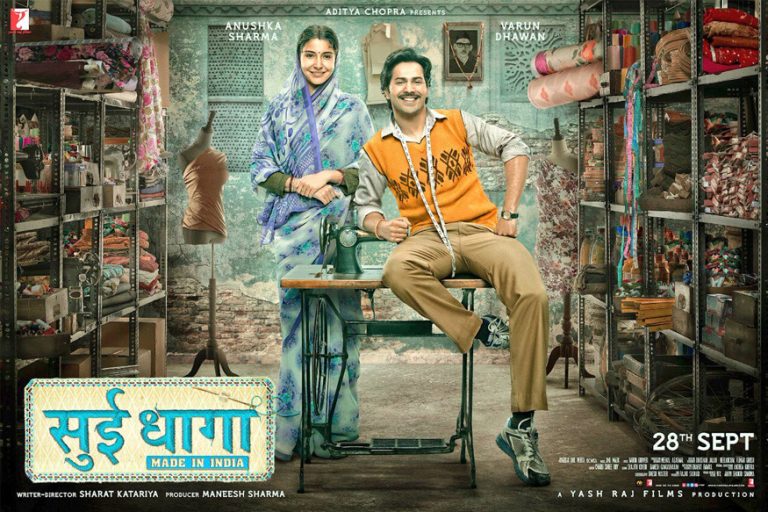
Anushka Sharma and Varun Dhawan starrer Sui Dhaaga is set to release on 28th September. From the trailer, it seems like a story about a journey of entrepreneurship, of a man and woman trying to be self-reliant and in the process creating something that is ‘made in India’.

Here are some of the portions of the trailer that stand out.

Sui Dhaaga trailer speaking about entrepreneurship, self-employment
Sui Dhaaga ‘Mad(e) in India’

Sui Dhaaga is a story about Mauji (Varun Dhawan) whose grandfather was into tailoring business but after his grandfather’s death, his family is forced to shut down the business. Mauji is forced to take up a job where he is subjected to humiliation. Mauji is married to Mamta (Anushka Sharma) who is an embroiderer. She nudges him to find a respectable work (job) instead of facing the daily humiliation at his current workplace. The couple with their sewing machine is able to get work of stitching garments but they are reluctant to make clothes for ‘Made In China’ label. They struggle to get their own label Sui-Dhaaga –Made In India and their story is about given the due recognition to Indian embroiderer and artists. The affable pairing of the duo and the storyline from the trailer has already appealed to the people.

The story of an unemployed youth who struggles and creates his own successful venture is bound to inspire youths to realize their entrepreneurial dreams. It talks about real problems close to home. So will Anushka Shama, like Akshay Kumar, get flak for propagating Narendra Modi’s ‘Make in India’ campaign? Will she be trolled and called names, like ‘Bhakt’, which Kumar sometimes get called now because of his pro-India views, for being part of a movie which incidentally fictionalises initiatives taken up by the Narendra Modi government, like startup India and encouraging small businesses through Mudra loans.

Going by the trend, with less than 20 days to release of Sui Dhaaga, we can only ask Anushka Sharma and Varun Dhawan to brace themselves for the abuses coming their way for being part of a ‘pro-Modi propaganda piece’.

ED summons six firms linked to irregularities in the Gomti Riverfront project sanctioned by Akhilesh Yadav

0

Six months after the Enforcement Directorate (ED) had registered a case to investigate alleged irregularities in the Gomti riverfront development project, the ED has now summoned six companies who were involved in the mega project at Lucknow, which was sanctioned by Akhilesh Yadav while he was the Chief Minister of Uttar Pradesh.

According to the Times of India report, the ED had prepared a list of companies last month, relating to the irregularities in the project. The ED while summoning these six companies said, “irregularities were observed during the course of the investigation which ranges from ‘excess payment’ to awarding contracts to blacklisted companies” as well as a mismatch in the contracted amount and released amount.

The companies summoned by ED are Gammon India Pvt Ltd, KK Spun Pipe Pvt Ltd, Rishu Construction, Hightech Competent Builders Pvt Ltd and Tarai Construction. The ED report says that the state government made excess payment to these six companies while some of the other companies did not even receive the original amount sanctioned in the contract. It further says that one company named Tarai Construction was awarded 13 contracts and also excess payments were done to this company.

Another company, Gammon India, despite being blacklisted in many states was awarded two contracts involving the highest contract value of Rs.665 crore to a single company, which according to the ED was higher than the actual cost.

KK Spun, another company alleged to have committed irregularities is said to have failed to even fulfil the basic requirement conditions for filing the tender. Interestingly, this company went on to register with the irrigation department after the tender was awarded to it, resulting in irregularities while awarding the contract. The ED officials said that some of the ministers and officials who worked under the previous Akhilesh Yadav government will be summoned in relation with the probe.

Gomti riverfront development is a Rs.1,990 crore project commissioned in the year 2015 by the then UP Chief Minister Akhilesh Yadav to develop the riverfront along the Gomti river, which flows through the city of Lucknow. The government had sanctioned Rs.747.4 crore in February 2015 but was then the amount was scaled to Rs.1990 crore by the Samajwadi government in 2016, a year before the state assembly elections.

Yogi Adityanath soon after coming to power had recommended a CBI investigation six months ago while accusing the previous government of massive financial irregularities in the project. The central agency had booked eight officials under sections pertaining to criminal misconduct by the public servant, criminal breach of trust, cheating, and forgery of valuable security, forgery with the purpose of cheating, using forged documents as genuine and demand of illegal gratification.

Research scholar calls out Shekhar Gupta’s ThePrint for misleading, click-baity headlines

Constantino Xavier, a research scholar at Brookings India today called out Shekhar Gupta and his digital venture ThePrint for using a misleading, clickbaity headline for an article authored by him.


In an article published on ThePrint, Xavier talks how at the recently concluded the Bay of Bengal Initiative for Multi-Sectoral Technical and Economic Cooperation (BIMSTEC) summit, Prime Minister Modi held a pragmatic approach towards the infrastructure connectivity and issues of concern for the member countries of Bangladesh, India, Myanmar, Sri Lanka, Thailand, Bhutan and Nepal. Xavier says how the declaration “marks a departure from this dispersion because it finally includes a series of commitments to strengthen the organisation’s human, financial and technical capacity.” He further added,

India’s BIMSTEC experience may also signal a subtler shift in its foreign policy momentum, now more conscious of its capacity limitations to deliver on the many bold commitments Prime Minister Modi made to the neighbourhood since 2014.

He concluded the article by saying how this was a positive step as India discovers both, its strengths and limitations, and was willing to focus on the initiatives which are already pending instead of making new promises.

The balanced piece by Xavier was published with the headline, “Finally, a summit where Modi govt made no meaningless, empty promises” underhandedly taking potshots at Prime Minister Modi. Upset about his views being used for scoring political points, Xavier said he would not like to write for ThePrint anymore, saying that India deserves better (than the pettiness displayed by ThePrint).

Xavier also pointed out another article by ThePrint which misrepresented India’s conversation with Nepal where India privately expressed its displeasure with Nepal at the Nepal Army’s pulling out of the first BIMSTEC military exercise which will be held in India.


Xavier pointed out how ThePrint politicised policy by trying to portray private communication as ‘scolded’. Unfortunately, in the last one week, it is the second time the Indian media has tried to portray that all is not well between India and her neighbour, Nepal. Earlier, media had tried to paint China opening its ports for trade for Nepal as an end of India’s monopoly over transit rights to the landlocked neighbour. The reality, however, was far from what was touted.

This is not the first time Shekhar Gupta’s ThePrint has been called out for lack of ethics. In July last year, Anuraag Saxena, a Singapore-based CA & MBA was maligned by ThePrint and his project was termed ‘communal’. Recently, ThePrint was caught perpetuating murderous ideas against RSS if Rahul Gandhi is voted to power. ThePrint even undermined the athletes’ performance at the recently concluded Asian Games and claimed that the Modi government is praising the athletes only because Delhi University Students’ Union elections are around the corner.

Assam’s NRC vs Jammu and Kashmir’s PRC: Drawing parallel among distinct laws and acknowledging the ‘liberal’ double-standard

The national security versus human rights debate is the biggest debate which is going to dominate public discourse in the coming few months. From Rohingyas to other outside communities who led to significant demographic changes in the past few years are uncertain about their future. The Parliament and Judiciary also have a different opinion on these subjects and latter showing deep respect to International Law and Relations have been sympathetic towards the refugee cause.

The idea which liberals endorse while talking about Kashmir is that unity and integrity in its absolute territorial sense can only be strengthened if it is not vulnerable by the mass influx and its borders remain safe. Their view echoes with the sentiment of majority Muslims by saying that their separate identity shall be preserved. The whole purpose of Maharaja’s notification of 1944 and later on the Presidential Order and ordinance inserted in Indian Constitution as Article 35A in 1954 was that local Punjabis who come from Sialkot towards RS Pora shall not entire as they pose threat to local businesses.

The presidential order extended Indian citizenship to the “state subjects” of Jammu and Kashmir. Sheikh Abdullah always claimed that the idea of Kashmiri Nationalism back then was backed by separate identity and class struggle and not separate religion as what they claim but the fact of the matter is that this Kashmir movement is not Prem Nath Bazaz’s movement or Sheikh Abdullah’s movement.

It is Hurriyat’s multilayered and well-orchestrated movement which draws its influence from Wahabi Islam. So creating Islamic brotherhood is the guiding factor for the separate state cause and not separate ethnic identity and since it is guided by religious beliefs and not nation-state (the concept of Jinnah and Ataturk Kamaal Pasha). Our liberals and humanitarian scholars have conveniently ignored this fact and have established this narrative that Kashmir problem is a political problem and it blames democratic India for all the problems more than turbulent Pakistan and colonial China.

The whole concept of Permanent Residence Certificate (PRC) making outsiders not entering and getting opportunities to avail the benefits of the state resources is flawed. This kind of political scenario is favourable for political outfits in Kashmir. The Supreme Court seems apprehensive to touch the constitutional issue of Article 35 A and Article 370. This article opposes the basic tenets of the Indian Constitution as it principally violates all the important articles whether it is Article 14, 15, 16 and Article 19. These articles are pillars to the Indian constitution.

However, their entire logic and reasoning take 360 degrees turn when the focus of the debate is Assam and West Bengal. In Assam, the tribal’s are anti-Chakma refugees (Hindus and Buddhists who had shifted from Bangladesh and Myanmar). The indigenous Assamese people felt the immigrants, who are already eating into their limited resources and rights, will benefit further as stakeholders once they are legitimized by citizenship. They feel that citizenship amendment bill which states that by giving citizenship to non-Muslim immigrants from Bangladesh; will reduce them to a minority in their own land.

Now let’s talk about Bodos from Assam and Hajongs settled in Arunachal Pradesh who had migrated from erstwhile East Pakistan. They are worst victims of persecution and still struggling and facing a severe existential crisis. The moment a Bodo complains about infiltration from across the border and talks about preserving a separate ethnic identity in a state which is poor and does not have adequate natural resources, entire focus changes of debate from tribal conflict to religious conflict and that is exactly where the hypocrisy of liberals gets exposed.

In Assam Calls for removing “illegal immigrants” from the electoral rolls were growing since 1979, and the flashpoint was the genocide that claimed nearly 2,000 lives across 14 villages on 18 February 1983. The agitation was spearheaded by the local people who demanded their right on the land and jobs, continued until the Assam Accord was signed in 1985.While the agreement called for “foreigners who had entered Assam between 1951 and 1961 to be given full citizenship rights, including the right to vote,” it mandated “all those who had come to Assam after 1971 were to be deported”. A sizeable Bodo population, the Assam Movement still forms the genesis of the demand for a National Register of Citizens (NRC). After the 1971 war, these areas which had a predominant Bodo population were slowly replaced by Bengali Muslims, and it turned into a fight for identity and land.

When the debate of NRC was raked up by Amit Shah in the Parliament, it was seen as an attempt to polarise but on the other hand when Hurriyat had shut the valley today before the Supreme Court’s Ruling on Article 35 A which was a confrontation and intimidation to the Courts is seen as “peaceful protest”.

The selective discourse by our intelligentsia is a common phenomenon but their stand gets exposed when we analyse the two case studies. The constitutional courts in India are supposed to be conscience keepers but more often they come across as moral guardians in these issues whose agenda turns out to be garnering good will. There sentimental value of such judgments and observations is more than the constitutional value. There is a constant attempt by liberal scholars who cultivate the thought that nationalism is subservient to constitutionalism but the fact of the matter is that both go hand in hand.

NDTV’s Prannoy Roy and Radhika Roy get show cause notice from SEBI for insider trading

0

As an evidence of increasing troubles for NDTV’s promoters Prannoy and Radhika Roy, the media company has informed the Bombay Stock Exchange (BSE) of them receiving a show cause notice from SEBI under the Securities and Exchange Board of India Act, 1992 (“SEBI Act”).

According to the information provided to BSE, Prannoy Roy and Radhika Roy, the Promoters of New Delhi Television Limited (NDTV) received the said show cause notice on the 10th of September 2018.

The show cause notice was dated August 31, 2018, and was issued under Sections 11(1), 11(4) and 113 of the SEBI Ac by SEBI, alleging violation of provisions of Section 12A (d) and (e) of SEBI Act read with Regulation 3(i) and Regulation 4 of SEBI (Prohibition of lnsider Trading) Regulations, 1992.

The SEBI act in Section 12 A specifically deals with insider trading which is the buying or selling of a security by someone who has access to material nonpublic information about the security. Insider trading can be illegal or legal depending on when the insider makes the trade. It is illegal when the material information is still nonpublic.

Section 12A (d) deals with the engagement of insider trading and Section 12 A (e) deals with a deal in securities while in possession of material or non-public information. It also deals with the communication of such material or non-public information to any other person, in a manner which is in contravention of the provisions of the SEBI Act.

Earlier too, NDTV has had a similar brush with the law when they got a show cause notice from the Income Tax Department. Earlier, the IT Department show cause notice pertained to the IT Department levying a penalty of Rs. 436.80 crores for the assessment year 2009-10. The channel had later approached the Delhi High Court which had refused to intervene in the matter and in turn asked the channel to approach the Commissioner of Income Tax (Appeals).

The Principal Commissioner of Income Tax had refused to stay the demand and instructed the channel to pay 30% of the penalty amount in a staggered manner by 15th June 2018. The said three instalments of this amount had to be paid on 15 April, 15 May and 15 June respectively.

PNB recovers record amount from defaulters due to Insolvency and Bankruptcy code

According to a Financial Express report, Punjab National Bank (PNB) recovered a record Rs 11,378 crore from defaulters in the first five months of this financial year, which is more than the state-run lender’s total recovery in the two years through 2017-18, according to the bank’s data.

The fraud-hit bank is trying to avoid featuring on the Reserve Bank of India’s watch-list after record losses last fiscal, mainly due to the Rs 14,357 crore fraud involving jewellers Nirav Modi and Mehul Choksi, PNB has stepped up efforts to recover money from the bank’s defaulters. It had made a recovery of Rs 5, 618 crores in the financial year 2017-18 and Rs 5,643 crore in the previous year.

The bank has set up a dedicated stressed asset vertical this financial year and has deployed as many as 3,000 employees to pursue recovery from various defaulters, on the other hand, its efforts were helped by the emergence of the Insolvency and the Bankruptcy Code (IBC), which was passed in 2016.

PNB was one of the biggest beneficiaries of the acquisition of debt-laden Bhushan Steel by Tata Steel through the new insolvency process, as it received Rs 3,081 crore. It recovered almost Rs 335 crores from Electrosteel and Rs 110 crore from Monnet Ispat through the IBC.

The finance ministry has already asked all the public sector lenders to improve their recoveries, along with implementing other reform measures and boost their business. At the same time, it has promised infusion of capital to strengthen their capital base and enable them to meet various regulatory requirements.

The record high recovery of loans comes at a time when Punjab National Bank is trying to leave the scandal behind, although the fraud has deteriorated its non-performing asset (NPA) ratios. As of June, Its net NPAs stood at 10.58%, against Bank of Baroda’s (BoB’s) 5.4% and Canara Bank’s 6.91%, two of the relatively more strong nationalised banks at present.

PNB has been able to beat its peers on certain other important parameters, For instance, at 42.6%, the share of its current account savings account (CASA) in total deposits as of June was better than BoB (40.8%) and Canara Bank (32.4%). A higher CASA-to-deposits ratio indicates more potential to generate profit, as the bank is getting money at lower costs due to relatively lower interest payout on such accounts.

PNB’s operating profit grew as much as 30.4% in the April-June period this year from a year before (despite a net loss), against BoB’s 13.5% and Canara Bank’s 18.6%. Its operating expenses, in fact, dropped 17.3% in the quarter ending June from the previous year, while Bank of Baroda’s rose 9.3% and Canara Bank’s rose 18.5%.

Lalu Yadav is suffering from depression, says his medical report

0

R K Shrivastava, the Director Rajendra Institute of Medical Sciences (RIMS), has stated that fodder scam convict Lalu Prasad Yadav is suffering from depression. According to reports, the RIMS doctors attending Lalu had mentioned it the in their assessment of the RJD supremo. The director of RIMS has reportedly stated that Lalu Yadav’s discharge report from AIIMS too, had mentioned depression.

However, the director denied receiving any updates about any psychiatrist examining Lalu Yadav as of now. The internal rift between his two sons has also been attributed to Lalu’s recent condition. It is said that Lalu prefers younger son Tejashwi Yadav as his heir, but his elder son Tej Pratap Yadav is more publicly acceptable than the younger son, which has reportedly caused some disturbance in the family.

Recently, Lalu Prasad Yadav was shifted to a different ward of the hospital after he complained to the RIMS officials regarding poor hygiene, mosquitoes and disturbance caused by the dogs. The RJD supremo will be now shifted to another ward for which he has to pay Rs 1,000 per day. The officials said that the changes were done only after obtaining permission from the concerned authorities.

Lalu Yadav was recently shifted to Ranchi from Mumbai’s Asian Heart Institute after the Jharkhand High Court rejected his bail in the fodder case and had ordered him to surrender before 30 August to the Ranchi Jail authorities.

Lalu Prasad Yadav has been found guilty for indulging in series of fodder scams when he was the Chief Minister of Bihar and is currently serving a total of 14 years in jail. He and his family members, including daughter Misa Bharati and son Tejashwi Yadav, are also facing several cases related to disproportionate assets and also for conducting benami transactions. Addition to this Lalu Prasad Yadav and his family, including Tejashwi Yadav are accused in multi-crore Indian Railway Catering and Tourism Corporation (IRCTC) scam

The underlying liberal doctrine on sexuality must be discarded to counter argument of ‘decriminalisation of bestiality’

0

In the afternoon of Monday, the 10th, I had the misfortune of coming upon an article that made an intellectual defence of bestiality. The article, authored by journalist Praveen Swami, makes a cogent case for the decriminalization of bestiality. Before I proceed any further, I would like to take a few words to compliment Mr Swami for displaying his intellectual fortitude and applying the principle of the supremacy of individual rights on an issue as controversial as bestiality. I recommend that readers first read the said article in its entirety before proceeding any further.

As a conservative, I have no compunction in stating that I believe the sexual conduct of individuals must be subject to certain social constraints. However, it would be interesting to witness those who propose that individual rights and choices should be the basis for the framing of laws in a civilized society rebut the arguments that Mr Swami has made in his piece. As far as I am concerned, Mr Swami’s arguments are very difficult, if not impossible, to refute if one buys into the argument that individual rights and choices should rule supreme in matters of sexuality and it is this premise that needs to be deconstructed.

The Supreme Court in its historic judgment decriminalizing homosexuality stated ‘Majoritarian views, popular morality cannot dictate constitutional rights’. “I am what I am, so take me as I am,” said Chief Justice of India Dipak Misra before adding “denial of self-expression is inviting death”.

One wonders why such arguments cannot be made to decriminalize bestiality. For matters of consent and cruelty towards animals, Mr Swami makes the arguments far more eloquently I could. Therefore, it is quite pointless to repeat them here. The only words I would like to add are, whether raping animals, assuming that having sex with animals is cruelty towards them, is worse than slaughtering them for food is a matter of philosophical debate and there cannot be a rational objective answer on the matter. I would further like to clarify that as a matter of principle, I support the decriminalization of homosexuality although I am a bit pessimistic about the consequences the decriminalization of it will have.

Praveen Swami’s article reminds me of Jonathan Haidt’s social intuitionist model of morality. As per the model, we reach moral conclusions not by logic or rationally approaching a moral proposition but that they are reached intuitively. Thus, a rational justification for the moral proposition is made after the individual has reached the moral judgment. He states that a person can change his moral judgment on a particular issue if new intuitions are activated by moral reasoning, which can be private or interpersonal.

The model, which is in stark contrast to the conventional psychological theories of morality that embrace morality, furthers the proposition with strong evidence that reasoning and justifications are made after a moral judgment has already been made. His conclusions come from his extensive studies on “moral dumbfounding” where people have strong moral reactions but fail to offer any rational explanation for the same. Thus, taking into account Haidt’s theory of morality, there appears to be clear evidence that morality is not based on logic and rationalism but on primal factors that shape human behaviour.

Jonathan Haidt, in his book, “The Righteous Mind”, further elaborates on the issue, a book that I highly recommend to our readers. Thus, it appears clear that morality is inherently ‘irrational’ and not based on logic, or at least based on a set of logic and assumptions that are not universal in nature. All of us have observed at least once during the course of a heated argument on contentious issues how the other person is completely unable to comprehend our rationale. It takes us a long time to discover, and often we never do, that it is because the other person’s arguments are based on a completely different premise than ours. Thus, it is completely alright for those who claim individual choice regarding matters of sexuality should transcend every other concern that they cannot bring themselves to support bestiality. But for that, they must embrace the notion that morality is inherently irrational and adjust their worldview accordingly.

Thus, as a conservative, Praveen Swami’s arguments neither trouble nor shock me because it is not too difficult to see where our laws regarding sexuality would be headed should we base our entire legal system on the basis of individual choice and rights. In addition to bestiality, there is also no logical reason to criminalize necrophilia should we accept the aforementioned premise of the supremacy of individual choices and rights. Indeed, no one is harmed when one has sex with a corpse, it’s a person’s individual choice and consent does not come into the picture as the object of sexual gratification in question is inanimate during the time of the intercourse. The youth branch of the Swedish Liberal People’s Party did argue that incest and necrophilia should be legalized. It is an interesting point to note here that studies on people’s reaction to incest played a major part in shaping Jonathan Haidt’s model of morality. The participants often could not give a good logical reason why incest was wrong even when all negative consequences of it were ruled out in a scenario they had to give their judgment on and often simply said: “It’s just wrong”.

Hence, it is important that we accept the fact that morality is inherently irrational before attempting to change social mores that could cause social turmoil. We need to be mindful of the fact that our moral reasoning makes perfect sense to us alone and what we perceive as ‘common sense’ may be the consequence of our inherent biases. Therefore, we must be honest with ourselves regarding our moral positions and make an attempt to estimate how society would change in the long run should people by and large accept our basic premise, the foundation on which our moral reasoning is based on.

A significant section of the population, mainly among the intellectual elite, has bought into the premise that laws regarding sexuality must be based on individual choices and rights alone. Mr Swami is one of the few people who displayed the intellectual rigour necessary to apply the premise to an issue as contentious as bestiality. I can dismiss his arguments entirely because I do not endorse his position that sexuality must not be subject to social regulations. My reasons for my stated position is that I believe traditional family values and traditional gender roles are essential for maintaining a healthy cohesive society. Destruction of traditional values spells the doom of a nation as can be evidenced by the turmoil that the European Union finds itself embroiled in. The system may not be perfect, nothing ever really is and there is inherent injustice in the system, but it makes it easier for people to lead meaningful satisfying lives and conduct themselves as a productive member of society. On the contrary, the position as endorsed by Mr Swami leads people to advocate for the decriminalization of bestiality and incest and necrophilia. These are not allegations or caricatures that I have conjured from my own head but has been demonstrated by those who take the premise of the supremacy of individual choice regarding sexuality to its logical conclusion.

The only bone of contention I have with Mr Swami is that he uses the ancient history of India and Hinduism to argue for the legalization of bestiality. Ancient scriptures and ancient art were composed in a certain era with a certain outlook on morality. It seems ridiculous to me that certain people would deem Hinduism to be the most patriarchal and most oppressive of all religions and then others of the same political orientation would claim that bestiality was viewed ancient Hindus “as just one more of a wide array of sexual practices.” It is disingenuous to twist our scriptures and history to suit one’s political narrative. And more importantly, it’s not the ancient art, that depicts bestiality, which governed people’s lives. There were laws like they are now, and people had to adhere to them and those laws, I would assume and with good reason, were not an ode to individual choice regarding sexuality. But the crux of the matter is, Mr Swami is not an expert on Temple art or a member of the sampradaya of the Temple he speaks of, therefore, he would be well advised to not make such baseless assertions.

Praveen Swami writes in his article, “The simple truth is: like so many behaviours most of us find repulsive, bestiality is an individual choice. How far societies are willing to concede the right to act on that choice is a good measure of the integrity of their democratic convictions.” I wholeheartedly concur. Therefore, I believe it is time to reject the liberal doctrine on sexuality.