Home Blog Page 7053

India’s rise as the Mobile manufacturing hub of the world

0

Recently, in July 2018, Samsung inaugurated the world’s largest mobile phone factory in Noida, India, which will roll out 120 million units per year. Samsung plans to use India not only for manufacturing and local selling but also as an export hub for India-made handsets. “We ‘Make in India’, ‘Make for India’ and now we will ‘Make for the World’, H C Hong, Chief Executive Officer at Samsung India said in his statement.

It must be noted that Samsung is just one cog in the large wheel of Mobile phones manufacturing industry in India which has developed at a mind-boggling pace within the last three years. A Business World report titled “Is India The New Mobile Manufacturing hub” reports the following promising developments –

  • India has attracted investment from 37 mobile manufacturing companies in the last one year
  • Many large global mobile phone manufacturers including American giant Apple and Chinese players Gionee, Xiaomi, Vivo, Oppo have set up large-scale manufacturing in India
  • Local Indian players are rapidly expanding manufacturing too. Micromax started a new plant in Uttarakhand and is planning investments in Telangana, Rajasthan and Maharashtra. Another Indian company LAVA built a facility in Noida and is planning a second unit shortly. Other Indian manufacturers like Celkon Mobiles, Spice Mobility and Karbonn are also adding new capacities
  • Mobile production in India crossed 100-million units and may cross 500 million in the next two years
  • In 2017, India became the world’s second largest mobile phone producer after the proportion of global handsets produced in India increased from 3% in 2014 to 11% in 2017
  • World’s biggest contract manufacturer of mobile phones, Foxconn is planning to build additional seven to eight new units in India

Foxconn’s competitor and Apple’s largest contract manufacturer Wistron is also investing INR 3000 crores (US$ 450 million) for setting up a manufacturing unit in Karnataka which will produce 100 million units every year and will generate thousands of jobs.

Source: Business World and Financial Express


Manufacturing vs Assembling

Admittedly, a large part of current mobile phone manufacturing in India includes only “assembling” of components imported from other countries. However, most manufacturing industries start similarly, while local component manufacturing develops subsequently.

A similar trend was witnessed in India’s automotive industry. In 1983, Maruti started operations with CKD (completely-knocked-down) kits of imported components. Over the years, localized production of components increased significantly, as part of the phased manufacturing process. Today, there are close to 250 Indian and Japanese component-makers operating in India. This enabled the Indian auto-components business to rise to global expectations and created vibrant clusters of auto component makers in Gurugram, Pune, Indore and Chennai.

Mobile manufacturing industry in China had followed the same cycle. When Foxconn established a massive presence in Zhengzhou, an entire vertical mobile phone supply chain developed in the region.

Similar green-shoots are now being witnessed in Indian mobile phones industry too. Vedanta has planned to start manufacturing LCD screens to be used in phones and other electronics. MediaTek, the chipsets‘ manufacturer has also started operations in India. As mobile phone manufacturing continues growing in India, more and more related businesses and component manufacturers are expected to spring up around phone manufacturing hubs.

Source: Economic Times, news18 and iTers News

To promote Prime Minister Modi’s “Make in India” project, the Indian government has incentivized local production through a variety of policies, including raising import duties on critical parts which makes direct investment in India more financially compelling to manufacturers. Consequently, more and more indigenous development is expected to replace the import of components.

For instance, in 2016-17, electronics worth $50 billion were manufactured in India compared to $43 billion in Imports. For the first time ever, local manufacturing in electronics exceeded imports. With the Electronics manufacturing corridor coming up in U.P., local manufacturing of electronic components is further expected to increase substantially.

Source: International Business Times and Financial Express

Way forward

Today, almost every big and small mobile company in the world is competing for not only selling in India but also manufacturing in India.

The FTTF (fast track task force), a government body under Ministry of Electronics and IT, has set a target to achieve around 500 million mobile phone production in India by 2019, with an estimated value of around US$ 46 billion. FTTF, with members from industry and government, has also set the target to create US$ 8 billion component manufacturing as result of growth in mobile phone production and create 1.5 million direct and indirect jobs by 2019. It’s an attractive opportunity which rings a sign of good times for global and Indian mobile phone manufacturers, consumers as well as for technology job seekers.

Disgraced former cop Sanjiv Bhatt caught sharing fake image about Kerala floods

0

Controversial former cop of Gujarat, Sanjiv Bhatt, yesterday an image of electricity workers on an electric pole claiming that these are the workers of Kerala State Electricity Board who were busy working round the clock to help restore power in the flood-hit state.


He further uses this image to say that since Kerala is working to get back on its feet, Modi and RSS ‘hate’ Kerala. However, the image Bhatt has shared is not from five days back but from October 2016 stolen from a Mathrubhumi, article which speaks about power cuts in Kerala.

Original image from Mathrubhumi from October 2016.

This image shared by Bhatt, who has a following of over 3.76 lakh on Twitter, had over 700 reactions. This is not the first time Bhatt has been caught spreading lies over social media to malign Modi. He had earlier tweeted morphed photo of PM Modi, disregarding dignity of women. He has also used social media to spread anti-India propaganda by making false claims about an image to make false allegations against the security forces in Kashmir.

Srinagar: stone pelting terrorists wave Pakistani and ISIS flags, disrupt Eid celebrations

0

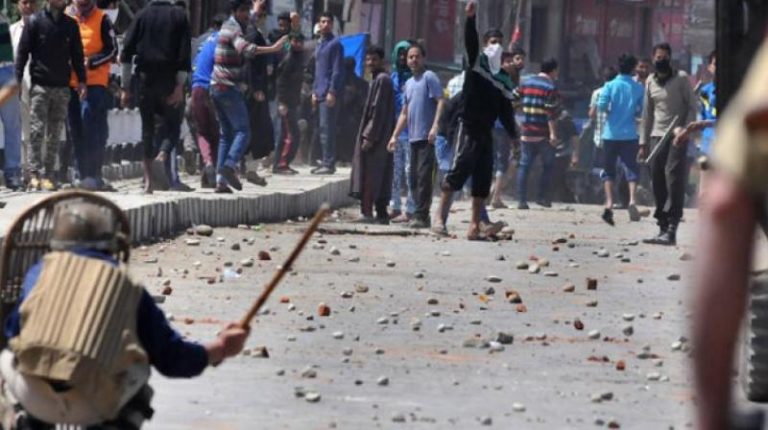
According to an ANI report, the celebrations of Eid-Al-Adha were marred by violence when stone pelting terrorists came out on the street, chanted slogans waved the Pakistan and ISIS flags and clashed with police personnel on duty in Srinagar’s Eidgah area, soon after Eid prayers. The policemen, trying to bring the situation under control were also assaulted by the stone-pelters.

In another incident, a policeman was shot dead by terrorists outside an Eidgah in Kulgam’s Zazripora, when he was leaving after offering prayers.

The central government had earlier announced the suspension of anti-terror operations in the valley in the month of Ramzan. But that had little effect on the fundamentalists as many more incidents of stone pelting were reported across Kashmir.

Condemning the rampant stonepelting incidents, Defence Minister Nirmala Sitharaman had said that although the armed forces cannot be held responsible for being firm with terrorists, it is extremely important to ensure safer movement of tourists to restore normalcy.

Incidents of stone pelting and attack on security forces and tourists have been on the rise in the valley. Earlier in May, a tourist from Tamil Nadu’s Chennai had lost his life in stone-pelting. Around the same time, a bus carrying school students was also attacked by unruly stone-pelters in Zawoora village of Shopian district. On June 1st, in Srinagar, a convoy of CRPF vehicles came under severe attack by a large mob.

In one such similar ghastly act, stone pelters had attacked the funeral procession of Lt Ummer Fayaz in Kashmir, mid last year which left the nation shocked. In an abhorrent display of their cold-bloodedness, not even sparing the mortal remains of the Lieutenant, they pelted stones on the Army personnel, late Lt Fayaz’s family members and his near and dear ones who gathered to pay their last respects to the brave soldier in his ancestral village in Kulgaon.

The central government has, however, taken a tough stance against it, stating that it will be demoralizing for the security forces as hundreds of personnel are injured every year due to stone pelting attacks. The center had also stated that going easy with the stone pelters will further encourage the terrorists of the valley to use civilians as human shield.

In its attempt to curb this menace, the National Investigative Agency (NIA) has been thoroughly focused on the terror funding in Kashmir for some months now.

At the start of June, the NIA had raided as many as 23 locations across Delhi, Haryana, and Kashmir in connection with the Pakistani funding which the Kashmiri separatist leaders are believed to receive in order to spread terror in the valley. Reports claimed that the NIA had identified 117 individuals who led stone pelting groups and gave instructions over WhatsApp and made few arrests too.

UP: Government cancels registration of madarsa after cleric prevents students from singing national anthem

0

The Uttar Pradesh government led by Yogi Adithyanath has decided to cancel the registration and derecognized a madarsa in Maharajganj district after a cleric allegedly prevented the students of the institution from singing the national anthem on Independence Day.

In the video that has been shared widely on social media, the cleric is seen saying the students to avoid singing the national anthem. He then goes on to say that it is not “jayaz” (permissible) in Islam. He is then seen asking students to sing ‘Sare jahan se acha’, even as a teacher protests against the cleric’s comments.


Following a probe, the state government has now decided to derecognise the madarsa and the Uttar Pradesh Madarsa Board has released immediate orders to suspend the licence and registration. Maulana Junaid Ansari and two others are reported to be under arrest on charges of sedition under Section 124-A and 153B (imputation assertion prejudicial to national integrity) for disrespecting the national anthem.

The government had asked for a report from the District Minority officer (DMO) after the incident. The board had earlier warned that it might cancel registration and other financial aid to modernisation of madrasa.

The Registrar of Madarsa Education Board, S N Pandey said that numbers of students in madarsa were less than what is required to be eligible for government aid and other benefits. “So its licence and registration stands suspended with immediate effect and in the next meeting of the Board, a proposal for its cancellation will be brought,” he noted.

U.P. Muslim Waqf and Haj Minister Mohsin Raza on Tuesday said that opposing the national anthem was an “anti-national act. Anyone opposing the national anthem will have to go to jail, be it a maulvi or pandit. There will be no compromise”.

This incident is not new in the state of Uttar Pradesh. Last year, Manzar-e-Islam, the biggest madarsa in Bareilly hoisted the Tiranga but did not sing the national anthem.

An eye-witness account of the ‘Great Calcutta Killing’ of August 1946

Foreword

The turmoil lasted for 4 days from the 16th August to the 19th August of 1946. The expression “The Great Calcutta Killing” was first used in an editorial of the premier newspaper “The Statesman” when it resumed publication on restoration of normalcy in the city of Calcutta, the then capital of undivided Bengal, ruled by the Muslim League Ministry headed by the Prime Minister- Hasan Shaheed Suhrawardy – who is widely believed to have engineered “The Great Calcutta Killing” through meticulously planned misuse of Government machinery on a colossal scale.

The Congress leadership which swore by “ Freedom for Undivided India” literally panicked after the occurrence of “The Great Calcutta Killing”. Gandhiji who pontificated that India could be divided only over his dead body kept mum and did not come out with any statement giving his reactions to the unprecedented Calcutta riots. Jawaharlal Nehru was pre-occupied with the formation of the Interim Government at the Centre in September 1946, in collaboration with the Muslim League. Neither Gandhiji nor Nehru cared to visit Calcutta to see the plight of the citizens after the holocaust of August 1946.

During the days preceding August 1946, the political atmosphere of the country was agog with confabulations between the Congress and the Muslim League about the political future of the country. The Muslim League pressed for the creation of Pakistan. As the Congress verbally rejected the proposal, the Muslim League headed by Md. Ali Jinnah held out the threat of achieving Pakistan through force – the slogan “Ladke lenge Pakistan” spread far and wide among the Muslims.

The Muslim League in pursuance of its demand for Pakistan announced that it would observe “Direct Action Day” on the 16th August 1946 throughout India. Bengal being the only province in India under Muslim League rule was apparently chosen by the Muslim League leadership as the suitable place for “demonstrating” Direct Action. The general public was vaguely apprehensive but nobody had any idea what-so-ever about what was going to happen on the Direct Action Day of the 16th August 1946.

The eye-witness was at that time a student of Rangpur Carmichael College in North Bengal of undivided Bengal. The eye-witness, a 20-year-old youngster, had graduated in 1946 and was to proceed to Calcutta in August 1946 to get himself enrolled as a student of MA class in Calcutta University. He left Rangpur on the 14th August 1946, reached Calcutta on the morning of the 15th August 1946. The riot started on the 16th August 1946.

The eye-witness account is given below in the first person:

I arrived in Calcutta from North Bengal on the morning of 15th August 1946 and travelled all over the city to carry out my assignments namely to enrol myself as a student of Calcutta University and the Law Department of Ripon College (now Surendranath College) as also to meet my relations in South Calcutta. I put up at our house located in North East Calcutta, the address being 59B Upper Circular Road. The house faces the palace of Raja of Kasim Bazar, located on the opposite side of the road. The railway terminus – Sealdah station – is a few furlongs away to the south and the Muslim locality of the Raja Bazar lies to the North, a few furlongs away from our house.

When I was returning home by a tram car on the evening of the 15th August I overheard the conversation of two fellow passengers who were discussing in a hushed voice about their forebodings regarding the Direct Action Day to be observed by the Muslim League the next day. On the next morning, after having breakfast, I went out to have a look at Upper Circular Road. It was 8 am. The road was deserted with empty tar drums strewn across the road to serve as roadblocks aimed at obstructing traffic. There were a few persons on the footpath and the atmosphere was peaceful. I did not sense any tension in the air. I had decided to spend the day indoors relaxing, having already done the important work on the previous day. Had bath and lunch and lay down for a midday siesta.

When I got up at 3 pm I was startled on hearing the alarming news of what happened on Upper Circular road while I was asleep. A neighbour gave the details of a huge procession of Muslims – all armed with long knives – that came out of Raja Bazar area at around 1 pm and travelled along Upper Circular Road, looting all the wayside shops and killing their occupants. There were two shops on either side of the entrance to our locality. The shops were looted and the shopkeepers were killed. Fortunately, the marauding mob did not enter the blind allay inside our locality. The riotous mob went ahead towards Calcutta Maidan to join the Direct Action Day Rally.

Apparently, the law and order machinery had broken down. Later I learnt that the famous cloth emporium – Kamalalaya Stores – located on Dharmatala Street (now Lenin Sarani) – was also looted by the mob from Raja Bazar and goods (costly sarees, shawls) worth millions of rupees were carried away by the looters. An atmosphere of gloom and tension had set in. The elderly people of the neighbourhood got together in the late afternoon to deliberate upon the measures to be taken to defend ourselves in the event of an attack on our locality by Muslim miscreants. A dilapidated cowshed was demolished to collect brickbats which were carried to various corners of the locality for being used to repel the attackers.

Volunteers were posted at vulnerable points of the locality to keep a watch on the developments. In the evening ominous silence prevailed. Instructions were given to the youngsters not to shout any slogans and to desist from any provocative action, keeping in view the Muslim hinterland of our locality.

In the evening, suddenly our locality was surrounded by Muslims displaying flaming torches. We all became tense, picked up brickbats and held them in our hands waiting with bated breath for the imminent attack. We did not shout any slogans. The torch-carrying mob kept standing for a few minutes without making any further move and finally dispersed. We heaved a sigh of relief. The terrace of our 3-storied house served as a watchtower from where the volunteers, including myself, kept a watch on the night sky of the city.

Our locality is situated on the eastern fringe of the city and the Hooghly river lies to the west of the city. The densely populated heart of the city lies between Upper Circular Road on the east and Hooghly river on the west. That the turmoil that started at midday today continued with unabated fury throughout the night was evident from what we saw from our watch-tower. The night sky over the heart of the city was illumined by the long tongue of flame licking the sky. Apparently, Muslim arsonists were having a field day, setting fire to residential buildings and factories. We saw about a dozen rings of fire – with leaping flames dispelling the darkness of the night. It was not possible for us to identify the places where huge fires were raging.

The Muslim festival month Ramzaan was on. Muslims were observing Roja. The morning of the 17th August was quiet and peaceful. The front road was however deserted. Vehicular traffic was not resumed. I could feel that as the day advanced, tension gradually grew in the atmosphere. In fact, the 17th August – Day 2 (the 16th August being Day 1) turned out in retrospect to be more eventful than Day 1.

At around 12 noon, a young neighbour rushed to me to give the alarming news that a Muslim miscreant carrying a spear was waiting outside the ramshackle gate at the entrance to our locality. I had a look at the gate and saw the lance-head glittering in the Sun. The lance was carried by a well-built Peshawari goonda who was apparently trying to force an entry.

Suhrawardy the Muslim League Leader had gathered Muslim marauders from all over India in Calcutta for observing Direct Action Day. My neighbour and I kept a close watch on the miscreant, holding brickbats in our hands. The Peshawari goon hesitated and finally left the place. It was a tense moment for us. An hour later, we heard the slogan shouting from a distance.

For the first time after 16th August, we heard slogans of “Jai Hind” and “Vande Mataram” indicating Hindu resistance amidst the so far one-sided Muslim aggression. Apparently, clashes were taking place at the crossing of Mirjapur Street and Harrison Road (now Mahatma Gandhi Road) near Purabi Cinema Hall. Later I learnt that a Muslim mob attacked the big hostel inhabited by Hindu residents who fought and succeeded in driving back the mob.

We heard on Day 2 the slogans were shouted by the Hindus who fought to defend themselves. There was a flutter in the early afternoon when a truck carrying a body of Sikhs, turban-less and wielding drawn swords, appeared on Upper Circular Road. It was time for Muslims to get panicky. There was no sign of Muslim miscreants of Raja Bazaar and we saw Muslim householders in our neighbourhood lift brickbats to the terrace of their houses as a measure of their self-defence. The truckload of Sikhs came from South Calcutta to check up the hapless condition of the Hindus about whom rumours were afloat, by daring to penetrate the Muslim area for the purpose.

The truck proceeded upto Science College where Hindu dominated area starts and returned to South Calcutta. As soon as the truck carrying the Sikhs disappeared the Muslim miscreants who hid so long came out and started gesticulating towards the departing truck. An elderly neighbour, Police Officer, wore his uniform with a belt equipped with a revolver, made bold to go out on the front road and came back with the good news that military tanks would soon start patrolling on Upper Circular Road, ensuring that there would be no trouble from the roadside.

The evening of Day 2 set in. We heard loudspeaker announcement by Muslim leaders cautioning Muslims of our area not to go out on the street as “Shoot at Sight” orders had been issued. We were startled in the evening when we heard the slogan shouting by a mob. We feared that an attack was imminent from the rear of our locality where a Muslim hinterland was located. We watched the situation for a few minutes and realised that Muslims, instead of going out on a “looting” spree and facing the risk of being shot, were instructed to indulge in slogan shouting from rooftops. The slogans were “ Allah Ho Akbar” “Quaid E Azam Zindabad” “Ladke lenge Pakistan” “Nara e Taqdeer”.

We gradually became used to the continuous sound of the slogan shouting and stopped attaching importance to it. Meanwhile, military tanks started patrolling the front road, The tank driver was signalled to stop in front of our locality. The Tank Commander- a British soldier, was requested to visit our locality. He acceded to our request and entered the blind lane leading to our house. He went upstairs to the terrace accompanied by three Garwahli soldiers. We pointed to the Muslim hinterland from where we apprehended an attack. The Garwahli soldiers held aloft their guns and aimed them at the Muslim hinterland. We were elated on seeing the aggressive posture of the soldiers and made a request to the Tank Commander to station the soldiers in our locality to keep a night-long vigil for our protection. The Tank Commander pleaded his inability to do so but assured us that in course of patrolling the area the tank would halt in front of our locality at hourly intervals throughout the night and he would personally check up our security status. The 17th August- 18th August night passed off smoothly thereafter without any incident.

On the next morning- 18th August- Day 3- there was a welcome development. “Relief Cars” started coming from South Calcutta to the riot-torn North East and Central Calcutta to pick up stranded Hindu residents who spent the past two days in a “marooned” condition, with a view to shifting them to a safer area.

Two buses halted on Upper Circular Road in front of the blind lane leading to our house. A decision was taken to shift the ladies and children in the first instance. The turn of the adult males would come later. The two buses got filled up quickly and left for South Calcutta. I stayed behind along with other male neighbours in our beleaguered locality. We could not stir out on the front road. Military tanks kept on patrolling the area throughout the day. We felt somewhat relaxed and Day3 passed off without any untoward incident. We, however, kept a night long watch on the Muslim hinterland situated in the rear of our locality.

On the morning of the 19th August- Day 4, we got ready for quitting our houses and awaited the arrival of the “Relief” buses. Buses came and all the remaining neighbours got together before boarding the buses, making sure that nobody was left behind in the abandoned locality. During the past three days, we were virtually in a marooned condition, having little contact with the outside world.

As the buses proceeded towards Raja Bazaar, through the riot-ravaged area, shocking sights greeted our eyes. Piles of bodies were heaped on hand driven carts placed at the entrance of almost every lane and by-lane. We had no idea about the extent of the carnage that took place during the past few days. Even on day 4, half burnt bodies were lying scattered on the road near Raja Bazaar uncared for. While travelling by bus through the Riot-torn area the realisation dawned upon us that we were fortunate enough to survive the holocaust that took place on an unprecedented scale in the city of Calcutta during the past three days. Our Buses halted at various places to pick up stranded residents before returning to South Calcutta.

My elder brother, a student of Bengal Engineering College Shibpur, met me a few days later. From him, I learnt about the massacre that took place on Day 4 (19th August) at Metiabruz, a Muslim locality located on the bank of the Hooghly river. Shibpur College is located on the opposite bank of the river. More than 500 labourers hailing from Orissa were residing in a Basti at Metiabruz. During the turmoil, they locked themselves up in the Basti and kept the lock outside the entrance door to create an impression that the Basti was vacant. Their presence in the Basti was however detected by the Muslims who butchered all of them and threw the bodies in the Hooghly river. The bloated bodies of the victims were seen floating on the river by my brother and his colleagues. The massacre took place on Day 4.

The city of Calcutta limped back to normalcy from 20th August onwards. During the 4 day turmoil from the 16th August to the 19th August, the city was completely paralysed. The trains did not move. Newspapers were not published. Civic amenities were disrupted. On re-opening, after the 4-day closure, the “Statesman” newspaper came out with an editorial captioned “The Great Calcutta Killing”.

The extent of the carnage was variously estimated. The estimated number of people killed ranged from 4000 to 10000. People coming from all corners of India especially from Bihar and Orissa congregated in the city for earning a living. These innocent and unwary people became victims of the Muslim marauders who gathered in thousands on Calcutta Maidan on 16th August 1946 enjoying the patronage of the Muslim League Government under the leadership of Muslim leader Suhrawardy.

The maidan meeting was attended by Jyoti Basu- the leader of the Communist Party of India which supported the creation of Pakistan. He ran away when the situation tended to go out of control. The protagonists of Pakistan pounced upon the Hindu citizens as they were presumed to be the votaries of undivided India.

The victims who lost their lives during the Direct Action Day turmoil which lasted for 4 days should be looked upon as patriots who opposed the division of India and creation of Pakistan. The 16th day of August should, therefore, be observed as the Day of National Mourning every year and the supreme sacrifice made by the votaries of undivided India should be gratefully remembered.

(This article was originally published on Bangodesh.com. The author, Sri Amitabha Ghosh, IA&AS, was born in the Ghosh Dastidar family. He is the son of Acharya Debaprad Ghosh, an Indian mathematician, linguist, lawyer, journalist, educationist and statesman. After completing his M.A. in Statistics, he joined the Indian Accounts and Auditing Service. He was the Accountant General of Bihar in his outstanding career)


Shoes hurled at Farooq Abdullah in Srinagar for chanting “Bharat Mata Ki Jai”

0

Former J&K Chief Minister and President of the National Conference, Farooq Abdullah was heckled and shoes were hurled at him as he went to attend the congregational prayers at the Hazratbal shrine in Srinagar on the occasion of Eid forcing him to leave the prayer ground.

Abdullah was heckled even before the imam leading the congregational prayers could begin the Eid sermon at the Hazratbal shrine.

People were apparently angry with Abdullah for chanting ‘Bharat Mata ki Jai’ and ‘Jai Hind’ while paying tribute to the late former Prime Minister Atal Bihari Vajpayee at the all-party prayer meeting on Monday. Abdullah had also called Vajpayee the “king of everyone’s heart”.

“The country has to change. I come here with a message of peace and harmony,” Abdullah told Zee News. “There are people who will oppose the peace. But we have to keep on trying. For how long will the people of my state suffer? The entire country is progressing. We need to progress too,” he added.

Indic Collective’s J Sai Deepak argues in SC against the Diwali cracker ban in NCR

0

After making a splash with his arguments in the Jagannath temple case, J Sai Deepak, on behalf of civil liberties group Indic Collective, once again made some salient arguments in the Court in the Diwali cracker ban case. Arguing against the ban, he cited a study which pointed to a variety of factors which contributed to high pollution in the NCR and none of which point towards Diwali as the sole or the biggest contributor.

He cited a 2018 report by a Parliamentary Standing Committee which mentioned 7 major causes of pollution in Delhi but didn’t include Diwali. Sai Deepak also submitted that imposing a blanket ban would effectively mean that the State has conceded that it is incapable of regulating an industry despite the existence of a regulatory mechanism.

He also demonstrated that bursting of crackers during Diwali is based on the faith and traditions of individuals and is a ritual that has a clear scriptural basis. Thus, he asserted that the bursting of crackers during Diwali is protected by Article 25(1) of the Constitution in light of the fact that it has a clear scriptural basis.

The Central government too has opposed the plea for a nationwide ban on the use, manufacture, licensing, sale, resale or distribution of firecrackers and sparklers of any kind during Diwali in a bid to combat pollution on an emergency basis. However, the Center has suggested alternative measures to curb pollution which includes the imposition of additional conditions on the manufacture and selling of high-decibel crackers.

The Centre proposed the use of “reduced emission firecrackers or improved firecrackers”. These are “low emission sound and light emitting functional crackers with PM reduction by 30-35% and a significant reduction in nitrogen oxide and sulphur dioxide due to in-situ water generation as a dust suppressant and low cost due to the usage of low-cost oxidants”.

The government of Tamil Nadu also opposed a nationwide ban on crackers. Senior Counsel Shekhar Nalpade deemed it an extreme measure and said a solution to the problem of pollution should not itself become a problem. The Tamil Nadu Fireworks and Amorces Manufacturers Association, Sivakasi, submitted that fireworks have been an integral feature of festivals of all communities. It was also submitted that the firework industry provides employment to 3 lakh people and indirectly to 10 lakh people. Any ban on fireworks will adversely affect the lives of lakhs of people.

Missionary bigotry of targeting vulnerable people during calamities must be called out

0

Rajiv Malhotra’s recent Tweet (since deleted) about donating to Hindu groups for the Kerala floods caused a flutter of responses from the “secular” ecosystem regarding “Hindu bigotry.” While his tweet could have been better worded, beyond political correctness certain glaring facts remain. Christian evangelical groups often use natural disasters to target non-Christian communities, first by blame, as Evangelist “Bro Lazarus Mohan” viciously did for the Kerala floods, and later by using their funds to prey on vulnerable communities desperate for help.

Take the Tsunami in 2004, for instance. The Guardian reported that Christian aid groups were trying to convert aid victims in Indonesia. The report read:

“Dozens of religious groups have moved into Aceh, looking to help tsunami victims – and convert them and others, creating tensions in the disaster area. The arrival of Western Christian groups with records of aggressive preaching risks confrontation with local Muslim leaders which could jeopardise the provision of aid to the 600,000 local people made homeless by the disaster.”

Of course, since here the target victims were Muslims, this got international coverage. And as has been the norm, targeting of vulnerable Hindus during the Tsunami in India got very little coverage. Malhotra, however, had documented large-scale conversions on the ground. The evangelists are like vultures, following disasters to prey on vulnerable people. This pattern is repeatedly seen—for instance with Christian Missionaries selling Jesus when Nepal was groaning in an earthquake.

On one hand, as the Guardian reported, “Mark Kosinski, an American evangelist who arrived in Aceh from Malaysia last week, said: ‘These people need food but they also need Jesus. God is trying to awaken people and help them realise salvation is in Christ.’”

On the other, Hindu (and Sikh) organizations do not do seva with a motive of conversion. Donating to these organizations, thus, means that the money will be used for service not to blackmail vulnerable people to choose between being able to follow their traditions and being able to feed their family. In desperate times, some would convert, given the enormous multi-billion dollar resources at the disposal of the evangelical army.

Even Yezidis escaping from the brutality of ISIS for following their ancestral traditions were later preyed on by Christian missionaries for the same intent. ISIS converted Yezidi, at the threat of death, to Islam. Christian missionaries exploited the vulnerability of the Yezidi with the aim of converting them to Christianity. The intent is not so different from the ISIS—the agenda is conversion to monopolistic religion. The Christian evangelicals used the threat to withhold essential aid, a death threat in many cases, with the same intent to convert. Simply the methods differ.

As the Voice of America reported:

“Some Western evangelical groups have made little effort to disguise a proselytizing motive underlining their humanitarian missions in Iraq’s Kurdistan. Some groups identified the Yazidi refugee influx into Kurdistan as a “golden opportunity” for conversion”.

U.S.-based non-profit Christian Aid Mission highlighted in one report on its website how Yazidis were “once inaccessible to native Iraqi missionaries, as members lived reclusively in distant mountains near the border with Turkey” but once Islamic extremists stormed their strongholds last summer forcing them to flee, missionary work became easier.”

This is an asymmetrical war.  Hindus will continue to work with seva bhava and groups like the evangelists will continue to target vulnerable Hindus, and other native communities, for conversion. Once converted, they would also become foot soldiers in the evangelical war, attacking the traditions of others. If you want to not enable bigotry, the best bet is to donate to Hindu groups working on the ground in a disaster such as Kerala because that contribution will benefit victims regardless of their religion, caste or creed. On the other hand, even organizations like Amazon India are supporting explicitly evangelical groups like World Vision which epitomize bigotry, with a “vision” to convert the world to Christianity.

So the question to Indian “seculars” is this. While they are upset by a call to donate to Hindu groups like Seva International, eschewing donating to proselytizing predatory religions, calling it “bigotry” they are unwilling to call out the Christian mission, which regards other traditions as “Satanic” and target vulnerable communities, for its explicit, global, imperial bigotry? Why is that? Why is it that they are unwilling to call out globally resourced monopolistic religions, where bigotry is an article of faith, but keep their guns trained on Hindus?

Let’s speak to the ordinary pluralistic Hindu. Yes, Hindus are naturally pluralistic. This is exactly why a tweet like Rajiv’s makes many Hindus uncomfortable. But this is exactly why Hindus must put in the effort to understand global totalitarian religions which reject pluralism and are on a crusade to convert the world to their exclusive dogma. If you really care about a plural world, these must be called out. As Karl Popper stated:

“Less well known is the paradox of tolerance: Unlimited tolerance must lead to the disappearance of tolerance. If we extend unlimited tolerance even to those who are intolerant, if we are not prepared to defend a tolerant society against the onslaught of the intolerant, then the tolerant will be destroyed, and tolerance with them.”

“Seculars” continue to preach “tolerance” to plural Hindus even in the face of an onslaught from the intolerant ones. The aim could only be one—the destruction of the tolerant. In that sense, Malhotra’s tweet to donate to Hindu groups is spot on, and is anti-bigotry, despite the noise. But unless one has the complete context, it is liable to be misunderstood, especially by plural, and unaware, Hindus. It’s time to wake up.

The trail of blasphemy laws: Indonesian woman imprisoned for complaining about mosque noise

0

An Indonesian court sentenced a woman to 18 months imprisonment under blasphemy law for complaining that a mosque near to her home was creating too much noise during its call to prayer.

According to a spokesperson for a district court in North Sumatra, Meiliana, 44, an ethnic Chinese Buddhist, was found guilty on Tuesday of “insulting Islam” and jailed for 18 months. The woman had asked her neighbourhood mosque to lower its sound system because it was too loud and hurt her ears.

The city court of Medan on Sumatra island said the woman’s comment made in 2016, triggered riots that saw angry Muslim mobs ransack Buddhist temples.

While the defendant’s lawyer, Rantau Sibarani, said his client would appeal the decision, Usman Hamid, Amnesty International Indonesia’s Executive Director showing displeasure on the court’s verdict said, “This ludicrous decision is a flagrant violation of freedom of expression. Sentencing someone to 18 months in prison for something so trivial is a stark illustration of the increasingly arbitrary and repressive application of the blasphemy law in the country,” and urged the court to reverse its ruling.

In 2015, while reviewing the practices adopted by Indonesia’s estimated 800,000 mosques, the Vice President Jusuf Kalla, who is also a member of the Indonesian Mosque Council, had concluded that places of worship should turn down their sound systems and not broadcast lengthy sermons to avoid agitating people living nearby.

According to monitoring by Human Rights Watch, since 2004, 147 people have been imprisoned for blasphemy or related laws. The number of cases has, however, slowed since 2014 under the administration of the current president, Joko “Jokowi” Widodo.

Indonesia is a sprawling archipelago of thousands of islands, which has a larger Muslim population than any other country in the world. While the country is officially pluralist, with six major religions recognized by the state, a recent rise in conservative interpretations of Islam aroused fears that the blasphemy laws were being used to subjugating minorities and violate religious freedoms.

According to Indonesia’s 1965 criminal code, any person who “deliberately” abuses a religion in public may be sentenced to up to five years in prison.

Last year, the former ethnic Chinese governor of Jakarta was tried and jailed for blasphemy after several Muslim groups accused him of insulting Islam when he said his political rivals were using the Quran to deceive voters.

The ruling was widely condemned and believed to be politically motivated. Basuki Tjahaja Purnama also lost his re-election bid because of the accusations.

With Islamic laws being extremely stringent, last year an anti-terrorism court (ATC) in Pakistan has sentenced a 30-year-old man, belonging to the minority Shia community, to death for allegedly posting blasphemous content on Facebook. The sentence is the harshest among cyber-crime related sentences handed down so far in Pakistan. This is perhaps the first ever case in the world when a social media user was sentenced to death by the court of law.

Figures obtained from independent records suggest that there have been at least 67 murders in Pakistan over unproven allegations since 1990.

In April this year, a stick-wielding mob in Abdul Wali Khan University in Mardan beat up a student named Mashal Khan to death following a dorm debate about religion.

In January 2011, a provincial governor was shot dead by his police guard who accused him of blasphemy after he criticised the law and defended a Christian woman sentenced to death.

Asia Bibi, a Christian woman, was convicted in 2010 for alleged blasphemy. Bibi is still in solitary confinement.

According to the Human Rights Commission of Pakistan, four people were sentenced to death for blasphemy last year.

Not long back, we had reported how an Indian-origin chef in the United Arab Emirates (a country that mostly disregards freedom of expression and takes cases of ‘blasphemy’ against Islam very seriously) had landed in a controversy with his life and livelihood jeopardized after he posted an allegedly anti-Islam tweet.

U.S. based anti-India propagandist spreads lies on Twitter again, UP Police refutes his claims

0

Part-time journalist, full-time propagandist, C.J. Werlemen, took to Twitter recently to wrongly claim that the BJP had banned the slaughter of livestock during Eid. Werlemen also claimed that the Police Officer was forcing an Imam to declare “Qurbani is a punishable crime” to his followers in the video that he had attached.


The first part of his claim is patently false as we have reported that the BJP had only banned the slaughter of animals in public and imposed a total ban on cow slaughter. In the video, it could be seen that the Policeman was merely standing beside the Imam and he cannot be seen uttering a single word during the entire length of the video. Although the audio in the video is not quite clear, the Imam appears to be appealing to his followers to follow the directions issued by the administration and warned them of the consequences if they didn’t.

Uttar Pradesh Police, who are quite active on Social media, refuted Werlemen’s claims and took a jibe at him over a previous occasion on which Werlemen had spread falsehood on social media and requested him not to spread rumours.


We had reported the incident which the Uttar Pradesh Police spoke of in their tweet. A migrant worker had been lynched in Jaipur on suspicion of being a child lifter, Werlemen had claimed that the incident had happened in Uttar Pradesh and used it to further his narrative of Hindu extremism.

C.J. Werlemen appears to have a special grudge against Uttar Pradesh, probably because a saffron-clad monk is the Chief Minister of the state. On another occasion, Kasganj Police had to refute his allegations after Werlemen accused them of teaming up with ‘Hindu extremists’ to target Muslims. In a separate instance, this time not involving Uttar Pradesh, Werlemen used a video depicting the violence during the Bhima-Koregaon clashes in Maharashtra and claimed that it, in fact, showed Hindus destroying Muslim property.

It appears Uttar Pradesh Police’s request to not spread rumours will once again fall on deaf ears.