Home Blog Page 7386

Following NCW intervention, Mahesh Murthy booked over sexual harassment charges

0

Venture capitalist Mahesh Murthy, who is also an investor in the Left-leaning self-proclaimed ‘media watchdog’, Newslaundry, has been booked over sexual harassment charges by Mumbai Police after the National Commission for Women (NCW) wrote to DGP, Maharashtra, requesting personal involvement in the case. A case against him has been registered under section 354 (D), 509 of IPC and under section 67 of IT Act.


A woman had filed a case, after which the NCW wrote to DGP about Murthy hurling objectionable remarks at women over social media. According to Police, Murthy has been charged with stalking and outraging the modesty of women under the IPC as well as other relevant sections of the IT Act.

As per reports, in November, 2017, the NCW had written to DGP along with several media reports where the women had complained against Murthy. Murthy had claimed to have apologised for some of his posts but the NCW demanded strict action against Murthy for his alleged conduct.

Earlier, we had reported about Murthy’s alleged misconduct towards women. Twitter user and founder of technology website FactorDaily, in a series of tweets, had accused Murthy of years of sexual misconduct. Many Twitter users reacted to this and welcomed the action by Mumbai Police.


Interestingly, Newslaundry has never reported on Murthy’s alleged misconduct and hasn’t even carried his denials. The portal had infamously tried to defend even Tarun Tejpal by questioning the woman who had made the charges, but has kept mum on allegations against Murthy. In case the portal carries any views in support of their investor, we will update this article in spirit of fairness.

UPDATE: After widespread criticism on social media about Newslaundry’s silence over the charges against Mahesh Murthy, the website finally published a report about Murthy being booked on Friday, 5th January 2018.

Anantkumar Hegde’s comments on constitutional amendments – a media manufactured controversy

0

The debate on the inclusion of the word ‘secular’ in the preamble has been raging in recent times due to the controversy surrounding the BJP MP Anantkumar Hegde. The minister said that “we (BJP) are here to change the constitution.” He did not say what exactly the change is going to be. The media and anti-BJP elements ganged up to twist his words on the topic of secularism and created huge brouhaha. To end the ruckus in the parliament, he tendered an apology in the house.

This episode raises an important logical question. Did the people and the governments which have amended the constitution in the past, have no allegiance to the constitution? Were they traitors? The first government to amend the constitution was led by Jawaharlal Nehru himself. Per the same logic, was he against the constitution? The 42nd amendment, which made sweeping changes to the constitution was passed under Indira Gandhi’s tenure. Was she then also a traitor?

In The Hindu, an article on this episode appeared on 2nd January, expressing deep concern over ‘threat to the secular character of the constitution’. The author, an advocate in the Madras High court wrote :

There was a point of time, perhaps, when we might have taken the idea of a secular, pluralistic India, tolerant of all sects and religions, as a position set in stone. But, incidents, especially since the early 1990s, have radically altered both reality and our imagination. That certain groups, including many within the political party presently in power at the Center and in many States, actively believe in a different kind of India is today intensely palpable.

Of course, some fundamental values of the constitution have to be preserved. Democracy, multi party democracy, federalism, secularism (in its true sense) and free speech must not be threatened by any government. But that doesn’t mean the favorite parts of the pseudo secular liberal elite class should never be touched. It doesn’t mean that a political party disliked by the same class, should be banned from amending the constitution as per what they think fit and in accordance with the mandate they have received.

There are many loopholes in the current constitution. Its vagueness on appointment of judges has given disproportionate power to judiciary. Lack of definition of the word ‘minority‘ has led to misuse of article 29 and article 30 of the constitution. Hindus who are in minority in 8 states are unable to get the benefits meant for minorities. Rampant conversion of gullible poor is also a matter of great concern.

Lokanath Mishra in his speech in the constituent assembly on (6 December 1948) argued against the freedom of propagation of religion and questioned the brand of secularism that was being written in the constitution. He said :

Sir, it has been repeated to our ears that ours is a secular State. I accepted this secularism in the sense that our State shall remain unconcerned with religion, and I thought that the secular State of partitioned India was the maximum of generosity of a Hindu dominated territory for its non-Hindu population [..]

Do we really believe that religion can be divorced from life, or is it our belief that in the midst of many religions we cannot decide which one to accept? If religion is beyond the ken of our State, let us clearly say so and delete all reference to rights relating to religion. If we find it necessary, let us be brave enough and say what it should be. [..]

But this unjust generosity of tabooing religion and yet making propagation of religion a fundamental right is some what uncanny and dangerous. Justice demands that the ancient faith and culture of the land should be given a fair deal, if not restored to its legitimate place after a thousand years of suppression.

As far as the freedom of future generations to amend the constitution is concerned, Jawaharalal Nehru himself has conceded that the constitution can be changed by the country from time to time in his address to the constituent assembly. Pt Jawaharlal Nehru in his constituent assembly speech on 8th November 1948 :

I should like this House when it considers the various controversies – there are bound to be controversies and there should be controversies because we are a living and vital nation, and it is right that people should think differently and it is also right that, thinking differently when they come to decisions, they should act unitedly in furtherance of those decisions.  […]

Vast number of minds and eyes look in this direction. We have to remember them. Hundreds of millions of our own people look to us and hundreds of millions of others also look to us; and remember this, that while we want this Constitution to be as solid and as permanent a structure as we can make it, nevertheless there is no permanence in Constitutions.  […]

It is right that House elected so – under this Constitution of course it will have the right to do any thing – should have an easy opportunity to make such changes as it wants to. But in any event, we should not make a Constitution such as some other great countries have, which are so rigid that they do not and cannot be adapted easily to changing conditions. Today especially, when the world is in turmoil and we are passing through a very swift period of transition, what we may do today may not be wholly applicable tomorrow. Therefore, while we make a Constitution which is sound and as basic as we can, it should also be flexible and for a period we should be in a position to change it with relative facility.

The basic structure and boundaries of power to amend of the Parliament is well defined by the Supreme court in various cases over the years. If any amendment is found to be against the spirit of the Constitution or principles of justice, the courts have the authority to strike them down as they did under the tyrannical rule of Indira Gandhi.

So what is this fuss all about? No constitution is perfect. And the document can be corrected and updated as per needs of the time and the mandate that the government of the has received. The Modi Government got a thumping majority for a reason. For the promises they made and in tune with the aspirations of a young nation. Why then is it to inconceivable that they should attempt to change the Constitution in accordance with those aspirations. For the Constitution is meant to reflect the will of the people, not the other way around.

[Transcripts of Constituent Assembly debates can be accessed on the Parliament website here]

This former Congress leader and vocal Kejriwal critic is now AAP Rajya Sabha nominee

0

It is indeed true that there are no permanent enemies in politics, especially when the political party is as opportunistic as Aam Aadmi Party. Amidst major speculations on who would be nominated, the names came as a surprise to many as a little known Sushil Gupta was one of the names.


As per Aam Aadmi Party, Gupta’s brief profile is as follows:


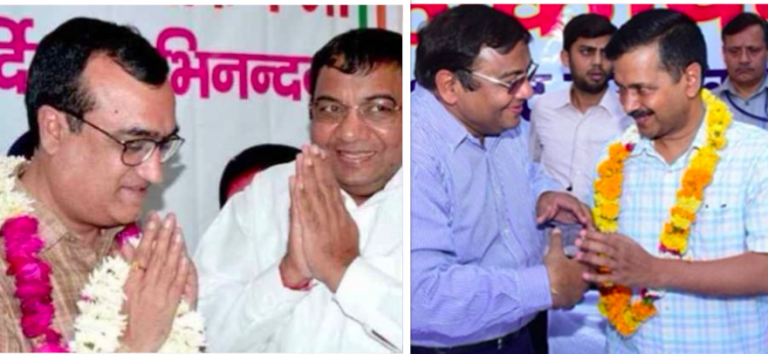
What the profile fails to mention is that till November, 2017, Gupta was a Congress leader, who had even fought elections in 2013 on Congress ticket. This former leader was also executive committee member of Delhi Pradesh Congress Committee and General Secretary of Delhi Pradesh Youth Congress Committee.

Soon, Congress leader Ajay Maken tweeted how just 40 days back Gupta had tendered his resignation, claiming he has been promised Rajya Sabha seat.


Amusingly, in 2016, Gupta had celebrated ‘vasooli divas’ demanding recovery of Rs. 854 crore Aam Aadmi Party led Delhi Government had spent in advertisements.

Meanwhile, many people were critical of Gupta’s nomination, including former and current team members of Aam Aadmi Party.


Deputy Chief Minister of Delhi, Manish Sisodia, has said that since Gupta runs a lot of schools which provide free education, he has been chosen. However, the picture could be different.


AAP co-founder Yogendra Yadav, too, was vocally critical of the decision.

They even accused of tickets being bought in Punjab elections and ‘accounts fudged’ and disappointment over AK (Kejriwal) going to ‘such an extent’.

Meanwhile, Kumar Vishwas, too, voiced his disappointment at ‘punished’ for saying the truth.

Rebel AAP leader Kapil Mishra also accused of killing the anti-corruption movement (by siding with Gupta) through his tweets.

Meanwhile, Arvind Kejriwal, instead of answering his volunteers and colleagues, resorted to retweeting tweets which praised him and his decision.

Battle of Koregaon : Lessons in Unity

0

(written by @TrueIndology and @Dimple_Kaul)

It is unfortunate that in the year 2018, India is witnessing caste clashes which, if unchecked, could blow into a major civil war. We are seeing Media and “Youth” politicians like Jignesh Mevani and Rahul Gandhi adding to the conflagration of caste politics.

This is what Rahul Gandhi tweeted:

The current President is a Hindu who comes from the Dalit community and he is the chief executive. He became the President when RSS/BJP are ruling at the Centre. Yet, a PM aspirant tweeted this falsehood.

Also read: Twitter locks account of True Indology as it exposed NDTV’s distorted claims of communal harmony in Jammu and Kashmir

To top it all, our Media that is perpetually on a spree of “Breaking News”, has added fuel to the fire by portraying it as a “Dalit vs Hindu“ issue.

For a really long time, we have been wanting to highlight how History has been, and still is, twisted by vested interests to exploit, existing or imaginary, fault lines within the Indian society. Most of the times, we have found media outlets acting as catalysts. They act as a platform for disseminating atrocity content. One such example of manufactured atrocity porn that was doing the rounds on Social Media came to our notice.

In the last few years, the fifth column has been working hard to foment and hype inter-caste fissures among Hindus. These entities (vested interests) in India, often aided from abroad, keep attempting to exploit internal, existing or imaginary, fault lines of the Indian society. They rely extensively on atrocity content to promote distrust among communities or groups of people. National and Global media and myriad “scholars’ of Indology and “South Asian Studies” have also been found to be acting as conduits.

These forces are determined to inculcate the feeling of victimhood internally among some communities within Hinduism to ensure that unity in the Hindu society does not get fortified. They also try to create groups based on faith and gender.

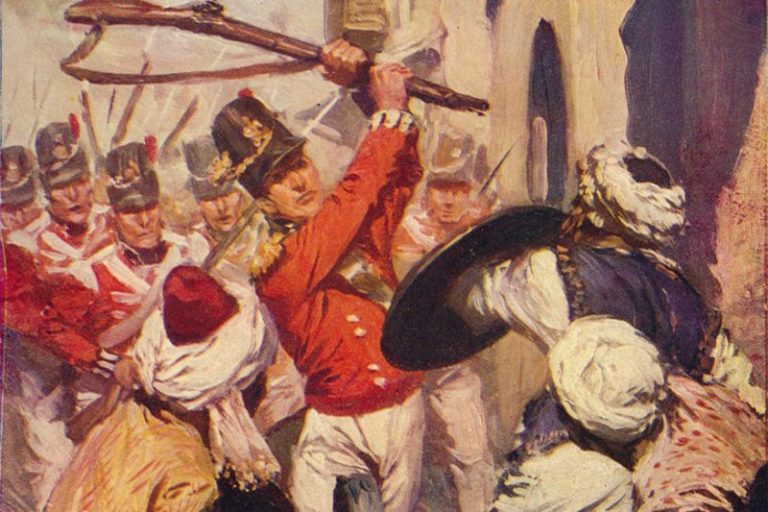
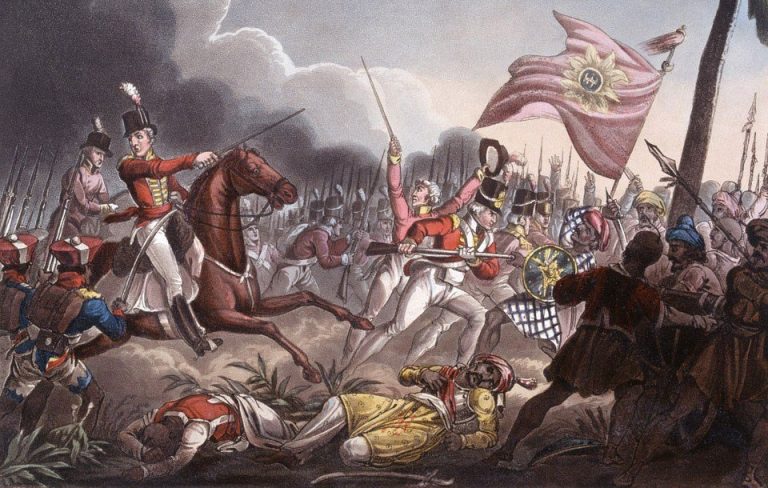
The Koregoan battle is just one of the many battles fought between the British and the Marathas. But suddenly it is in the news. Why should this battle, hardly an indecipherable footnote of history, be in the news now? Because, the fifth column has been trying hard (without success) to search for one battle in History where Dalits battled Brahmins. There are no such battles. This is the only such event, the facts of which, when twisted provide a good template to write atrocity porn – demonize one community (Brahmins) and inculcate the feeling of victimhood in another (Mahars/Dalits).

As we will show in the article, Koregaon was NOT a battle between Dalits and “Upper Castes”. The British did NOT win in this battle. More importantly, we will show that this “Dalits against non-Dalits” narrative, where only the former are oppressed, and only the latter are oppressors, is the most misleading misconception perpetuated over the years to paint Hinduism as a proponent of segregation.

We are writing this post not only to refute this article, but also as a case study to highlight how you can identify atrocity content. In that way, it is a rebuttal to all those posts that use this set template!

The column begins with complete falsehood.

 The commemoration and celebration of Bhima Koregaon revolves around the defeat of Peshwas by the untouchable soldiers of the colonial army at that time.

The fact is that the battle was between the British and the Peshwas. Fact also is that the Peshwas were NOT defeated in this battle. We have the documentary evidence of James Grant Duff, a soldier and prominent historian of that time, to corroborate the same.

Even if we forget Duff’s written evidence and believe that the British won the battle, how does it become a Dalit victory instead of a British victory? Did the British side have even a single Mahar/Dalit in any prominent position in this battle? Can they name one Dalit lieutenant fighting for British in this battle? The answer is an emphatic NO.

The British did not give any Dalit such position. If Mahar foot soldiers being a part of the British side makes it a Mahar victory, then India has undoubtedly won both the world wars! And why stop at that? A creative mind could also argue that the First War of Indian Independence in 1857 is also a Dalit victory over Brahmins since Mazhabi Dalit Sikhs and Bombay regiment Mahars of British Army defeated the mutiny led by Brahmins such as Mangal Pande, Rani Lakshmi Bai, Tanttya Tope and Peshwa Nana Saheb.

However, since fiction is not our forte, we will stick to facts. And the fact is that it cannot, by any stretch of imagination, be considered a British win. It was a British retreat. Even the British had initially not claimed it as a victory. During the course of Parliamentary debates in March 1819, the British had described their feats at Koregaon as follows

“In the end, they secured not only unmolested retreat, they also carried off their wounded”

If anything, far from a “victory”, the British failed in their mission. The British on January 1, 1818, took their troops from Seroor towards Pune with an intention to invade and conquer the Peshwa capital. They were unexpectedly intercepted by Marathas midway at Koregaon. They were heavily outnumbered. Yes, both the British and their sepoys, (both Dalit and Non Dalit), fought bravely and inflicted casualties on Marathas. But they also had to suffer many casualties and abort their Pune mission to retreat back to Seroor[1].

And how did British show their gratitude to these Dalits who had laid down their lives? They stopped recruiting Mahars in their Army in 1892, citing the reason that “Mahars are not a martial race but low-caste untouchables[2]”.

Further, most of the nomadic and former “untouchable castes” were classified by British as “Criminal Tribes”. All members of castes were declared inherently “criminal” and restrictions were imposed on their movement. All male members of these communities had to report weekly to local police[3]. As Stephen Cohen shows, the British after conquering India simply dismissed “untouchables” as “useless soldiers”. They drew sharp caste lines by recruiting “handsome men from high castes”:

“Why bother to recruit the “dhobi [an untouchable washerman caste battalions,” one series of articles in the Pioneer argued, if they could not be trusted against the formidable Pathans. Untouchables were docile creatures, perhaps suitable for internal guard duty or labor battalions, but otherwise useless as soldiers….. “largest, handsomest, and cleverest looking men were undoubtedly the high castes”

When British stopped recruiting Dalit Mahars in British Army because of their “Aryan” and “Martial race” theories, the Mahars sent a request to British wherein they claimed they were Kshatriyas and requested British to enroll them. It is to be noted that Mahars of British Army were nothing like Jignesh Mevanis of today. Ambedkar’s father was also a Mahar soldier and he was a devout Hindu. He kept reciting the Ramayana and the Mahabharata. It is ironical that the current day “Dalit” Yuva Netas are glorifying the British and their victories.

The column further states,

Acknowledging and remembering this battle – by turning up in such large numbers and assembling at the site – actually runs counter to the normative aspect of the caste system, which does not allow space to a Dalit to act as a militant.

Ancient Hindu scriptures like the Manusmriti have mentioned very clearly that a Dalit, or the lower caste Shudras and the Ati-Shudras, do not have the right to even have this force in their defence. Koregaon remembrance also goes against this very idea of what we call caste normalcy.

It challenges the dominant Hindu-nationalist perspective about Dalits – as a polite, manageable community silently suffering the existing caste hierarchies and caste injustice. By celebrating Koregaon in this manner, Dalits are saying ‘No’. They are saying: “We will celebrate the militancy that is part of our history”. Upper castes have either stifled our histories, or twisted them because they don’t find them suitable for continuing their narrative of Hindu nationalism. To retain their hold on history, they reject the notion of parallel histories.

You cannot miss the atrocity porn 101 in display above. A marked characteristic of atrocity writing is that it unfailingly projects the past into the present. The column, written in the 21st century, uses a made-up victory of an incident involving Mahars in the 19th century , to make the commemoration of an “imaginary” British win, a part of Dalit struggle.

Moreover, the column says that the Hindu society did not allow Dalits to equip themselves (“militarize themselves”)  and carry arms. Interestingly, these claims are nullified by Mahars themselves. According to tradition of the largest section of Mahars, Somavamshi Mahars, their ancestors fought with Pandavas in the Mahabharata war[4].

If they were not allowed to fight or defend, how did this tradition come about?

One could dismiss the tradition as pure legend, but we cannot ignore that Mahars fought in Shivaji’s Army[5]. Or that Shivnak Mahar was gifted the village of Kalambi by Rajaram, Shivaji’s son. Or that Shivnak’s grandson, also named Shivnak Mahar, saved the life of  Pureshwaram Bhau in the battle of Kharda in 1795 against Nizam. In fact, when some people objected to Shivnak Mahar’s presence in the Maratha camp, the Peshwa’s Brahmin advisor Hiroji Patankar told them that in warfare there should be no concern for caste[6]. Nagnak Mahar captured fort of Vairatgad from Muslims and gave it to Rajaram. He was made Patil of Satara[7].

Making these facts public would spoil the narrative that helps fuel riots. No wonder, we have not heard the caste warriors proclaim these documented realities.

Any sane person would be shocked by the felicitation of the “supposed” victory of a Colonial power from another country over natives facilitated by fellow citizens. What makes it sickening is that the British Army consisted of people from various communities and not just the Mahars. Similarly, as noted by British observers like Major Dirom, the Peshwa Infantry consisted of people from low castes. Therefore, even when soldiers from either side were killed, it included Indians from various communities. It also means that the Mahars of the British Army fought against the Dalits of the Peshwa Army.

How does it then become some Mahar against Peshwa battle instead of a British versus Indians battle? The “Mahars” of the British forces also killed Indians (who included Dalits) of the Peshwa Army and this is  celebrated in 21st century India!

Have you found anyone glorifying Shivnak Mahar? You won’t, for, glorifying him takes the wind out of the sails of these forces that want to create caste wars in India.

One may ask as to how did the Mahars end up in the British Army? It is not as if the British ran some training college and recruited candidates from there! There is a long history of Mahars serving in the Maratha Army, for, the Peshwas recruited them in good numbers. Mahars capitalized on this experience in Peshwa’s army, became acquainted with warfare and were able to enlist themselves in British Army[8].

It is to be noted that the Mahars and Peshwas had a cordial relationship. To begin with, Peshwa Madhavrao in c.1770 CE abolished Veth or extraction of forced labor from lower castes/classes. Every kind of service began to be paid in cash[9]. Significantly, Veth in Peshwa domains was abolished 50 years before slavery was abolished in the British Empire.

When Madhavrao was born, Peshwa Balaji Baji Rao had granted 300 hectares of tax free land to “lower caste” communities like Kolis, Ramosis and Mahars. Under these Mahars and other “lower castes”, many Hillmen were posted as guards[10]. Madhavrao’s deed was not without historical precedent. Already during Shivaji’s time, his Brahman commander Mahadaji Nilkanthrao bestowed a naik vatan of Purandar fort to two Mahars. 40 guards were placed under the command of each Mahar[11].

One incident particularly illustrates the social condition of Mahars under Peshwa rule. In 1748, the Mahars of Paudkhor district appealed to the district official as follows:

It was the custom that Vatandai Joshi officiates as the priest at the marriages of us Mahars. In other districts too, a Brähmana is to officiate at the marriages of Mahars. However a dispute over the transaction (denen ghenen) between us and Joshis arose and Joshis stopped officiating at our marriages. This state of affairs has been continuing for some 15 or 20 years. So we beg you to restore the matter as before, taking the custom of other districts into consideration[12].

Basically, a group of Brahmans of Paudkhor district had refused officiating at Mahar marriages owing to some dispute. The Peshwas did not take kindly to this gesture and ordered these Brahmans to officiate at Mahar weddings (ASS 1-74). They even levied a fine of 10 rupees and forced the Brahmans to officiate at Mahar weddings

This does not seem to be an oppressive behavior towards Mahars. It was only after relentless appeals by Brahmans that an enquiry was conducted and the Brahmans were given the option of not officiating at Mahar marriages for this district, although they always had to officiate for Mahars and other Dalits in other districts.

It is to be noted that Mahars enjoyed great prominence in certain rituals. When Panwar Rajputs celebrated Narayan Deo festival, they invited Mahars to partake the first Prasad[13].

In the Shanti festival, it was Mahars who played prominent role. In British India, 20 Mahars wanted to convert to Islam, but turned back on being refused to be admitted into Mosque[14].

One big tendency of the so-called caste warriors is to bracket everyone from the “low caste” as “Dalits” and create an illusion of a Dalit against non-Dalits society, where only the non-Dalits “oppressed” Dalits. Nothing can be farther from truth. Many authors have documented how caste behavior was practiced even within the so called “low castes”. One Dalit sub-caste ill-treating the other (considered lower in social order), was largely prevalent and no amount of white-washing can falsify this fact.

It is to be noted how the Mahars themselves ill-treated the Mangs (whom the Mahars considered lower to them). To begin with, Mahars did not accept food from the castes such as Mang and Bhangi, whom the Mahars considered to be polluted[15].

When a Mang bridegroom rode a horse as against a bull, the Mahars made an official complaint against them. According to Mahars, only their grooms had the right to ride the horses and not those of Mangs . Mahars sent appeals to Peshwa urging him to prohibit Mang grooms from riding horses and stay content with riding bulls[16].

Horse was a status symbol and Mahars felt only they and not the Mang were entitled to this privilege. Mahar superiority over fellow Dalit Mangs had nothing to do with Varna or Smriti. No Smriti says Mahars had any privilege over their fellow Dalit Mangs. In support to their appeal, the Mahars did not refer to any Smriti but pointed to an existing state of things and existing relative tribal order of their society. As Mahars enjoyed cordial relations with Peshwa, their request was accepted and Mang grooms were forbidden to mount horses.

Is it any surprise, then, that Mang considered Mahars as their arch enemies and delighted in decapitated the heads of Mahars? The Gazetteer observes, “The proudest moment of a Mang’s life is said to be when he hangs a Mahar”[17]. By contrast, both the Mahar and Mang employed Brahmans wherever available. What was common to Mahars and Mangs was they  respected the Brahmans and followed Hindu traditions. It was a Hindu festival named Shanti dedicated to Mother Goddess which made Mahars and Mangs as well as Dalits and non Dalits put aside their differences and celebrate the festival together, acting as a unifier.

Looking at caste with colonial glasses makes one overlook the more obvious aspect of Tribalism. In fact, it was British who solidified tribal caste boundaries. Yes, the British initially recruited Mahars because in early decades of 19th century they were not in any position to choose. As we have seen, the British stopped Mahar recruitment by 1892 and preferred “handsome high caste men” in army. Introduction of postal services dealt a blow to traditional jobs of Mahars as “messengers”. Thus like many other low castes, Mahars had to migrate to urban centres of British India. In this environment, they became low paid labourers in their traditional professions. The recruitment to menial jobs were done on basis of caste and caste divisions were reinforced like never before.

In colonial hospitals and medical colleges, many of the north Indian funerary specialists known as Doms were employed as mortuary attendants and dissecting-room assistants. In textile production too, mill hands were often from the groups which had come to be identified as ‘impure’ or unclean[18].

Far from the fluid, open-ended labour and tenancy relationships in rural environments of Peshwa’s Maharashtra, the Dalits became subject to caste conventions like never before in towns of British India [19].

Colonial British officials like Alexander Robertson depicted the preceding Peshwa age as the one when Dalits had to lead a horrible life with no opportunities. They justified the colonial rule by depicting the British as liberator of “depressed classes”. However, the reality is strikingly different. Far from the days of Peshwa Madhavrao when Mahars could have large vatans, contemporary British manuals on house management instructed British housewives to recruit domestic servants of “correct” caste origin.

In early colonial period, forests were felled and “tribal” people were disarmed/subordinated. Ploughing this land brought the pastoralist tribes against the tillers. British industries led to stagnation of traditional artisans. British modernization and introduction of roads, railways and ports created demand for cheap labour. The British maintained large cantonments, larger than anything done by previous polities. They needed a large number of manual scavenging labour as well as cheap labour for their tea plantations. The British recruited them from groups like Mahar, Bhangi and Chamar, whom they invariably referred to as “sweeper classes”. Caste notions of purity and pollution were increasingly invoked to serve the new demand.

Thus, we agree with Indologist Susan Bayly when she says that untouchability as we know it is largely a product of British colonialism

Untouchability as we now know it is thus very largely a product of colonial modernity, taking shape against a background of new economic opportunities including recruitment to the mills, docks and Public Works Departments, and to the labour corps which supported both the British and sepoy regiments[20].

Instead of making Manu the villain and attributing every blame to his Smriti, perhaps we need to wake up and read all the texts that are painted as fountainhead of discrimination. Caste discrimination existed and exists even now in our society. This is an undeniable fact and we should all work towards eliminating it. Instead of attributing all the blame of discrimination on one Smriti and one community, we should ask how much of our inherent tribalism was responsible. We should also ask whether by blaming one community we are only rekindling the same tribalism and furthering Caste animosities.

This is what we need to be aware of, and rise against. Please make sure that this is your year of awareness. Do not allow vested interests to divide the great tradition of Sanatan. Explore. Find out for yourself if what they are demonizing is indeed wicked or simply a stick for them to beat and divide us with. Arise, awake, and stop not till the goal is reached.

We stand with Dalits in general and Mahars in particular. We are proud of their martial history and wish to remind them of their Mahabharata tradition. We caution them against forces who are bent on destroying the social fabric of our society.

We leave you with these lines from the Kathopnishad:

उत्तिष्ठत जाग्रत प्राप्य वरान्निबोधत,
क्षुरासन्न धारा निशिता दुरत्यद्दुर्गम पथ: तत् कवयो वदन्ति|

Arise! Awake! Approach the great and learn.
Like the sharp edge of a razor is that path,
so the wise say−hard to tread and difficult to cross.

References :

[1] Sharaddha Kumbhojkar, Politics, Caste and remembrance of the Raj pp.40

[2] Revival of Buddhism in Modern India Page 81

[3] Bates, Crispin (1995). “Race, Caste and Tribe in Central India: the early origins of Indian anthropometry”. In Robb, Peter. The Concept of Race in South Asia. Delhi: Oxford University Press. p. 227.

[4] The Tribes And Castes Of The Central Provinces Of India Vol IV pp 132.133

[5] Jadunath Sarkar, Shivaji and his Times, P.363

[6] KV Kotawale, politics of the Dalits. 1974 pp 142-145

[7] V.Longer, Forefront for Ever: The History of the Mahar Regiment p.12

[8] Christophe Jaffrelot,  Dr Ambedkar and Untouchability: Analysing and Fighting Caste p.19

[9] GS Sardesai, New History of the Marathas: The expansion of the Maratha power, 1707-1772 p.346

[10] Kotani, CASTE SYSTEM, UNTOUCH ABILITY AND THE DEPRESSED p.70

[11] Ibid P.70

[12] Ibid P.73

[13] The Tribes And Castes Of The Central Provinces Of India Vol IV pp 131

[14] Ibid P.139

[15] Gazetteer of the Bombay presidency 1885 pp.440

[16] 1776. SSRPD VI-816

[17] Gazetteer of the Bombay presidency 1885 pp.443

[18] Susan Bayly, Caste, Society and Politics in India from the Eighteenth Century to the Modern Age pp.226

[19] Ibid pp.226

[20] Ibid pp.226

Tejashwi Yadav, Manish Tewari and others face contempt of court charges post Fodder Scam verdict

0

The special CBI court issued contempt of court notices to senior RJD leaders, including Tejashwi Yadav, former deputy chief minister of Bihar, and Lalu Yadav’s son, after the Fodder Scam verdict.


Tejashwi had accused Bihar Chief Minister Nitish Kumar and the BJP of trying to malign Lalu.


He further stated that only fault of Lalu was that he was born in backward caste and fought for social justice.


Congress leader Manish Tewari also faces contempt of court charges in the fodder scam for speaking against the judgement.

Manish Tewari had defended Lalu and implied the verdict as BJP’s agenda.


Meanwhile, Lalu’s quantum of sentence will be pronounced tomorrow.

On 23rd December, 2017, special CBI court in Ranchi had announced Lalu guilty in fodder scam. Lalu specifically was convicted in a Rs 89 lakh Deogarh treasury case, which is one of the five fodder scam cases in which Lalu is an accused. It was alleged that fraudulent withdraws were made from the Deogarh treasury 1991 and 1993.

But this conviction episode wasn’t without high drama.

A few minutes before the actual conviction, the media, possibly by tapping into their telepathic instincts, jumped the gun to give Lalu supporters a reason to cheer.

Republic TV airs video clip where Jignesh Mevani is seen inciting people

0

In a shocking video clip that has been aired by news channel Republic, it can be seen that the Vadgam MLA Jignesh Mevani was calling on people to take to streets. In a heated speech, 12 hours before violence erupted, Mevani could be heard asking people to take the ‘Battle of Bhima Koregoan’ forward against the modern ‘Peshwais’.


The video shows Mevani delivering a speech at the 200th anniversary of the Battle of Bhima Koregaon in Pune district on Sunday. He says that the cause (of Dalits) cannot be fought in electoral politics. He says that the discussion should be held in state assemblies as well as in Parliament, but the battle will be on the streets. ‘The domination of one caste over other castes will end only after fighting on the streets’, he asserted. A day after the speech was delivered, violence broke out where one person was killed. Rahul Babaji Pharangade was allegedly identified as a Maratha because of his jacket that had Shivaji embossed on it. He was accosted, severely assaulted and beaten to death, according to local villagers.

This raises doubts whether the caste violence was planned. Many Twitter users also raised similar questions regarding the violence.


Twitter users also pointed out provocative messages which went viral on social media some of which calling for “burial of new Peshwas” taking a confrontational approach. Many people on social media pointed out how these posters could have played a part in the developments.

Many users were also reminded of the divisive caste-based politics Congress had played back in the 1980s.


Jignesh had joined hands with Congress, following which, he fought the recently concluded Gujarat Assembly elections.

Meanwhile, Pune Police has been approached to file an FIR against Mevani and Umar Khalid, the JNU student who was indicted by Delhi Police for allegedly getting anti-India posters at JNU at an event to show solidarity with Afzal Guru.


Two youths, Akshay Bikkad and Anand Dond, wrote that “due to Mevani’s remarks, tension has erupted in the state between two communities. He provocated (provoked) people to ‘Come on street and retaliate.’ Due to this statement people came out and tension erupted.”

After BJP’s successful 272+ campaign in 2014, supporter launches a Mission 360+ campaign for 2019

0

During the buildup to the 2014 Lok Sabha campaign, the BJP had launched an ambitious mission 272 plus campaign, which enabled various interested citizens to volunteer towards helping the party secure the magical 272 mark in the Lok Sabha elections. This initiative turned out to be a resounding success, considering BJP ended up winning 282 seats that year.

Now a popular Twitter user named Vijay (@centerofright), having over 73,000 followers, has decided to take things to the next level by launching a volunteer program to help BJP achieve 360+ seats in the 2019 Lok Sabha polls:


To launch this program, Vijay has created a website named mission360.plus, where interested volunteers can sign-up and contribute to the 2019 campaign. In the “about” section, this 360+ initiative is described as:

#Mission360+ is a volunteer driven effort to bring supporters of BJP and Narendra Modi to achieve the goal of 360 Plus seats in the 2019 Lok Sabha elections

An article accompanying the volunteer sign-up form acknowledges that many supporters wanted to contribute their time and effort for the 2019 election campaign. It asserted how in 2014, thanks to everyone coming together, a Narendra Modi led BJP government came to power after defeating the Congress which was in power for a decade.

It claims that the 2019 campaign is being initiated to ensure that the Modi government’s good work is continued and that the Congress is prevented from returning to power, “directly or indirectly”.

In order for someone to sign-up interested users can scroll down to the end of the aforementioned article and fill this simple form:

Form (Part 1)
Form ( Part 2)

As seen above, one needs to provide his/her name, email, preferred volunteering modes, list of interests and twitter ID, after which they are good to go. Instead of filling the form, one can also drop a mail at [email protected].

This initiative is a purely volunteer driven initiative and further details regarding the mission would be conveyed once a good number of volunteers sign-up.

Such an initiative right at the start of 2018 might signify that online supporters of the BJP have sounded the bugle for 2019 Lok Sabha poll,s and the activity might further intensify in the coming days.

The logical fallacy of celebrating ‘Dalit victory’ at Battle of Koregaon

0

“History is written by the victor and not the vanquished”

The victor adds colour to the history that suits his or her reasoning and the way he or she wants to set the narrative. The way this coloured history is told or taught to the current generation has its own ramifications. Ramifications in how the generation perceives and propagates the narrative to future generation.

A community with a history of persecution and imposed social disability is bound to hold grudge towards the oppressor. In a socially diverse country like India, it becomes more pivotal to form the narrative carefully, but more important than that, truthfully.

Recently, to commemorate the “Watershed moment for Dalit community in their struggle against caste prejudices”, newly elected Gujarat MLA Jignesh Mevani along with JNU student and alleged separatist Umar Khalid attended the bicentenary of the Bhima-Koregaon battle of January 1, 1818.

For the uninitiated, the battle was fought between British East India Company and Peshwa Baji Rao II. It is celebrated as a “Dalit victory” because East India Company had Mahar (a Dalit caste) soldiers while Baji Rao II was a Brahmin.

It comes as little surprise that these casteist leaders are using a 200 years old battle to reignite caste debate which will garner votes for them, however it raises few eyebrows when acclaimed commentators on social media and in the mainstream media also paint Battle of Koregaon as a “Dalit victory over upper caste oppressors”.

These commentators have significant following and considerable influence on their audiences. Hence it becomes imperative to dissect and separate fact from fiction. Sample this or this in the mainstream media or the tweets below, which I value more:


Some of the claims like “Dalits were ordered to tie a broom round their backs so that their footprints can be swept” are argued to be having no documentary evidence:


However, that is is secondary issue, and also, one can not deny the atrocities Dalits in general were subjected to and are still made to suffer in some parts of India. It is not in scope neither in interest of this article to dissect documentary evidence in history books.

This article tries to bring your attention to a glaring logical fallacy that some commentators assume while Battle of Koregaon as a “Dalit victory over upper caste oppressors” because British army had Dalit soldiers and Peshwa was a Brahmin.

It is too simplistic, naive, and even sinister.

There is certain ideology even in a war. A soldier is not fighting to douse his personal grudge. A soldier fights under a flag. That’s the basis of war conventions and that is why there is certain dignity accorded to war prisoners.

The soldier is neither your enemy nor your criminal. He merely represents a flag. The soldier didn’t kill your people. The flag, the country did. Apologies, if this sounds like Gurmehar Kaur, but in fact it’s exactly the opposite. Pakistan, indeed, killed her father and not the war neither the Pakistani soldier. There is no logic to assume that Mahar soldiers were not fighting for a flag but a personal battle.

But even if, for argument’s sake, we assume that a soldier is fighting his personal battle, this has to apply on both sides. For example, in light of the above argument, if I am to assume that the Mahar soldier was actually fighting caste oppression and not merely following British orders as he was bound to by being employed in a British infantry, I have to apply the same corollary to the other side too. The Mahar was not fighting the Peshwas or the Maratha flag. He was fighting against an individual, a foot soldier, a Maratha soldier who was in all probability an Arab (Muslim), as described here, here and here.

How is it then a battle against caste oppression? In fact, it could be said that it was a Dalit vs Muslim battle, not between two Hindu castes.

From the book ‘Rise and Progress of the British Power in India’ by Peter Auber

In fact, not only that the Peshwa army that fought in Koregaon contained majority of Arabs (Muslims), even the British East India Regiment of Bombay Native Infantry was not a Mahar exclusive regiment. There is no British document substantiating that the Bombay Native Infantry was a Mahar exclusive or Mahar dominated regiment. One of the demand of Ambedkar in 1932 was to induct more soldiers from Mahar community and that’s how Mahar Regiment came into force in 1942.

The obelisk (stone pillar), which a commemorative construction post the ‘victory’ and seen today as a ‘Dalit monument’ by some, named Captain Staunton and praised the British Army in general when it was made, and not Dalits or any foot soldier for that matter. This fact is recorded in this gazette by the British:

Gazetteer of the Bombay Presidency
The message on the obelisk (stone pillar)

So it was always a war for the British. The portrayal of the battle as a “Mahar/Dalit victory” is a later development; a result of Dalit activism and celebration of ‘alternative history’.

If you see the battle as a defeat of Peshwa army of the Maratha Confederacy, the victor has to be a flag and not a caste or a person, which is the British East India Company.

All I am saying is, you can’t be selective in picking up belligerents of a war. While on one side, you pick the flag, the other side can’t be a foot soldier. It has to be a flag as well. Or if you pick foot soldiers, apply the same to the other side. So it was, either British vs Peshwas or Mahar vs Arabs. It can’t be Mahar vs Peshwas. Take your pick.

Footnotes:

  1. Mahars served Marathas as well:

    From the book ‘Dalit Movement in India and Its Leaders, 1857-1956’ by Rāmacandra Kshīrasāgara
  2. As is claimed generally, the war didn’t result in any decisive victory for either side:

    From the book ‘Peshwa Bajirao II and The Downfall of The Maratha Power’ by S. G. Vaidya

German Police tweeted New Year greetings in Arabic, outrage and a Twitter suspension followed

0

Cologne Police in Germany tweeted new year’s wishes in German, English, French and Arabic which sparked outrage among Germans on Twitter.


Some users reacted whether the police will now come on camels,


While others pointed out how there are probably more Polish and Russian speaking people in Germany, but shocking German Police would choose Arabic over these languages to tweet the greeting.


Meanwhile, Beatrix von Storch, deputy leader of Germany’s far-right AfD party, had her Twitter account suspended for 12 hours on Monday after she accused Cologne Police of appeasing “barbaric, gang-raping Muslim hordes of men” after they tweeted a new year message in Arabic. She then re-posted the same message on Facebook, where it was also blocked for reasons of incitement.

She was referring to the 2015 incident where mass sexual assaults on women took place by men of mostly Arab or North African origin. Witnesses and police had described men working in ‘coordinated’ groups to grope women who were unable to escape, while two women reported they were raped. Back then, Cologne Police was also accused of covering up the mass sexual assault as the Police had said the celebrations had passed off peacefully while dozens of women had said they were robbed and sexually assaulted.

Reacting to criticism, Cologne Police spokesperson has said that they simply wanted to be understood by more people. While German is the official language of Germany, the language spoken by maximum immigrants in Germany is Turkish, followed by Kurdish, not Arabic.

4 Congress MLAs join the BJP, less than a month after Rahul Gandhi became Congress President

0

In a jolt to Congress’s aspirations in the state of Meghalaya, 4 Congress MLAs today joined the BJP, in presence of senior BJP leaders like Ram Madhav and Union Minister KJ Alphons:


Things might soon turn out to be more embarrassing for the Congress as according to Naveen Kapoor, a journalist with the ANI, seven other Congress leaders apart from these four MLAs are also expected to join the BJP today.

The mass exodus from the Congress began on Friday when five legislators resigned from the party to join the National People’s Party which is an ally of the BJP. Apart from this, two independent legislators who were supporting the incumbent Congress government, decided to resign from the assembly.

As a result of these resignations, the total Congress MLAs fell to 24, in a now 51 member assembly. The Congress coalition though continues to retain the majority, thanks to its allies which takes its consolidated strength to 35. Its allies include, eight independents, two from the NCP and a solitary member of North East Socialist Democratic Party.

Incidentally this switch-over from the Congress, comes barely 15 days after Rahul Gandhi was ‘elected’ as the Congress president, thereby ushering the party into a new era. As a result of this, people might start questioning as to how much confidence state level leaders have in Rahul Gandhi, considering a few didn’t even wait for a whole month to experience congress under Rahul Gandhi.

The state goes to polls next year and such “side-switching”, might signal a realignment in the state’s political scene. This switch over to the BJP also significantly comes ahead of BJP President Amit Shah’s visit to the state on 6th January. In this visit, Shah is going to address an election rally and will also take stock of the election preparations.

It remains to be seen whether this dissipating political strength of the Congress party in Meghalaya works in favour of the BJP, thereby enabling the latter to form a government in the state.