Home Blog Page 7397

How did Gujarati Muslims vote with Congress’ soft Hindutva approach in Gujarat Assembly Elections

0

It is perhaps the travesty of our times that the definition of ‘secularism’ has been distorted beyond recognition. What once merely used to mean the separation of religion and state, has morphed into a political tool to not only appease the minorities into voting as a block for one particular “secular” party, but also for a party which can offend the majority more effectively. BJP is of course considered a majoritarian, anti-minority particularly anti-muslim party in spite of their motto of “sabka saath sabka vikas,” simply because it refuses to appease the minority and trample upon the majority.

Congress has always played politics of minority (Muslim) appeasement in the name of secularism. Specially after Narendra Modi became CM of Gujarat in 2002. And this time, Congress managed to up its vote share from 38% in 2002 to almost 41% in 2017.

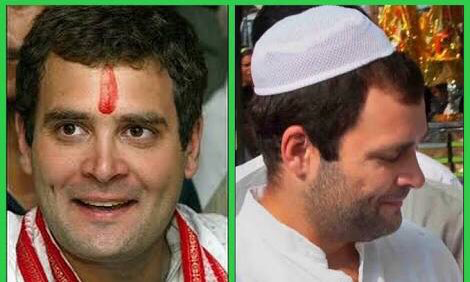
Last year BJP government faced the storm of agitation by the affluent Patidar community demanding reservation. Patidars have been traditional BJP supporters but BJP couldn’t fulfill their demand because of constitutional limitations. Sensing the mood of Gujarat, Congress ditched their muslim appeasement agenda to woo angry Patidars. It promised them reservation and adopted “Soft Hindutva”. Rahul Gandhi visited several temples during his campaign and even was declared as a Janeudhari Shiv Bhakt.

This ‘soft Hindutva’ approach of Congress was amusing to many. This was the same Congress which was perceived to be  anti majority their approach, whose Prime Minister Manmohan Singh had once declared that muslims had the first right on national resources. The same Congress housed leaders who concocted the ‘Hindu Terror’ bogey. Thus, this U-Turn seemed very interesting. It was also initially reported that because of Congress’ new found love for Hindutva, the Muslim voters of Gujarat were not only disgruntled with the Congress party but may also abandon them in the Gujarat Elections.

However, voting patterns in the Electoral process often need closer analysis to understand whether the available data backs up such sweeping generalizations and electoral claims.

Muslims account for almost 10% of Gujarat’s population. There are 34 assembly seats in Gujarat where Muslims constituents more than 15% of vote share and to understand how they voted, we must look at the candidates and how the votes were cast in favour of those candidates in at least a few constituencies. One of the ways to ascertain this, is to see if Muslims backed non Congress candidates.

1. Kutch’s Abdasa

This constituency has about 58,000 muslim voters who constitute about 29% of the voters. This is how this constituency voted.
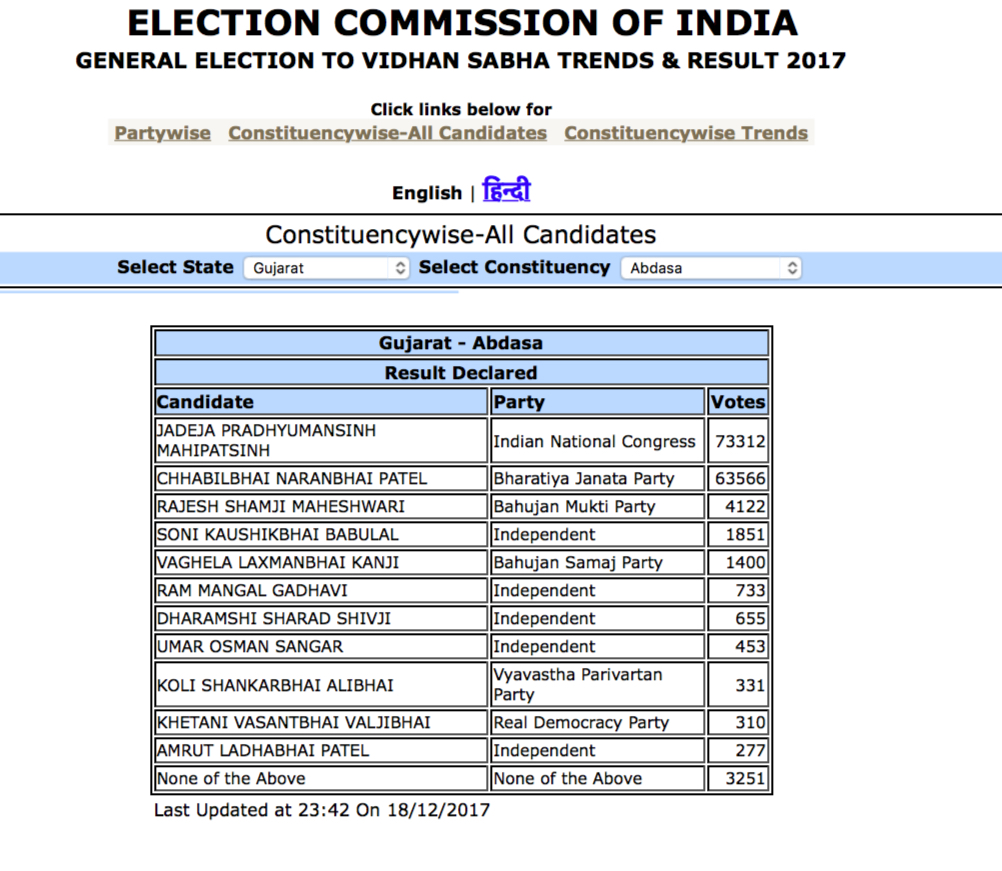
The Congress candidate Jadeja Pradhyumansinh Mahipatsingh won with 73312 votes to him name while an independent Muslim candidate, Umar Osman Sangar, polled only 453 votes. Interestingly, despite theories of ‘muslims angry with Congress’, the party managed to increase its win margin since in 2014, Congress candidate Shaktisinh Gohil had won with a mere margin of 700 votes. It is thus evident, that while Muslims may have been disgruntled with Congress, they have still voted for Congress heavily, abandoning even the Independent muslim candidate.

2. Kutch’s Mandvi-Mundra Constituency

The total voter base is 2.24 lakhs and more than 50,000 voters are Muslim. Almost 24% of voter base. Here BJP’s Virendra Singh Jadeja won but Congress’ Shakti Sinh Gohil got 70423 votes while 3 other Muslim candidates got 1105, 559 and 178 votes only.
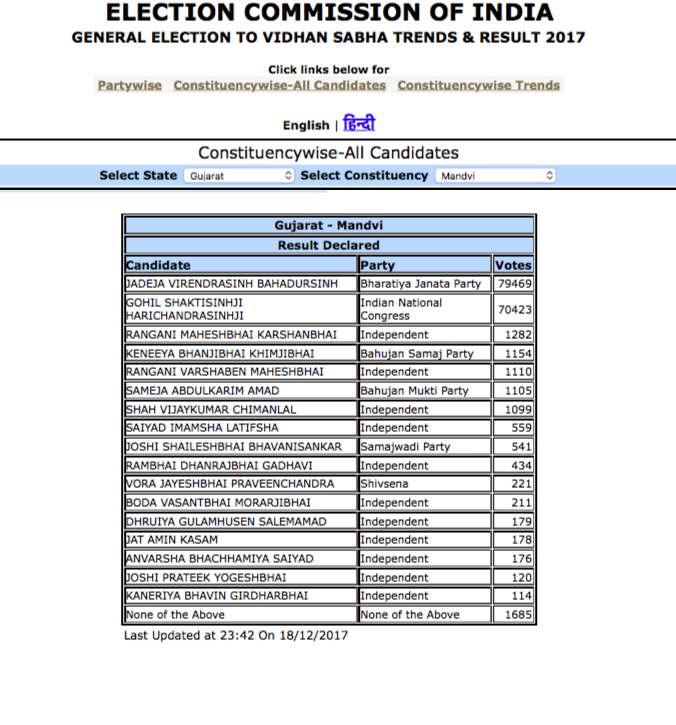
This constituency, other than the 50,000 muslim voters has about 31,000 Dalits, 25,000 Patidars and 21,000 Rajputs voters. While it would seem like BJP managed to defeat Patidar anger and rope in Dalit and Rajput voters, it would also seem like the Muslim voters have stood by Congress, abandoning even the 3 Muslim candidates.

3. Ahmedabad’s Vejalpur Constituency

Total voters here were almost 2.50 lakhs with more than 90000 Muslim voters. Almost 36% of voter base. Congress candidate got 95181 votes while 2 Muslim candidates Saiyad Kausarali Faiyazali and Shaikh Yunus Ghulam Rasul won only 197 and 185 votes respectively.
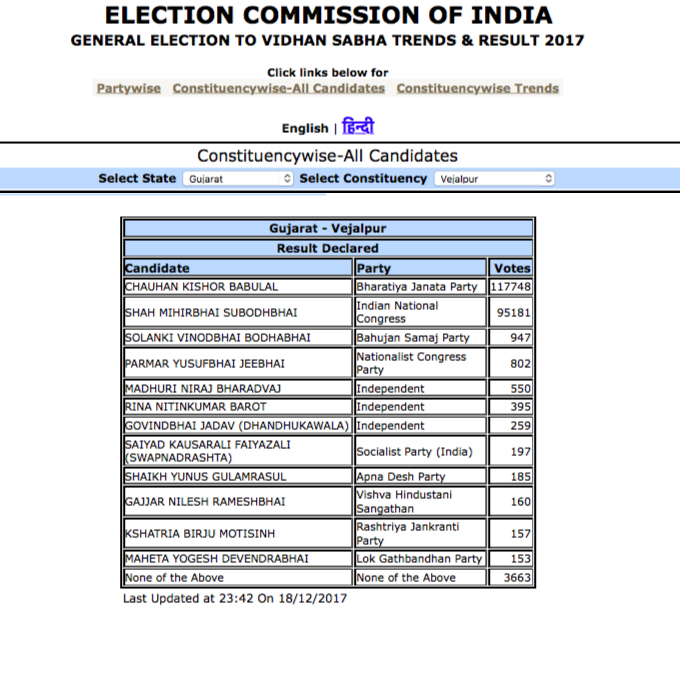
The Lok Sabha constituency has around 1.4 lakh Muslim votes, of which 90,000 live in Vejalpur Assembly seat, covering Juhapura and Sarkhej areas. While BJP won in this constituency by polling 117748 votes, it is seen that the muslim candidates did terribly while Congress, coming in second, polled 95181 votes.

4. Bharuch

In Bharuch which has almost 38% of muslim vote share of total 2.4 lakh votes, Congress’ Jayesh bhai Patel got 66600 votes and only muslim candidate Patel Imran got 1062 votes.
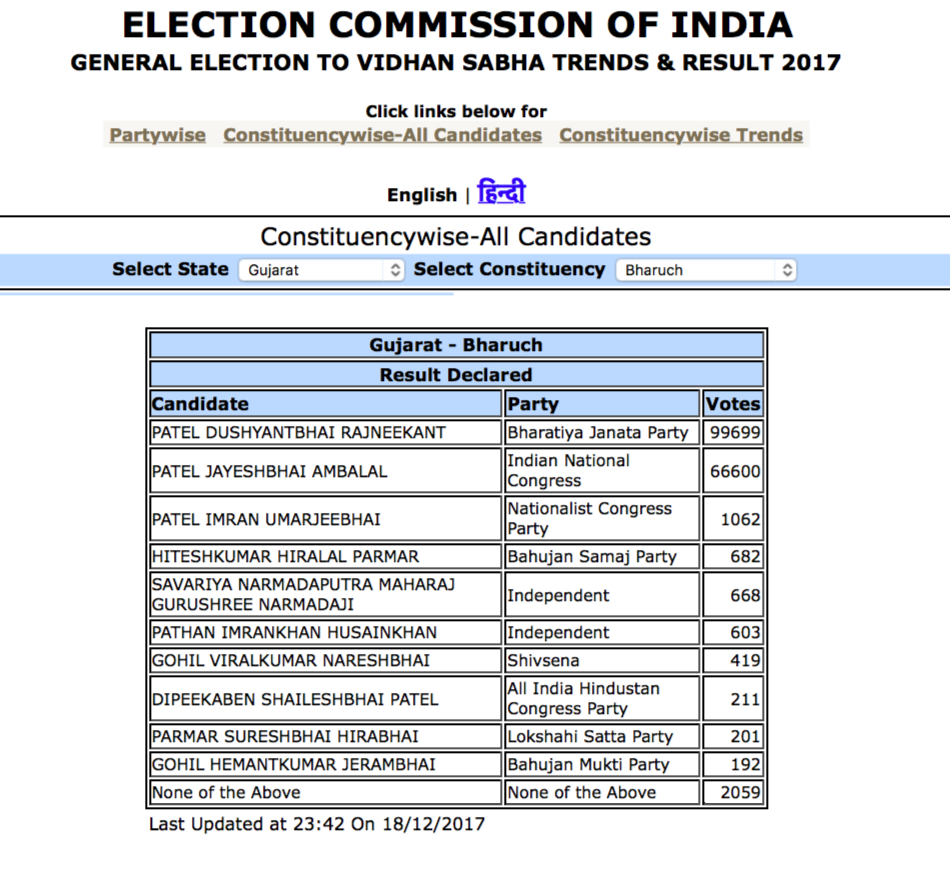
These are of course just a few examples, but while it may seem like since BJP is winning in some Muslim majority areas, that Muslims might be voting for BJP, numbers seem to point to the fact that the Muslims have rallied behind Congress yet again. According to polling agency VDP Associates, almost 88% Muslims voted for congress. There might have been marginal muslim votes that might have gone to BJP, but despite the widespread narrative of muslims being angry with Congress, they have, in most constituencies, abandoned even independent muslim candidates in their favour.

While Congress did peddle their ‘soft hindutva’ stand, it was also believed that perhaps the Congress party raked up a storm by having Rahul’s name in the ‘non hindu’ register of the Somnath Temple to try to not lose its minority voter base, and if numbers are to be believed, their methods seem to have worked.

It would seem like BJP won due to Hindu consolidation and Congress seems to have not only retained its minority share, but also managed to divide the Hindu vote to favour them in certain areas. This might also explain the reduction in BJP’s seat share. Muslims backed Congress in 2012, and despite Rahul Gandhi’s soft Hindutva approach, they seem to have backed Congress in 2017 yet again.
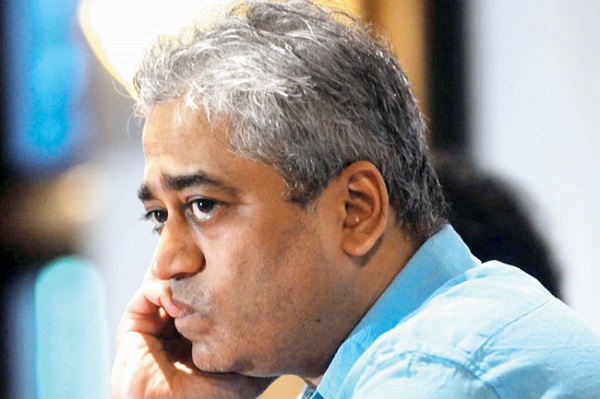
Rajdeep Sardesai slammed by Smriti Irani for his bias while covering Gujarat elections

0

Controversial journalist Rajdeep Sardesai has throughout his journalistic career managed to get slammed by various guests who have appeared on his shows.

We had recently created a list of five times Rajdeep Sardesai was absolutely decimated by guests he set out to interview, like former president Pranab Mukherjee, Billionaire Mukesh Ambani and actor Amitabh Bachchan to name a few.

Apart from interviews, he has also been called out during his regular panel discussions. Something like this was seen recently, when BJP’s GVL Narsimha Rao during a heated discussion called Rajdeep an “apologist for the Congress party” (Video via. @LOLiyapa):


Rajdeep was again on the receiving end of similar ‘barbs’ on election counting day, and this time they were launched by Union Minister Smriti Irani.

As captured by twitter user named @moronhumour, Rajdeep Sardesai is seen asking Ms. Irani whether she is afraid that her party’s organisation may start to weaken, if local leadership isn’t empowered and the party keeps focusing on a single person’s (Modi’s) charisma:


After ensuring that it was indeed Rajdeep who had posed this question, she claimed that when it comes to Sonia Gandhi, Rajdeep doesn’t focus on the charisma of local leaders and that Rajdeep has a ‘special love’ for Narendra Modi for which she (Ms. Irani) is grateful.

She further claimed that she had never seen Rajdeep so worried about the local leadership and organisation of the BJP, and asked him to in turn worry about ‘his own organisation’ which has got a new president in the form of Rahul Gandhi.

Ms. Irani though didn’t stop at that, and even decided to take a potshot at Rajdeep on Arnab Goswami’s show:

Here, Such a statement strongly implied that she was referring to Rajdeep Sardesai and moments later she jokingly questioned whether they (Republic TV) didn’t want her to name Rajdeep on their show.

This isn’t the only time Ms. Irani has taken Rajdeep to task when it comes to his journalism’. We had reported how Ms. Irani had asked Rajdeep to do “better research” before trying to either attack her or her HRD ministry in a fraud college matter.

EVMs silence critics by passing Gujarat test with flying colours

0

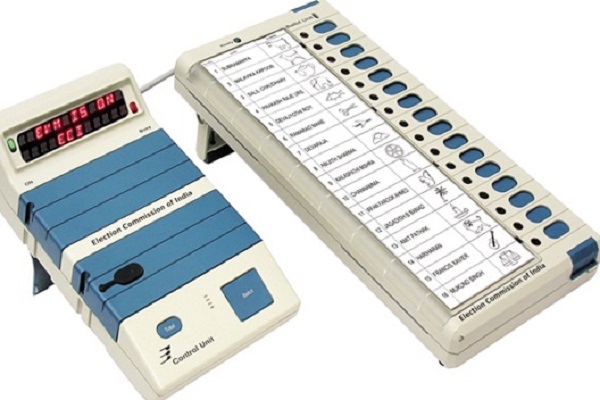
When the polling for the first phase of Gujarat election commenced, so did the conspiracy theories which alleged rampant EVM malfunctioning and hacking.

We reported how, almost hours after the polling began, Twitter users accused NDTV of spreading panic about malfunctioning EVMs. Later, things were taken to the next level after controversial journalist Sagarika Ghose decided to spread amusing allegations about EVMs getting hacked via Bluetooth signals.

The EVM tampering angle kept growing and yesterday on counting day, both AAP and Congress leaders came up with similar allegations to possibly defend against their poor performance in the state:


The EVMs though now have a chance to hit back now after it has been reported [1][2] that they have passed the Gujarat ‘test’ with flying colours.

As reported, the Election Commission officials have claimed that random vote counts in 182 seats of the state and their corresponding VVPAT paper trail have proved to be a 100% match, which means that there was no discrepancy in what button the voter had pressed and what the EVM consequently registered in its system.

This exercise of checking random vote counts was announced by the Election Commission to counter the allegations that the EVMs were manipulated in BJP’s favour.

In order to make these checks, polling stations in each constituency were selected on random via a lottery. This lottery too was transparent and representatives of all the political parties were present during the process.

As per various former Chief Election Commissioners like T S Krishnamurthy, N Gopalaswami, S Y Quraishi and H S Brahma, this cliffhanger result where the BJP barely managed to cross the majority mark, should be enough to quell apprehensions about the EVMs.

It remains to be seen whether the political parties would take a leaf out of the Election Commission’s page and stop questioning the credibility of the EVMs. But that may not be the case after all, as the Congress party had recently knocked on the Supreme Court’s doors, asking for a manual counting of at-least 20% of paper slips in each constituency. The Supreme Court had refused to entertain this plea.

Why BJP lost seats as compared to 2012 although it increased its vote share

0

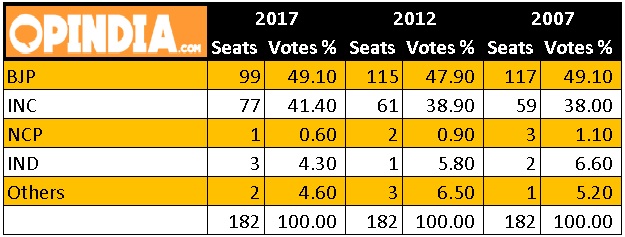
The Gujarat elections results are out, and the BJP has secured 99 seats whereas the Congress has reached 77 seats. A comparison purely based on seats shows that BJP’s tally has come down from the 115 seats of 2012 whereas Congress has moved up from the 61 seats it won then. But the vote-share statistics show something different.

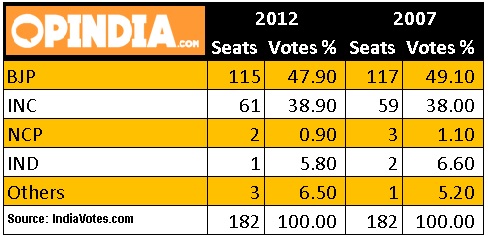
If one sees the voteshare percentages for last 2 Gujarat assembly elections, one can see that BJP’s performance in 2017 is as good as its 2007 tally, when Modi was at his peak. But, while they secured 117 seats in 2007, this time around they won only 99 seats. The same vote share percentage yielded 18 seats less. On an absolute basis as well, 49.10% is a staggering voter share percentage.

The seats obtained from this voteshare are lower this time around because the Congress managed to increase its voteshare from 38% in 2007 to 41.40%. The incremental 3.1% helped Congress massively. Even so, BJP still has a healthy lead of 7.7% over Congress’s voteshare. Then why the reduction in seats?

It is possible that the votes for BJP were all concentrated whereas Congress’s votes were spread more evenly across. Now that the results are out, an analysis reveals exactly this.

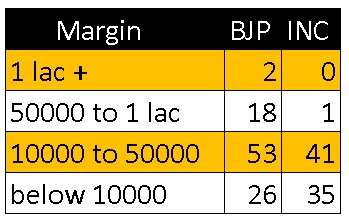
The highest margin for a BJP victory is 1.17 lacs in Ghatlodia. Whereas the highest margin for the Congress is just 50,776 in Mandvi. In fact, BJP won in 20 seats with margins of 50,000+ whereas Congress won just the Mandvi seat with 50,000+ margin. In all these 20 seats, the votes beyond the Congress mark are basically useless. The same votes, if secured in some other seats may have meant something. This is why we see the aberration between voteshare and seats.

A deeper analysis reveals that the BJP’s average margin is also much higher. BJP’s average margin is 29,967 whereas the Congress’s average margin is just 13,239. A margin wise split of seats won is as below:

While the BJP won big, the Congress won smaller, but more, as compared to their earlier performances. Thus in spite of a lower voteshare, it kind of punched above its weight.

When we see the data of past elections also, we see that the average margin has substantially increased for BJP, whereas the margin for Congress has actually decreased:


While in politics, a victory is a victory regardless of margins, for a political party to truly prosper in the long term, it must be willing to introspect and strategise to gain lost ground in the next election. BJP is known to be brutal as far as self analysis is concerned, and perhaps, why the party couldn’t win the same number of seats as 2012 and 2007, despite increasing it’s vote share is something that the party needs to figure out and rectify going forward.

People react after a roller coaster counting sees BJP notching victories in Gujarat and Himachal

0

Monday evening saw the end of a long, arduous, exhilarating and an amply controversial election season where the BJP emerged victorious in both Gujarat and Himachal Pradesh.

Based on latest election commission data, the BJP is confirmed to have crossed the majority mark after winning 96 seats and are leading on 3 others. In Himachal the BJP swept the polls after winning 34 as per latest data and leading on 10 others.

Things though weren’t looking so simple in the morning after BJP and the Congress were moving neck to neck in Gujarat, based on initial trends. This sent a shiver down BJP supporters’ spine, as is evident by the number of Retweets on this post:


On one hand some were getting scared and on the other, it was supposedly ‘euphoria’ time for others:


One user accurately captured the initial emotions via the lens of EVM tampering:


Soon things stabilised for the BJP and it looked like the party might comfortably get the majority. Having said that, the party though fell way short of Amit Shah’s target of 150 seats, and one twitter explained why:


Some analysed the challenge which the BJP was facing:


Even though the BJP had almost won, a few people took a stance of cautious optimism:


One journalist took a potshot at what the future narrative might be:


Some leftists websites even seem to be in no mood to waste time:


Even though Gujarat wasn’t the smoothest ride the BJP has had in recent times, the party might consider the elections to be a success nonetheless, and may start working on ways to further consolidate its position in Indian politics during the days to come.

The Gujarat Verdict, from the lens of Vote Share

0

One of the most hotly contested elections in recent history is over. The Gujarat election was truly high-stakes battle for both the main contenders. BJP was battling 22 years of anti-incumbency. Besides, the state unit had to deal with the  loss of the undisputed king of the state, as he moved to the centre. The State BJP had not even come close to finding a proper replacement. In state elections, the local leadership is important. The Patidar agitation was another major local issue. National issues which get magnified in Gujarat due to its high trader population are Demonetisation and GST.

The Congress too was playing a high stakes battle. In the recent Rajya Sabha elections in Gujarat, the Congress was forced to move 44 MLAs to a resort in Karnataka, after BJP had managed to woe away many of the MLAs. Congress went without a local face in Gujarat and instead projected Rahul Gandhi as the main face of the Congress challenge. Rahul on his part put almost everything at stake: His religious outlook, his party president-ship, his credibility etc.

The election results were a complete see saw. Early trends indicated a healthy lead for BJP. Soon the lead evaporated and became a neck and neck contest with the Congress. For a brief period, the Congress actually went ahead of the BJP. Soon, Congress fell back, and BJP was back into the lead. Then BJP moved ahead and after going into a sort of undefeatable lead, showed some hints of vulnerability.

Finally, as of now the BJP has secured 99 seats (leads+wins) whereas the Congress has reached 77 seats (leads+wins). A comparison purely based on seats shows that BJP’s tally has come down from the 115 seats of 2012 whereas Congress has moved up from the 61 seats its won then. But more interesting than the actual seats, is the magic of vote-share

In the 2012 assembly elections, the BJP had managed to get 47.9% of the votes, which converted to 115 seats. The Congress had gotten 38.9% of the votes, which translated to just 61 seats, in the house of 182. In the 2007 assembly elections, the BJP had secured 49.1% of the votes to get 117 seats, so a 1.2% jump in vote share resulted only 2 more seats. The Congress at that time had secured 38% votes, and 59 seats.

If we see the vote shares for the 2014 Lok Sabha elections, the BJP had amassed a massive 60.1% of the votes, and the Congress had crashed to 33.5%. Although the parameters and factors in state and central polls are totally different, one inference can be drawn that the Congress’s base voteshare, even during the 2014 wave, was 33.5%, i.e. 33.5% of the voters are hard-core Congress voters who do not move come what may.

Now if we look at the vote-shares of the 2017 Assembly elections in Gujarat, the picture is interesting. The BJP has improved its voteshare from the 2012 polls and is almost back to 2007 levels, with 49.1% of voteshare. This in itself is massive. A state BJP without a strong leader, on the back of 22 years anti-incumbency, with GST and Demonetization impact, improving voteshare to Modi-as-CM levels is a very good performance. In fact, in assembly elections in the last 2 decades, BJP’s best voteshare has been 49.9% in 2002, so 2017 is not far off from the best.

But the Congress has also gained quite a bit. The Congress voteshare is around 41.4% up from the 38% odd it secured in the past 2 assembly elections. The increase in Congress’s votesshare is more than BJP’s increase in voteshare, but Congress seems to have won the additional votes from Others and not from BJP.

Comparing this data with the other elections going on, in Himachal Pradesh, one sees that BJP’s lead in terms of votershare 7.7% is actually more than the margin it has in Himachal, which is 6.7%. BJP’s absolute voteshare in Himachal is 48.6% which is lower than the Gujarat number of 49.1%. In spite of higher voteshare in Gujarat, BJP is winning a higher proportion of seats in Himachal, as compared to the seats it is winning in Gujarat. The higher voteshare in Gujarat is not translating into a higher number of seats.

One inference from all this data is: BJP may have increased its margins in strongholds, Congress may have wrested a few seats in the places where the battle was closely fought, because it cornered the opposition votes which were a bit more fragmented earlier. The gains of BJP could be in seats where it was already winning, thus increasing margins, whereas Congress may have gained in seats where it was narrowly losing earlier. Hence, BJP’s seats tally has reduced, in spite of an increase in voteshare and the Congress has bettered its tally due to its increased voteshare.

What does this mean for Gujarat and the country at large? If the opposition consolidates and comes together, BJP is not invincible. We saw it in Bihar where 2 hard-core foes came together to crush the BJP. It did not work in Uttar Pradesh, where the wave was too strong for any coalition to survive. In Gujarat, a small consolidation showed that the Congress can at least put up a decent show. Come 2019, can the opposition stitch together a nationwide coalition? Samajwadi party scion has already hinted at it!

Check out these tweets predicting a BJP loss in Gujarat before they are deleted

0

On Monday, soon after the counting began in Gujarat, twitter was sent into turmoil after it was noticed that unlike what the exit polls predicted, Congress and the BJP were moving neck to neck in the state and at one point it was speculated the we might see a hung assembly in Gujarat.

This resulted in a section of twitter suffering a meltdown over a prospective BJP defeat, and another section prematurely jumping the gun to predict a BJP loss. But BJP supporters soon breathed a sigh of relief after their party pulled through to dominate in about 99 seats in the state, comfortably above the 92 majority mark.

But such a BJP victory might turn out to be slightly embarrassing for these prominent personalities who outright or subtly predicted a BJP loss in the state:


When the battle was too close to call during the initial counting, some couldn’t stop themselves from passing conclusions:


It remains to be seen whether they would now delete these tweets or would they decide to spin their arguments by claiming that these results are a moral victory for the Congress, like some senior Congress leaders are doing.

Congress can’t decide whether to blame EVM tampering for loss or claim moral victory in Gujarat

0

When the counting began for the Gujarat assembly elections in morning, it looked like Gujarat might head towards a hung assembly as initial trends showed a neck to neck fight between the Congress and the BJP in Gujarat, with the Congress leading in the Saurashtra-Kutch region and BJP holding fort in south Gujarat.

Things have worked out in the BJP’s favour since then and as per Election Commission data, the ruling party seems to be hovering around the 98 seat mark and the Congress is projected to win about 78 seats.

While the election counting drama was playing out, the various leaders and its hardcore supporters came out to react to their party’s performance.

These reactions though might become a story in themselves as, on one hand some leaders are claiming that the Congress has achieved a moral victory in the state and on the other hand, some are claiming that the party has been hard done due to EVM tampering.

This EVM tampering theory was spread by Congress leader Sanjay Nirupam and Congress supporter Tehseen Poonawalla who incidentally is on a crusade to prove these conspiracy theories:


Senior Congress leaders like Shashi Tharoor and  former Rajasthan CM Ashok Gehlot decided to differ and claimed that the results were actually a moral victory for the Congress:
[youtube https://www.youtube.com/watch?v=ob5cTgOvWyQ?start=36]

Here Ashok Gehlot is clearly heard saying that, whatever may be the result, only the Congress party will be considered victorious in the eyes of the nation.

Shashi Tharoor too is seen claiming that the Congress hasn’t done badly and the trend suggests a ‘positive direction’:


These contradictions throw up a paradox. If the Congress party has indeed achieved a ‘moral victory’ and EVMs too were tampered with, then some might question whether these faulty EVMs played some role in Congress achieving that ‘moral victory.

It also might solidify the theory that, EVM and their alleged tampering was merely Congress’s focal point to attack the BJP or a defence mechanism to hide its own shortcomings.

Find out which Exit Poll got the Gujarat electoral predictions absolutely spot on

0

The counting of the Gujarat and Himachal Pradesh assembly elections began on tumultuous note with the Sensex tanking almost 800 point during the initial counting. The initial trends showed a neck to neck fight between the Congress and the BJP in Gujarat, with the Congress leading in the Saurashtra-Kutch region and BJP holding fort in south Gujarat.

Since then, the momentum has more than swung in the BJP’s favour, with the party comfortably expected to bag about 102 out of 182 seats in Gujarat. This meant that the party comfortably managed to cross the majority mark of 92 in the state. The Congress seems to be coming a distant second by possibly bagging 75 seats.

Apart from the actual results, the vote share too emerged as a big story with the BJP notching an impressive 49.2% vote share, as per latest trends.

One of the most intriguing aspects during the buildup to every electoral counting are the exit polls and this Gujarat election was no different. Various polling agencies collaborated with prominent media houses or even put up solo exit poll projections:

Exit Poll Projections BJP seats Congress seats Others
ABP-CSDS117641
TV9-CVoter108740
Axis-India Today99-11368-82-
VMR-Times Now108-11861-710-3
Republic-JanKiBaat115-13050-650-2
Today's Chanakya135 (+-11)47 (+-11)-
Nirmana TV (Gujarati)104744

As seen above, all the exit polls projected the BJP to get a majority in the state and seem to be getting proven right on that count. But making a broad prediction is one thing and being accurate is another. So which Exit Poll got it absolutely right in Gujarat or came the closest in getting it right?

These are the latest electoral figures from the Election Commission for the state of Gujarat (During the publication of the article):

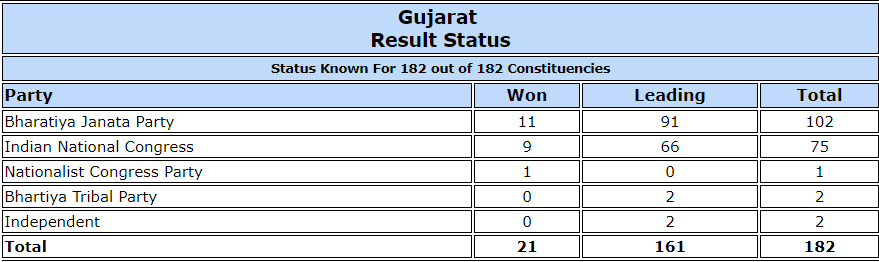
Latest election trends based on Election Commission’s website taken at 13:41 PM on 17th December 

As per the above data, the BJP has won 11 seats and is leading on 91 others which totals to a domination on 101 seats. The Congress on the other hand has won nine seats and is leading on 66 others. The others are dominating on five seats.

Based on this data, one notices that the Axis-India Today poll got the projection right considering it estimated the BJP seats to fall under the range of 99 to 113 and the Congress to win about 68-82 seats. Predicting a range is a very convenient way to project situations but the median of its projection turns out to be, 106 seats for the BJP and 75 seats for the Congress.

This means that Nirmani TV, which is a local channel in Gujarat, holistically seems to be coming the closest by projecting 104 seats for the BJP, 74 for the Congress and four for others. Tv9-CVoter too came close with its projections by predicting 108 seats for the BJP.

Coming to the other exit polls, Today’s Chanakya seems to be getting its projection of 135 seats grossly wrong and even ABP-CSDS, Republic-JanKiBaat missed their projection margins.

Another interesting story of the exit polls was the sudden projection of 117 seats for the BJP made by ABP-CSDS. CSDS earlier in collaboration with Lokniti and ABP had projected a vote share of 43% each for the Congress and the BJP, which is a far cry from the current 49.2% vote share which is BJP is bagging.

Overall, one might call it a better performance for the exit polls as compared to the Uttar Pradesh elections where all the exit polls got amply it wrong with only News24-Chanakya coming closest by predicting 285 seats for the BJP. The BJP ended up winning 312 seats in the state…

VIDEO: ‘The OpIndia Recap’ with Sham Sharma – dispelling myths surrounding the FRDI Bill

0

After a good second episode last Saturday, we are back with third episode of ‘The Opindia Recap’ by Sham Sharma, an MBA student at the Roosevelt University, Chicago and a sales professional.

There are a lot of misconceptions about the Finance Resolution and Deposit Insurance(FRDI) Bill, primarily that the government can do what they want with your deposited money. Some are spreading this due to lack of research, and some are spreading this because some people just do not like the current government, and are willing to do what it takes to discredit it. This is dangerous, and hence, important to counter. This week, Sham debunks the misconceptions and downright lies surrounding the FRDI Bill by some in the Media including Vinod Dua of ‘The Wire’.

He also views the FRDI bill in the global context and analyses why it is important for a growing economy such as India.

[youtube https://www.youtube.com/watch?v=8CLHQN6Qmj0]

You can also watch the video on YouTube.

We thank Sham for this collaboration!