Home Blog Page 7436

Political ‘Sholay’: political parties get filmier as election campaigns get more dramatic

0

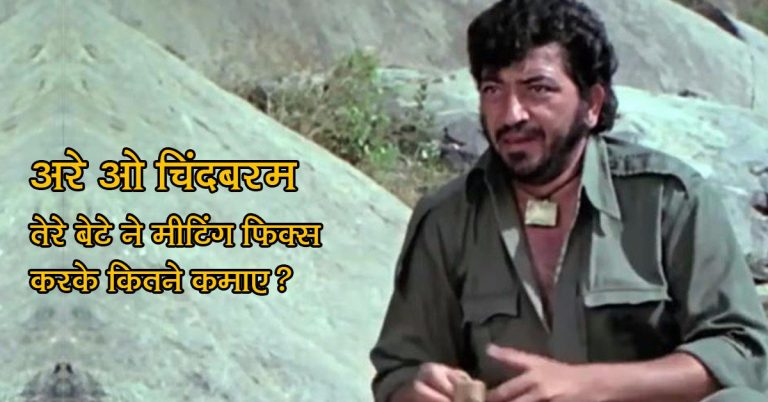
On Monday, during his drama-filled visit to Gujarat, Rahul Gandhi had referred to Goods and Service Tax (GST), introduced by Prime Minister Modi with effective from 1st July, as ‘Gabbar Singh Tax’.


Gabbar Singh is a popular fictional dacoit from the film Sholay, played by Amjad Khan. The film also starred Amitabh Bachchan, Jaya Bachchan, Dharmendra, Hema Malini and Sanjeev Kumar. Of course, this little jibe of Gandhi amused a lot of people.


Soon, a lot of “Gabbar” memes and jokes started flooding in.


Some accounts paying tributes to slain journalist Gauri Lankesh, too joined in the fun.


A day later, Bharatiya Janata Party (BJP)’s youth wing, Bharatiya Janata Yuva Morcha (BJYM), retorted with their own set of Gabbar memes.


Whether we believe GST is Gabbar Singh Tax or Gabbar is back, one thing is for sure, the meme wars have just started.

Just kidding! We don’t promote violence of any kind.

Bank Recapitalization – sorting the myths from the facts

0

BIG BUSINESS BAILOUT!! TAX PAYER MONEY!! ADANI AMBANI, NPAs!! Etc etc etc screamed the Twitter liberal circle. On the other hand a section of dolts kept saying “we need reforms”. This is not enough. Need to do more. A golden chance to correct errors is being missed. Etc etc etc..

Its not quite clear what these people intend to say. Anyway I shall keep that for some other day. Let us focus on the Bank Recapitalization part for now. I shall try and explain the whole activity in as many simple terms as possible.

What is Capital Adequacy Ratio (CAR)/(CRAR):

A bank cannot keep on lending. There are certain limits to it. These limits are set to protect depositors like you and me and to promote a stable and efficient financial system. Thus the capital “adequacy” ratio, as the name suggests, is a measure of a “bank’s capital.” It is expressed as a percentage of a bank’s risk weighted credit exposures or in simpler terms its “loans”. CAR is also known as Capital to Risk (Weighted) Assets Ratio (CRAR)

So What was the problem with CRAR?

Indiscriminate Lending under UPA government!!
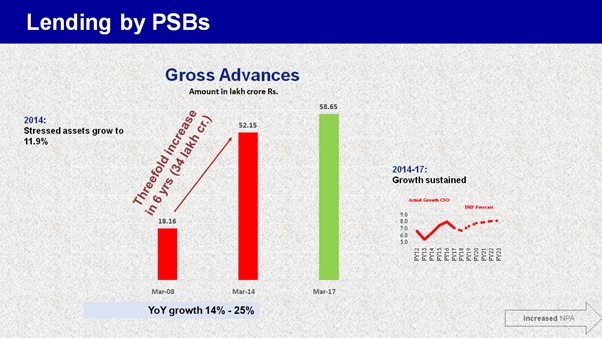
This chart explains how loan portfolio of banks increased manifold. There were certainly few allegations that loans were issued on phone calls and under influence from top politicians. Some of the practices from then are captured in Vijay Mallya’s saga. Anyway, this lending led to an increase in NPA’s. If you lend to an unviable project, it cannot service the debt! This is precisely what happened. As on today the total banking NPAs have crossed Rs 8 lakh crore in the quarter ended June 2017, 90% of which are from public sector banks.

When an account is declared “NPA” banks have to mandatorily make “provisions” for bad loans in their books which leaves them with even lesser money to lend further and very badly affects their profitability and capital adequacy.

So tell me who is to be blamed for this situation? The people under who’s tenure the loans were given or the people who are trying to fix the rot?

This indiscriminate lending has resulted in six banks having been put under the “prompt corrective action” category by the Reserve Bank of India. This means that their activities like announcing dividend, opening branches, hiring and giving further loans to below investment grade rated entities are restricted. In fact the headlines should read how UPA nearly collapsed the banking system.

Banks had to cushion in a lot of provisions to cover up these loans. A graph issued by the Finance Ministry covers this aspect:
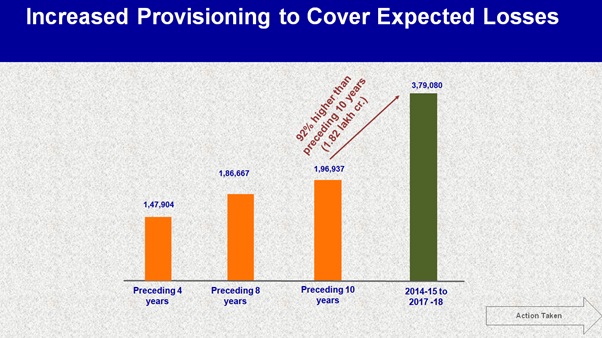
All in all, poor oversight by the UPA government over functioning of the Public Sector Banks, nearly collapsed our economy. The provisioning has eroded the capital adequacy ratio thereby hampering the ability of banks to lend fresh loans.

So why this “Capitalisation of Banks”

Capitalisation simply means infusing fresh capital with the banks. This time the government is planning to issue “Capitalisation bonds” to raise funds. Here is one of the ways it can be done:

Government issues bonds. Banks subscribe to bonds. Government gets funds. Government uses same funds to infuse into banks and thereby expanding their capital base. Thus improving CRAR. This allows banks to lend fresh loans and even allows them to raise even more funds from outsiders at cheaper rate.

These fresh loans generate productive assets, jobs and create demand. Demand drives the economy. The exact mechanism of these bonds has not been announced yet but it will come out in due course of time.

Who shall benefit out of this?

Anybody who is willing and eligible for a commercial loan from a bank shall benefit out of this. Banks, which are currently stressed and cannot lend much, will be freer to lend. They need eligible and good borrowers to keep the cycle running. The Finance Minstry highlighted that special focus shall be given on Mudra and Standup India loans once fresh capital is infused.

Are Tax Payers Bailing Out Banks?

The technical versions may say NO, but to put it bluntly: Yes. But we have to remember there is no other option. We are in a tight spot, and this could be the best out of bad options. Let anyone tell you otherwise, we cannot let our banks die.

Are Tax Payers bailing out the NPA accounts or big defaulters?

No. The proceedings under various laws are going on. The recovery proceedings against defaulters will not stop. There is a difference between bailing out a bank and an individual borrower. So no, you aren’t paying Vijay Mallya’s loan off.

What is the guarantee that future loans will not go bad?

True. There is no guarantee. They may also go the same way. For that systemic reforms have been taken by this government. Here is a glimpse of the same.
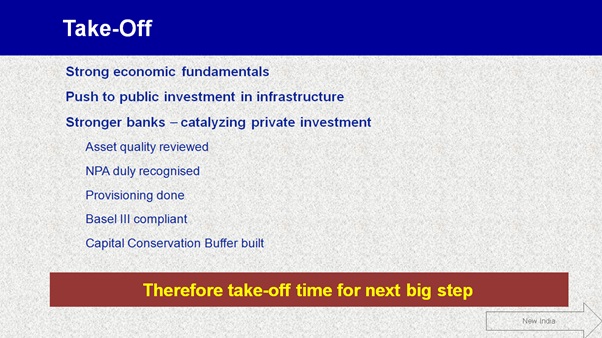
Lending based on sound principles will ensure lesser NPA’s. Bank Boards and credit appraisal system have been revamped. Insolvency and Bankruptcy code has been enacted. State Bank Group has been consolidated. MOUs with 11 Public Sector Banks have been signed to ensure a turnaround. None of this was done by the UPA. It was done under the Modi Government.

Conclusion

Instead of following views of some policy wonks and copy-paste “economists” on twitter, listen to what experts have to say. There is no denying that Banks today are not in the best of shape. There is also no denying that most of the loans which are causing troubles, were extended during the UPA regime. The current Government is essentially cleaning up the mess of the previous Government, and as you know, in any clean-up, hands will get dirty. The public at large needs to only ensure that even after this clean up, Banks do not go back to their old ways of lending. Stricter norms for loan appraisal need to be enforced and the Government must ensure that we do not see a repeat of the crisis.

Post Script

If you are a Raghuram Rajan fan and are wondering “what would he have done”, read this:

“I think it’s important to recognize that banks do need capital and you need to put it aside and if it means that there are other resources allocations that should be reduced, so be it. I mean, that’s the cost of staying within the budget. This is not painless,”


“A Brahmin is always a rapist”: Has the Indian left lost control of its loons?

0

Like fire, you could say that, fanaticism is a good servant but a bad master. It has a way of spinning out of control and coming back to burn the hand that lit the fuse.

A similar thing seems to be happening with the bitter harvest of left wing extremism that our campuses and intellectual circles have been cultivating for years, with a booster shot being administered after Narendra Modi became Prime Minister.

The Kanhaiyyas of the world may have realised that it is more profitable to ask for “Bharat mein Azaadi” instead of “Bharat se Azaadi“, but how will the left wing worthies stop Kanhaiyya’s Kanhaiyya?

Untitled.png

These names have been compiled in a Facebook post by a radical leftist lawyer by the name of Raya Sarkar based in Davis, California. A cursory glance at the list shows a preponderance of names from India’s “Institutions of Higher Dissent” such as Jadavpur University, JNU, FTII and arts departments of Delhi University.

What is noteworthy is that the poster has not presented any evidence whatsoever in support of these accusations. While it is impossible not to feel for innocent people who may be facing public character assassination, it is also impossible not to relish how liberal circles are being singed by the fire of irresponsible, radical leftism that they lighted themselves.

The panic in liberal circles has set in swiftly. Far left propaganda blog Kafila has released a statement by several strident radical feminists who are “dismayed by the initiative on Facebook, in which men are being listed and named as sexual harassers with no context or explanation.” The more suave left wing website Scroll has had to step in to publicise the statement on Kafila.

Untitled.png

In a delicious irony, radical leftists have appealed to other radical leftists to utilise “institutions and procedures”. From “revolution” and “Azaadi” to appealing for respect towards established institutions and procedures … that’s the plight of leftists caught on the wrong side of their own fanatic tide.

This was also acknowledged on the Facebook post naming alleged sexual harassers, which clearly exposed the fault lines in the left:

But who can stop the tide of fanaticism? Like I said, they can manage Kanhaiyya, but who will manage Kanhaiyya’s Kanhaiyyas? The loose cannons of the left are going rogue : here is just a sample of the hatred they are spewing below Raya Sarkar’s Facebook post.

Untitled.png

A Brahmin is always a rapist? The radical left’s mask is slipping. Their hatred is showing. They have been done in by their own loons.

What has happened to Hindustan Times’ database ‘hate-tracker’?

0

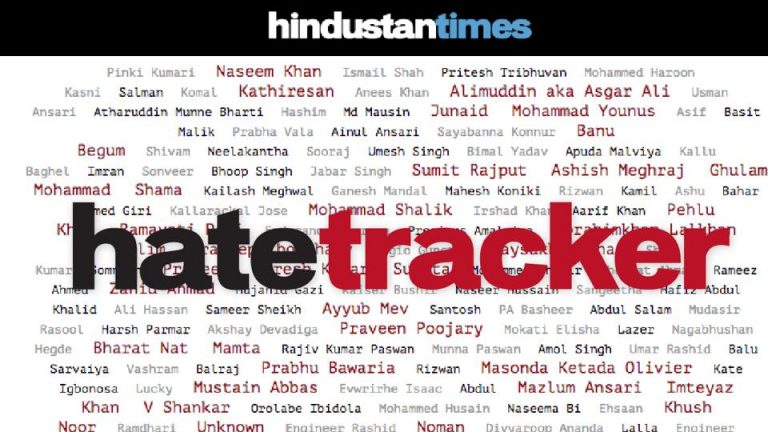
On 28th July, 2017, Hindustan Times had introduced a “Hate Tracker” which it claimed was “a national database on crimes in the name of religion, caste, race”. They even had an option where you could “submit” a hate “incident” which would be added to their database only if it meets their “editorial criteria”.

Ever since, the Hate Tracker has come for severe criticism for its obvious bias. Rather than being a common database of crimes against all communities, castes and people, it had warped into a repository where majority of the victims were Muslims and Dalits. Hate crimes against people belonging to certain political or religious inclination were conveniently ignored, and so were crimes perpetrated by people belonging to certain political or religious ideology.

Scientist and columnist Anand Ranganathan was one of the first one to spot and point out this obvious bias. We had covered how he had debunked the Hate Tracker, one tweet after another.

Today, Ranganathan discovered to his suprise, that the link to the Hate Tracker no longer went to the original page:


This is what it looked like, on 24/10/2017:

The bias of the tool is evident from just a glance at the most recent “hate” crimes tracked by it (as on 24/10/2017):

Today,  when Ranganathan visited the site, he was welcomed with this screen:

Is it really the end of this contrived, one-sided tool of bigotry? Some would assume so because even the editor, Bobby Ghosh,  who oversaw the introduction of this Hate Tracker, quit the publication just 14 months into his job. During  his time, as many as four editions and three bureaus, including the business bureau in Delhi and Mumbai were shut down, laying off an unknown number of journalists.

Is it the beginning of a course-correction by Hindustan Times or is the Hate Tracker down for “technical reasons”? A questionnaire was sent to the Editor at the Hindustan Times, reply to which is awaited and will be appended to this post.

Stage is set: Election Commission declares Gujarat Assembly election dates

0

Voter Verifiable Paper Audit Trail (VVPAT) machines will be used in the Legislative Assembly elections which will be held in Gujarat on 9th and 14th December, in two phases, declared the Election Commission today. Earlier, the Election commission had come under lot of flak for allegedly deliberately lingering declaring election date thereby delaying implementation of model code of conduct.

The Election Commission said that they delayed the declaration of election date owing to the unprecedented rains in July this year, which killed over 200 people.


The results will be declared on 18th December along with Himachal Pradesh Assembly elections. The election campaign expense has been capped at Rs. 28 lakh per candidate and separate bank account will have to be opened by candidates for election spending. A dedicated mobile app will be in place for people to lodge a complaint with the EC and a provision to upload pictures also will be provided.

Riding high on the unprecedented victory in Uttar Pradesh Assembly elections, BJP President Amit Shah has set the target of over 150 out of 182 seats in upcoming Gujarat Assembly elections. While the BJP does stand more than very good chance of winning the elections, 150 is a bit overambitious. We had earlier reported how Gujarat elections this year won’t be a cakewalk for the BJP which faces a two decade long anti incumbency. Moreover, the pressure is building up since it is home state of Prime Minister Narendra Modi and BJP President Amit Shah.

The Left-leaning media houses have already started their ‘Operation Gujarat‘ with fake stories and biased opinion-editorial stories being pushed on regular basis. Not surprising since all forces are putting their weight around the Gujarat elections because whatever the result, Gujarat election will be shown as the ‘proof’ of BJP’s failure or victory at Centre in 2019 General Elections.  No wonder the Congress was ready to gamble the entire state to save one Rajya Sabha seat in the Rajya Sabha re-elections for 3 seats held in August and Congress is now taking up the soft Hindutva approach to woo the voters by making Congress Vice President Rahul Gandhi visit temples on his Gujarat campaign trail.


Congress is also back at playing its divisive caste-based politics where they are trying to rope in the ‘rising’ political faces of Gujarat, Jignesh Mevani, Hardik Patel and Alpesh Thakor.

Whatever it is, we now wait for December 18 and watch as the drama unfolds. We have our popcorns ready.

Dear ‘liberals’, hate us, thats all you can do, but spare our babies

0

Perhaps the most divine and the most sensitive time in a woman’s life is when she is expecting a child. Our hormones shimmy around all over the place and most pregnant women enter the realm of paranoia when it comes to the well being on the unborn child. She is said to be the vessel of humanity. Carrying the divine within her womb. Perhaps nothing is more godly, than a mother creating life from scratch. Her entire life, wrapped up in that little infant she carries within. 

I remember when I was pregnant not too long ago and towards the end, owing to certain complication, I was bed ridden for over a month. Everyday, I felt like a part of me was dying is despair. Not because I thought myself as ill, but because I was counting minutes till my baby could be born, and I would know for certain that my angel was fine.

Shefali Vaidya today shared her pregnancy experience. She was carrying triplets, and owing to complications, she was bed ridden during the later part of her pregnancy. In an emotional thread, she shared how when she was 25 weeks pregnant, she was told her babies have a 30% chance of survival. Her struggle was immense, as would any mother’s be. She got through it owing to her unwavering faith in Guru Nanak, her prayers, a mother’s will to fight for her child’s wellbeing, and listening to a soulful rendition of Jana Gana Mana.

The moment she wrote that thread, the ‘liberal’ cabal went after her like a pack of wolves. Mocking her mercilessly. Tirelessly. Relentlessly. Calling her a liar. An attention seeker.


A “Sanghi bhakt” who was making stories up about the life of her children just to get famous on social media. the ‘liberals’ even went as far as to say that she wouldn’t have been mocked had she been more “credible” and not a bhakt.

At the crux of it all, a mother sharing an emotional story about her pregnancy struggle was ridiculed because they didn’t really like her political ideology.

I was reminded of the time when I was 7 months pregnant and a lady took the liberty of wishing “I delivered an abnormal child and jail and bleed to death”. Or someone wondering if I might die of Preeclampsia. And it is no surprise, that the lady who wished death on my child and me, is still one of the darlings of the left liberal cabal on social media.

Shefali was subjected to ridicule of the worst kind. Political banter, abuses, threats is something the women on the right have learnt to deal with. Learnt to sail through and never expect the “oh, poor baby”. We scream if needed. We block if we want. We stand up and make ourselves heard. No matter what the price is.

It thus seems evident, that the cabal seems to have realised, that the only way to break the women they don’t particularly like, is to go after their kids. That corner of their heart, that is the most vulnerable. Their children.

I wouldn’t be exaggerating if I said in their political and ideological hate, nothing is off limits. To these despicable men and women, nothing is sacred. They would hunt down anyone who dares to speak against their ideology of hate. Anyone who can remotely threaten the tangled web they weave with the help of which, they climb the political ladder. In their bid to please the establishment, the close coterie of left ‘liberals’, they can walk over graves. Not even a mother’s emotions is sacred to vultures who wouldn’t mind counting dead bodies, if it meant climbing equal number of steps in the power ladder.

It amuses and pains me, at the same time, that it is these people who have the temerity to talk about women’s rights and women’s empowerment. They have the temerity to accuse others of misogyny and sexism. When what they do, what they have done today, doesn’t stop at just misogyny and sexism, but borders on sacrilege.

The cabal has an uncanny ability to make heroes out of the women they think politically convenient, and make villains out of the ones they don’t. While yesterday, a woman normalising rape and glorifying misogyny by saying “Why would Rahul Gandhi rape when he can get any woman he wants”, was applauded by members of the cabal including the usual Congressmen and the likes of Prashant Bhushan, today, a woman is being viciously abused and her children brutally mocked for her ordeal as a pregnant woman.

Blog by Sadhavi Khosla, a Congress supporter. This portion now stands deleted in her blog.
Prashant Bhushan endorsing Sadhavi’s post which encourages rape culture

I, as a woman, as the “liberals” this – Do they realise their own hypocrisy while they partake in movements like #MeToo? Do they realise that the abysmal lows they seem to have travelled to see nothing wrong in abusing a woman talking about her premature children who battled the gods just to keep breathing? Do they see the ugliness in what their political hatred has turned into? Is nothing sacred? Even the life of children? No wonder many of us do not wish to share happiness on this platform, because people have a way to turn that into ugliness as well.


While what happened with Shefali today makes me sick to my stomach, I know this – while the liberals might use a woman’s motherhood and vulternabilities to lash out at her out of ideological hate, they fail to realise the strength a woman draws from her children. They fail to realise, that a woman who fought through a time like that, can weather through pretty much anything. You, dear despicables, won’t weaken the women you seem to take so much pleasure in hounding. You will only make them stronger. They will survive, they will triumph, they will conquer and they will live on. There is just nothing you can possibly do about it.

NIA arrests son of global terrorist and head of Hizbul Muhajideen Syed Salahuddin

0

In a major breakthrough, the National Investigation Agency has arrested Syed Shahid Yusuf, son of Hizbul Mujahideen head, Syed Salahuddin, who was questioned in 2011 terror funding.


Syed Shahid Yusuf is a J&K government employee and was found to be in touch with Saudi Arabia-based Hizbul Mujahideen operative Aijaz Ahmad Bhat, who is also an accused in the case, and had received money to allegedly fuel and fund secessionist and terrorist activities in the Valley.

Aijaz Maqbool, resident of Saudi Arabia played a key role in sending hawala money to the tune of about Rs. 4 crore 57 lakh.

It is believed that Yusuf had accepted money transferred via Western Union by Aijaz, who is on the run, which was used to fund terror activities in J&K. As soon as he reached NIA office on Tuesday in response to the summons issued, he was arrested.

The NIA has so far filed two charge sheets against six people which included G M Bhat, a close aide of pro-Pakistan separatist Syed Ali Shah Geelani, Mohammed Siddiq Ganai, Ghulam Jeelani Liloo and Farooq Ahmed Dagga. While the four accused are in judicial custody, Mohamed Maqbool Pandit and Aijaz Ahmed Bhat, who are also chargesheeted by the NIA, are absconding. An Interpol Red Corner notice has been issued against both.

In June this year, the US State Department had designated Syed Shahid Yusuf’s father Syed Salahuddin, a global terrorist. He is the key mastermind on the attack on Pathankot air base in Punjab in 2016. A prominent figure of Jihadi landscape, 71-year-old Salahuddin is also the head of United Jihad Council, an umbrella organisation of terror outfits – Lashkar-e-Taiba and Jaish-e-Mohammed. Salahuddin is considered be close to LeT chief Hafiz Muhammad Saeed, the mastermind of the 26/11 attacks.

Read the statement issued by the NIA on Yusuf’s arrest:

FM Jaitley announces bank recapitalization plan, amidst data showing Indian Economy’s position

Finance Minister Arun Jaitley who in recent days has been under media scrutiny after the recent drop in GDP growth rates, today decided to create quite a bit of a flutter. It was reported that at 4 PM on Tuesday, Arun Jaitley would be making a major announcement and as a result speculations became rife.

A few citizens felt that Income Tax rate would be on the cards and a few others felt that GST would be the main point of agenda. Reports on the other hand speculated that the announcement would be pertaining to the banking sector and would focus on the recapitalisation plans of banks.

Twitter users too were gripped by this speculation:


After about a 30 minute delay, Jaitley finally started his conference to end the whole suspense. He stated that the government would be appropriately responding to any challenges faced by the economy. He affirmed that they want to ensure that India remains a high growth economy and after analysing the whole scenario, the government was convinced that macro-economic fundamentals are strong.

Hence a presentation was created to chart out ways by which the economy can be developed further.

The presentation began by showcasing how inflation and current account deficit have both shrunk and the Forex reserves have crossed beyond $400 billion. The presentation then put out charts which claimed that the GDP in the long term would be shrugging off the recent dip. The government continued its presentation by putting out the “transformational reforms” it has taken like, GST, disinvestment program, increased public spending when it comes to road, railway, electricity etc sectors.

They finally came to the point and put forth the major announcements what the cabinet decided today. These bold steps mainly pertained to public sector banks:

  • An Public sector banks capitalisation plan of Rs 2 lakh 11 thousand crores.
  • The above will be achieved through Recapitalisation bonds of Rs 1,35,000 and budgetary support of about Rs 76,000. Recapitalisation is basically the process to restructure the debt and equity of a company. The nature and details of the bonds would be determined by the government and the details would be made clear later.
  • Trade receivable enhanced discounting system (TReDS) for micro, small and medium enterprises (MSME). TReDS allows discounting of bills by MSMEs and allows a seller to get credit against a bill which is due to him at a later date. The discount is the interest paid to the financier.
  • Industry specific custom-made MUDRA schemes were also announced, details of which will be worked out.

Jaitley in a concluding statement stressed that efforts have been made to increase public spending. He also talked about how the non-performing assets (NPA) of banks were not clear in the past and only via the asset quality review, capital infusion, provisioning norms, the true financial health of the public sector banks were revealed. Thus a bold step like that capitalisation plan was undertaken and in the coming days a series of banking reforms too would also be announced.

As affirmed by the government, this presentation was a response to the current situation of the economy and it remains to be seen how effective these steps are when it comes to the final economic results and numbers.

Gabbar Singh Tax Congress style? Twitter users react to Punjab govt taxing domestic animals

0

Earlier today, the Congress government in Punjab announced that people in Punjab will have to pay tax for having domestic animals. These taxes were in range of Rs 250 per year for having small animals like dogs, cats, pigs, sheep, etc. and Rs 500 per year for bigger animals like buffaloes, cows, camels, horses, elephants, etc.

Apart from the taxes, the state government also announced that an identification mark or number will be given to each animal and a ‘microchip will be installed’ in the animal, though it’s not clear whether it is to track moments of the animals or to detect any ‘tax evasion’.

The step left Twitter users with deep amusement and some anger too. Not only the tax rule didn’t differentiate whether a domestic animal was pet or part of vocation of a poor family, it also didn’t go down well with animal lovers, especially the dog lovers, who didn’t like the idea of a ‘microchip being installed’. There were a range of reactions to this step, such as:


Some wondered about the categorization of some animals in the tax structure:


Punjab government was bashed for the proposal, which was seem anti-poor and anti-farmer:


Congress as a political party also drew flak, as only yesterday its Vice President Rahul Gandhi mocked GST as “Gabbar Singh Tax”. So what to call this new tax by Punjab government?


And some Twitter users were already thinking too ahead:


Update: Following widespread criticism and ridicule, Punjab government has denied reports about taxing domestic animals.

Jan Dhan Yojana: showing small, but steady impact on our lives

0

Launched by Prime Minister Narendra Modi in August 2014, just months after assuming office, Jan Dhan Yojana is India’s mission for financial inclusion and last mile connectivity, is finally showing small, but impactful results. According to the website, as on 18th October, 30.49 crore beneficiaries have banked so far with about Rs. 67,316.28 crore balance in their accounts.

In a 2017 working paper, Georgetown University professor Sumit Agarwal and his co-authors studied account activity in 1.5 million PMJDY (Pradhan Mantri Jan Dhan Yojana) accounts from August 2014 to May 2015. The study revealed that while the usage started off slow, as about 81% of new consumers did not make any deposits in the first six months, once they got aware about financial services, they embraced the banking system. Within one year, the frequency of remittances and deposit and withdrawal transactions gradually reached the same level as a comparable set of accounts opened before the PMJDY. Along with demand, the supply of financial products rose as well.

The authors found an increase in lending in regions where the PMJDY generated new demand for formal credit. The scheme has tapped into the unmet demand for financial services. Contrary to allegations, the spurt in new accounts under PMJDY does not seem to be linked to demonetisation. While the investigations are on regarding the spike in bank accounts, maintenance of stable balances and increase of banking transactions seems to be disproving these allegations.

Not just that, bulk of the RuPay card transactions are through ATMs, while about 25-30 million customers have started transacting via point of sale (PoS) terminals, signifying the advent of e-commerce and digital transactions in rural India, thus catering to the rural and semi-urban brackets. Studies also show that the accounts opened under PMJDY are steadily being used actively, with as many as 70% accounts moving from dormancy to active use. There has also been significant decrease in zero-balance accounts. When the scheme was launched in August 2014, there were about 76.81% zero-balance accounts in September, 2014. This has come down to about 20% of the total accounts.

Surprisingly, not just financial inclusion and stability, PMJDY has also helped villagers in cutting down on alcohol and tobacco. The statistically significant and economically meaningful drop in consumption of intoxicants has been found in the rural areas which have more Jan Dhan Accounts. The report said that better channelising of subsidies could have helped in curbing unproductive expenditure on alcohol and tobacco expenditure in rural India.