Home Blog Page 7539

Ajmer Dargah’s diwan ‘sacked’ and declared non-Muslim for opposing cow slaughter

Syed Zainul Abedin Ali Khan, the diwan (spiritual head) of the Ajmer Dargah, the famous Sufi Shrine of Rajasthan, has been removed from his post by his own brother, who thought that this views on cow slaughter and beef eating was against Islam.

A couple of days back, Syed Zainul Abedin had not only supported ban on cow slaughter but had appealed to Muslims to give up beef eating to respect the sentiments of their Hindu brethren. He had also spoken against triple talaq.

“My family and I have taken a pledge on this day that we will never have beef for the rest of our lives,” he is reported to have said on Monday.

But now it appears that this family is in no mood to support his beliefs.

He has apparently been “sacked” from the post of diwan by his younger brother Syed Alaudin Alimi, who not only declared himself the new diwan but also declared Syed Zainul Abedin as a “non-Muslim” for his views on cow slaughter and beef.

Alaudin Alimi claims that he has the support of the family, who are supposed to be the direct descendants of Khwaja Moinuddin Chisti, in whose honour the dargah has been made.

Alimi says that he discussed his brother’s views with some clerics who apparently told him that Zainul Abedin had become an ‘apostate’ because he had spoken in violation of Islamic laws. He further claims to have called a meeting of the family (Chisti clan) and declared himself the diwan.

“He (Zainul Abedin) has lost the right to continue as the diwan of Ajmer Dargah because one needs to be a Sunni and Hanfi Muslim for that,” Alimi is reported to have said, justifying his deeds.

However, Syed Zainul Abedin claims that his brother has no right to remove him as the dargah is governed by a committee as per the provisions of the Durgah Khawaja Saheb Act, 1955. The post of diwan has no management control but gets a salary from the committee, which is appointed by the government.

Although the post of diwan is hereditary and Alaudin Alimi is claiming support of the entire clan and clerics, he will have to move court as the committee is in support of Zainul Abedin.

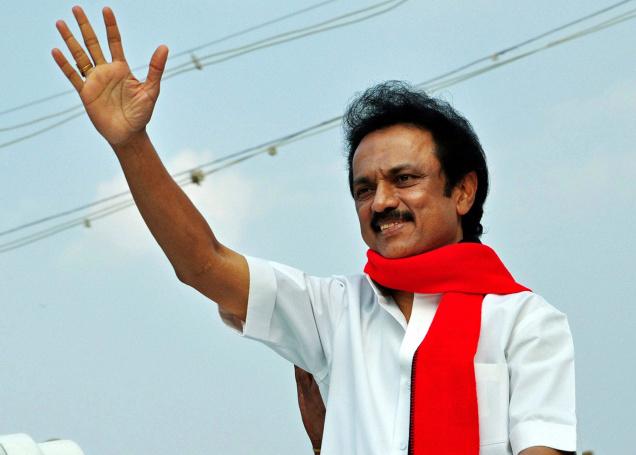
DMK leader MK Stalin ko gussa kyun aata hai?

DMK leader M.K. Stalin, who is the son of DMK supremo Karunanidhi, is currently the working president of the party. Although not popular yet on the microblogging site, Stalin is present on Twitter and has notched about 1700 tweets. Apart from tweeting, he also seems to have developed a habit which annoys every Twitter user.

SG Suryah is one such Twitter user. Suryah is an attorney, columnist and is also the Vice President of Tamil Nadu’s BJP youth wing. On Saturday, he wrote an article that debunked the allegations which were being spread by Stalin to create an anti-Hindi debate in the state. These allegations by Stalin were perpetrated in a detailed statement released on March 30th.

Some of the allegations which Surya debunked were:

  • The Modi govt was imposing Hindi as it was introducing Sanskrit/Hindi as a third language in place of German. (response: This is applicable in Kendriya Vidyalays only but Tamil Nadu and Puducherry are exempted from following the three-language formula. German was removed as it was introduced by the UPA government without following rules)
  • Sanskrit Week was being forced upon schools. (response: There is no force; Sanskrit Week has not been made mandatory)
  • Sanskrit was imposed due to the introduction of half-hour Sanskrit news bulletin in Doordarshan. (response: Doordarshan was already having a 5 minutes bulletin which was expanded. Further, how is it any imposition – no one is forced to follow the bulletin – or how does it compromise Tamil?)
  • Modi government was forcing government officers and Departments to use Hindi as a communication language. (response: it was a decision taken by the UPA government and it is compulsory only in Hindi speaking states, not in Tamil Nadu)

Surya also shared the same on his Twitter account and tagged Stalin:


Apparently Stalin either didn’t like Surya’s criticism or the fact that he was tagged by Surya and reportedly proceeded to block him:


What made matters worse was that, Surya was actually followed by Stalin before he decided to block him:


This tendency of eminent personalities to block people who haven’t abused or trolled them, has long irked many on twitter. Twitter does have a mute feature by which people automatically can escape seeing mentions or replies from unwanted accounts. What’s more peculiar in this case is the fact that Stain followed Surya.

So technically as Surya is associated with the BJP, Stalin was already getting some content critical of either him or the DMK on his timeline. But he neither unfollowed him or blocked him for the following criticism:


Intolerance anyone? Or rather “असहिष्णुता”?

Kerala pastor wants short skirts banned in Church, asks followers to give their kids ‘Christian names’

In a letter published in Idukki diocese bulletin in Kerala, a bishop named Mar Mathew Anikuzhikattil has urged girls to not wear outfits which end above the knee when they are inside the church. He also wished the women churchgoers to wear ‘special’ clothes during prayers and rituals.

Apart from this, he also gave other advice like asking parents to give Christian names to their kids, asking them to restrict their kids’ social media use, and also asked them (parents) not to blame the priest and nuns in front of their kids, which might affect the kids inclination towards divinity.

Even though the Bishop is well within his rights to put out his guidelines, it remains to be seen whether the usual suspects profess their outrage in this matter. As is the norm, even though our country conditionally allows free speech, its usage is usually exclusively reserved when it comes to criticizing Hindu institutions.

In December 2015, Justice S. Vaidyanathan of the Madras HC had prescribed a dress code for entry into temples, supposedly to to enhance the spiritual ambiance among devotees. This had drawn the ire of various groups and appeals were filed which had ensured a temporary stay on the order. According to one of the petitions, such an order was against the fundamental rights, particularly of women and children.

The petitions by two women’s association and the State government ensured that the order was ultimately set aside. It remains to be seen if similar groups now file cases against this Kerala pastor for making a statement, which going by the earlier logic, infringes women’s fundamental rights.

This isn’t the only time the Church fraternity in Kerala has been in the news for the wrong reasons. Just recently we had reported how a Kerala pastor had wanted women wearing Jeans and T-shirts to drown into the sea. He also claimed how such dresses aroused men and boys who then slipped into sin.

There also has been a serious child abuse scandal associated with the Kerala catholic church when a minor was reportedly raped by the vicar of a church and various people associated with the church then tried to shield him.

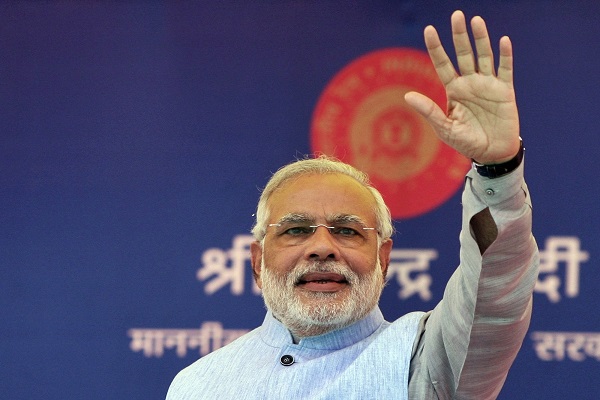
4 governance obstacles Mr. Modi needs to cross to seal the 2019 hurdle race

0

With the highest number of MLAs of any party in 24 years and UP firmly in the bag, the NDA under Prime Minister Narendra Modi is well on its way to match the political might of the old Congress under Nehru and Indira. With the dark days of political instability behind us and a decisive leader, India has a chance to finally take the big leap forward on the economic front and claim its rightful place on the world map.

But to get there, Modi administration will have to deftly tackle these 4 big challenges we face:

  1. Universal healthcare
  2. Universal primary education
  3. Universal social security & shelter
  4. Personal freedom, liberty, law & justice

In this article, based on my own experience I propose how the Modi administration could go about tackling these issues.

Universal healthcare

Often, when I travel in the so-called advanced economy countries and find people living in remote areas seemingly away from civilization, my first thought is – what do they do when there is a medical emergency? I find that they can get access to the nearest hospital (which may be many miles away) – by one simple phone call. A chopper would be there in minutes and shift the patient in real time for medical help.

I was involved in a major car crash in USA and saw the emergency response first hand. I was trapped inside my car for a short while and by the time I crawled out on my own (without any injury) I found that the police and ambulance had arrived and the fire engine was on its way. They were there in maybe under 10 minutes. I was driven to the nearest hospital and medical tests were done on priority. I also saw at the front entrance, a chopper land ferrying a pregnant woman in an advanced state of labour.

On the other hand, in India you read of accident victims lying on the road bleeding to death, ambulances stuck in traffic, emergency patients denied access to a road or a hospital because a VVIP visit and you begin to get a sense of how badly we have failed.

It will take time to change the system and culture, but two main areas (amongst many) which can be fixed without too much effort are Insurance and Primary Healthcare.

Insurance:

We need to have very rigorous health insurance system where even the poorest of poor get access to quality healthcare. These schemes must cover the plethora of private hospitals and these hospitals must come under a common law wherein they cannot turn away patients and the fundamental target must be to save lives, provide emergency care and treatment.

Citizens can take their own insurance covers also for added benefit. Cashless treatment in hospitals must be the norm and covered under either the universal or individual insurance schemes. Today this is missing and while the current government has started a health insurance scheme for the poor and marginalized (Pradhan Mantri Suraksha Bima Yojana), it is still linked to a bank account.

Also, it is my considered opinion that it has not been given sufficient publicity, focus or attention. This could be due to lack of rigorous systems in place or the propensity of the administration to consider this an avoidable effort. But this needs to be pursued aggressively by the govt, implemented and demonstrated to the citizens that it works. The dividends of such an effort would be humungous.

Primary healthcare:

In some states, doctors by law are supposed to serve in rural areas, but very few do so. We don’t need laws making rural service compulsory, instead, it is critical to understand that doctors posted in remote, rural areas find themselves losing the opportunity to expand their knowledge, have no access to education, housing, infrastructure or medicines in such locations and unless an individual is being idealistic, 99% of the people will find a way to avoid this posting.

The government can learn from the milk dairy industry, which since 4 decades is providing quality healthcare to cows/buffaloes in even the remotest of villages and the veterinary doctors enjoy the postings. So how did they do it?

Even in the eighties, all the doctors were posted at the nearest district headquarters. Each had a car equipped with a radio and their movement monitored by a central control room. Each doctor/car would traverse a prefixed route every day covering a set of villages on a weekly basis and they dispensed medical care and medicines to the cows. The village knew on what day the doctor would come and would be ready. If, however, there was an emergency, a separate car/doctor would drive down to that village on the other days and a special charge would be levied to discourage people from misusing the facility. If the emergency was dire, the control room would know which car/doctor was driving anywhere nearest to that village and ask them to take a detour.

This system ensured that the doctors stayed in urban habitation, had access to education, housing/infra for their families and returned home each night. Many grateful villagers would often bestow upon the doctor freebies like some fresh vegetables, fruits or such as a mark of gratitude, friendship, affection. Today with sophisticated communication technology and automobiles there is no reason why such a system cannot be implemented across the country. This is a necessity and can be a huge vote-puller for any party/Govt which implements this.

Universal primary education

In the case of Universal education, the Government passed an RTE law and dusted its hands off on a job well done. Problem solved. But has it? Primary education is left to the private sector and most of the government(municipal) schools have fared poorly. The private schools charge obscene fees, have many bored wives of corporate honchos and officers as teachers to protect themselves against government action & once again it is a business not treated as an essential service in nation building.

Given the geographies and challenges of our infra and safety of children, the government must open smaller primary schools in each locality which are accessible even by walk if required in an emergency, hire the women in that locality and train them. Admission and transfers must be made easy so that even the children of construction workers and such who live in that area can study.

The government can invite corporates to sponsor and manage these education initiatives under CSR funds and if needed give tax breaks. There is a 1.1% education cess on imports alone and in 2015-2016 total imports were $379,596 M, this translates to about $4176 M or INR 28,811 Crores. The budget states a figure of INR 29,407 Crores. Given that the under-14 population of India is 35 Crores, it is entirely possible to provide this access.

What gets measured, gets improved and so to improve the quality of these Gov run schools, the schools must be made more transparent and their performance should be measured and be open for public scrutiny. Financial and social Incentives of the staff should be linked to the qualitative and quantitative performance of the school.

Universal social security

It will always remain a dream to have 100% employment, and often global incidents or health related issues or physical debilitation create a mass of people who lose the ability to earn a living.

If we believe in human dignity, then there must be a universal fund and infrastructure that can take care of the most in need and support them. Again one may not be able to provide the best but society, corporate must be encouraged to create systems that can provide the basic minimum every citizen deserves. There can be night shelters for the homeless (especially during winter), community soup kitchens to feed the destitute. And insurance schemes which the employed can subscribe to whereby if they lose their job or a limb, they can still earn a living wage.

Personal freedom, liberty, law & justice

One cannot grow and expand his horizons unless she has freedom. Often, many say that we have too much democracy. Maybe true in a way, but what we probably have is selective freedom and discretionary democracy. This must change. Laws must be changed to protect every thought, every idea to flourish and the 18th-century notions of sedition and blasphemy must go. This freedom of expression or speech must be absolute and not limited to who is powerful and has muscle power and thus they think they are right.  If a left wing opinion must be respected, then equal respect must be given to a right wing view. The law cannot differentiate between the two.

The law must be framed such that this freedom is protected and there are clear limitations by way of discipline and conduct to protect the sovereignty and security of the country. When these are transgressed, the law must take its own course in a swift and firm manner.

Even after 70 years of independence, justice system remains in the grips of the rich and powerful. Every citizen must have the confidence that they can seek protection by the justice system. Today, often policemen refuse to even file FIRs, or act in a partisan manner, get influenced by political and money power. Cases that go to court get dragged for decades. Justice must not only be timely but also seen to be delivered. Punishment must be equally swift. The pathetic state of our police systems and judiciary can be gauged by the fact that rarely does a citizen wants to seek the help of the law.

Here again, the government understands the challenge but the system (including the police, judges and judicial system) itself opposes changes, since they have become units dispensing favours and wielding power. Unless there are radical changes in police and judiciary – India, however democratic, can never occupy the high seat of being truly called an advanced nation.

***

Social Media, 2014 election and the current government has brought in a huge change when it comes to citizen involvement in issues. Quite often, this manifests itself as angst and impatience; it’s imperative to channelize this engagement into positive nation building activity and not become private battles over trivial issues. India today is at the cross roads of change and the road we take will determine our future.

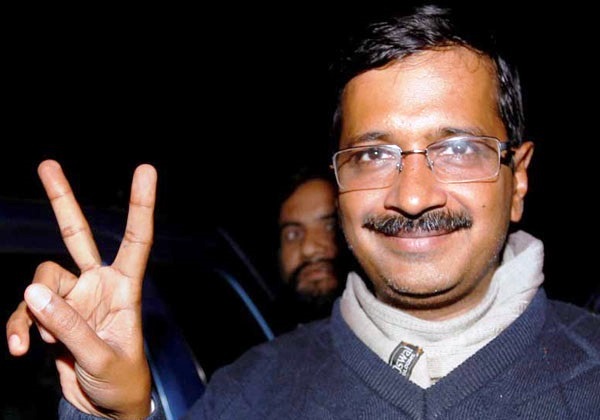
Making taxpayers pay Kejriwal’s legal expenses, all you need to know

Even though the Delhi Government led by AAP supremo Arvind Kejriwal rules over one of the smaller territories in the country, it hasn’t prevented them from creating large controversies at almost regular intervals.

Only last week we had reported how they were put in the dock by Delhi’s LG (Lieutenant Governor) for misusing the Delhi taxpayers’ money while putting out advertisements. Now there is a new controversy of misusing taxpayers’ money.

As reported by news portal KhabarE, Chief Minister Arvind Kejriwal wants the Delhi taxpayers to pay the legal expenses incurred by him, arguably in a personal capacity, for fighting the defamation case filed by BJP leader and Union Finance Minister Arun Jaitley.

In case, you haven’t followed the controversy, here is a summary:

Q: What is this whole issue about?

Ans: BJP leader Arun Jaitley, in December 2015, had filed a defamation case against Kejriwal and 5 others for what he claimed were false allegations regarding his alleged role in certain irregularities in the DDCA (Delhi & District Cricket Association). Jaitley sought compensation of 10 crore rupees due to damages caused by alleged defamatory statements by Kejriwal.

In the court, Kejriwal was represented by noted lawyer Ram Jethmalani. Jethmalani, in some media interviews, had claimed that he will fight the case for free, charging a token money of just one rupee, even though his professional fees are pretty high.

However, documents available with some in media reveal that so far Jethmalani has billed Kejriwal a whopping Rs 3.42 crores. Out of these, Rs 1.22 crores have been directed to be paid from the exchequer of Delhi government:


Q: So what is wrong in it?

Ans: Arun Jaitley had filed the defamation against Kejriwal in a personal capacity and thus many experts argue that Kejriwal should defend the case in personal capacity too, because the case has been filed against the individual and not the Delhi Chief Minister. Kejriwal is understood to have issued those statements in capacity of a politician, not as a public officer.

Though having said that, legal experts believe that invoking section 80 of the Civil Procedure Code would have allowed Kejriwal to turn this into a matter involving the Delhi CM, which he didn’t do.

Documents with the media further suggest that on 21st December 2016, Manish Sisodia, the Deputy Chief Minister of Delhi, had directed the General Administration Dept led by Gopal Rai to pay the legal bills as and when Ram Jethmalani sent them. Curiously in the letter, Sisodia also mentioned that this concerned file need not be sent to the LG for approval. This is being interpreted as a fear that the LG might have rejected the proposal as they were in contravention of rules.

Q: Why had Jaitley filed a defamation case against Kejriwal?

Ans: Kejriwal and his fellow party members had alleged that for the 13 years, when Jaitley was the chief of the DDCA, the body was involved in irregularities. Jaitley was accused by AAP leaders of directly or indirectly giving consent to massive corruption in the cricket body.

They alleged that additional expenditure of Rs 90 crore was incurred on renovating the Feroz Shah Kotla stadium and that fake companies were setup by DDCA officials to siphon off money. They also alleged that there were irregularities even in team selection by the DDCA like forging age certificates and that players selected were of Jaitley’s personal choice. Jaitley had received support from cricketers like Gautam Gambhir, Virender Sehwag, and Virat Kohli at that time, however Kejriwal continued to claim corruption and irregularities.

All this irked Jaitley, and Kejriwal and others were put on trial on 25th March this year in a criminal defamation case. Ram Jethmalani had asked some rather ridiculous questions to Arun Jaitley as part of the proceedings, about which we had earlier reported.

Q: What is Ram Jethmalani’s response to this controversy?

Ans: Ram Jethmalani had claimed that he only charges the rich and works for free for the poor, though he had also claimed that he will be working pro-bono for Kejriwal. He doesn’t appear to have clarified when did his plan of offering his services free of cost change (leading him to send the bills to Kejriwal), but now he is saying that he can still offer his services free of cost:


Interestingly as Jethmalani says he will ‘appear’ for free it raises the question about what will happen to his retainer fees of 1 crore rupees. Does it mean that he expects at least one crore to be paid?

Q: If Arvind Kejriwal loses the cases and he has to pay Jaitey 10 crores, would he make the Delhi taxpayers pay it too?

Ans: Very good question. Maybe yes, given how the Delhi government is justifying paying the current legal fee from the state exchequer.

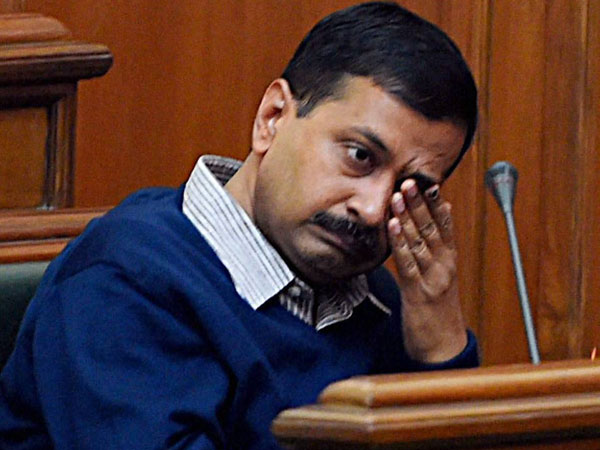
What the right-wing in India can learn from Arvind Kejriwal’s debacle

0

Arvind Kejriwal and his journey should be seen in two parts. The first part is when he rode on the anti-corruption sentiment as a saviour of the republic and won handsomely. However insignificant it might appear to be (just one small half-state like Delhi), but he won a fair electoral victory.

Part II is Arvind Kejriwal in his role as the Chief Minister of Delhi. This is where it all started falling apart and still is.

Why is it that someone who promised so much, appeared to make all the right noises, attracted some very good professionals, has failed so spectacularly. One can attribute all this to his overreaching obsession to become the Prime Minister in a very short time. So let’s say he becomes the Prime Minister tomorrow. What next? What will he do? Does he have a plan?

Arvind Kejriwal has failed in his second innings because of one and only one reason – he does not have an agenda.

His is a typical leftist problem – exploit dissatisfaction against the establishment to win power but when in power they are woefully out of implementable ideas. ‘Peace’, ‘Equality’ sounds melodious but how exactly does one implement Peace and Equality? By manipulating history textbooks?

However, there is a lesson for the ‘right-wing’ in this short story about Arvind Kejriwal.

Let’s assume tomorrow BJP wins each and every seat in the country – this includes all local, state and central elections. The party has captured absolute power. All illegal abattoirs will be closed, cow slaughter will be banned and maybe even RTE will be repealed, what next? Ask this simple question to yourself – what exactly are the long-term changes that you want to make?

A part of the RW (right-wing) anger is merely prejudiced, but the other part is a genuine perception of injustice gathered over the years. How can we distinguish between the two? Does the right-wing have a soundly articulated agenda and a plan to implement the same?

Let me explain it with an example:

Our education sector is compromised. Okay. So what are the required changes and how to implement those? There are ideas which one comes across once in a while. But how can we achieve coherence in those scattered ideas? And more importantly how can we sensitize the general public as to why there is a need to reform the system? Is there a sound argument which we can build for the same? Replacing left-wing prejudices with right-wing prejudices will be a poor strategy.

Most right-wingers are amateurs who, unlike the left elites, do not have enough clout to lobby for their ideas. There are ideas which come up on the social media and various blogs and websites. But many of these ideas are contributed by part-timers who do not have resources to follow up on them.

What we need today is a formal forum where status quo can be challenged. A platform where participants can highlight concern areas, contribute ideas and propose solutions. Moderators can select concepts from various areas and shape them into implementable solutions. These should be thoroughly debated over and passed on to the power centres for consideration.

A concept like this will have multiple benefits. RW will not be exposed when in power. Good ideas will receive the attention they deserve. We will be heard. Disproportionate amount of narrative is controlled by the Left. It is important to grab the narrative and discuss issues which really matter and in a way which makes an impact. Such a system will also be a protective hedge to prevent governments from falling in the Lutyen’s blackhole.

One of the major reasons why the 1857 uprising failed is that it was an unorganized effort. Rebels lacked an ideology or programme that could be implemented in captured areas. None of them knew what to do after the capture of a region. Arvind Kejriwal, if you observe closely has suffered due to the same effect. It is the coherence of ideas which transforms individual efforts into a movement, the lack of which reduces the same to an uprising.

Lutyen’s is waiting for today’s uprising to fail so that their movement can resume. After the failure of 1857, it took another 90 years for Bharat to achieve Independence.

****

Post Script: Filling infrastructural gaps, Swachchh Bharat, GST and other attempted reforms are the basics that every right minded government should have done. That we are left to cheer even the basics only tells us how much our previous governments have failed but make no mistake – this is in no way visionary, we are merely playing catch up.

MP EVM controversy mostly a result of low IQ journalists and vile politicians

We had earlier reported how a light-hearted banter by the Chief Electoral Officer (CEO) of Madhya Pradesh was reported as ‘threat to journalists’ by certain media organisations. The CEO had thrown that banter during a public demonstration of an EVM with VVPAT system in Bhind ahead of an assembly bye-election.

Not only that, the mainstream media showed its bias or incompetence by picking up a particular report by Dainik Bhaskar where it was claimed that different buttons on EVMs returned BJP symbols, and repeated it thousand times, even though reports by other two newspapers – Nai Duniya and Patrika – didn’t claim so and even a report by Dainik Bhaskar itself, which was changed later, had claimed that the EVM buttons were working fine. You can read our report on the above incident here.

Conflicting reports by different newspapers could be an example of deliberate mischief by journalists, which can’t be ruled out, but we will give benefit of doubt to the local journalists and assume that they were inadequately educated or not skilled enough to understand what was going on.

One can even argue that the local journalists were egomaniac enough not to take the light-hearted banter by the CEO lightly, and decided to ‘teach her a lesson’ by claiming that she was serious. However, we’d again give benefit of doubt and assume that they didn’t get the humour or sarcasm of the CEO and didn’t misreport about her conduct out of any ill-will.

Now a journalist who can’t understand a sarcastic comment by the Chief Electoral Officer can be credited to be clumsy enough to not understand how VVPAT (voter verified paper audit trail) system works.

To repeat yet again, VVPAT is a system where a machine (not the EVM, but a different machine attached to the EVM) prints a paper slip after a voter presses any button on the EVM. The voter physically verifies if the paper slip has the name and symbol of the same party (and candidate) he had voted for, as he can see the slip, which later gets dropped in a ballot box (drop box). If he claims that wrong symbol was printed, he has to sign a declaration saying so.

This lack of awareness or skill to understand how the VVPAT system works was highlighted again today when many journalists confused a VVPAT’s printing machine with the Electronic Voting Machine (EVM). Equipped with the confidence that they can never be wrong, the journalists went on to write stories like:

‘Faulty’ Bhind EVM was last used in Kanpur polls, says EC team

The above report in the Times of India quoted officials from the Election Commission of India and claimed that the EVM, which allegedly printed only BJP symbols regardless of the buttons pressed, was last used in Uttar Pradesh elections.

Firstly, the report repeated the unverified claims of Dainik Bhaskar, and secondly it gave further fodder to Congress and AAP leaders, who not only used it as “proof” that elections were rigged in Uttar Pradesh, but further asked why was the EVM transferred even though they are mandated not to be taken out till 45 days are over since the time of declaration of results of the elections where they were last used.

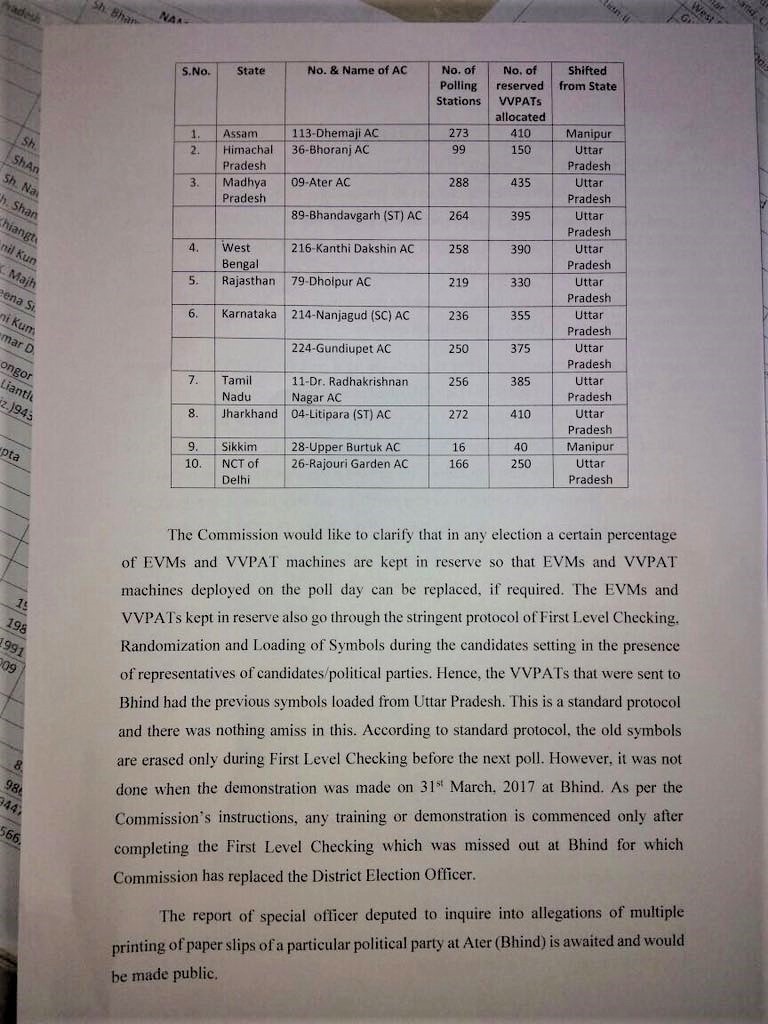
Now it appears that the EC team had told them about VVPAT’s printing machine, but the clueless journalists reported them as EVMs. The printing machines of VVPAT system are not mandated to be frozen for 45 days, hence they were brought to Bhind as such machines are not in abundance. Only the print outs from those machines are to be stored for 45 days along with the EVMs.

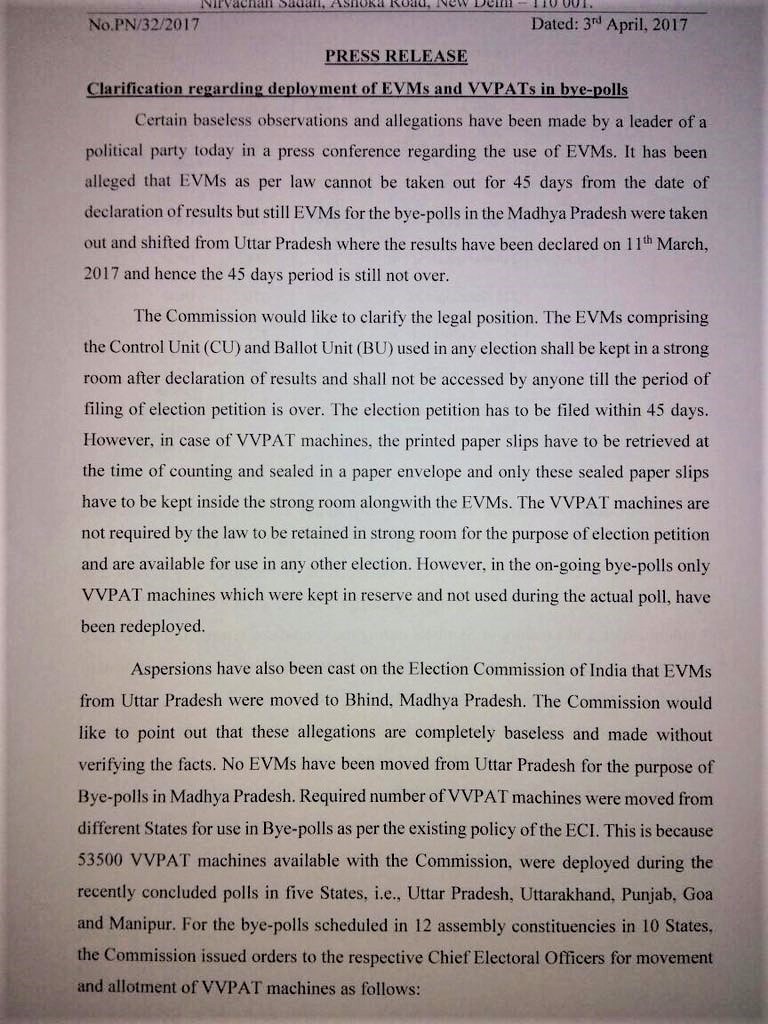
The same was clarified in a press release issued by the Election Commission of India:

Press release by election commission over Bhind EVM controversy

Press release by election commission over Bhind EVM controversy - 2

The press release by the Election Commission also clarified that the VVPAT’s printing machine was not reset during the demonstration and hence there could have been some confusion over what names or symbols were getting printed. This perhaps also explains the original confusion, which was later blown out of proportion by a clueless media and some vile politicians.

Since the demonstration was made without resetting the earlier symbols and undertaking what is known as First Level Checking, the Election Commission replaced the District Election Officer as disciplinary action. This too is being wrongly claimed as a “proof” – that disciplinary action was taken because EVMs were faulty – whereas disciplinary action was taken because standard procedures were not followed.

Nonetheless, the Election Commission has declared that it will still look into the allegations of multiple buttons printing the symbol of the same political party, and the findings will be made public soon.

Repeating this popular story about Maharishi Valmiki can land you in jail

It is one of the most repeated stories and chances are that you might have also either heard it or have used it at some point of time, most certainly approvingly. And the story is: Maharishi Valmiki was a dacoit, and was known as Ratnakar, before he became a sage and wrote Ramayana.

According to legend, Ratnakar, supposed to be born in a so-called low-caste, was rechristened as Valmiki and given the status of Maharishi (great sage) and a great Brahmin by Narada Muni after Ratnakar performed tapasya (deep meditation).

However, the Valmiki community, especially those living in Punjab, don’t like that part of the story that says that Maharishi Valmiki was any dacoit at any point in his earlier life.

If you repeat this part of the story, even approvingly without meaning disrespect to Maharishi Valmiki, and especially at a mass media platform, you will attract the wrath of some activists belonging to the community.

The same has happened to TV actress and host Rakhi Sawant, who could be arrested for calling Maharishi Valmiki a murderer (well, she sensationalized, out of habit, and turned the ‘dacoit’ part of the story into a ‘murderer’). She repeated this story to make a point about how someone indulged in criminal activities came become a great sage, and thus people should be given second chances in their lives, but ended up offending members of the Valmiki community.

She was repeating the story on some TV channel in July last year to make a point that just like Valmiki (Ratnakar) can become a sage, Mika Singh – the Bollywood singer who had once forcibly kissed her and who uses abusive language on Twitter – can also change and become a better person.

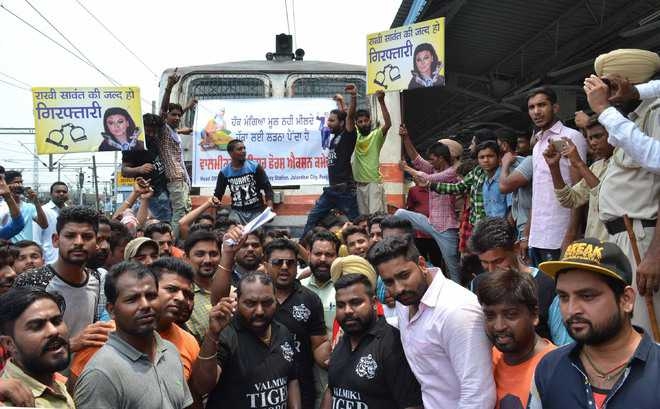
Shatabdi stopped by Valmiki community
Train stopped to protest against Rakhi Sawant in July 2016

Members of the Valmiki community were reportedly offended over her referring to Maharishi Valmiki’s past as criminal (and not over the comparisons with Mika Singh, which we thought was more ridiculous). A case was registered against Rakhi Sawant under IPC 295 for offending religious sentiments. Protesters had even stopped a train in Punjab demanding her arrest.

According to latest reports, a team of Punjab Police has now left for Mumbai to arrest Rakhi Sawant, against whom an arrest warrant was issued by a local court in Ludhiana. The warrant was issued after the actress couldn’t attend hearings at the court even after repeated summons.

However, this is not the for the first time that Valmiki community has taken to courts against people who repeat this story. Way back in 2009, a case was registered against TV channel Star Plus and producers of a serial Bidai, where this story was repeated, even though approvingly.

The case is still going on and the activists vow to take it to logical conclusion. Last year, even the Supreme Court refused to give relief to the TV channel and producers. While hearing the same case, the High Court had observed that there was no credible evidence to suggest that Maharishi Valmiki was a dacoit in his earlier life.

“From Vedic literature, up to 9th century AD, there is no reference as such that Maharishi Valmiki led a life of a dacoit or highwayman,” the judge is reported to have to have said, which arguably has now become a precedent and the activists of Valmiki community don’t take lightly any reference to the same.

Apart from cases against the Star Plus and Rakhi Sawant, Valmiki community protesters had got the Arshad Warsi starrer The Legend of Michael Mishra banned in Punjab as the movie too had a dialogue that repeated the story about Maharishi Valmiki being a dacoit once.

The ‘liberal’ bully of India, and how he is now at his worst

0

I have read books, attended lectures, seen documentaries to pass exams, killed time to get introduced to ideas, but I make sense of the world by relating observations with my own felt experiences. Pardon me now if what comes next feels like a profiling of plump kids, but it is just a description vivid in memory.

Many of us may have encountered bullies in school or college. I remember one as a huge, tall, plump guy who looked strong and was indeed bigger and stronger than most of us, but more importantly he was glib and loud. The fear was not only of getting beaten by him but that he would loudly talk about it, publicly tease us, and the shame would multiply the pain.

Bullies try to attract you with their benevolence, try to restrain you with threat, and finally malign you when you cannot be restrained. Simply described, the nature of interaction of a bully is 3-staged:

  • Benevolence – Mujhe karate mein black-belt tak aati hai, koi kuchh bole toh mera naam lena. (I am good enough to be a black-belt in Karate, take my name if someone bothers you)
  • Threat – Zyada hero mat ban, mujhe Karate me black belt tak aati hai. (Don’t act smart, I am good enough to be a black-belt in karate)
  • Maligning – Wo padhai me achha nahi hai, wo jhuth bolta hai aur usko toh Karate bhi nahi aati. Kisi din koi sabak sikhayega tab pata chalega. (*Bundle of accusations*… and he doesn’t even know karate. He’ll learn when some day someone teaches him a lesson)

You would likely be enamored by his brave claims at first, but when you see him running with his belly button exemplifying Brownian motion and his cheeks darting about furiously, so much so that if the face had not held them together, they’d drop down to makes holes in the ground and cause a dust storm, you start to doubt their Karate claims.

When you believe in your own abilities, the threats don’t work anymore. That is when he maligns you, hoping someone else will get the better of you and he will chuckle in your dismay and maybe reassert himself once you are broken.

Anyone would be happy to get over these bullies in our lives, but that would be a mistake. Our institution called “world”, broad based the attitudes of individual bullies and made an ideology of it! We call adherents of this ideology “Liberals”!

***

Marx wrote about how the poor are poor because the rich are rich and founded the concept of history as an interplay of conflict. He postulated that only the proletariat created value and produced goods; the Bourgeoisie added no value.

It is wrong to say though that Marx himself produced no goods, hence no value. It is wrong to question whether bales of textile or an assembly of vehicles would come out of a stack of Das Capital. Marx’ work did indeed have a self replicating product. It made of factory of left liberals, who in their own right, are “thought-capitalists”.

I am focusing on these summary concepts of Marx:

  • The world is driven by conflict – thus a fight is imminent and a side has to be taken
  • Materialism is the basis of social dynamics. Ideology frames itself on the substrate of materialism – thus man is a slave to control of matter and has never had free will.
  • Religion is the opiate of masses – a false consciousness, used by the ruling class to keep masses subdued.
  • A revolution shall break down this established order and replace it with a utopian world.

He told us everything that was wrong, but not how the right world would look like (which is why communism has failed many times over). Marx-bhakts took it upon themselves to reverse the wrong he identified and hoped that a sui-generis right world would emerge.

In keeping with these concepts, the leftists strive continuously to:

  • Identify a victim mass to take a side
  • Mobilize the victim mass
  • Overthrow the “perceived” ruling class
  • For persisting dominance, indoctrinate the masses and give them new standards of morality NOT guided by religion.

History testifies that Communist regimes have succeeded only so far as grabbing power. The promise of a utopia became an even more distant dream everywhere they were in power. Liberationist liberals have given us some of the most ruthless, dictatorial and decadent regimes across the world. They successfully engineered mayhem across the world but created failed systems and failed at keeping their dominance intact.

Their failure elsewhere has an important lesson, that dominance by brute force last only as long as it successfully overpowers the resistance. But moral dominance has permanence. Morality sets standards of right and wrong and inspires uncritical obedience. For example, killing a cow may be proscribed by morality of one culture, they will protest and possibly mobilize if one legalizes cow slaughter. For complete obedience, the masses’ sense of right and wrong should align with the domineers’. In India, this morality is guided by the many millennia old Hindu culture. THIS is where the liberals came in conflict with Hinduism!

India was more difficult for the left liberals than the rest, because it has been a very complex society, not stratified on class (material possession), deeply religious, where the majority was a mass persecuted for a millennium based on religion. To side by the victims in order to mobilize them here, they would have to be sympathetic to the Hindu religion!

They tried their class struggle project in all earnestness. The Naxalbari movement is well known but ended without notable consequence, its vestiges seen only in the secular terrorism known (un)popularly as Maoism. However with the Nehruvian order in place, the liberals were comfortably placed in a position of power and proceeding with their project of moral, ideological control for full obedience.

Educational institutions and media, we all know now, have been vehicles for this journey to complete dominance.  The means employed, in their gradual obliteration of our cultural moorings was sidelining Hindu history, whitewashing oppression at the hands of Jesuits and Islamic invaders and playing up the caste fault lines.

In their battle against Hinduism, the oppressed castes gave them an entity that perfectly fitted their conflict-victim model. Their efforts became more pronounced specially since 90s, in the post Mandal era when these fault lines cracked deeper. The attempt was never to reduce caste consciousness to gradual irrelevance but to make caste groups compete with one another for privileged access to power.

In this conflict, the liberals played the monkey with a balance beam and always had proximity to power as mediators. This was the era of political capitalists innovating with Muslim-Yadav, Muslim-Dalit alliances and an ever-increasing identification of politics with (caste) mathematics.

In India, Muslims have been held as a constant in liberal equations for utilitarian reasons, even though they are a religious entity. With their minority status, the course of our communal history and being a generally closed society, Muslims have long harbored insecurities vis-à-vis the majority. A ready victim is a veritable asset for liberals. Social insularity and low levels of secular / scientific education have made them impermeable to liberal indoctrination, so liberal do not even want to walk the road. They are happy appeasing them, playing up their insecurities and keeping them together as a mass at their disposal.

Like the typical bully, they were benevolent and rewarded obedience with nepotism. Like my bully’s make-believe spectacle of “knowledge of karate”, they claimed superiority by professing knowledge of “secularism and liberalism”.

The resistance that emerged in the form of RSS was threatened with bans. Popular leaders of this resistance met with untimely and unnatural deaths. Using threat with murders and attacks, to bully out the resistance is an ongoing exercise in Kerala and West Bengal. The PM of today, was hounded for over a decade with fake cases. These are quite in line with the second identified attitude of the bully.

But using threat for bullying was finally put to failure on the 14th May 2014 when despite the raucous hounding and torment, India chose Narendra Modi to be the Prime Minister. This also signaled the failure of their efforts of deepening the caste fault-lines and emergence of an evolving unity around governance outcomes and Hindu identity. The idea of using caste groups as mass victims is increasingly looking futile now.

Optimistic attempts to rejuvenate them can never be ruled out though, and there have been such persistent attempts. Every headline that starts with “Dalit man beaten….”, “Dalit woman raped…” or tweets and statements that say, “Do minorities like Muslims, Christians, Dalits have a place in this new India…” are religious attempts to break open the Hindu religion.

But now, with their quiver seemingly empty, the strongest hope of liberal bullies is that someone else punishes Hindus while they seek morbid satisfaction from their fate or get an attempt to reassert themselves with “I told you so”.

Simple observation of their narrative through tweets, posts and articles will have us realize that they are looking at the worldwide Muslim radicalization and could be optimistic about successfully alienating and infusing insecurity in India’s large Muslim population. The religious fear-mongering is not even subtle now, especially after Adityanath, a Hindu Yogi, became Chief Minister of India’s most populous state.

If he delivers material goods and services (at which he has made a strong start), the liberal song of a divorce between Hindutva and development will find no chorus. They will only be left with notional assets of “secularism” to sell, for which the number of buyers are receding by the day. Only extended communal strife can possibly make secularism a saleable entity again!

The desperation of liberals at this juncture is now webbed in dangerous possibilities. The bully I knew was a child. He grew to be a fine gentleman and a dear friend.

But I doubt that an ideology walking the beaten track for over a century despite humiliating tumbles will change for the better. Be watchful for what may come!


Daaru pe Dialogue: what I told my right-wing Hindu friend about removing 295(A)

0

Last night I committed the cardinal sin. I had a discussion about politics/social issues over beer with a friend, who identifies himself as a “Right Wing Hindu”.

It all started thanks to this tweet by former AAP leader Prashant Bhushan where he had said, “Romeo loved just one lady, while Krishna was a legendary Eve teaser.Would Adityanath have the guts to call his vigilantes AntiKrishna squads?”

This tweet was enough to let the whole of Twitter on fire. And let me be clear, I completely sympathise with the Hindu anger. After all, there is a man called Kamlesh Tiwari who was thrown in jail because he called a Prophet of a minority religion a homosexual. That was enough for him to get death threats, and now the man will live his life with a real bounty over his head.

So, anyways, this is how the conversation between both of us happened. I am sharing the entire exchange in a conversational format so that everyone gets the gist of the discussion. Obviously, the conversation has been “de-beered” to make it worthy of publication:

Friend: Did you read Prashant Bhushan’s tweet? Once again yet another person goes after Hindu Gods, and no one will do anything about it. Look at what @padhalikha says “Some Sanghis get all principled & ask for removal of 295A, as if that bothers us! Police not with you and Jihadis with us is what we’d love!”

This is you, every time something like this happens you go on saying that we should remove 295A (IPC section that makes it a crime to outrage religious beliefs) so that we can also criticise Islam and there will be a level playing field. But when we criticise Islam they behead us. Who will take that risk? Liberals already love Islam. People like you just don’t get it. Removal of 295A won’t help us even one bit. What we need to start doing is start using the same law against them, and that is how we will get even.

Me: Bhai, calm down. I get your anger. First of all, if you remember correctly, I am the guy who filed a complaint against Vishal Dadlani when he criticised the Jain muni Tarun Sagar Ji Maharaj. But what happened after that? Various complaints got filed around India. Vishal Dadlani got a little scared and went and apologised to Tarun Sagar Ji Maharaj and things died down. What do you think will happen this time? There will be outrage. Some people might file a police complaint again. By the time a FIR is registered (that is very doubtful) Prashant Bhushan will apologise and say he was misunderstood. He will say he meant XYZ instead of ABC. Sab chilla ke baith jaayenge and then after a few days someone will say something again. How does this solve anything?

Do you think if you go on using this law the criticism or even abuse of Hinduism will stop? Hinduism has seen and survived much more virulent criticism while this law was there. So this is not helping Hindus.

You might want to get even, but will this change the inherent nature of Islam and the problems that exist in our society? Do you think that suddenly if people start taking offence to the criticism of Hinduism and file complaints in police stations, we will have a sudden change in the hearts and minds of Islamists? Do you think evangelists will stop conversion?

Friend: So what if 295A does not go. At least some abuse against Hinduism will reduce. And some of these hypocrite liberals will get some good treatment.

Me: Abuse will reduce, but to a very minimal extent. Also, you might see them as big problem on Twitter, but liberals are a tiny subset of the problem. If you are a right-wing Hindu, you should realise that bigger problem on ground is conversions.

Have you read the Quran? Or for that matter have you had a cursory look at the Old Testament. There are verses after verses in both those books that criticise the very basis on which Hinduism is based on. The Abrahamic lobby will go on criticising Hinduism by merely uttering what is written in their holy books, and you cannot stop them. Have you forgotten the Calcutta Quran Petition? People tried to ban the verses that preached hatred in the Quran, and they lost.

See this is our problem. We assume that the other side will follow our rules and behave in a certain way. What I on the other hand am trying to say, is that we need to assume that the other side will go on criticising Hinduism under the guise of freedom to practice and preach their religion. You have to realise that you are competing against two global/powerful proselytising/predatory faiths.

Friend: But how does that affect Hindus? Come what may, liberals will never criticise Islam or Christianity in India. They never do.

Me: yaar, these Twitter and TV liberals are not the only liberals. If 295A were not around, Sanal Edamaruku would not be living outside India. There are so many young kids who have given up Islam/Christianity but don’t criticise them openly because of the fear of being jailed. Not only that, I have met so many young Muslims and Christians who secretly admire Hinduism and dislike their faith but will not speak about these issues openly.

Friend: They don’t fear being jailed, but being beheaded. An atheist blogger in Kerala was killed only last month by Muslim fanatics, you know.

Me: I agree that is a very vital issue. But that’s law and order problem, not 295A problem which is about free speech.

In fact, why isn’t anyone in this country willing to identify where the problem lies? It is almost as if the entire law and order machinery in India has taken a back seat so that anyone and everyone can come up and start fomenting trouble. The first amendment by Nehru made ‘threat to public order’ as one of the ‘reasonable restrictions’ on free speech. Now that gives license that you create an atmosphere were you threatened public order, and the speech is suppressed, legally! Thanks to Nehru.

Friend: You have just proven my point. 295A goes but first amendment remains. Who benefits? Surely not the Hindus!

Me: I hear you. In fact the recent changes proposed by Law Commission makes it even worse for free speech. But, we have to fight for these rights only.

Another problem is that we are a highly under-policed society. The ratio of police personnel per lakh of the population is abysmally low in India. Now I am not suggesting we go to a strictly Western model and attain the recommended ratio as per the United Nations. The safety and security of each and every citizen of India has to be a non-partisan issue. Instead of holding politicians across political lines accountable, we are trying to find refuge under one banner or the other and accepting a society that is based on competitive psychosis.

Maybe what I am saying is far away from the ground realities of India. But just because the reality is grim, does that mean we start accepting mediocrity? I certainly don’t think so. As an active and responsible citizen of India, I will always try to shed light on issues that I feel have to be looked at in a non-partisan way. If that means someone calls me a dreamer so be it, I can live with that. But I refuse to let the political class of India wash their hands off this one. I sincerely hope that a significant number of supporters across political parties start talking to their representatives about this current state of affairs and demand them to solve this problem in unequivocal terms.

Friend: Hmm, So what are you suggesting? Be more precise.

Me: Well, as you already know, I want the removal of 295A so that everyone in India gets the freedom to criticise religious ideas. Because, unless we don’t have the freedom to criticise religious ideas we cannot defend ourselves against predatory Abrahamic faiths.

Secondly, we should oppose the recent law commission recommendations. The day is not far away from where we might start having laws where it might be ok to criticise the majority religion, but, critique of minority religions might get completely outlawed under the guise of hate speech.

Don’t believe what I am saying? Just look at what has happened recently in Canada. The Canadian parliament has passed a motion called M103, a non-binding motion that calls on the government to ‘condemn Islamophobia and all forms of systemic racism and religious discrimination’. In short, this is a backdoor entry to stop criticism of Islam and only Islam.

In India knowing what our leftists are capable of, I won’t be surprised that we get some law that states that as Muslims and Christians are a minority in India, we cannot criticise these religions at all. Have you forgotten Manmohan Singh’s words where he said that Minorities, particularly the Muslim minority, have the 1st right over our nation’s resources.

Who is to say that they won’t extend this kind of thought process to other areas? Today the BJP is in power. But it won’t be there forever. What if UPA comes back to power? We have to make sure that we have the freedom to criticse bad ideas irrespective of who is in power. And time to get that freedom is now!

I believe we have the best man for that job right now. If anyone can do this, it is Narendra Modi. It is time to fix the police force and judiciary. We should demand from him is that we make sure that we transform into a Law and Order based society from the current semi gangland democracy that we are where any random mob can cause threat to public order.

Friend: Arey yaar, Modi akela kya kya karega?

Me: Sab karega, per abhi hum saath beer peete hain.