Home Blog Page 7540

Massive crackdown on money laundering shell companies in 100s of locations

The Enforcement Directorate in what may be a massive exercise against money laundering, raided hundreds of locations in 16 cities in order to crackdown on shell companies. The raids were launched by the ED from the early hours of Saturday.

Various teams comprising of 300 officials raided the premises in cities like Delhi, Chennai, Kolkata, Chandigarh, Patna, Ranchi, Ahmedabad, Bhubaneswar and Bengaluru to name a few.

Some of the companies which were raided had links to prominent politicians like YSR Congress chief Jagan Mohan Reddy, NCP leader Chhagan Bhujbal and a controversial Noida bureaucrat Yadav Singh. Incidentally Reddy, Bhujbal have been under investigation for money laundering in the past.

The companies which fit into ED and other agencies definition of Shell Companies are:

Companies setup using nominal paid up capital, high reserves and surplus on account of receipt of high share premium, investment in unlisted companies, no dividend income, high cash in hand, private companies as majority shareholders, low turnover and operating income, nominal expenses, nominal statutory payments and stock in trade and minimum fixed asset.

ED believes that these companies are in violation of the the Prevention of Money Laundering Act (PMLA) and the Foreign Exchange Management Act (FEMA) acts.

In the past three years the agencies have identified 1155 shell companies which they believe were used to carry out dubious transactions worth over 13,300 crores. This report also indicated that the Saturday’s raids were based on authorities suspecting over 550 people of laundering 3,900 crore after demonetization via such companies.

This action by the ED stems from the government’s announcement of cracking down on shell companies on 10th February. The ED was one of the intelligence agencies and ministries which were empowered under a special task force set up under the direction of the PMO. The govt has set up a target of prosecuting 10 lakh of such firms and also to prepare an Aadhaar-based KYC registry to check future instances of money laundering by them.

This expedition of searching for shell companies was largely successful as the authorities found a whooping 700 shell companies registered at a single address in Mumbai.

Election Commission explains in detail why EVMs can’t be hacked, asks AAP to introspect over defeats

The Election Commission of India (ECI) has sent a detailed response to the Aam Aadmi Party (AAP), which had claimed that Electronic Voting Machines (EVMs) could have been tampered with, which led to AAP’s defeat in Punjab assembly polls.

These ridiculous allegations were made by AAP supremo Arvind Kejriwal himself in a press conference, where he also demanded that ECI should tally the VVPAT (voter verified paper audit trail) data with the numbers registered by EVMs, so that people are convinced that EVMs were working fine.

VVPAT is a system where a machine (not the EVM, but a different machine attached to the EVM) prints a paper slip after a voter presses any button on the EVM. The voter physically verifies if the paper slip has the name and symbol of the same party (and candidate) he had voted for, as he can see the slip, which later gets dropped in a drop box. If he claims that wrong symbol was printed, he has to sign a declaration saying so.

Today, ECI put up a detailed response and not only rejected all charges of AAP, but even asked the party to introspect over the defeat instead of unfairly blaming the commission or the machines.

The response (pdf link) lists in details why it is practically impossible to tamper with the EVMs. The key reasons cited are:

  1. EVMs are standalone machines and not connected with internet or any other network that can give away control, so can’t be ‘hacked’ the way other systems are compromised.
  2. The chip in EVMs can be programmed only once and it’s burnt into the EVMs at the time of manufacture. They can not be programmed again to transfer all or a part of all votes to a particular party.
  3. ECI had given chances to various people, right from year 2009, to demonstrate how EVMs can be tampered with, but they either failed or refused to demonstrate.
  4. Every EVM in every election is checked in presence of representatives of political parties before election process beings. If any machine is found malfunctioning, it is not used in elections.
  5. Mock polls are done by representatives of political parties themselves and at least 1000 mock votes are registered. Some rumours had claimed that after first 100 votes, rest of the votes are transferred, so this rumour is also killed in this process.
  6. The machines found working well are stored in strong room with a ‘pink paper seal’ that is signed by representatives of all political parties. This seal ensures that the chosen EVM’s body can not be opened and no hardware changes can be made. Software changes can not be made as explained in point 1 and 2 above.
  7. Which EVM goes to which assembly or polling booth, is decided through a computerised randomisation process. This randomised allocation also happens in the presence of representative of political parties.
  8. A mock poll is done again after EVMs are assigned constituencies, and the candidate list is set to the machines. This is again done in the presence of representative of political parties.
  9. Yet another mock poll in presence of representative of political parties takes place on the actual day of polling at every polling station.
  10. Paper and thread seals are put on EVMs (after blocking those buttons that have no corresponding candidates) before the actual polling begins. This is also done in presence of representative of political parties and they are allowed to put their signatures on the seal.
  11. Once the polling is over, and “close” button is pressed, after which the data is final and secured, entire EVM is sealed. And again, it done in presence of representative of political parties and they are allowed to put their signatures on the seal.
  12. The political parties are allowed to put their seals even on strong rooms where the EVMs are stored, and they are allowed to keep a watch on the strong rooms round the clock.

It is clear that any attempt at tampering of EVMs can be spotted by a political party representative right from the time EVMs are chosen for the elections to the time of counting when the seal is opened. AAP or any other party had no complaints in this entire process, but they started claiming EVM tampering once the results were announced.

As a result, the ECI in their response told AAP:

It is for your party to introspect as to why your party could not perform as per your expectations and it is unfair on the part of your party to attribute unsatisfactory poll performance of your party to the alleged tamperability of EVMs.

Not the just that, the ECI asked AAP to behave like a responsible political party and not twist the words of the Supreme Court. The ECI clarified that the Supreme Court, while hearing petitions and directing the state to use VVPAT system, had not cast any aspersions or expressed any doubt that election process could be rigged by the use of EVMs.

Responding to AAP’s demand of tallying EVM votes with VVPAT slips in the constituencies where they were used in the recently concluded Punjab assembly elections, the ECI asked AAP to refer to the Conduct of Election Rules, which specify that once results are declared, only the High Court can take such a decision.

So it appears that Arvind Kejriwal had again issued a statement (demand of tallying votes) without reading rules and laws. It remains to be seen if he approaches the High Court after this or goes back to spreading lies about EVM tampering.

Blocked? Twitter now allows you to send a last message with request to unblock

Twitter recently released updates for both its mobile and desktop versions, and for the most part, the users were unhappy. They didn’t hold back from expressing their disquiet:


They were most annoyed with the tweaking of  Twitter reply features where the user name doesn’t show up in the replies anymore. This has made things very confusing for most users.

The users though missed one of the coolest features which Twitter has introduced which allows you to send one message to someone who has blocked you, so that you can convince them to unblock.

The blocking feature on Twitter is one of their most controversial ones as getting blocked by someone not just doesn’t allow you to reply to them, it doesn’t even allow you to view their tweets.

Many a times people might get blocked from celebrities or public figures for being sarcastic or even a bit of an a**hole, but once blocked, one has to resort to asking other people to request the blocker to unblock you.

This new feature though allows you to write a 140 character reply to convince someone to unblock you. For it to be most effective, one might need to apologise profusely.

So how to use this feature?

See the ”learn more” option in the picture above? Just click that and you will be directed to twitter’s webpage where you will see a ”send message to @username” option.

Write the message in the box and then click ‘send’. You though won’t be notified if and when the person unblocks you. You just have to keep checking.

This exercise by twitter might help it curry some favour of Twitter users who have time and again criticised Twitter India for suspending accounts of users chiefly belonging to the right-wing ideology or those who were critical of the Aam Aadmi Party.

PS: Skeptical about this so called new feature of Twitter? Well you should be because this report was a part of our April Fool prank. No Twitter isn’t nice enough to do something like this and if they did, most people might use it to abuse people one last time.

Kejriwal’s anti-corruption unit was actually used to spy on officials and journalists: Reports

In March 2016, reports had emerged that the Kejriwal govt in Delhi had enacted a special team to monitor corruption in various govt departments. This team was supposed to report directly to the Chief Minister’s Office and its composition and functioning was kept confidential.

Though things were not as simple as they looked. A panel commissioned by the former L-G Najeeb Jung had found that this special team, known as a Feedback Unit, was in violation of rules as it didn’t have the required approval by the L-G. After this revelation the Kejriwal government claimed that this bureau had never existed. You can read our earlier report about this here.

Jung referred this matter to the CBI, which has reportedly found that that this unit did exist was given a 1 crore budget to carry out ”secret services”. Mysteriously out of this 1 crore, the CBI could find expense records of only Rs 50,000, which were used to uncover corruption in a private body. There were other irregularities like no records of employees even though salaries worth 41 lakh rupees were released.

Now it appears that this Feedback Unit was not constituted for any monitoring of corruption, but to indulge in snooping on behalf of Arvind Kejriwal. As reported by DNA here, this anti-corruption unit was allegedly used as a spy unit by the AAP government. The report claims that 20 govt officials were appointed to this bureau from intelligence agencies, RAW, police among others. Out of these, 5 resigned after they found that their task was to actually snoop on journalists, bureaucrats and central government officials.

Two of these officials left in the 1st two months, three a bit later, and one official was asked to quit by the government. Incidentally the report claimed that Kejriwal wanted a team of 49 ‘spies’ (maybe as a tribute to his 1st govt which lasted 49 days?) but finally settled on 20. These 20 officials were appointed allegedly without following any recruitment rules.

According to the DNA report, the remaining 14 officials (after 5 quit and 1 was asked to go) continued their ‘services’ until L-G directed the state government to close the unit down. They had access to the 1 crore rupees budgeted for carrying out snooping and sting operations. The report also claimed that even though records showed that the unit was formed under the Vigilance Department, it was actually run by the CM’s Office. Vigilance Department was kept in dark about the details.

Quoting sources, the DNA report claims that the the snooping bureau was set up a floor below of the Anti-Corruption Bureau’s office at Vikash Bhavan II, but the ACB was not even aware about it.

If all of this is true, then Kejriwal not only didn’t do much about corruption, he ended up spying on his people under the garb of fighting corruption.

Modi govt solicits smart solutions by organising a mega Hackathon

We had recently reported about how the Rajasthan Government became the first state government to organise a Hackathon. 500 coders had participated in a two day event on 20th and 21st March to implement their ideas on three digital interfaces used by the state govt.

To refresh things a bit, Hackathon is generally a 2-3 day intense event where coders and tech guys congregate at a venue to find a solution to a technical problem or create a running software prototype from scratch in that small period. The platform on which the prototype is to be based is generally provided by the organizers of the event.

Now the Central Government has taken this idea of Hackathon to the next level by organising what they call as the World’s Biggest Hackathon:

The event named as Smart India Hackathon 2017, is scheduled for this weekend on 1st and 2nd April. Over 10,000 programmers in 1266 teams in 26 cities are participating in this event making it the World’s biggest Hackathon.

This Hackathon will also be addressed by PM Modi at 10 PM tonight. The PM has also been enthusiastic about this event and he sent out a series of tweets on Friday:

For this Hackathon, 29 ministries had identified 598 problems which needed digital solutions. The wiling participants were asked to submit their solution ideas from 9th Nov 2016 to 20th Feb 2017. The response was overwhelming with the government receiving over 7532 submissions in the last few days.

The final 1266 teams were shortlisted based on their ideas. One of the software solutions pertained to the Railways, where the ministry wanted a software which could track the condition of railway lines and allied infrastructure, and generate auto warning messages about the need for urgent maintenance.

As this Smart India Hackathon is a collective term for Hackathons organized by 29 ministries, the participants had to travel to the city where their ministry in question had setup a center.

The coding session in the Hackathon began at 8:30 AM this morning with everything from snacks to meals having been arranged at the venue. There would also be inputs by experts, lasting for about 7-10 min for each team. The first round of evaluation by three judges at a panel would be done at 7:00 PM today. As the Hackathon involves working a lot in a short amount of time, one is expected to put sleep on the backseat. To aid that, the participants would be provided energy drinks.

The 2nd day of the Hackathon will begin with a Yoga session at 6:00 AM and the coding would stop at 5:00 PM, after which the judging would begin. The shortlisted 6-8 teams at each center would give a PowerPoint presentation and a final pitch to the judges after which 4 winning teams at each center would be announced in the evening.

The winners at each of the 29 centers, which amounts to 116 teams would receive cash prizes of Rs 1 lakh for 1st place, 75 thousands for the 2nd, 50 thousands for the 3rd, and 10 thousand for the 4th place. The winners would also be invited to a Gala event in Delhi in the 2nd week of April.

As expected this Hackathon in its maiden year is generating a lot of  interest. The solutions if found suitable would be inculcated in the digital platforms of various ministries. This would not just strengthen the government’s digital backbone but it would also provide a good learning experience for all the participants. Below are a few pictures and reactions from various centers of the Hackathon:


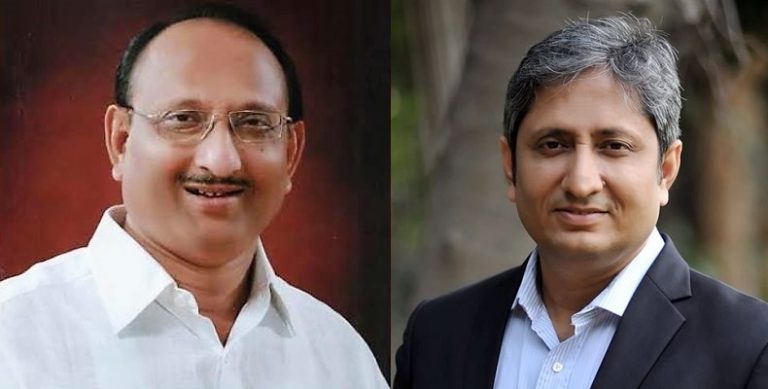
Ravish Kumar breaks silence, condemns his brother accused in the Bihar sex scandal

Brajesh Kumar Pandey, who is the brother of noted journalist Ravish Kumar, has been absconding after been accused of running a sex racket in Bihar. Brajesh was also a senior Congress leader and the VP of the party, but was forced to resign after the allegations surfaced.

There have been reports that suggested that attempts were being made to suppress the case by exerting political pressure on the authorities. The reports claimed that Brajesh was being shielded as he was the brother of an influential journalist.

For the victim, who had filed this case, things took a turn for the worse when the police, who first were reluctant to lodge an FIR, started questioning her repeatedly to point out inconsistencies. Meanwhile, the main accused Nikhil was arrested, but Brajesh is reportedly hiding in Delhi.

While police hunts Brajesh Kumar, people were intrigued by Ravish Kumar’s silence in the whole case. Ravish, who is vocally an idealist in most cases, was keeping quiet when it came to accusations against his own brother. Not just was Brajesh accused of a serious crime, he was not also turning himself in to seek penance for his crime. Plus to make matters worse, Ravish hadn’t even denied the reported political pressure that was exerted on the police to go slow in this case.

Ravish though has finally decided to break his silence in the case. He reportedly released a statement to the media on Friday wherein he acknowledged the charges against his brother. He denied his hand in trying to save his brother and condemned his brother for not turning himself in and aiding the authorities. He however added that he was certain the charges against his brother were false and hoped that the truth soon comes out.

He further warned his brother that if he didn’t surrender to the police by 31st April, he will blacken the screen of his TV and also his own face in protest. The proposed black day will be observed on 32nd April, he confirmed. Obviously, it is April Fool’s Joke. Ravish Kumar has done nothing of this sort.

However, the rest of the article is true. So far as the latest updates are concerned, police has still been unable to trace Ravish Kumar’s brother while the main accused Nikhil has been sent to police custody. According to reports, Nikhil is not being grilled the way he should have been by the police.

Kejriwal spreads another lie in desperation to prove EVM tampering

BSP supremo Mayawati might have gone silent over her allegations that BJP won Uttar Pradesh elections due to EVM (Electronic Voting Machine) tampering, but AAP supremo Arvind Kejriwal is in no mood to accept defeat and move on.

Starting around last midnight, Kejriwal and his team are working overtime to spread a news that an EVM, equipped with VVPAT (voter verified paper audit trail) system, had been registering votes in favour of BJP regardless of the button one pressed on the machine.

VVPAT is a system where the machine prints a paper slip after a voter presses the button on EVM. The voter physically verifies if the paper slip has the name and symbol of the same party (and candidate) he voted for. The slip then drops in a box (ballot box or drop box) which can be counted if EVM numbers are disputed. This system is being planned to be used more and more in upcoming elections. If a voter claims that wrong slip was printed, he or she can sign a declaration saying so at the polling booth. (this paragraph was updated to make VVPAT functioning clearer)

By the time of writing this report, Kejriwal had tweeted and re-tweeted at least 15 times, referring to the same incident of VVPAT EVM voting in favour of BJP, which allegedly happened in Bhind region of Madhya Pradesh where a bye-election to an assembly seat is scheduled to take place.

Here is one sample tweet by Kejriwal:


The video shared by Kejriwal is of a ‘news report’ by a TV channel called Samay, where it is being alleged that the EVM printed slips in favour of ‘lotus’ (BJP) and the Chief Electoral Officer of Madhya Pradesh “warned” the journalists not to report about it.

Various tweets referring to the same incident has by now been shared by various leaders of AAP, including Deputy CM of Delhi Manish Sisodia, and by many AAP supporters who are claiming this to be the ultimate proof that EVMs are tampered with. Some of these tweets were re-tweeted by Kejriwal to convince everyone about the veracity of the report and claims.

Kejriwal also shared a “video proof” by re-tweeting the following tweet by a journalist, who for all practical purposes acts like an AAP worker:


If one looks at the video shared by the so-called journalist, one can clearly see that the Chief Electoral Officer is jokingly warning the journalists. It is only expected of her, as allegations of EVM tampering have been reduced to a joke by likes of Kejriwal. Her mock warning was twisted as real warning, as if to hide some “scam”, by some journalists and political parties.

Intrigued by such claims, we decided to take a look at various sources to ascertain what exactly had happened, and this is what we found:

  • The Chief Electoral Officer of Madhya Pradesh, Saleena Singh, was inspecting the EVM in presence of journalists and representatives of political parties ahead of the assembly by-election.
  • When she pressed button no. 4 to check the machine, the VVPAT printed a slip that showed that the vote had been registered in favour of BJP.
  • This led to everyone’s amusement in wake of all the allegations of EVM tampering in favour of BJP. Saleena Singh then used this occasion to warn the journalists in jest, and the video clearly shows everyone is laughing.
  • As it was the case, button number 4 was assigned to BJP and Ms Singh coincidentally happened to press that first.
  • Ms Singh then proceeded to press other buttons, and the associated VVPAT prints showed names and symbols of other parties, which is how it should be.

The above chain of incidents, which took place yesterday, is confirmed by local reports in Nai Duniya, Dainik Bhaskar, and Patrika newspapers.

However, Bhaskar and Patrika had misleading headlines. A print report in Bhaskar even claimed that ‘lotus’ came out twice after pressing different buttons in succession. A clipping of the same report is being shared by many AAP and Congress supporters, but the report on their website confirms that the second button returned slip in favour of a non-BJP party. The report also confirms that the Chief Electoral Officer was ‘threatening’ the media in jest, yet their headline makes it appear as if she was serious while threatening.

UPDATE: After our report, Bhaskar changed their online report (unfortunately we didn’t take a screenshot) to propagate the theory being spread by AAP and Congress supporters. Their misleading report is now being treated as source for similar reports by other media organisations, while ignoring other reports that contradict this version. Following are the screenshots of the Nai Duniya and Patrika reports respectively, which confirms that different buttons returned different party symbols (screenshots are being uploaded just in case those reports are also changed, although they have not been changed till 4.30 PM today):

Local newspaper report confirming that the machine was working properly and the electoral commissioner was being light-hearted
Nai Duniya report confirming that the machine was working properly and the electoral commissioner was being light-hearted when she ‘threatened’ the media.
A misleading and sensationalist headline by Patrika, but the report confirms that officer was joking and that the EVM worked well on pressing subsequent buttons.

UPDATE 2: One of our readers on Twitter had taken the screenshot of the original Dainik Bhaskar report, and one can see how they changed their own report to support the claims of Kejriwal. The original report had said that symbol of another political party came out when the EVM button was pressed for the second time:


As it appears, the Congress members started crying foul the moment first vote coincidentally showed BJP. The subsequent votes, which showed that the EVM was working correctly, were not only ignored by the Congress party, but even by some sections of the media, who twisted the entire episode and the light-hearted behaviour of the Chief Electoral Officer to create a controversy.

What was started by Congress and sarcasm-challenged cum fact-free media, was then picked up online by AAP supporters, and finally by AAP supremo himself. As you read this report, AAP is working full time spreading the above misinformation on social media and elsewhere.

Unfortunately, the hunger for power in some leaders have gone to an extent where they now don’t care for facts or nuances and would do anything to create unrest and weaken people’s faith in democratic processes and institutions.

Pakistan declares Dalits as different religion from Hinduism in their census

0

Pakistan is having a census after 19 years. The country hopes to have an accurate estimate of not only its growing population but also an idea about the status of ethnic and religious minorities, population strength of whom have been dwindling over time due to persecution and limited opportunities.

The exercise was in news in India a couple of weeks back because Sikhs were not being counted separately in the census. They were being clubbed in “Others” in the column where one was expected to choose one’s religion. Hindus, Christians, and Ahmadis were among the options but there was no option for Sikhs, Parsis or Baha’i.

There was a hue and cry even in Pakistan with cricketer turned politician Imran Khan raising this issue, which incidentally was also reported in India. The Sikh community of Pakistan took the issue to courts. Subsequently, Peshawar High Court asked the authorities to count Sikhs separately, though half of the first phase of the census was already over by then. The second block of the first phase started today and it is not clear if Sikhs are being counted separately.

While inattention to Sikhs made news in India, and rightly so, another controversy related to one’s religion in Pakistani census has largely gone unnoticed in India. And this time it is about Hindus.

Pakistan has virtually declared that ‘Scheduled Castes’ (also known as ‘Dalits’ in popular socio-political discourse) are not Hindus. In the column where one needs to indicate one’s religion, “Scheduled Castes” is one of the options apart from Hinduism. So, one has to either indicate himself as Hindu or a Dalit. He can’t be both.

It should be noted that a majority of Hindus left in Pakistan are believed to be Dalits, who could not migrate either due to lack of financial resources or because some of them believed in the Dalit-Muslim unity theory. They face discrimination and crimes like abductions and forced conversions from Muslim extremists quite often. Further, they hardly enjoy any clout in the political landscape.

Which is why there has been muted opposition to this move by the government of Pakistan to divide Hindus in the census. Among those voicing concerns has been the Pakistan Hindu Council, whose patron-in-chief Dr. Ramesh Kumar Vankwani, who also happens to be a member of the National Assembly of Paksitan, has opposed the move.

“In the current census, Hindus have been divided into Hindus and the Scheduled Castes. The Pakistan Hindu Council believes that this is a deliberate attempt to divide the population strength of the country’s largest religious minority,” Dr. Vankwani wrote in an article published today.

However, such concerns have neither found a serious audience in Pakistan nor in India. In Pakistan, Hindus are in hopeless situation, while in India, those who control the narrative would rather welcome this move and want it replicated in India!

The so-called left-liberal ‘secular’ intelligentsia in India has often argued that Dalits are not part of the mainstream Hindu society. They propagate such arguments based on the discredited Aryan Invasion Theory and other quasi-fictional beliefs that they flaunt as “alternative history”. This step by the Pakistani government would rather embolden them than bother them.

But for the rest of us, it should mean warning bells, for Pakistan has set the ball rolling, which is in line with their declared policy of exploiting fault-lines in the Indian society. This step of counting Dalits separately from Hindus could be aimed at seeding similar demands in India rather than collecting data for domestic purposes. Remember that last year, the Pakistani senate had adopted a resolution that talked about exploiting fault-lines in the Indian society, especially around the Dalits.

Don’t be surprised if similar demands are raised in India for the next census, which is slated to take place in 2021. And if the Congress/UPA government comes back in 2019, it won’t be surprising if India follows the footsteps of Pakistan in declaring Dalit identity distinct from Hinduism.

This sinister agenda by Pakistan has to be fought on the domestic front mainly, and the social organisations have to brace up for this assault. Suitable and favourable conditions have to be created where discredited or fictional theories are not easily believed by the marginalised sections.

Apart from attempting to declare Dalits as non-Hindus, there will be attempts to talk about the Muslim-Dalit unity too. It will be timely to recall the case of Jogendra Nath Mandal, Pakistan’s first Law Minister, who was a Dalit, and who resigned from the government of Pakistan and migrated to India after he realised that the talk of Muslim-Dalit unity was a hogwash and Hindu/Dalit interests were not safe in an Islamist nation-state.

Perhaps this attempt to divide Hindus is a step towards whitewashing the Jogendra Nath Mandal episode in Pakistan’s history, so that it can be argued that Dalits couldn’t get their due because they were not recognised separately. This narrative will not only find traction within Pakistan for obvious reasons, but it could be sold in India too.

Pakistan’s attempt to divide the Hindu community and re-write history could have been ignored as their internal matter if it were not sinister. One may argue that what else to expect from a country that divided Muslims too and declared Ahmadis as non-Muslims. But this is not just their internal matter. Stakes are high.

Pakistan has introduced a new entry into their census form column, but it is basically a signal to the fifth column in India.


India Today slammed on Twitter for suggestive headline on SRK’s daughter

Suhana Khan is just 16 years old. She is not into any form of public life, and is happily living her teenage life. But she is the daughter of Bollywood mega star Shahrukh Khan. And according to Indian media, that is enough for them to objectify a private individual, a teenager, by using pictures of her available on the net.

Earlier in the day, India Today published a story titled: “20 photos of Suhana Khan to spice up your Friday, in case you had other plans“.

Well, there were no direct sexual references, but the message was loud and clear. And that upset many on Twitter:


In the above screenshot, it is ironical than on one hand India Today is insulting a young female, and on the other hand, it is organising a “Woman Summit”. Soon, the outrage spread as more user joined in:


Eventually, India Today decided to take action. No, they did not take down the article, but instead decided to change the headline to: “Flashback Friday: 20 photos of Suhana Khan that will make you look forward to her Bollywood debut“.


//platform.twitter.com/widgets.js
But, the URL to the story still reads: “suhana-khan-photos-wild-party”, which clearly shows the intention of the site. In future, if anyone runs a search with those keywords, he will surely land at this page.

This is not for the first time though that SRK’s daughter has attracted media’s attention in rather sexualised way. India Today itself almost exactly a year back had published her photos and titled it “This photo of Shah Rukh Khan’s daughter Suhana in bikini along with AbRam goes viral“. The article had a photo of hers from her Facebook profile too.

NDTV India refuses to apologize for its coverage of the Pathankot terror Attack

NDTV India which is embroiled in the Pathankot Attack reportage controversy, today in a Supreme Court hearing declined to apologise for its coverage for which it was doled out a token one day ban by the I&B ministry. It may be noted that even this ban was later put on hold by the I&B Ministry. Now the matter will be heard in detail in the Supreme Court:


As exclusively reported by us here, NDTV India received this ban from the I&B ministry for its live coverage of the anti-terror operations via which the channel gave away sensitive information about the Pathankot airbase, like the details of ammunition stockpiled in the airbase, MIGs, fighter planes, rocket launchers, mortars, helicopters, fuel tanks, etc., which could have been misused by the terrorists to cause grave harm to the airbase and the people inside it.

We had recently reported how NDTV India had moved to the Supreme Court after its Hindi channel received the 1 day ban. As the Supreme Court had decided to hear its case, the ban had to be suspended. In one of the hearings of the case on 24th March,  Attorney General Mukul Rohtagi who was representing the I&B ministry had asked for a clear apology from the NDTV which was represented by eminent lawyer Harish Salve. Had NDTV India agreed to do so, it would have been the end of the story.

The apology templates which Salve had come up with in that hearing like ”NDTV is a very responsible media organization. We regret the unfortunate incident which occurred”, ”we regret the controversy that led to the incident” were deemed too generic by Rohtagi. The case was then adjourned for 31st March, i.e. today when NDTV was supposed to let the court know if it agreed to the modifications suggested by the govt.

Clearly NDTV India has now refused to make the modifications and hence refused to apologize in this case. This will now lead to the Supreme Court to provide a detailed hearing in the matter after which it will provide its judgement.

This manoeuvre by NDTV is a clear gamble as it can now either win or lose a lot more than it would have had it provided an apology. As the legal correspondent of the IE pointed out, ”NDTV India is in the dock for violating the telecast norms.” If the Supreme Court finds it guilty for the same just like the Inter Ministerial Committee of the I&B Ministry had back in Nov ’16 the government might not be keen on letting the channel off with just a simple apology, provided it shows some spine.

NDTV on the other hand might be hoping that the case drags on for some time due to which it might fade from public memory. Though if it is indeed found innocent there might not be a better scenario as had it agreed to apologize today it would have been a clear admission of guilt.