Home Blog Page 7642

An open letter by a cop to those opposing death penalty to Yakub

Dear “Intelligentsia” of India,

I am not a TV panelist. I am not a “human rights” activist. I am not a lawyer. I am not a political commentator. I am not a best-selling author. I am not the son or  grandson of a famous man. I am an aam aadmi. More than an aam aadmi, I am an officer in the Indian Police force. And I am writing this letter to all of you, after seeing your robust defence of a terrorist.

Why I mention who I am is important because unlike all of you, I don’t sit in plush AC offices and write editorials seeking clemency for a murderer. Nor do I visit TV studios and shout myself hoarse. Instead I meet such killers every single day. But I don’t meet them for cocktail parties or at press conferences (like some of you do).

I meet them on the road, in the streets, with weapons in their arms and hate in their eyes. I have been in situations with them where they would not hesitate a single moment before pulling the trigger on me, but I have to consider all the ramifications like “human rights”, “due process” and “fake encounter” before I save my life and of the innocent people around me.

Given the above I believe I am in a far better position to comment on a mass murderer like Yakub Memon than any of you are.

To defend this criminal, multitudes of arguments have been put forth by what are now called “Adarsh Liberals” in our society. Luckily, almost no one has pleaded that he is innocent. The situation is such that Indians have to be grateful to our “Intelligentsia” for such small mercies.

But one common hypothesis put forward by many is that Yakub Memon surrendered to the Indian authorities, and then cooperated with the investigations. Plain lies. Late B Raman, one of India’s finest intelligence officers wrote this in his article:

He had come to Kathmandu secretly from Karachi to consult a relative and a lawyer on the advisability of some members of the Memon family, including himself, who felt uncomfortable with Pakistan’s Inter-Services Intelligence, returning to India and surrendering to the Mumbai police. The relative and the lawyer advised him against surrender due to a fear that justice might not be done to them. They advised Yakub to go back to Karachi.

Before he could board the flight to Karachi, he was picked up by the Nepal police on suspicion, identified and rapidly moved to India.

This was yesterday confirmed on some news channels when they interviewed the Nepali police officer. He re-iterated that there was no deal and Yakub was fleeing to Karachi. Then why are our “Intelligentsia” hell bent on stating otherwise?

Let me put it another way: I know there is a rat in my house, and I place a laddoo in a trap. The rat gets caught and then pleads for mercy saying that he had come to “surrender” because I had offered him a “laddoo” (deal). Do I let him live?

The second common argument is “but we are against death penalty. It is barbaric”. My simple question is: Did it take the death sentence of a terrorist to wake up the bleeding heart activists? Couldn’t you demand a change in law for so many years? Why are you crying for this beast?

For the record even I am not decided on this issue. Just because we are from the police force doesn’t mean we do not value human life. But in the case of a terrorist, what choice do we have? Do we preserve him hoping he will reform? Can terrorists who come with guns in their hands and an unshakable belief that what they are doing (killing innocent people) is right, be ever reformed?

Forget reformation, keeping such a dastardly mind alive is a big security risk too. Every time he is shifted from jails we have to be our toes to see if any attempt will be made by his gang members to either kill him, so that he is silenced or rescue him, so that he can continue his activities. And there is always the risk that one fine day his friends will hold some innocent civilians hostage and demand his release, so that we can put our lives at risk all over again to re-capture him.

You want to abolish death penalty? Go ahead, but not for terrorists.

Some of our “intelligentsia” have been crying that “due processes of law” have not been followed in this case. It is a shame that a case which is going for 2 decades, which has been debated at multiple levels of the judiciary, even at the highest level, is still subjected to scrutiny by mis-informed, half-read, cretins sitting in AC cabins and reading op-eds. If you did have a problem with the process, why did you not raise your voice in 2013 when he was sentenced to death? Why now when his death is imminent? Are these delaying tactics? Where do your loyalties lie dear “Intelligentsia”? I sincerely hope all these people are tried for contempt of court.

And finally there are some utter lowlifes who have given this entire thing a political, communal and even casteist colour. How can one party whichever it may be, be held responsible for a Supreme Court verdict, which has taken 2 decades and during which time multiple political parties have fought in courts against Yakub Memon? Do you have even an iota of conscience and rationality left in you when you make such absurdly illogical statements to defend a terrorist?

In the aftermath of the Gurdaspur attacks, it has been reported that now India may be a target of the ISIS. In such situations Indians must unite and fight such a huge demon. But given how our “Intelligentsia” are hell bent in sowing seeds of discord among us, I fear we will be easy targets for such groups. While we keep shouting Hindu-Muslim, Brahmin-Dalit, BJP-Congress, I fear these terrorists will rip my poor country apart.

– A “thulla”

(The author’s identity has been withheld on request of the author)

Moneylife – fighting a lone battle against NSE, with no support from media

0

Readers of OpIndia.com are aware of the lies and spins propagated by the mainstream media to support their ideologies and/or political parties. A section of media has a cosy club and we know them as the Lutyens club; this just being an euphemism for a “newstrader” or a “presstitute“. If any member of this group is shown the mirror, their comrades jump into defend them – however absurd the charge may be. However, one news organization, which does not seem to belong to this club is – Moneylife.

Moneylife magazine published a copy of the letter it received from one of its patrons from Singapore about potential issues in “algorithmic trading” at the National Stock Exchange, the NSE (this letter was originally written to SEBI). You can read the letter here. Moneylife’s founder Sucheta Dalal wrote a piece with the title “Blowing the Whistle on Manipulation in NSE“, where this issue was highlighted. Algorithmic trading is a pre-defined software based trading strategy, where a tool analyses market dynamics, processes the information and deploys trading bets in stocks and/or in indices. This leads to sudden changes in dynamics in a counter, where unexpected liquidity can lead to increased volatility. Algorithmic trading, per se, is a well established practice across the world. However, in this case, the whistleblower alleged NSE of “market manipulation, which allowed certain vested brokers to get market price information ahead of the rest of the market”.

Following this story, the good people at NSE were clearly shaken by how a small magazine can question their credibility. NSE promptly slapped a Rs 100 cr defamation lawsuit against Moneylife magazine. Luckily for Moneylife, the Bombay High Court chided NSE by saying “NSE cannot use defamation to gag the press. How is it defamation when Ms Dalal sent you questions before publishing the article and you (NSE) chose not to respond to the query?” Moneylife has also agreed not to republish the report till the verdict is out. As per news on social media, Subramaniam Swamy has agreed to fight for Moneylife in this case.

There are two areas of concern in this case. Firstly, NSE’s high-handedness and secondly, mainstream media leaving Moneylife to fend for itself.

NSE has been notorious in silencing writers when something negative is written on them – through lawsuits or through sheer force. Here is another example. In November 2014, mumbaiwalla.com had written a piece on how NSE bullied big media houses like Economic Times and Mint to drop their stories on BSE complaining to SEBI about NSE’s malpractice. In this piece, NSE’s Divya Malik Lahiri accepted that NSE forced Mint to drop the story against NSE and at the same time, threatened mumbaiwalla to take down the story or face legal consequences. In that instance too, Sucheta Dalal questioned Mint editor Sukumar Ranganathan about the dropping of story. He accepted that Mint had dropped the story, but was not convincing in the reasons for doing so. Interestingly, there was also a historical link to this – Ira Dugal, who headed the Mumbai bureau of Mint and Divya Malik Lahiri, who was NSE spokeswoman – both broke their bread together at NDTV, earlier in their career. Whatever the background, it was evident that NSE’s high-handed approach had worked and Mint had removed the story.

One may wonder why NSE has to resort to these legal fights. One easy answer is that they are mighty scared of skeletons falling out of their cupboard, if they acknowledge something is amiss. However, let us not get carried away. Another answer to this may be its “brand value”. NSE is certainly the biggest bourse in India in terms of turnover and it also has many trading products to its credit. However, as Times rightly says, they lag behind the BSE’s “Sensex” in terms of brand value. So, any negative story will hurt their credibility further and hence, NSE tries to silence voices that question. It is time for NSE to “decline politely” or “rubbish allegations” or “clarify later”- than to be in news for wrong reasons.

Now, let us see the list of mainstream journalists who have expressed support to Moneylife in its fight against NSE – after all, this is about “free press” – a favorite subject for the liberal media. If you are expecting an exhaustive list, you are in for a surprise. Sucheta Dalal herself tweeted that she hasn’t received any support whatsoever from her colleagues.

She also gives the reason why she may not be getting that support in the near future:

It is not that this Gang of 37 do not meddle in others’ affairs – even in vain. Here is an example:

When Rajdeep Sardesai showed his bravado at the Madison Square Garden, Shekhar Gupta was out of the blocks in a flash.

Any apology for this tweet, when truth came out? You must be kidding…

Now we do not wish to reproduce all the tweets where MSM has come out in support of one of their own. However, as folks who look up to free and honest media for our news, we would be delighted to see the journalistic fraternity and others come out in support of Moneylife magazine in its fight against NSE. Our journalists and other eminent personalities are quick to stand up even if some celebrities are trolled by abusive handles, yet when a media organization is facing a Rs 100 crore lawsuit, no one comes ahead!

Mind you! We are NOT for a moment saying that Moneylife cannot fight its battles and Moneylife has NOT sought our help either. We think it is only appropriate to support honest and true journalism. If anyone of you think, Moneylife does not deserve OpIndia’s support, do let us know. We will consider your views.

Fact-Checking the “facts” of FactChecker.in – Power Ministry claims

Recently a site called factchecker.in took up a noble initiative: to fact check the claims of the Government. It is always a good thing to verify things said by Governments and Politicians. And although such sites were missing for a long time, its at least a start that they have sprung up now. But when one gets too obsessed with proving someone wrong, facts take a backseat and opinions start masquerading as facts. This is easily visible in the series of posts put up by factchecker.in.

Let us look at their post with the sensational title: “Power Ministry: Series Of False Claims, Marginal Improvements”. Looking at the title one would assume power ministry has got it all wrong. Let us have a closer look.

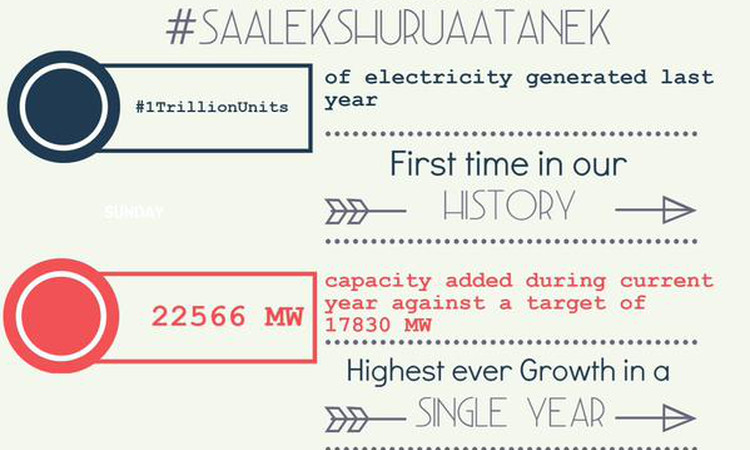
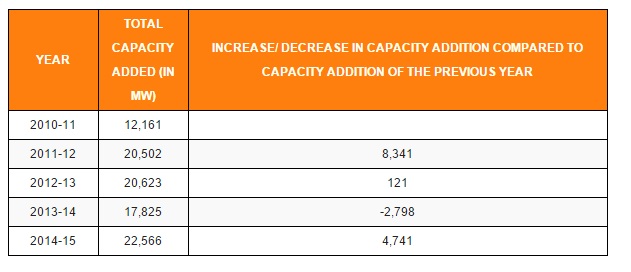
1. Claim by Power Ministry: 22,566 megawatts (MW) in power-generation capacity added in 14-15, the “highest-ever growth in a single year”

Here factchecker.in resorts to some clever-by-half methods of twisting data. From the ministry’s claim, it would be clear to anyone that 22566 MW added is the highest annual addition ever i.e. highest ever growth in power-generation capacity. This is brought out by the table put up by factchecker.in as well. Column 2, which shows the annual addition, shows that the highest addition was in 2014-15, thus “highest ever growth” of power generation capacity was in 2014-15.UntitledBut they somehow wanted to prove these claims wrong, hence they added another “parameter”. Hence they added the last column, which talks about “increase/decrease in addition” i.e. “growth of growth”. No analysis usually talks about “growth of growth”. Neither does the Government claim talk about this. Yet, they use this invented parameter of “growth of growth” to counter the basic claim. This inspite of the fact that their own table very clearly says, in column 2, that the highest ever growth was in 2014-15. Shifting of goal-posts, but not very cleverly.
2. Claim by Power Ministry: 1 trillion units of electricity were generated last year; first time in history

Here, the site says “Reality: it required only an additional 33 billion units, or 3.4%, to touch the trillion-unit mark”. So the site admits that the claim that 1 trillion units were generated is true. So what is the “fact-check” here? The Government’s claim is true. The only argument factchecker.in has is to reach 1 trillion units, only 33 billion units were needed. A truly lame fact-check.

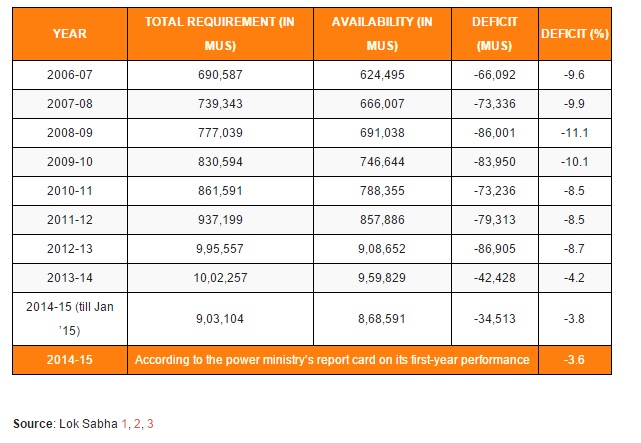
3. Claim by Power Ministry: “Deficit reduced to 3.6%, “the lowest ever””.

Here, the following table is presented by factchecker.in:factchecker

A cursory glance at this table itself shows that the deficit percentage is in fact the lowest in 2014-15. The second last last column of the table reflects deficit in absolute terms and the last column talks about deficit in percentage terms. In both the columns, the lowest figures for absolute and percentage deficit appear for 2014-15. So does the site itself say that the Government’s claim is true? Nope.

It then says the “Reality” is that the decrease in deficit compared to the earlier year is marginal. Maybe the author lost track of the original claim and let his biases creep in here, because the claim was never for “greatest reduction of deficit” but was for “lowest deficit ever”, which has been proved by the table given by them itself.

4. Claim by Power Ministry: A “significant increase” in wind-energy capacity installed during 2014-15.

The ministry says 2,312 MW wind-energy capacity was installed during 2014-15, compared to 2,083 MW during 2013-14, and terms it a “significant increase”. Note that the ministry is not saying that its the “highest ever” increase, it only says “significant”. Here the “Reality” as per factchecker.in is “ Higher capacities were installed” in earlier years. Shifting goalposts again? Government doesn’t stake claim for “highest increase”, it only asserts that there has been a significant increase. But factchecker.in shifts the argument to “highest ever increase”. Why? We are not sure.

5. Claim by Power Ministry: “Significant increase” in small hydro projects

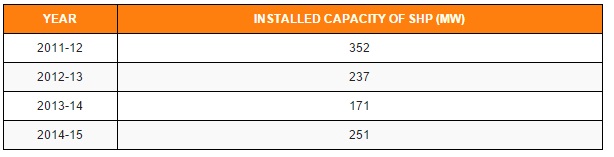
Similar to the above, the ministry says 251 MW capacity in small hydro projects was installed during 2014-15 compared to 171 MW during 2013-14, and terms this a “significant increase”. Once again, goal-posts are shifted and factchecker.in claims that comparable or higher capacities were installed in earlier years. Again, the ministry has staked claim only to a “significant increase” not “highest ever increase” but factchecker.in doesn’t have time for such small facts. To further prove its point, the site produces the following table:

Untitled

And this table further weakens the stand of factchecker.in. If you observe, you will realize capacity added has steadily fallen from 2011-12 to 2013-14. In fact capacity has fallen by 51% from the peak figure of 352 MW in 2011-12. Thus every year, there has been a “significant decrease”. It is only in 2014-15 that this trend is broken and we see an increase. In fact the increase is a whopping 47% as compared to the 2013-14 figure. Not only is this the first increase in 4 years, it is also a “significant increase”. But factchecker.in fails to notice this.

6. Claim by Power Ministry: Four-year record in coal production

Factchecker.in here says, the ministry has claimed that there has been an increase of 32 million tonnes (MT) in 2014-15 taking the output to 494 MT in 2014-15, compared to 462 MT in 2013-14. This the ministry says is an  “increase higher than increase in previous 4 years”.

Here factchecker.in says: “The production figure of 462 MT during 2013-14 does not match data tabled by the current Coal Minister in Parliament on July 17, 2014. That data puts coal production during 2013-14 at 566 MT and not 462 MT. More significantly, coal production of 494 MT in 2014-15 is less than the coal production during each of the previous five years (2009-10 to 2013-14)”

This is the “most egregious fact check” where perhaps out of frustration at not having been able to prove a single fact wrong, wrong facts are being presented. The article confuses the output of Coal India Ltd. (CIL) with the output of Coal Industry and comes out with absurd conclusions. The data tabled by the minister obviously does not tally with the data in the claim, because the data tabled i.e. 566 MT was for”total domestic production” of coal, while the data in the claim i.e. 462 MT is production of Coal India only. This can be easily verified by checking this news article which says Coal India’s production was 462 MT in 2013-14.

Coal India’s production for 2014-15 is indeed 494 MT as evidenced by this report. From such publicly available data, we can tabulate Coal India’s production for 5 years.

YearCoal India Production in MTIncrease
2010-11431.32
2011-12435.844.52
2012-13452.2016.36
2013-14462.4110.21
2014-15494.2331.82

(2010-11, 2011-12, 2012-13, 2013-14, 2014-15)

As you can see from above, the increase for the first 4 years combined is 31.09 MT and the increase in just 1 year from 2013-14 to 2014-15 is 31.82. Thus the ministry’s claim that the 32 MT increase is “higher than increase in previous 4 years” is absolutely correct. Yet factchecker.in arrived at a different conclusion.

Thus all the 6 claims of the ministry which were “debunked” by factchecker.in stand true and the “debunking” done by factchecker.in is found wanting in logic, data and reasoning. The site has done similar exercises on the claims of other ministries too. We will soon analyse the same and see if those rebuttals too are found to be illogical.

Update: This report of factchecker.in was published by Business Standard on 25th July. Today they have published an apology with a rebuttal from the power ministry which is in line with our objections above.

Last day of APJ Abdul Kalam – He went away teaching all of us

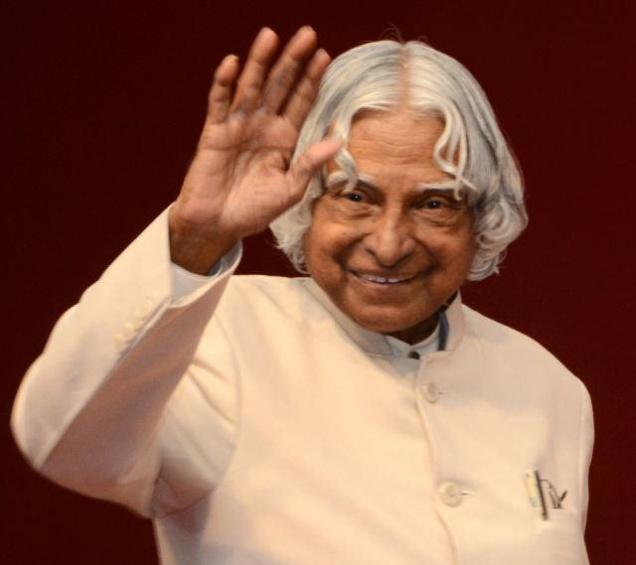
Last night, one of India’s most respected and loved personalities, Former President Dr APJ Abdul Kalam passed away in IIM Shillong. He was there to deliver a lecture on ‘Livable Planet’ but collapsed 5 minutes into his speech. Dr Kalam’s life has been an inspiration to so many Indians. Even on his last day, he exemplified all that he stood for. This is brought out by a Facebook post written by his Advsior and close associate Srijan Pal Singh.

We bring you some excerpts of the same.

Singh describes their long journey to Shillong to deliver a lecture at the IIM, and reveals how a 83 year old man was always passionate and ready to go to far-flung areas in order to speak to young minds. No amount of hardships or ‘fear’ would deter Mr. Kalam from sharing his views with young minds:

Our day, 27th July, began at 12 noon, when we took our seats in the flight to Guwahati. Dr. Kalam was (on seat) 1A and I was (on) IC. He was wearing a dark colored “Kalam suit”, and I started off complimenting, “Nice color!” Little did I know this was going to be the last color I will see on him. Long, 2.5 hours of flying in the monsoon weather. I hate turbulence, and he had mastered over them. Whenever he would see me go cold in shaking plane, he would just pull down the window pane and saw, “Now you don’t see any fear!”. That was followed by another 2.5 hours of car drive to IIM Shillong. For these two legged trip of five hours we talked, discussed and debated. These were amongst hundreds of the long flights and longer drives we have been together over the last six years.

Though focused on his mission, Dr Kalam’s thoughts were also with the brave jawans of India who fought for our safety as there was a terror attack going on in Punjab on the same day. He was also concerned about terrorism as something which could destroy humanity. Although he was known as the “missile man” and journalists like Sagarika Ghose had labelled him “Bomb Daddy“, the man always pined for peace in the world.

First, Dr. Kalam was absolutely worried about the attacks in Punjab. The loss of innocent lives left him filled with sorrow. The topic of lecture at IIM Shillong was Creating a Livable Planet Earth. He related the incident to the topic and said, “it seems the man made forces are as big a threat to the livability of earth as pollution”. We discussed on how, if this trend of violence, pollution and reckless human action continues we will forced to leave earth. “Thirty years, at this rate, maybe”, he said. “You guys must do something about it… it is going to be your future world”

Perhaps this is the last wish of Dr. Kalam – the young Indians have to take control and make sure this earth is a livable and peaceful place.

Kalam was also worried about the way Parliament was not functioning. But his approach was positive – to look out for solutions. But it appears that our politicians had made it tough even for Dr. Kalam. He didn’t have a ready solution.

Our second discussion was more national. For the past two days, Dr. Kalam was worried that time and again Parliament, the supreme institution of democracy, was dysfunctional. He said, “I have seen two different governments in my tenure. I have seen more after that. This disruption just keeps happening. It is not right. I really need to find out a way to ensure that the parliament works on developmental politics.” He then asked me to prepare a surprise assignment question for the students at IIM Shillong, which he would give them only at the end of the lecture. He wanted to them to suggest three innovative ways to make the Parliament more productive and vibrant. Then, after a while he returned on it. “But how can ask them to give solutions if I don’t have any myself”. For the next one hour, we thwarted options after options, who come up with his recommendation over the issue. We wanted to include this discussion in our upcoming book, Advantage India.

Clearly, our politicians can pay a tribute to this great son of India by making the parliament function at least for a week. He wanted to see this. Are our lawmakers listening?

Not sure of our lawmakers, but Kalam surely was watching and listening to everything and everyone around him. In his post, Singh recounts how Kalam couldn’t help but notice ‘discomfort’ being caused to a security person.

Third, was an experience from the beauty of his humility. We were in a convoy of 6-7 cars. Dr. Kalam and I were in the second car. Ahead us was an open gypsy with three soldiers in it. Two of them were sitting on either side and one lean guy was standing atop, holding his gun. One hour into the road journey, Dr. Kalam said, “Why is he standing? He will get tired. This is like punishment. Can you ask a wireless message to given that he may sit?” I had to convince him, he has been probably instructed to keep standing for better security. He did not relent. We tried radio messaging, that did not work. For the next 1.5 hours of the journey, he reminded me thrice to see if I can hand signal him to sit down. Finally, realizing there is little we can do – he told me, “I want to meet him and thank him”. Later, when we landed in IIM Shillong, I went inquiring through security people and got hold of the standing guy. I took him inside and Dr. Kalam greeted him. He shook his hand, said thank you buddy. “Are you tired? Would you like something to eat? I am sorry you had to stand so long because of me”. The young lean guard, draped in black cloth, was surprised at the treatment. He lost words, just said, “Sir, aap ke liye to 6 ghante bhi khade rahenge”.

This episode demonstrated that in spite of being such a highly placed dignitary, he was humble to the core. How many individuals at his level can claim to have similar empathy for people far below them in social ranks?

The Facebook post by Singh also tells us that Dr. Kalam wanted to be remembered as a ‘Teacher’, much before a scientist, a writer, or a former President of India.

Often he would ask me, “You are young, decide what will like to be remembered for?” I kept thinking of new impressive answers, till one day I gave up and resorted to tit-for-tat. I asked him back, “First you tell me, what will you like to be remembered for? President, Scientist, Writer, Missile man, India 2020, Target 3 billion…. What?” I thought I had made the question easier by giving options, but he sprang on me a surprise. “Teacher”, he said.

You are indeed a teacher Sir. Even your last day has taught us much – compassion, concern, positivity, determination, and an indomitable spirit to see India progress and develop.

Keep inspiring sir, and keep igniting our minds.

We, the people of India,
Your students.

Memories of Kargil war from my School Diary

When I was 10 years old, I was admitted to a boarding school – 170 km away from my home, inside decently vegetated and sparsely populated valleys, established in a place which is still more famous for its phonetics and appearances in Vividh Bharti announcements than anything else.

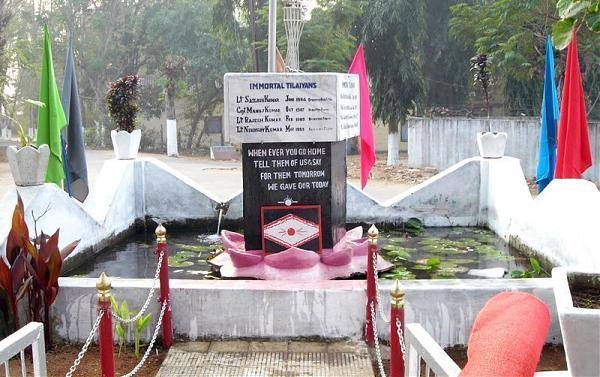
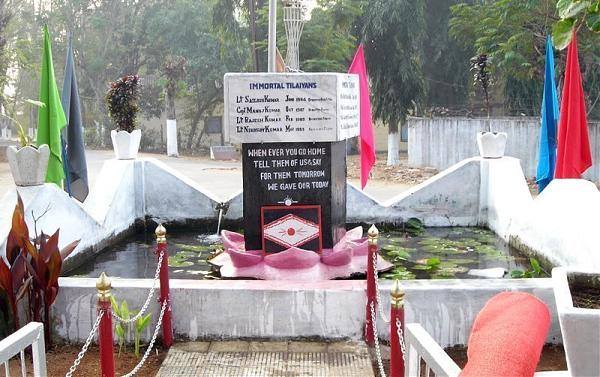
Even now, whenever I think of my school, the first few pictorial flashbacks remain the same as I had when I went on my first school vacation – a huge white gate over which “Sainik School Tilaiya” was written, two small cannons kept beside the gate, a defunct blue-coloured fighter plane inside a park, students running in colourful red, blue, orange, green shirt in the morning in a weird haircut, and a stone in the middle of the school over which was called “Immortal Tilaiyans”.


Immortal Tilaiyans
Immortal Tilaiyans

As a 10 year kid, I could only associate martyrs with essays, history quizzes, movies and songs sung on 15th August or 26th January. I read names of school alumni who died in Operation Blue Star, Operation Pawan and other similar combats. My first reactions after watching the stone were more bookish and pedantic than real.

Every morning, the whole school had to run as unit formations and perform physical training. Subedars from the Indian Army were specially assigned to the school for 2-3 three years to train us. These subedars were people with low emotions; they rarely talked about anything apart from running or sports. After serving for 2-3 years, they were transferred back to borders. We got a funny, but strict subedar when I was in class 7th. I was a super lazy undisciplined kid, so my frequency to encounter him and get punished was high. Even though we were punished by him, we used to joke with him during sports time. My schoolmates kept funny nickname for him which we used to shout during morning run while crossing him.

He was okay with our mass hooting, he knew how to deal with hooliganism. I faintly remember when was he transferred and we got a new subedar as our PT instructor, but I clearly remember returning to school after the vacation of 1999. My friend told be that Subedar ji is killed in Kargil, he was shot in his head.

The next time I passed “Immortal Tilaiyans”, I read it again. It says, “When you go home, tell them of us and say, “For your tomorrow, we gave our today”

PS: This post was published last year on my facebook page, but my sentiments are still the same 🙂

Sreenivasan Jain edits embarrassing portions from Ramdev’s interview

We had written last week how journalist Sreenivasan Jain had gone overboard in defending corruption in his last truth vs hype show. In the same show, he had also made attacks on Baba Ramdev for speaking at IIT Delhi, and for partnering with it on the Unnat Bharat program. Subsequently, he was schooled by Baba Ramdev on twitter, who later invited him for an open debate on science. Jain took up the challenge and decided to interview Baba. But little did he know, he had fallen into a trap.

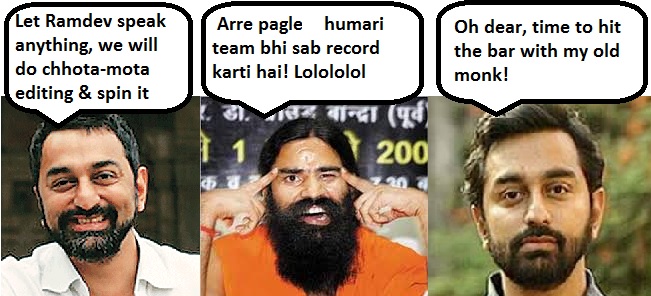
Jain conducted the interview, and then presented a heavily edited, cut and spliced version of the same, after adding his biased spins. But Ramdev Baba had an ace up his sleeve. He had recorded the entire interview separately, and uploaded the full interview, unedited, taken in one shot, on Youtube. Even a NDTV journalist fool would realise Jain has massively distorted Baba’s views by watching both the videos, but we will make it even clearer with a detailed dissection.

The first distortion is in the title itself, which quotes Baba as saying ‘I Am a Scientist Baba’. Fact is, Baba Ramdev never called himself a “scientist”, he only said he is “scientific” in his methods. By purposely changing this small word, Jain tried to create an impression that Ramdev, who is not trained to be a scientist, is calling himself a scientist.

Next, Jain comes to the main question: Many Swamis and other religious institutions, including Ramdev’s Patanjali have been involved with Unnat Bharat and have partnered with IIT. What is the connection of such organizations with rural technology of IITs?

To this question, there are two answers. One, which Sreenivasan Jain showed, after cut-pasting various segments. And second, what Ramdev actually said:

Ramdev’s edited reply as shown by NDTV: Firstly, I am not a spokesman for anybody else. I can speak for myself. Firstly, English media have a misconception that sadhus have no connection with science. (cut) I was born itself in the family of a uneducated farmer. And we have mixed science with Yoga (cut) You were harping on cow, saffron, baba, with a big red circle around the “baba”. I am a frank baba, and scientific baba, and I sleep on the floor, and I have a dream that India should progress.

Edits Explained: The portion after the first cut, was  actually in response to a totally different question, but Sreenivasan Jain deliberately put it here. The part after the second cut, is from the last few minutes of the interview, where Ramdev, after placing all facts, attacked Jain’s blind biases.

What Ramdev actually said: (continued from before the first cut) Ramdev reveals that more than 100 scientists work with him. He had called them for the interview but they did not come. He further said they are working in botany, agriculture, animal industry, food. They are also working on economic measures which will help farmers in the village.

Then Jain says: “So you say you have been working with farmers for quite some time?”. That is when Ramdev said the part about being born in the family of a farmer. Further Ramdev explained that they have worked in thousands of villages, where they increased income of farmers, helped with de-addiction, helped cows which were affected by high urea, thus helping farmers. He also said they are the first in the country to develop a urea-free animal food. He also mentioned the 1000 acre farm they have, where without urea and other chemicals, they have managed to produce 1.5 times to 2 times the normal output, and where the cost is only Rs 4000 per acre, as against the standard Rs 4000 (edit) 12000 per acre.

Why doesn’t Jain show all this? Simple, it will prove that Sreenivasan is a poorly researched liar masquerading as a journalist with facts. Ramdev completely exposes Jain’s ignorance about his work, which is exactly the “rural technology” which is needed for a scheme like Unnat Bharat.

Next in Sreenivasan’s deliberately edited video, he abruptly says “but what has this got to do with IIT?”, once again omitting some portion before this sentence. Before this sentence, Ramdev says he has started the world’s biggest herbal food park, and made it a profitable venture. He further elaborates that it generates direct employment for over 1 lakh people. Again, an achievement of Ramdev in the field of “Rural technology” which embarrassed Jain and hence was not shown.

Later, Jain asks some political questions. And this is where NDTV’s editor should win an Oscar for editing because the sheer skulduggery employed by Sreenivasan Jain here is unbelievable. Mind you, Jain is the same guy who won “Journalist of the year award” recently, so you can imagine the deplorable levels of journalism in India, if a first grade liar gets this award. First, let us see what actually happened, as per the unedited interview:

1. (Jain Question 1): The state of farmers is quite poor, other people are also troubled, Modi Government has completed one year, are you satisfied with the running of the Government?

2. (Ramdev Answer 1):  Modi has started well, some of his schemes may take 1, 2 or 5 years to show results. He is involved in nation-building programmes, not vote-bank building programmes. He wants to take India ahead, and is trying with honesty and hard-work. He works for 18-20 hours a day. But he must also start work which creates vote-banks (i.e. for the backward and downtrodden people).

3. (Jain Question 2): Vyapam has come forward, Vasundhara Raje’s and Sushma Swaraj’s issues have come, many Maharashtra Government ministers are accused of scandals. Don’t you think BJP’s image is changing because of these scams, and Modi is silent on all of this?

4. (Ramdev Answer 2): I had supported Modi. You can see my tapes from before, I have said, without Modi, BJP is nothing. I am not a BJP spokesperson, I am self made, I am not BJP’s baba. (Now Sreenivasan Jain probes baba repeatedly, and asks him to comment on Modi’s silence. Ramdev avoids for a long time, and finally replies) From my side, no comments. We should comment, only when the matter is more clear. Scams should not happen, and scamsters are the enemies of the entire country. Till things are not clear, making premature statements is not correct. I don’t want to get into a new controversy.

Now what award-winning journalist Sreenivasan Jain does is, shows his first question, and then shows Ramdev’s second answer! He completely deletes the first answer which was on how Modi’s Government has performed, and instead shows the answer which relates to the various scams. This is the depth Sreenivasan Jain goes to perpetuate his propaganda and save himself after he has been thoroughly exposed. Maybe he did so because there was no chance of “hitting the bar” with Ramdev.

Jain also omitted another part of the interview, where Ramdev schooled him again

“I have been to IIM also and many IITs are calling me even now, but I haven’t been able to give them time. I have been to AIIMS also, that too during UPA time, on the invitation of Ghulam Nabi Azad, and the doctors there who heard me said that they got to learn somethings from me. I agree many babas have many scams, but such people are present in media, in politics, hence people should think before making statements.”

Sreenivasan Jain, has been regularly exposed by us, his hilarious show on Jan Dhan Yojana, and his brazen defence of the corrupt. But it is a shame that such fraudulent journalists still command prime-time shows in India.

Why Criminal Defamation, a relic of colonial era, must go

0

The timeless wisdom of the ancient Indian mantra Satyameva Jayate found  in Mundaka Upanishad and meaning “Truth Alone Triumphs” was adopted as the National Motto of India. But truth is often unpalatable to those in power and thus a decision was taken to retain S.499, S.500 of the Macaulay Code to control natives, also known as Indian Penal Code, 1860. These sections on Criminal Defamation enacted in year 1860, penalise even “Truth” unless it is in “Public Good” whatever that imprecise, vague, pro-British colonial/Government policy term may mean. The aim of English masters to fetter truth by “Public Good” was to completely restrict freedom of speech as anything critical of the Imperial British power.

The purpose of not following the national motto in criminal law, even after independence is simple, it is done to restrict free speech, as a person even though he may speak the truth, he may still have to face a criminal trial to prove  his truthful statement was in “Public Good” or “Good Faith”. During such a trial the person will be referred to as accused with all its resultant stigma, quite apart from the hardship and expenses of criminal trial, and thus citizens knowing the consequences, will prudently decide not to speak freely.

Comparisons are odious, yet oddly informative. It makes a stark study in contrast to observe how politicians enacted constitutional amendments in the USA and India after coming to power. The First Amendment to the Constitution of the US, states- “Congress shall make no law abridging the freedom of speech, or of the press”. Thus by the first amendment, the Government recognized the fundamental right of citizens to free speech and that no law shall abridge it. In India unfortunately the First Amendment to Constitution did the opposite, it severely restricted right to free speech recognized by Article 19 (1) (a) by adding Article 19(2) which retained the existing law i.e. Criminal Defamation and also gave further power to make laws to restrict Free Speech on various grounds.

Thus while American Government after coming to power gave Free Speech rights, by its first amendment, The Indian Government by its very first amendment, decided to restrict Freedom of Speech. In these first amendments lies the destiny of citizenry right to free speech.

This tendency in Indian Politicians to suppress the voice of people after assuming power was not restricted to the past, it is alive even now as was evidenced from recent circular of AAP Government to file Criminal Defamation cases, to supress voices and scare people from sharing opinion. It was stayed by the Hon’ble Supreme Court, which took a dim view of the hypocrisy of the situation where on one hand Chief Minister Arvind Kejriwal took shelter under Dr Subramanian Swamy’s petition to quash Criminal Defamation law and on other hand issued a circular to file Criminal Defamation cases on others. Later AAP Government withdrew the circular, though this writer will not be surprised if in case the Supreme Court does not strike down the law, such a circular may be issued again.

The Hon’ble Supreme Court in recent years has usually given a liberal interpretation to the fundamental rights of citizens. This was necessary to curb the Government’s desire to restrict peoples’ right and control them. By the first amendment which brought Art 19 (2) into the Constitution, the Government got power to restrict freedom of speech. The language of Art 19(2) had term “reasonable restrictions….on freedom of Speech”, The court considered the phrase “reasonable restrictions” which prefaces Government powers in Article 19 (2) to make laws to restrict speech to be of importance, and has interpreted it to mean that the law has to be “reasonable”. Many jurisdictions consider laws restricting basic freedoms reasonable only if they  do not unduly restrict the freedom sought to be restricted. Such “restrictions” have direct nexus with an important aim sought to be achieved and other effective alternatives are not available.

Further as Criminal Defamation has penal consequences it’s important to keep in mind that under Article 21 “Protection of life and personal liberty”- No person shall be deprived of his life or personal liberty except according to procedure established by law. The word ”law” used in Article 21 is of utmost importance as Supreme Court has interpreted it to mean law which is “Just, Fair and Reasonable” and not any arbitrary or capricious law.

Based on above parameters of interpretation of fundamental rights as evolved by SC S.499 has to be declared unconstitutional on various grounds amongst which some in brief are-

1) Any law in which a person can be sent to jail even though he spoke only the truth is not Just, Fair or Reasonable and violates Fundamental Rights

2) Sarcasm, Irony can also be defamation. The very purpose of sarcasm, irony is often exaggeration to highlight a point, frequently used by cartoonist, comedians and various people in public life. To consider it defamation will have “Chilling Effect” on public debate vital in a democracy.

3) S.499 criminalizes making imputations against a company or association, e.g. of doing corruption, environmental damage, malpractices etc. Thus for allegedly harming reputation of a financial/legal entity by words, a person can be sent to jail, which is violative of Art 19, 21 as recourse to financial loss of reputation for a company cannot be jail for a human being. It can only be civil damages.

Beyond this there are various other grounds including International Treaties, S 199(2) of CRPC, and arguments on interplay of fundamental rights which have been taken up in Supreme Court but due to space constraints not being set out here.

In western countries including America, laws have been passed restricting even civil suits of damages as they were being used by rich, powerful, influential individuals and corporations to stifle free speech by bringing – Strategic Lawsuit Against Public Participation called (SLAPP). Under this type of legal action the aim is to  frighten and silence critics due to costs of mounting a legal defence by them. This goes on until the defendant decides to abandon criticism or opposition and thus restricts their right to free speech.

In India unfortunately mere speech without any physical action still has criminal consequences and can land you in jail. In order for citizens to regain freedom including of speech for which freedom fighters fought, which the Constituent Assembly recognized, which was enshrined in the original Constitution and which was taken away by the very first amendment it is essential that the challenge mounted in the Supreme Court in Subramanian Swamy Vs Union of India succeeds.

By- Ishkaran Singh Bhandari

Disclaimer- Author of this article is assisting Dr Subramanian Swamy in the Constitutional Challenge to abolish Criminal Defamation. The opinions expressed within this article are the personal opinions of the author. OpIndia.com is not responsible for the accuracy, completeness, suitability, or validity of any information on this article. All information is provided on an as-is basis. The information, facts or opinions appearing in the article do not reflect the views of OpIndia.com and OpIndia.com does not assume any responsibility or liability for the same.

Sreenivasan Jain: In defence of the corrupt

0

Sreenivasan Jain has made a transition from his traditional role of asking tough questions to people accused in various scams and scandals to defending such individuals using dubious means. We had shown earlier how Sreenivasan Jain had joined the Adarsh Liberal clique of journalists and formed a “Teesta Defence League”.

Through his tweets Jain questioned the raids on Teesta and asked “why this heavy hand” was used in dealing with Teesta’s “financial impropriety”, as if financial impropriety is some chhota- mota bomb blast which needs to be ignored. Sreenivasan Jain perhaps doesn’t know that raids are one of the most common forms of tackling financial crimes, as Income Tax Department regularly carries out on tax evaders.

Next, Jain asked for examples of CBI raids on NGOs, hoping that no such examples would come up and he can easily cry “Teesta is being victimized”:


Smart Trolls swung in to action yet again, and showed him the Truth hidden in his Hype. This report from 2013 says 24 cases of NGOs suspected of flouting FCRA norms were referred to the CBI. This report from 2012 says 12 NGOs were under the CBI scanner for FCRA violations. If Jain himself admits that there could have been “financial impropriety” why does he want Teesta to get special treatment, when in the past numerous NGOs facing similar charges were under CBI investigation? And if Teesta is in fact completely innocent, why this reaction to a probe? Why is Jain so desperate to protect a person accused of corruption?

Further, in his latest episode of Truth vs Hype, Jain moves to another person accused of “financial impropriety”. He goes to NCERT, where the Director, Parvin Sinclair, resigned from her post halfway into her tenure over alleged financial irregularities. It is a convenient case for him because her Christian surname juxtaposed against Saffronization claims is easy propaganda material.

In May 2012, under the non-victimizing, non-saffron UPA Government, the Central Vigilance Commission (CVC) recommended an inquiry against Sinclair based on allegations of irregularities in the purchase of paper worth Rs 50 crores. Outlook, at that time had reported that from the audit reports it had accessed it was evident that although rules said the paper needs to be tested before procurement, Sinclair had begun the process of allocating contracts before receiving the test reports itself. As the investigation went on, Sinclair put her side across, but the CVC wasn’t satisfied. Since then, the issue had remained pending with the ministry without any action being taken.

In any other circumstance, a neutral reporter would ask why the Government is sitting on a case of corruption and not taking any decision. But Sreenivasan Jain chose a different path. He tried to whitewash this scam, by glossing over some selected facts, and straight away asked Sinclair her version. She said to him:

“If I remember correctly and you will have to check the files, it was done simultaneously (with the placing of order)”

There you have it. The Director of NCERT herself admits that she began allocating contracts “simultaneously” even when the paper was being tested. Can anyone place an order for a product even when the product is not certified to be of standard quality?  Do you normally go to a clothes shop and purchase a shirt even when you are trying it on? A neutral journalist would have picked up this immediately, but Sreenivasan Jain did not.

Secondly, she just relies on her memory, does not even try to say confidently that she had not broken rules, nor does she provide any documentary evidence. Even Jain never insists on any such evidence. If indeed she had a water-tight case, and Jain knew this, both of them would have made sure they present this to the public, to make it clear that Sinclair was victimized. But both of them did not go down this road and this is revealing.

Well maybe for Jain, these were “chhota-mota” aberrations and he gave her a clean chit. He further says that the first topic HRD Minister Smrit Irani brought up in her meeting with the NCERT, was of this pending allegation. Instead of lauding a minister for taking action on a case of corruption, which was pending for unknown reasons with the ministry, Jain raises suspicion as to why this was the first topic. Hilarious.

Jain then goes on to suggest that Sinclair might have been removed because the NCERT had almost finished revising the curriculum, and that was not ideologically acceptable to the Government. But, he himself unknowingly punctures this argument saying that the curriculum revision was halted because the formulation of the New Education Policy, with NCERT and wide-spread consultations was already under way, after 30 long years. Lastly, Jain digresses and says the original complaint was filed by Right Winger Dinanath Batra. Were Audit Reports saying Sinclair flouted rules also written by Batra?

In his Truth vs Hype show, Jain also talks about the resignation of IIT Delhi’s director Shevgaonkar, and again links it with Government Interference etc but never mentions that Shevgaonkar, who is rumoured to have written speeches for Rahul Gandhi, oversaw the signing of an MoU to set up an overseas campus of IIT Delhi, which was in complete violation of the IIT Act.

Similarly he talks about the rejig of the council at ICHR, claiming leftists have been shunted out. But he fails to mention the irregularities at ICHR, under the earlier “leftist” councils, where crores of rupees were spent over a 9 volume book project which was started 26 years ago and is still going on. He also does not mention that people like Purabi Roy, a renowned scholar and historian who also happens to be the wife of a CPI MP in the Rajya Sabha, continue to be in the ICHR, along with UPA appointees like  Sachidananda Sahai.

Thus over the past week or so, Sreenivasan Jain has been ultra defensive about Teesta Setalvad, who accepted illegal donations of $ 2.9 lakhs, has belittled a CVC probe into financial irregularities at NCERT, and ignored legal issues at IIT Delhi and ICHR, only to support his coterie and to claim the Government is either vindictive or interfering with institutions.

It is only in Indian Mainstream media that we see journalists baying for the head of ministers for giving an NOC to a person accused of a financial scam, to meet his (edit) ailing wife, and the same journalists later defending and belittling the crimes of other people accused of financial impropriety with impunity.

Firstpost declares Bajrangi Bhaijaan communal because Salman says Jai Shri Ram, and not Khudahafiz

0

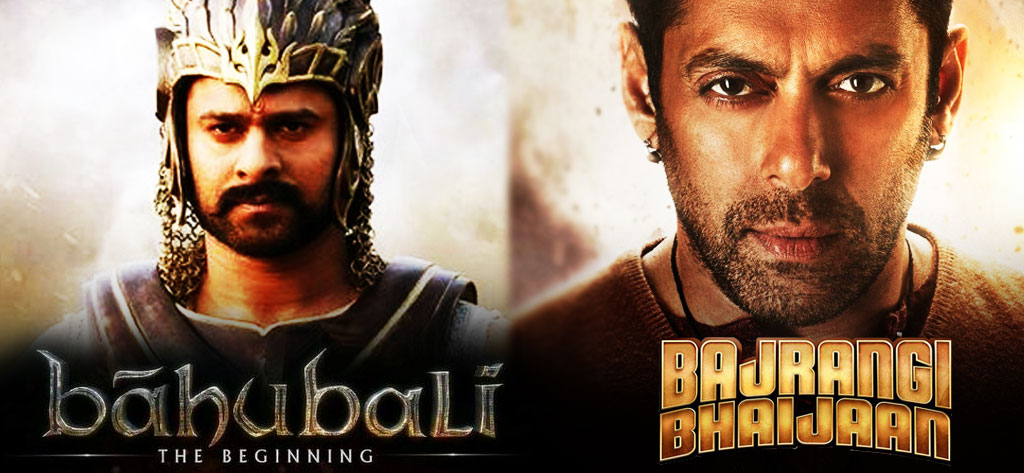
A few days back, I along with my office colleagues went to watch the Telugu version of ‘Baahubali’. None of the screens in Hyderabad was running the Hindi dubbed print, so in spite being a non-Telugu majority, out exuberant team decided to watch the Telugu version. We, fortunately, had a Telugu speaking colleague with us who not only tolerated our homonyms, but also translated the movie to us at regular intervals. We consumed popcorns, slurped cold-drinks, enjoyed our puns and returned with minds relieved of the office stress. Baahubali has a very average script with sets incongruently changing in different parts of the movie, but it was certainly a visual delight. SS. Rajamouli has successfully established a grandeur which can inspire many cinema makers who create period movies.

The earning stats of Baahubali were very exciting, so after returning home, I glanced through movie review on the internet. Sadly, my excitement to read about Baahubali soon changed into frustration after reading a few articles. In an absurd vindictive article ‘SS Rajamouli’s Baahubali now has a religion and it is decidedly Hindu‘ published on FirstPost, the vitriol filled editor picked some random tweets, plugged-in some muddled references of Mohammad Rafi and Naushad.  In fact, by the time I finished the ‘movie’ article, I was confused whether Sandipan Sharma wrote a report, preached sermons, spread hatred or wrote a Hindutva article in haste.

It has become a fashion among left-liberals to smother movie reviews with words like “Saffronization of Cinema”, “Hindutva” and “Indian Male”. Within 2 days, another bigoted editor of First Post, Deepanjana Pal, wrote an insidious piece on ‘Bajrangi Bhaijaan’. Deepanjana is so full of loath that she got distressed to see people enjoying the movie, and concluded it as a message from RSS and Hindutva brigade. The writer appears ridiculously pitiable in the sections where she tried to scratch the past present and future of Bollywood. She exposes her stupidity and naiveté when she writes:

It’s almost as though Bollywood is subtly sticking its tongue out to those who want to censor Indian culture and popular entertainment. If all the right-wing wants are paeans to its awesomeness, Bollywood will deliver with heroes like Pavan and Prem, who get the girl and the audience’s sympathies, who are undeniably heroic; but who are equally undeniably, absolute idiots.

Either Deepanjana watched her first Bollywood masala movie, or she is an idiot of such an order that after watching a routine masala movie, she generalized the movie as a message:

The message is clear: the women of North India are suckers for pecs and abs, and the shakha produces men who are studly, loyal and idiots. Eid Mubarak, bhakts.

In her concluding paragraphs, Deepanjana spews out all her mask-hidden communal bile. After writing “Bhakts”, “Hindutva” and “Jai Shri Ram” for multiple times, she writes, “The India of Bajrangi Bhaijaan isn’t a multi-cultural, secular nation.” Her deep-seeded hatred, class based mindset and bias against Hindus speaking “Jai Shri Ram” is quite evident in the whole article, but what disturbed me the most was her malicious attempt to create rift between Muslims and Hindus. I unfollowed FirstPost on twitter after reading this thrice:

After a moulvi helps Pavan out of a tricky situation, he says, “Khudahafiz” to Pavan. Pavan is thankful, but he has no words to wish the moulvi a safe journey as the moulvi returns to a potentially dangerous situation. Because hello, Pavan is Hindu. He can’t say “khudahafiz” back even though that’s exactly what he wants to say. Maybe “Hanumanhafiz”…?

Such articles are nothing, but mirror images of views of opportunists in VHP, Bajrang Dal, etc., who can only see politics and religion in a movie.

Survey reveals 80% people dissatisfied with the quality of mainstream media in India

0

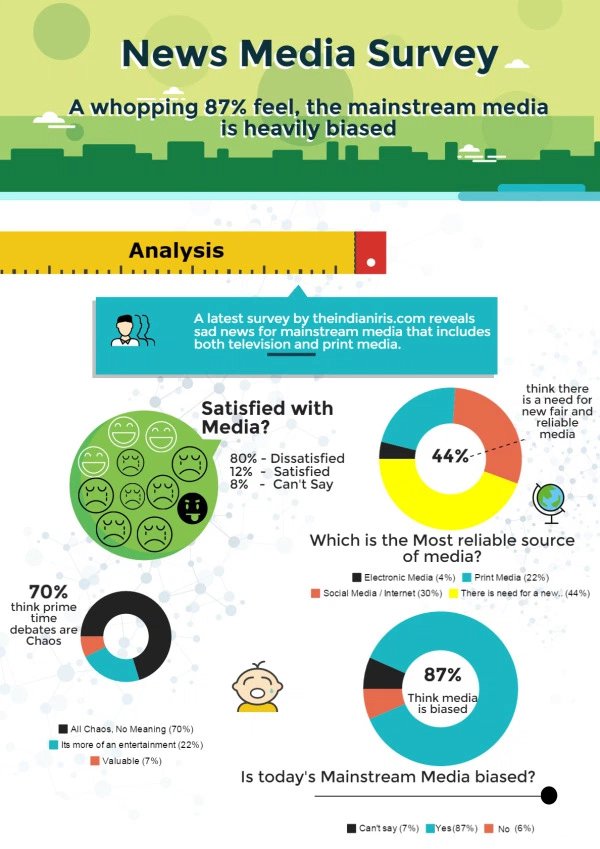
A latest survey has revealed sad news for mainstream media that includes both television and print media. The survey sought responses on a range of questions to gauge the perception of mainstream media. The survey was conducted by The Indian Iris,  a group of individuals from IIT, IIM A/B, Univ of Southern California, professional from top firms, and authors include research fellows from IIMs, XLRI etc. It was conducted both online (email and Facebook) and offline among over 500 respondents, mostly in the age range of 18-40 years.

When asked if they were satisfied with the quality of news produced by today’s mainstream media, a whopping 80% said that they are dissatisfied. Only 12% were satisfied, whereas the remaining 8% were undecided.

When asked if they thought that today’s mainstream media was fair or unbiased, the responses are even more startling. A vast majority of 87% thought that today’s mainstream media was heavily biased. Only 7% believe that the mainstream media is fair, and the remaining 6% are undecided.

In terms of utility and value, over 70% found the prime time debates on news channels to be more of a chaos without any meaning. Only about 7% people found some value in these debates, whereas 23% found these debates more of an entertainment show than anything else.

When asked which media they thought was the most reliable, 44%, a majority of the respondents, called for a new fair and reliable media outlet. 30% see Social Media/Internet a more reliable source of news compared to the print and the electronic media.

Electronic media seems to have completely lost the trust of people, whereas print media is still reliable with 22% people finding it that way. Shockingly, only 4% of the surveyed people found the Electronic Media reliable. It’s time that the Electronic Media do some introspection on why the trust has eroded to such an extent.

The survey also asked respondents to comment on their expectations from the future media. People put forward variety of ideas and concerns.

The first and the foremost, fairness and transparency are what they expect from the media. Media, considered the fourth pillar of democracy should honestly play its role. They should not propagate a specific political or business interest. Many people mentioned that media should be corruption free. They need to come out of their current image of being ‘news traders’. They must present facts without fabrication. Over sensationalization may also be killing the trust in the news channels, many felt.

Survey Results Infographic

Two recent examples shall shed more light on the issues plaguing our fourth pillar of the media today. The first is pertaining to the controversies surrounding Lalit Modi, and Rajasthan CM Vasundhara Raje. Barring a few media channels, all news channels were running live commentaries, organising prime time debates and arranging special interviews until a few pictures of Robert Vadra, Priyanka, and Rahul Gandhi surfaced on social media. This now raises serious questions on the credibility of media as to how it got silenced so quickly. Noted writer Tavleen Singh did write a detailed article commenting media’s dubious role in raising and then silencing the issue.

The second example is the death of a four year old child in a road accident involving erstwhile dream girl turned MP, Hema Malini. This too raises serious questions on how media prioritizes its news. While full attention was given to the head injuries of the MP, death of the child was largely ignored by the media in the quest of TRP. A quick Google image search on this news clearly shows how much attention was given to the death of the poor child compared to the head injuries of Hema Malini.

There are countless other examples of how Media has failed to fulfill its duties as the fourth pillar of democracy. The Internet is providing power to the people and social media has emerged as a new source of information. However, the gullible and the young may not be able to discern between real news and propaganda running on the social media. This calls for a fair and reliable source of information which objective and backed by data. It’s time that the mainstream media revisit its key role in our democracy.

Author, Narayan Singh Rao, is co-founder at www.theindianiris.com and an IIT- IIM alumnus and can be reached at [email protected]