I am not a cinema expert. I am not a cinema intellectual who can comment on nitty-gritty and punctuations of cinema. I am just a normal cinema viewer who takes out some time for out of ordinary office life to watch a few movies.
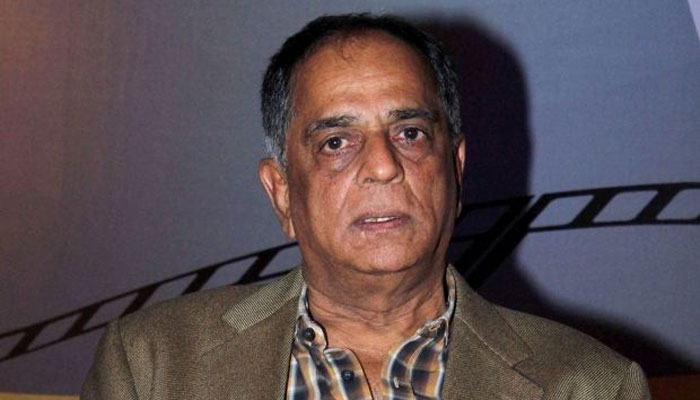
Last month, OpIndia.com team discussed the members of previous Censor Board – Leela Samson, Ira Bhaskar and Anjum Rajabali. A new Board was elected under the chairmanship of Pahlaj Nihalani.
After Leela Samson was targeted for her partisan behavior and connections with Congress, it was expected that Pahlaj Nihalani will not only be targeted, but also be used as a conduit to attack the government. And Pahlaj Nihalani didn’t disappoint his rivals.
To be very honest, I would not comment on films done by Pahlaj Nihalani because personally I feel that those are not even discussion worthy. I am more bothered about his recent statements, interviews and opinions.
Pahlaj Nihalani
A few days after being inducted in the Central Board of Film Certification (CBFC) Board, Pahlaj sent a list of cuss-word which will be banned by Censor Board. Even the government conveyed a displeasure with the list; On February 25, Anurag Kashyap met I&B minister Rajyavardhan Singh Rathore, and after the meeting, he expressed satisfaction with the proceedings. However, the harm was done.
While official statements given by Pahlaj Nihalani are spreading sense of despair, his interviews are putting many questions on the current Censor Board. Pahlaj Nihalani shot a self-targeting missile when he targeted Sharmila Tagore for passing films like Omkara and Gangs of Wasseypur. The so-called cinema stalwart probably went with an abuse-detector, closed his eyes, put fingers inside his ears, counted the number of times the abuse-detector beeped after the movie, and concluded his wisdom.
In an interview to Dipti Nagpaul, The Indian Express, when Pahlaj Nihalani was asked his idea of a good film, he said, “One that can be viewed with the family, the focus should be on the story, the emotions and dialogues, not the craft”, he also added, “like my film Aankhen, a good film should either entertain or impart values.”
I will not comment on Aankhen, because I have already said that I don’t find his movie discussion worthy, but the Panchtantra-motivated-values-seeking Censor Board chief shocked me with his inept single dimension judgment of “good” cinema. Cinema has evolved from the trivial definition of “mirror of society” to expression of anything which can be imagined with creativity and skills, but Pahlaj Nihalani is still sauntering in the cultural lanes created by Sooraj Barjatya where everyone, including dog and cats, are happy family members. Mr. Nihalani is supported by team members like Ashoke Pandit, who boasts about intellect required to head a cultural board: “An official from the railways board cannot head a cultural institution”, but declares AIB as a porn show.
I feel bad for art and cinema in India. Cinema is not engineering in which screws and bolts need to be fixed in particular order and SOPs (Standard Operating Procedures) have to be followed. Cinema spans infinite possibilities of expressions. International cinema is Neorealism, Nouvelle Vague, La Nouvelle Vague, and India, where Parallel Cinema movement started in 1950, is regressing to the happy-ending-high-moral format. As earlier mentioned by bwoyblunder, “We don’t need preachers or priests in the Censor board, to uphold whatever their idea of “Indian Culture” is, but we need artists, who can understand what another artist is trying to convey. The board must respect the Freedom of Expression of an artist, and must allow it within the realms of the law. Wherever there is a law (like Section 294) which can be misused, the Censor board should take a progressive stance. We don’t need shackles, just guidelines.”
Pahlaj Nihalani is an easy target for the media. He will be regularly targeted for his views on religion, sex, violence and ethos in cinema. Sadly, more than anything else, cinema will suffer. Chandra Prakash Dwivedi, who is also a part of the Censor Board, is much mature and logical than Pahlaj Nihalani or Ashoke Pandit. His interviews and statements inject hope and positivity. It would be better for cinema and the image of Censor Board if he is appointed as the chief of Censor Board.
It’s still not very clear exactly what has been banned in Maharashtra i.e. whether its the slaughter of calves, bulls, bullocks etc. Some news reports suggest only Bullocks may be up for slaughter now. This has already been linked to “Hindutva” and “Brahminical” tendencies by some of the usual suspects:
#BeefBan isn’t about preventing cruelty to animals, it’s about imposing Brahminical culture on all. 1/n
But, we do know what is already banned in other states of India. States like Punjab, Haryana, Himachal Pradesh and even Jammu & Kashmir have a blanket ban of ANY type of bovine slaughter. Are these states, especially Jammu & Kashmir prone to “Hindutva” or “Brahminical” forces? Also, most of the acts are in force for a long time. While the merits of such a ban are debatable, it is surely a bit hypocritical to make this a religious or casteist debate.
Prohibition of cow slaughter is a Directive Principles of State Policy contained in Article 48 of the Constitution. It reads, “The State shall endeavour to organise agriculture and animal husbandry on modern and scientific lines and shall, in particular, take steps for preserving and improving the breeds, and prohibiting the slaughter of cows and calves and other milch and draught cattle”. Any attempt to give it a communal angle is not sustainable. Also, Even Mahatma Gandhi, was against Cow Slaughter. Someone should remind this to Mr Tushar Gandhi, who is the great-grand son of Mahatma Gandhi:
Beef Ban in Maharashtra is anti Dalit, Christians and Muslims.
Voluntary slaughter of any bovine animal such as ox, bull, cow or calf
THE RANBIR PENAL CODE, 1932
DELHI
Buffalo
Slaughter of all agricultural cattle is totally prohibited.
THE DELHI AGRICULTURAL CATTLE PRESERVATION ACT, 1994
HARYANA
NONE
Slaughter of cow (and its progeny) totally prohibited.
THE PUNJAB PROHIBITION OF COW SLAUGHTER ACT, 1955
HIMACHAL PRADESH
NONE
Slaughter of cow (and its progeny) totally prohibited.
THE PUNJAB PROHIBITION OF COW SLAUGHTER ACT, 1955
PUNJAB
NONE
Slaughter of cow (and its progeny) totally prohibited.
THE PUNJAB PROHIBITION OF COW SLAUGHTER ACT, 1955
RAJASTHAN
NONE
All bovine animals (includes cow, calf, heifer, bull or bullocks)
THE RAJASTHAN BOVINE ANIMAL (PROHIBITION OF SLAUGHTER AND REGULATION OF TEMPORARY MIGRATION OR EXPORT) ACT, 1995
ASSAM
Slaughter of all cattle allowed on ‘fit-for-slaughter’ certificate
Slaughter of any cattle without ‘fit-for-slaughter’ certificate
THE ASSAM CATTLE PRESERVATION ACT, 1950
BIHAR
Slaughter of bull or bullock of over 15 years of age or has become permanently incapacitated for work or breeding due to injury, deformity or any incurable disease.
Slaughter of cow and calf, Bulls or bullocks totally prohibited except as stated previously
THE BIHAR PRESERVATION AND IMPROVEMENT OF ANIMALS ACT, 1955
GUJARAT
Slaughter of buffaloes permitted on certain conditions
Slaughter of cow, calf, bull or bullock totally prohibited.
THE BOMBAY ANIMAL PRESERVATION ACT, 1954 (APPLIED TO GUJARAT )
ORISSA
Slaughter of bull, bullock on fit-for-slaughter certificate
Slaughter of cow totally prohibited.
THE ORISSA PREVENTION OF COW SLAUGHTER ACT, 1960
UTTAR PRADESH
Slaughter of bull or bullock permitted on ‘fit-for-slaughter’ certificate
Slaughter of cow totally prohibited.
THE UTTAR PRADESH PREVENTION OF COW SLAUGHTER ACT, 1955
GOA
Cow, only if the animal is suffering pain or contagious disease or for medical research. Bulls, Bullocks on on obtaining a "fit-for-slaughter" certificate
Any other Cow
THE GOA ANIMAL PRESERVATION ACT, 1995 & The Goa, Daman & Diu Prevention of Cow Slaughter Act, 1978
Electoral defeats often lead to splintering of a party into various groups who blame each other for various debacles. But in AAP, we have a party which has registered an astounding victory, and is still battling with inner-party differences. Is it because the problems are too deep-seated for even a landslide win to wipe out? Prashant Bhushan in his letter, has made the following allegations:
1. Transparency and Accountability
AAP has not put their accounts online, only put donations, not expenses. This is against the stand of transparency taken by AAP
Neither Decisions nor Minutes of meetings of the National Executive (NE) nor of the PAC are available on the website
Minutes of such meetings are not even maintained
Although as per AAP’s constitution candidates are to be approved by PAC, in Delhi, not even bio-datas of the candidates were shared with PAC and such selection was done by the DECG (Delhi Elections Campaign Group)
Even till November 2014, attempts were made by AAP to seek Congress support in Delhi, in violation of the decisions taken at the National Executive earlier
Several decisions of the National Disciplinary Committee have not been implemented
The NE and PAC do not meet regularly and members are not informed of the meetings if any
The NE and PAC lack both regional and gender balance
2. Inner Party Democracy and Swaraj
List of members/volunteers has not been prepared till date and hence no elections have ever taken place.
Volunteer meetings in Delhi were a free for all where anybody could walk in
When people raised objections to “importing of candidates from BJP and Congress”, they were “silenced brutally”
Candidates were allowed to contest even after they were found illegally storing liquor and openly declaring on video that its OK to lure voters
One candidate was made a fall guy for putting up communally sensitive posters
Kejriwal over-ruled the NE’s decision to allow various State Units to contest state elections thus making a “mockery of the principles of democracy and Swaraj”
One person centric campaign in Delhi is against the principles of Swaraj and leads to a “supremo controlled party”
3. Policies of the Party
Reports of 30 Expert Committees and over a 100 experts, on policies of the party have been ignored for 2 years
This results in Volunteers and Spokespersons often not knowing how to react to important issues
4. Funds of the Party
There is no systematic planning of how huge donations received are to be spent
Money is spent arbitrarily by unauthorized people due to the lack of empowered committee or decision-making system
Some volunteers are paid but vast majority of them are unpaid
5. Unethical means and practices
Karan Singh was expelled from the party on the basis of fraudulent SMSs under the name of AAVAAM and Singh’s pleas for investigation were ignored
Eventually by Police Investigation it was known that Deepak Chowdhary (who had nothing to do with AVAM) had fraudulently sent the SMS, yet no action was taken against him
A communal poster was put up by the party, and Amanatullah (now MLA) was forced to take the blame
Warning: I would like to state at the outset that I am not an economist by training and don’t have the slightest pretense of being one. Readers are more than welcome to post constructive criticism in the comments section.
The Modi Sarkaar was elected with much fanfare in 2014 on the promise of a complete overhaul of the status-quo and stem the fiscal stagnation that had set in during the last days of UPA-2. The buzzword among the business community was ‘big-bang’ reforms which would unleash the nascent growth potential unlike never before. In that respect, finance minister Jaitley’s first full budget didn’t quite live up to the dramatic hype, but it was far from a damp squib. First and foremost, the FM should be congratulated for not getting carried away by the election victory in 2014, the extreme expectations of the investor community post that victory, and most importantly, the recent electoral drubbing in Delhi. The budget (which includes Suresh Prabhu’s rail budget too) bears the quintessential hallmark of the Modi Govt so far, that of balancing economic pragmatism and deriving tangible and achievable solutions for existing problems.
The major takeaway was the reduction of corporate taxes from 30% to 25%. This was a brave step to take for the FM in this internet age, where the default position of a large fraction of the chattering class is to hypocritically be opposed to anything corporate. The 30% rate was among some of the highest in Asia, and also higher when compared to the average corporate tax rate in the world.
This “reduction” will be copled with removal of exemptions enjoyed by Corporates. These exemptions are often matter of litigation and removing them will boost confidence in Tax regime. This move is sure to boost growth over the next few years, more so considering that FM Jaitley has managed to boost investor sentiment by keeping the fiscal deficit within target for this year (2014-2015), though admittedly the 3 percent target has been pushed forward by an year (2017-2018).
The 70,000 crore increase in infrastructure investment, backed by Suresh Prabhu’s commitment to fulfill existing rail projects, will aid in India becoming a very attractive investment destination in the next few years. All of this will translate into more jobs, a key requirement for poverty alleviation as it’s impossible for agriculture and Government projects to provide most of the employment, particularly in the manufacturing and service sector.
Despite the naysayers, the BJP Government has also shown far more commitment in stemming black money than any Government before and this has already resulted in a sizeable sum of money recovered by the Government. (). This was also reflected in the budget where Mr. Jaitely has promised tougher anti black money measures. It is of course possible that the law could merely be a paper tiger, but the success or failure of this law can only be known after a few years.
Mr. Jaitley has also shown that he is willing to empower the states, indeed at the expense of the centre, in order to consolidate federalism and improve the delivery of welfare schemes. This does come with its share of pros and cons, but broadly speaking, competitive federalism fueled by large intra-state migration, would necessitate that state Governments would have to be more alert than before to the needs of their citizens and not depend excessively on special packages from the centre.
The NDA Government has long been considered by its opponents as being too pro-corporate and too anti-poor. Thus, it was unlikely that even from a pessimistic, political angle, welfare schemes would have seen a drastic cut in this budget. Indeed, Mr. Jaitley increased the MNREGA budget by 5000 crores, despite PM Modi tearing into the UPA’s pet scheme just a day earlier . This might seem a bit counter-intuitive, but it is clear that the Government does not want to completely abolish MNREGA, but streamline and make it more efficient (coupled with the Jan Dhan Yojna) which if executed properly, would actually result in sustainable asset creation for the Indian state.
The long-term vision of a universal social security system is also a very good one, the success of which of course will depend a lot on the Jan Dhan Yojna and the Aadhar card. The other steps taken by Mr. Jaitley such as complete exemption for Swachch Bharat Abhiyaan, the establishment of the MUDRA bank, the different insurance schemes, appropriating unclaimed PPF/EPF funds into a senior citizens fund; are all welcome and while seemingly simple in the letter, will go a long way in actually providing tangible results.
The one major negative point that sticks out quite strongly though is the unchanged IT rates. This is bound to pinch the middle-class a bit, more so considering that the service tax has increased from 12.36 to 14%. While this would most probably be the rate when the GST is introduced in 2016, and there is bound to be an increase in the IT limit then, the immediate pinch on the middle-class consumer which is the overwhelming base for large parts of the service sector, could have been addressed better by increasing the exemption limit by at least Rs. 25,000. Naively speaking, one would also expect that the service sector would also be hurt a bit in this fiscal because of this policy of the Government. Though Mr. Jaitley claims that an individual tax payer can save up to Rs. 4,44,200, this is nothing but the quintessential Indian Jugaad and while benefiting certain sectors, would not result in cold, hard cash in the hands of the individual.
Mr. Jaitley was forced to walk a financial tightrope this year with very little room for manoeuvring. His policies have largely addressed all sections of society, some more so than others. The broad vision of the Government is sound, and its vision long-term. Some of the more debatable ideas of the Modi Government requires adequate backing by the states and the overall bureaucracy, and will take time to implement. Time will tell if 2015 was the beginning of a sustained Achche Din for the Indian state.
On February 26th, 2015, writer Avijit Roy was hacked to death assailants possible linked to the Jamat E Islami on the streets of Dhaka. The attack on Roy and his wife—who is injured and in hospital—was not very different from that on cartoonists at Charlie Hebdo, the weekly satirical magazine, in Paris in January. What was different was the outrage. While huge support from all corners of the globe poured in for Charlie Hebdo on social and mainstream media, Roy’s murder has neither been covered well in the mainstream media at least in India nor is there is a similar outrage on social media.
I am leaving aside mainstream media because they are generally known for selective outrage and coverage. This is especially true of the Indian mainstream media. What has disappointed me more is the relatively muted reaction to Roy’s murder on social media, especially in India.
Alright, not many of us, including me, were aware of Roy’s work before his death. But how many of us in India were aware of Charlie Hebdo before the Paris attacks? And yet there were many Je Suis Charlies. Does Roy’s murder—he was killed for a reason not very different from that for Charlie Hebdo cartoonist—not deserve similar reaction? Why no Je Suis Avijit trending on social media as yet?
I do not expect much outrage from the west although Roy was an American citizen and was visiting his native Bangladesh when he was attacked. The west is known for double standards when it comes terror attacks. Notice how they always speak of September 11th, Madrid bombings, London underground bombings but never about 26/11 attacks in Mumbai. Was it not a terror attack? In fact, Mumbai suffered three major terror attacks between 1993 and 2008.
No, I am not worried about the muted reaction from western commentators or individuals on social media, who were outraged by Charlie Hebdo. One kind of expects this. It is obvious. For them life of a western citizen is more valuable than the life of a citizen from India or Bangladesh. In Roy’s case it is even more shocking because, as I noted earlier, Roy was an American citizen. As I am writing this, I am yet to find any comments from the U.S. President Barack Obama. He was very quick to react to the murder of Russian opposition leader Boris Nemstov, who was shot dead on Saturday morning. But he is yet to react—I haven’t come across any statements or a tweet—condemning the attack on a American citizen.
But more than the west’s reaction, more than Obama’s reaction, my concern is the relatively muted reaction in India. Many Je Suis Charlies sprung up after the Paris attack. As I am writing this, I don’t see a similar reaction to Roy’s murder. This tells me that either the Je Suis Charlies were just following a popular twitter trend, or to them events in Paris matter more than the events closer home.
Don’t get me wrong. The reaction to the Paris attacks was warranted. But do the events in Paris in any way pose a direct threat to India? No they don’t. But events in Bangladesh do. There are a lot of misconceptions about Bangladesh in India, one being that like Pakistan, it is a Muslim state. It is not. It is a secular state. Islam is by far the largest religion in the country but even the United Nations sees the country as “mainly moderate Muslim democratic country.”
Bangladesh is also part of the Next Eleven or N-11, a term coined by former Goldman Sachs economist Jim O’ Neill. O’Neill, who also came up with famous BRICs group of countries, said in a research paper that Bangladesh along with the 10 other countries in the report could become the world’s largest economies in this century.
Of course, Bangladesh, like any developing country, has its fair share of problems. The country is marred by extreme poverty and corruption. But there is also a growing threat of Islamist extremism. This is why Indians should be worried about the attack on Roy. While there have been protests over Roy’s death, highlighting the fact that Bangladesh remains a largely tolerant country, Islamic extremism is a growing menace. Rising extremism in a moderate Muslim country in the neighborhood is more worrying than an attack in Paris. It should have got more coverage on the media. It commanded a stronger reaction. Indeed, according to stories floating on social media, Farabi Shafiur Rahman, who had threatened to kill Avijit Roy, has fled into West Bengal. The same state that in 2013 saw 16 Islamic organizations hold a rally in support of Jamat E Islami, which is not just linked to the murder of Roy but whose top leader was also involved in war crimes in 1971.
The relatively muted reaction so far does come as a shock, especially after the outpouring of support for Charlie Hebdo. To all the Je Suis Charlies in India, if your support for Charlie Hebdo was more to do with following a Twitter trend then for your information, the most recent trend on Twitter is #The Dress. To those that have been selective in their outrage, you should consider changing your Twitter handle to Je Suis Hypocrite.
What is a Budget? It is a set of announcements which the Government makes, and proposes to implement in the next one year. While we make a huge hue and cry over these announcements, very few people actually see if these promises were actually implemented, and if so, did the yield the desired results.
@c_aashishtook us through the latest Budget. We now take a look at some of the key declarations from Budget 2014, and see if the Government fulfilled its commitments. We have only included those proposals which can be realistically achieved in a year. Certain ideas like “Smart Cities” may take even a decade to fully materialise given the enormous work needed, hence they have been omitted.
Promise
Status
Solution to GST Deadlock
Achieved
FDI in Defence
Achieved
FDI in Construction
Achieved
Integrated eBiz platform
Achieved
Financial Inclusion Mission for all households
Achieved
Providing Stable Taxation Regime
Achieved
FDI in Insurance
Not achieved
Impasse in Coal Sector
Partially Achieved
Overhauling the subsidy regime
Partially Achieved
A. 20 MAJOR ANNOUNCEMENTS : 9 Achieved, 9 Partially Achieved/Work in Progress, 2 Not Achieved
1. Expenditure Management Commission
Status: Partially Achieved – In August 2014, the commission was set up, headed by former RBI governor Bimal Jalan. It was scheduled to give its Interim report before Budget 2015, and it did submit the same in January 2015. It will be interesting to see what inputs Jaitley gets from this report and how he implements the same.
2. Overhauling the subsidy regime, including food and petroleum subsidies, and making it more targeted
Status: Partially Achieved – Modified Direct Benefit Transfer to LPG consumers called Pahal was launched in 54 districts on 15.11.2014. It has been launched in the remaining districts of the country from 1.1.2015.
3. Solution to GST Deadlock
Status: Achieved – By negotiating with states and by accepting their demands, the Central Government came to a consensus on the GST bill and it was finally tabled before the parliament in December 2014. The promise of ironing out differences has been achieved, and now the economy is waiting for the roll-out of the GST Act as scheduled.
4. Providing Stable Taxation Regime:
Status: Achieved – High Level Committee has been constituted to scrutinize all fresh cases arising out of the retrospective amendments of 2012. Also, now notified Resident applicants can apply for “Advance Ruling” on tax issues, to avoid litigations.
5. FDI in Defence
Status: Achieved – In line with the “Make-In-India” focus, In August 2014, Government notified the increase in FDI cap for Defence upto 49% through approval route.
6. FDI in Insurance
Status: Not achieved The government has promulgated an Ordinance to increase FDI to 49%, but has failed to get it ratified in the Rajya Sabha until now.
7. FDI in Construction
Status: Achieved – In December 2014, The Government announced changes in the norms for FDI in Construction, in an effort to attract more money into the country to build new hotels, housing and townships.
8. e-VISA
Status: Achieved – Tourist Visa on Arrival enabled with Electronic Travel Authorization has been extended to citizens of 43 countries in the first phase on 9 designated airports from 27.11.2014.
9. Decision on unclaimed amounts with PPF etc
Status: Not Achieved- A Committee has been constituted, which was supposed to give its report by December 2014 but till now no report has come. It has held two meetings on 26.9.2014 and 29.12.2014.
10. Finance to 5 lakh landless farmers
Status: Partially Achieved- In November 2014, RBI issued detailed guidelines to banks, to facilitate loans to landless farmers. A State wise target for financing 5 lakh Joint Farming Groups through Joint Liability Group mode financing has been communicated. Whether 5,00,000 such farmers eventually availed this facility is not known, but the set-up for the same was definitely put in place.
11. Integrated eBiz platform
Status: Achieved – On 19th February,the “eBiz Portal” was launched by the Government with integration of the 13 priority services. Read more here.
12. Rs 10000 crore fund for startups.
Status: Partially Achieved- The fund has been established, scheme has been formulated and RBI’s comments have been received. The matter with regard to the source of investment is under consideration
13. 8500 Km National Highway to be constructed during current Financial Year (Upto March 2015)
Status: Partially Achieved- Till December, 2014, 2475 km. highway has been constructed. It doesnt seem likely that the Government will achieve its target
14. Impasse in Coal Sector to be resolved
Status: Partially Achieved- The Coal Mines (Special provisions) Ordinance, 2014 has been promulgated. E-auction of the coal blocks has been initiated.
15. Financial Inclusion Mission for all households in the country
Status: Achieved – “Pradhan Mantri Jan-DhanYojana was launched on 28.08.2014. As per Survey result, out of 2105.93 lakh households, 2105.52 lakh households have been covered.
16. Framework for licensing small banks and other differentiated banks
Status: Achieved – The final guidelines on licensing of Small Finance Banks in the private sector and Payments Banks have been placed by RBI on its website on 27th November, 2014. Applications for setting up such banks were invited by 16th January, 2015.
17. Detailed Project Reports on River Linking
Status: Partially Achieved- 16 Feasibility Reports have been completed. Rs 60 crore has been allocated in the current financial year 2014-15 for the work of preparation of the DPR for inter linking of river under IWRSD Component of the Plan scheme namely River basin Management.
18. Power & Water Reforms for Delhi
Status: Achieved –
Power reforms: Scheme approved. Rs 200 crore released to Govt. of NCT of Delhi.
Water reforms: The SFC in its meeting held on 16.12.2014, approved for Rs 450 crore and Rs 50 crore for Renuka dam. Payment of Rs 270 crore was released to Govt. of NCT Delhi on 22.12.2014.
19. Swacch Bharat Abhiyan
Status: Partially Achieved- The Scheme has been launched on 2.10.2014. Guidelines have been issued on 28.12.2014.
20. Review of definition of MSME
Status: Partially Achieved- The draft Amendment Bill to change the definition of MSME has been circulated to all the concerned Ministries/ Departments, State Governments and other stakeholders for comments.
B. MAJOR SCHEMES: 7 Achieved, 2 Partially Achieved/Work in Progress, 1 Not Achieved
1. National multi-scale programme ‘Skill India’
Status: Not Achieved- Although a new Ministry i.e. Ministry of Skill Development & Entrepreneurship has been created, the programme is still being worked out.
2. Deen Dayal Upadhyaya Gram Jyoti Yojana to augment power supply in rural areas
Status: Partially Achieved- The Scheme has been approved by Cabinet Committee on Economic Affairs (CCEA) on 20.11.2014.
3. Varishtha Pension Bima Yojana
Status: Achieved – Varishtha Pension Bima Yojana was launched on 14.8.2014.
4. Beti Bachao, Beti Padhao Yojana
Status: Achieved – The Scheme was launched on 22.1.2015.
5. Pradhan Mantri Gram Sadak Yojana
Status: Achieved – Joint detailed Plan/Guidelines were formulated and issued to all State Governments on 31.7.2014
6. Pandit Madan Mohan Malviya New Teachers Training Programme
Status: Achieved – Launched on 25.12.2014
7. School Assessment Programme
Status: Achieved – Has been approved and is being rolled out.
8. “One Rank One Pension”
Status: Partially Achieved- A working Group suggested some possible options for implementation of the scheme. The modalities are under consideration.
9. Young Leaders Programme to promote leadership skills
Status: Achieved – A new Central Sector Scheme namely, ‘National Youth Leaders Programme (NYLP)’ was launched in December 2014.
10. Interest Subvention Scheme for Short Term Crop Loans
Status: Achieved – Cabinet has approved the proposal on 10.12.2014. Guidelines have been issued on 18.12.2014.
(Most of the above information is available here in the Government of India’s Action taken Report)
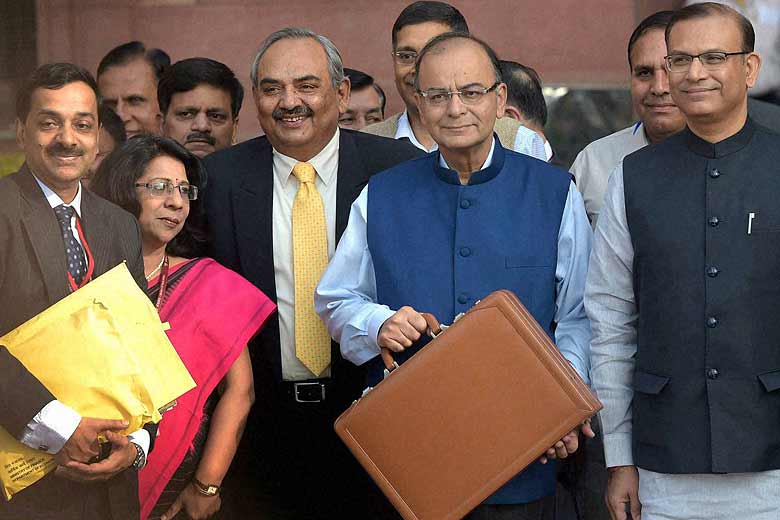
Finance Minister Mr. Arun Jaitley presented the Union Budget for the financial year 2015-16 on February 28, 2015.
There are several ways to evaluate a budget – since there is no common set of expectations, it is impossible to categorize a budget as unanimously great or poor in most circumstances. Let’s try and look at this budget with respect to a few important parameters / considerations.
Size of the Central Government
CREDIT: PIB INDIA
As per the recommendations of the Finance Commission, the government will transfer 1.78 lakh crore of extra money to the states as part of their share of central taxes. This is about 42% of the total central taxes, up from 32% earlier – an increase of 31%. Accounting for other transfers, about 62% of the money available (including non plan grants and loans, central assistance to states and UTs and centrally sponsored schemes) to be spent now in India will be with the states. This automatically reduces the size and hence the scope of spending for the central government – not just for this year, but on a recurring basis.
Several key areas like healthcare, education and
Several key areas like healthcare, education and panchayati raj will now be funded not in Delhi, but every state will have discretion on what to do and how. This of course also means the need for greater accountability, transparency and results outcome by each state. This is not just an economic, but also a political risk. The lack of outcomes may be difficult to correct or explain and easy to pass buck on.
The increase planned for revenues and expenditure for 2015-16 is not very aggressive. Revenue goes up by about 1.6% and expenses by just over 5% for the next financial year. This does factor in an aggressive Divestment target of Rs. 69,000 cr – which may be tough to meet given the experience of last two years.
Overall, fiscal federalism is the keyword as far as financial management is concerned.
Overall: Positive
Headline Numbers
The fiscal deficit will be 3.9% of the GDP for 2015/16, against the original plan of 3.6%. The government will get to the Finance Commission recommendation of 3% fiscal deficit a year later than planned. This seems an area of caution, though the government has made it clear that the leeway taken here is for infrastructure spending, not for increased subsidization.
The Current Account Deficit is seen at 1.3% as against the 2.1% target that was being chased. This of course involves global and macro factors.
The GDP growth projections are higher at 8%-8.5% for the next year. But these numbers are now difficult to relate to the past, given the revised GDP series baselining. These numbers will become more relatable only if the corporate earnings keep pace and the tax collection numbers go up. Else, while in line with the international practices, the government will find it difficult to explain this switch from factor prices to market prices for GDP calculation and reporting.
Overall: Neutral
Subsidies
With the increased transfers to states, several centrally administered schemes will now depend on the states for funding, implementation and direction.
For some schemes, there will be no central grants at all going forward. About 12% of the centrally funded schemes fall in this category. About 38% of the schemes, including Swachh Bharata, AID Control and Rural Housing scheme will need heavy involvement of states. These are also some of the highlight areas of the Modi government in terms of messaging. Hence, the government has exposed itself to a big political risk for the purpose of financial prudence. This is a great, brave step, but can of course prove counterproductive too. Half of all central schemes will be fully funded by the central government including an increased allocation to the MNREGS.
The subsidies as whole will come down by 0.35% of GDP – a significant number but also helped by the oil price decline.
There was no specific detail on rationalization of other subsidy areas like fertilizers – which eventually have to be addressed by the government.
Overall: Positive on the direction taken; could have done more.
Spending on Key Result Areas
The central government spending focus seems to be on infrastructure – roads, railways and irrigation being the main thrust areas. Very importantly, the railway budget and the union budget seemed in line with each other on expectations of funding, involving private parties and seeking external funding.
CREDIT: REUTERS
The government will now allow tax free bonds to fund these sectors, in addition to the increased outlay of Rs. 70,000 cr. There seems to be an attempt to bring all aspects of infrastructure spending through one umbrella of National Infrastructure Investment Corporation – it remains to be seen if NIIC becomes the nodal agency to raise finances for specific projects or if ministries will be allowed to go to the public directly and individually.
Additionally, the government announced 4 new ultra mega power projects, each with 4000 MW+ generation capacity. With coal linkages sorted out, this should serve as positive messaging for states to take similar measures. On shipping, the government will encourage ports to corporatize, which will pave way for reduced reliance on government funding and management control.
The government provided for increased credit for rural programs via a Rural Infrastructure Development Fund in additional to new credit and refinancing facilities for rural borrowers including farmers.
Overall: Positive
Enabling Legislation
The budget proposed a new law on curbing black money – owning foreign assets of an illegal nature. The law provides for severe criminal penalties for violations. This is good in theory but the implementation here will be the key. The clarity of how the assets are classified across a range of taxpayers and how the Income Tax authorities view past accumulation of assets and their future treatment will be critical. Improper implementation can lead to sticky harassment situations for taxpayers.
Government proposed to create a social security net focusing on health and accident insurance. This can be critical for the unorganized sector over a period of time. Again, how the schemes are funded and what involvement the government has will be the key implementation focus.
The biggest reform seems to be the decreasing monopoly of EPFO and ESI for pension and health insurance segments. The budget makes the use of employee provident fund voluntary and introducing competition to save via National Pension Scheme. The role of ESI will no longer be a monopoly – there will be a choice of opting for any IRDA approved player. These changes will again have a big impact over time. Increasing use of NPS will bring depth to the markets where the investments are eventually made. This will lead to availability a variety of direct benefit / contribution products over a long term horizon. Similarly, using IRDA approved insurers will be positive when seen in light of 49% FDI carrot in insurance.
The government proposes to use the massive post office network to increase banking operations – coupled with the Jan Dhan Yojana, this can be the fastest way to promote financial inclusion and deepening payments and banking markets. Again, the capability of the postal department to make this happen will remain in doubt till results are seen on the ground.
Despite a focus on “Make In India”, the policy area missed specific targeted sops for manufacturing in specific sectors and / or geographies in India.
Overall: Positive on the direction taken; big dependency on the speed and efficiency of implementation. Negative on the scope of coverage – could have done more specifically for the Manufacturing sector.
Market Legislation and Reforms
The government has promised to bring in several enabling legislations specifically for the regulatory structure of the market. The verbiage and provisions will be important to watch. However, the announcements are significant and far reaching.
Securities and Exchange Board of India (SEBI) will be the regulator for commodities too – this will bring in a unified view of risk management and counterparty credit risk in the market.
There will be a new bankruptcy bill, which will make it easier to close companies and liquidate businesses. This bill may have a negative impact too in the times when banks, specifically Public Sector Banks, are grappling with large NPAs on their books. How this latter problem is addressed remains to be seen.
There seems to be a broad agreement between the government and the RBI on monetary policy framework and inflation targeting responsibilities. The government has proposed to amend the RBI Act to facilitate this. On the other side, there will be a Public Debt Management Commission formed to regulate government borrowing guidelines and timing.
The budge envisages creating a Trade Receivables Discounting System for MSMEs which should improve the liquidity management for MSMEs. This will however need big technology support and adoption, and while in principle an interesting investment, the benefit realization here can be a few years off.
Overall: Positive
Taxation
This was the biggest mixed bag area for the budget. There were some positive points, but also a lot of iffy areas, which could have been avoided.
The General Anti Avoidance Rules or GAAR implementation is deferred by 2 years and the government has promised to keep the focus forward looking rather than retrospective. This should increase the overall confidence in Indian taxation system for foreign investors.
The Wealth Tax has been abolished but to offset the tax revenue, the government has brought in a 2% additional surcharge on those with 1 cr+ of taxable income. Notwithstanding the rhetoric on “shifting tax burden from super rich to hard working successful people”, this is a huge reform. Wealth Tax was routinely avoided and the effort involved in assessments and computation was not proportional the amount garnered – just over Rs 1000 cr. The 2% surcharge – being a surcharge and not an increase in the marginal rate – can be taken off at any time if the overall tax collections stabilize and look positive.
The Corporate Tax rate reduction from 30% to 25% over 4 years starting next year will be a positive. Most corporate entities today pay tax in the range of 20-23% effective rate, after a lot of effort being spent on claiming exemptions and searching for loopholes in the provisions. Bringing the rate down to 25% and taking off exemptions may promote at least a few of them to just pay the flat rate if the cost of mathematical management is higher than the additional 2-5% they will cough up.
Increasing Service Tax from 12.36% to 14% to bring the rates in line with the proposed GST rates from April 1, 2016 is the main negative. This will have a short term issue of extra tax burden across a range of services. Also small businesses, which don’t have the pricing power to pass on the tax increase, will see a decline in margin of 1.64% in their businesses. Also, retaining excise at 12.5% and these two rates diverging when the idea is to align with likely GST rates (14% – 18%?) does not look organized.
Areas like customs duty reduction on 22 items, but no changes on gold related import curbs, doubling of duty on imported commercial vehicles (hardly any market for it) and doubling the cess on coal looked arbitrary and not part of any larger plan. Especially the coal cess – which will definitely result in reduction of bid amounts on the fresh coal block auctions proposed for later this month.
The government did not offer any relaxation on the personal income tax slabs. It is quite likely that the government wants the indirect taxes to stabilize in the next 2-3 years before reforming the direct taxes. However, this was optically poor management, despite the new exemptions offered, whereby Rs. 4.44 lakhs worth of exemptions are available for all salaried individuals. In reality, to claim some of them in entirety, one has to have an income of Rs 15-20 lakhs (e.g. if your income was Rs. 5 lakhs per annum, you can’t take a housing loan big enough to claim Rs. 2 lakh in interest relief), so the exemptions don’t fully make up for the perceived taxation pinch.
Overall: Negative
Other Areas
The budget proposed several side casts – allocations for politics, optics and some forward looking areas not fully funded or fleshed out.
The government plans to encourage monetization and eventual “dematerialization” of gold, including creation of gold bonds. There will also be introduction of India made gold coins to offer a supply side solution to a big demand (and smuggling) area.
A new bank – MUDRA bank – will be formed to fund informal sector enterprises. Setting up a new bank is significant – the informal economy sees very little availability of credit. This can be a game changer over time, but the current Rs. 3000 cr refinance structure may not be very significant. Of course, over time, the government should not be engaged in this function at all, but given the wide gap for the unbanked today in India, this is a positive step.
Rationalization of capital gains for the real estate investment trusts and clarification of rules governing the taxation of offshore funds will be good for the industry. This will help the Private Equity players in a big way, providing more visibility and control of their operations.
Retaining the outlay for the Minority Affairs ministry and new schemes like “Nai Manzil” and “The Everlasting Flame” were some of the other political decisions.
Overall: Neutral
In summary, this budget was not about a roadmap for 2015-16, but incorporated structural, forward looking elements. The success of this budget will depend on greater center- state alignment, and an overall focus on good governance and implementation of policies and legislation. To this extent, the budget seems to have covered the short term acceptably, but keeping in play a big and transformational long term upside.
After trying to create a huge buzz– which soon faded under the discourses of World Cup, Railway Budget and Union Budget – Indian Express has yet again failed to simulate anything close to the Radiagate.
According to one of the reports by The Indian Express, in 2009, during the UPA government, an Essar executive put out an office memo with a proposal to gift 200 top-end cellphones to politicians and MPs. One other report alleges involvement of Sriprakash Jaiswal, Digvijaya Singh, Motilal Vora, Yashbant Narayan Singh Laguri and BJP’s Varun Gandhi for referring candidates for jobs in Essar. Most of these politicians pricked the bubble by saying, “We do recommend unemployed youth from our constituency.”
The Indian Express also dedicated special sections to Nitin Gadkari who was not in the government. In fact, he was asked to step down as the party President of BJP. It would have been more concrete if The Indian Express highlighted something more about the involvement of Nitin Gadkari than writing that: an email to the yacht captain, made it very clear: “are very important people… see they are comfortable.”
The Indian Express highlights a mail chain which says:
On July 5, the Captain receives another email: “Guests will arrive in Nice on afternoon of July 7 and will depart on July 9… kindly make arrangement for picking them up from Nice on July 7… all 9 guests are pure vegetarian — kindly make the food arrangements accordingly…”
Sandip Roy from First post takes a jibe at these reports by writing, “Essargate has a luxury yacht but hardly any of the other masala ingredients that make for a juicy scandal. Where are the dancing girls and the briefcases of cash? Nitin Gadkari even stuck to his “pure vegetarian” diet on board that yacht and came on board as a full family which when you think of it, sounds more wholesome than scandals should be.”
The narratives were expected to divulge some strong nexus between lobbyists, journalists, industrialists and politicians. However, ordinary stories without strong evidences make the whole coverage look like another TRP hungry journalism by The Indian Express.
The only harsh impact these reports could do or possibly do in the future is to question the role of media and journalists in business houses. After the Essar Leaks were made public, 2 big journalists (Sandeep Bamzai, Editor of Mail Today, and Anupama Airy, Energy Editor of Hindustan Times ) resigned. It is interesting to note that while Hindustan Times Editor-in-Chief Sanjoy Narayan is taking high moral and ethical stand, Anupama Airy has put serious allegations against other people in the organization.
The News Minute has pointed out some of her allegations, including this:
She also claims she had been asked to bring in more than Rs 1 crore worth of sponsorships every year for the annual HT Leadership Summit, and says: “I have been used but I considered it my duty to do things for my organisation and my bosses.”
Questions on the involvement of media don’t stop here. Tehelka, a media face which talks about morality and ethos had defended Essar in 2G scam case. DNA India rightly questions: is too much of a coincidence that the Essar group was also sponsoring media events in Tehelka soon after the magazine printed stories in favour of Essar. In November 2011, Essar group also sponsored Tehelka’s first think fest, held in Goa. Essar chief Prashant Ruia was also a speaker at this event in a session on second day. The 2014 Lok Sabha candidate of AAP* – Ashish Khetan, who was a journalist in 2011 – had also defended Essar during the same period by calling CBI’s enquiry a Mad Conspiracy.
While these reports failed to strongly conclude involvements of lobbyists, industrialists, and politicians, it has surely put media under scanner.
*Correction: Earlier, we mentioned Ashish Khetan as the minister of AAP. We have corrected it to 2014 Lok Sabha candidate of AAP.
Rs. 25 crore for Rural Infrastructure Development Bank
Rs. 300 crore to support Micro Irrigation Programme
EDUCATION
AIIMS in Jammu and Kashmir, Punjab, Tamil Nadu, Himachal Pradesh, Bihar and Assam
IIT in Karnataka, Indian Institute of Mines and Dhanbad to be upgraded
PG institute of Horticulture in Armtisar
Kerala to have University of Disability Studies
Pharma centres in Maharashtra, Rajasthan, Chhattisgarh
INFRASTRUCTURE
Rs. 70,000 crores to Infrastructure sector
PPP model for infrastructure development to be revitalised and govt. to bear majority of the risk.
Tax-free bonds for projects in rail, road and irrigation
Rs. 150 crore allocated for Research & Development
NITI to be established and involvement of entrepreneurs, researchers to foster scientific innovations
Govt proposes to set up 5 ultra mega power projects, each of 4000 MW, will be plug and play projects.
TAXATION
Rate of corporate tax reduced to 25% over next four years
Wealth tax to be abolished
Additional 2% surcharge for the super rich with income of over Rs. 1 crore
100% exemption for contribution to Swachch Bharat, apart from CSR
DEFENCE
Rs. 2,46,726 crore for Defence
Focus on Make in India for quick manufacturing of Defence equipment
WELFARE SCHEME
50,000 toilets constructed under Swachh Bharath Abhiyan
Housing for all by 2020
Upgradation 80,000 secondary schools
For the Atal Pension Yojna, govt. will contribute 50% of the premium limited to Rs. 1000 a year
New scheme for physical aids and assisted living devices for people aged over 80
Govt to use Rs. 9000 crore unclaimed funds in PPF/EPF for Senior Citizens Fund
Rs. 5,000 crore additional allocation for MGNREGA
MUDRA bank will refinance micro finance orgs. to encourage first generation SC/ST entrepreneurs
Govt to create universal social security system for all Indians
RENEWABLE ENERGY
Rs. 75 crore for electric cars production
Renewable energy target for 2022: 100K MW in solar; 60K MW in wind; 10K MW in biomss and 5K MW in small hydro
TOURISM
Churches and convents in old Goa, Hampi, Elephanta caves, Forests of Rajasthan, Leh palace, Varanasi , Jallianwala Bagh, Qutb Shahi tombs at Hyderabad to be under the new tourism scheme
We had earlier seen how a case of theft in a Delhi school was used by the media to drive mass hysteria about communal attack. Now a similar case has come to light where facts have been sacrificed in favor of sensationalism and propaganda.
A couple of days back, some Twitter users complained that the Prime Minister’s Office (PMO) website was asking for ‘password’ when accessing the page containing information on assets of union ministers.
One of the first ones to raise this issue was J Gopikrishnan, a journalist with The Pioneer, who tweeted this on 24th February:
Within 10 minutes, a Twitter user explained to him that it was a technical glitch, and the ‘password’ thing could be bypassed by a simple modification in the URL:
@jgopikrishnan70 It seems some beta trial is on so its protected. U cud still see it by removing the beta in the beginning @radharaju18
So on the 24th February itself, for a person with some common IT knowledge and who can read tweets, it was clear that the PMO website had some technical glitch causing the web page to become inaccessible for a common user.
Obviously, this ‘glitch’ can’t be ignored, and there was a genuine case of asking the PMO if, as far as information technology is concerned, the government of India was lagging behind on some fronts.
Seriousness of this cannot be over-emphasized, as government collects some private and confidential data of citizens, and thus security of the IT infrastructure deployed by the government should be a concern.
So at this point of time, on 24th February, the media had a valid reason to ask the PMO why this technical glitch was there in the first place.
However, the Times of India, a tabloid renowned for printing cleavages of Bollywood actresses, decided to ignore facts and publish a report, two days after people on Twitter knew that it was a technical glitch, titled “PMO blocks access to information on ministers’ assets”
The report was filed by a little known reporter Himanshi Dhawan, whose official twitter handle, as reported on TOI website, is suspended for some unknown reason. It is clear that Himanshi either doesn’t know how to use Twitter or how to use a phone to call up the PMO and ask about the issue.
But the reporter surely knows how to write an alarming and paranoid news report. Soon the report was lapped up by usual “OMG, Modi is so fascist” choir group. Indiscriminate accusations of conspiracy started flowing thick and fast:
While the PMO cared to respond and clarify, what is interesting is that the Times of India journalist doesn’t care to clarify if any attempt was made to contact the PMO to get their side of the story (an accepted and required journalistic principle):
@dhawan_himanshi Hi, reg. report published about PMO blocking access, was there any attempt to contact concerned authorities ? Thanks
At time of publishing of this story, a response from the reporter was still pending.
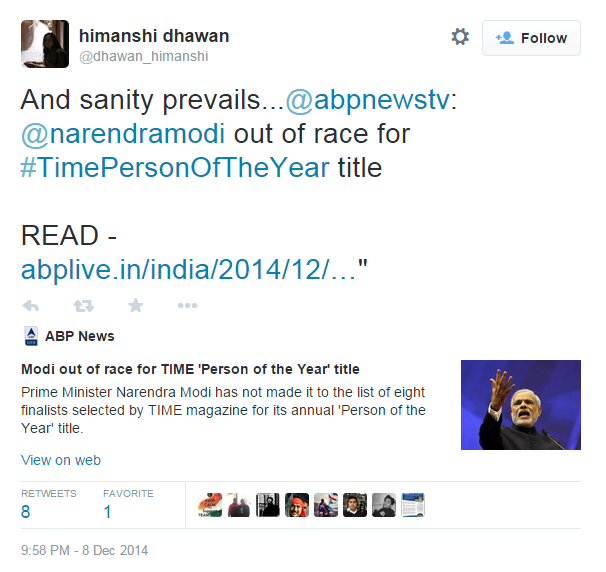
This shocking lacunae, coupled with overall conspiratorial /paranoid tone of the article, as well as this rather inappropriate tweet from the reporter (see the image below) raises serious questions about state of Indian journalism:
Betrays the ‘feelings’ the reporter has for Modi?
At the least, it tells us that when hidden agenda and paranoia drive journalism, truth and impartiality are the first casualties.