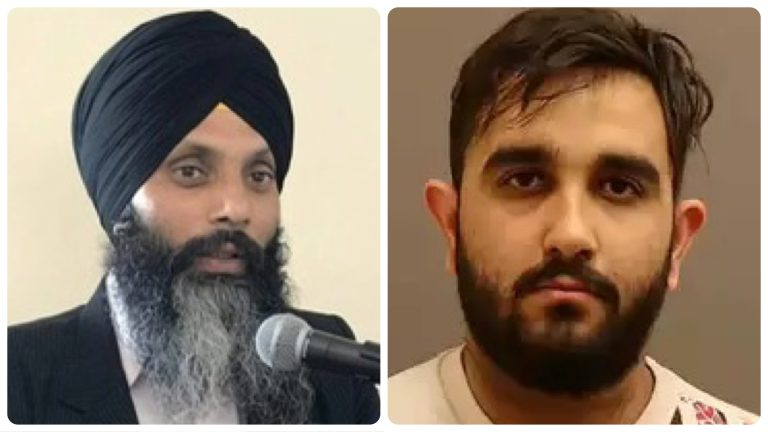
Three Indian nationals have been apprehended by Canadian law enforcement in connection with the killing of Khalistan separatist Hardeep Singh Nijjar.
These individuals, residing in Canada as non-permanent residents, allegedly fulfilled various roles during the incident at the Guru Nanak Sikh Gurdwara in Surrey, British Columbia, where Nijjar was fatally shot.
Mandeep Mooker, an RCMP superintendent, disclosed that the individuals in question, Karan Brar, Karanpreet Singh, and Kamalpreet Singh, all in their twenties, were apprehended in Edmonton.
Mooker further asserted that investigations are underway to determine any potential links between the suspects and the Indian government.
Earlier last year, Canada blamed India for authorising the assassination of Khalistani terror Hardeep Singh Nijjar in British Columbia, setting off a diplomatic row between New Delhi and Ontario that saw the return of at least 40 Canadian diplomats working in India.
India had vehemently denied allegations of ‘Indian agencies behind Nijjar killing’ and called them “absurd” and “motivated”.
While Canada continues to blame ‘Indian agents’ for commissioning a hit squad to take down Nijjar, it has failed to provide credible evidence that linked the assassination of the Sikh separatist leader with the Indian government.
Moreover, one of the three arrested in connection with the murder had harboured anti-Modi, pro-Khalistani tendencies, as per media reports and his Facebook page. According to a report published in Jagran, Karan Brar, one of the three arrested suspects arrested by Canada Police, hails from Kotkapura city in the Faridkot district of Punjab. This suspect had travelled to Canada on a study visa approximately four and a half years ago.
Interestingly, a Facebook account named Karan Brar matches the description and details mentioned in the Jagran report. Below attached is the screenshot of Karan Brar’s Facebook profile. In the About section, Karan mentions that he lives in Edmonton, Alberta, Canada, and is from Kotkapura in Punjab, which matches the details in the Jagran report.
Karan Brar’s Facebook profile
Karan is the only son of his parents. His father, Mandeep Singh Brar, passed away due to a heart attack just on April 18th this year. Meanwhile, his mother, Ramandeep Brar, had also shifted to Singapore about two and a half years ago. Brar had recently shared a post mourning the death of his father, Mandeep Singh Brar.
Karan Brar mourned his father’s death on FB earlier last month
Karan Brar’s anti-Modi, pro-Khalistani posts
However, what is interesting is the fact that Brar has posted anti-Modi and pro-Khalistani content on his Facebook profile page. In one of the posts he uploaded in 2020, Brar had called for boycotting PM Modi.
Before that, he had thrown a challenge on Facebook, calling for a boycott of actor Kangana Ranaut.
The posts were made in the wake of the ‘farmer protest’ in India following the passage of three farm laws. The ‘farmer protest’ witnessed large-scale violence as the rabble-rousers, a significant section of those supporting Khalistan, hijacked the protests and ran riot across different parts of the country. Several notable personalities, including PM Modi and actor Kangana Ranaut, had come under the attack of the farm protest sympathisers, with many of them such as Karan Brar, calling for their ostracisation with boycott calls.
The Northern state of Uttarakhand has been grappling with forest fires for the past two weeks, destroying over 1000 acres of forest area. Amid this, a video of a man surfaced on social media wherein he was seen boasting about setting fire to forests.
“See guys, we are finally setting the forests on fire. Our job is to set things on fire and play with it. We keep playing with fire. And today we are here to do this yet again. We will turn these mountains and leaves into ashes,” a man was heard saying.
“We keep on doing this. This is my uncle Sukhlal who keep setting forests on fire. Never mess with people who know how to burn down things. Never challenge Biharis,” he continued. Later in the video, another man was spotted welding a stick.
Migrants from Bihar burn forest in Uttarakhand and say "We will burn down entire forest, dont challenge Biharis"
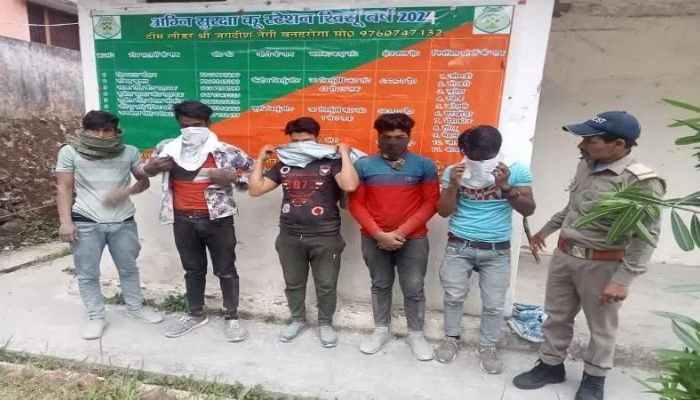
The date of the recording of the video remains unknown at this point. On Sunday (28th April), the Uttarakhand Forest Department arrested five labourers from Bihar for setting fire to reserved forest areas of Khirsu.
They were identified as Mosar Alam, Nazifar Alam, Nurul, Salim and Feroz Alam.
The Uttarakhand police have arrested 52 people so far for setting fire to forests and destroying several acres of pristine land. As per reports, a total of 804 incidents of forest fires have been recorded and 315 cases have been registered under the Forest Conservation Act.
The forest fires have impacted human settlements, wild animals and even water sources.
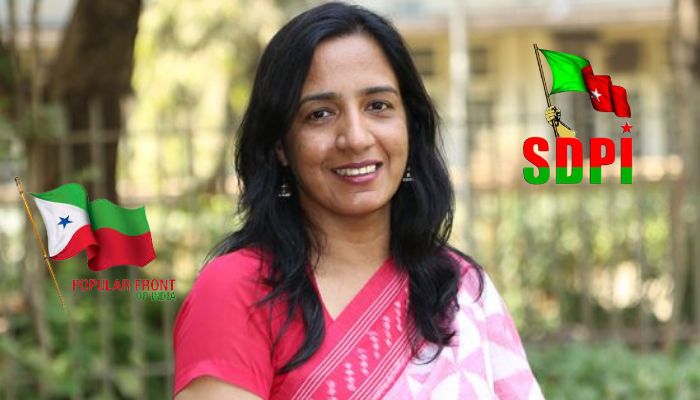
On Friday (3rd May), the Social Democratic Party of India (SDPI) extended its support to Parveen Shaikh, the Principal of The Somaiya School who has now come under scanner for her pro-Hamas stance.
SDPI is the political arm of the banned radical Islamist outfit, Popular Front of India (PFI). In a Facebook post, the Pune unit of SDPI threw its weight behind Parveen Shaikh and dubbed OpInida’s expose as a testimony of ‘Islamophobia in India.’
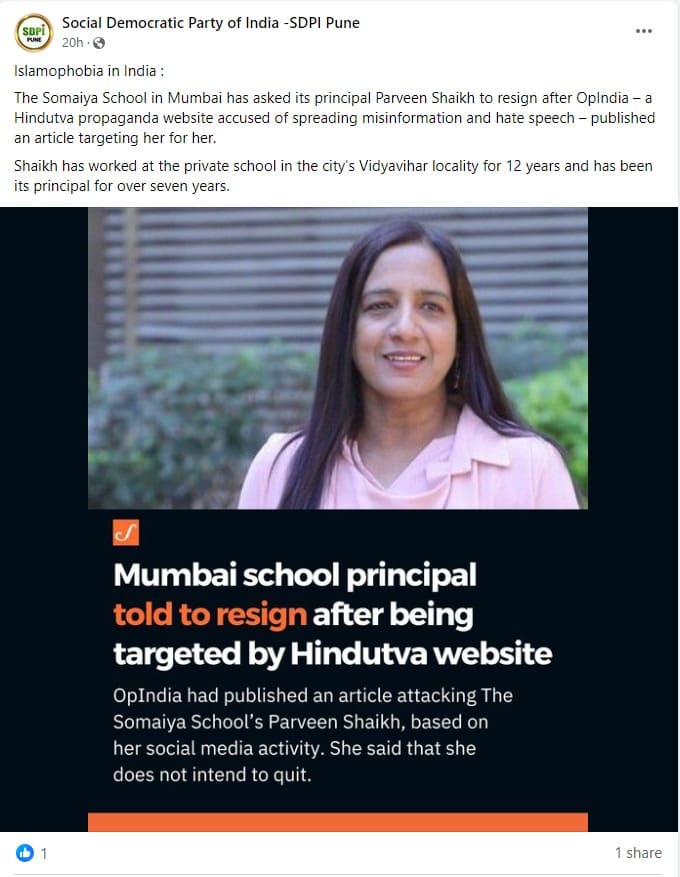
“Islamophobia in India : The Somaiya School in Mumbai has asked its principal Parveen Shaikh to resign after OpIndia…published an article targeting her for her. Shaikh has worked at the private school in the city’s Vidyavihar locality for 12 years and has been its principal for over seven years,” the political arm of PFI claimed.
Screengrab of the Facebook post of SDPI Pune
The development comes amid reports about radical Islamist outfit, PFI, trying to revive itself through SDPI.
Citing sources, ANI reported in September last year that PFI had been recruiting new members to form a youth organisation in association with SDPI.
“The banned outfit has also introduced some changes to its old recruiting methods, sources told ANI, adding that the induction process now involves picking up 4 to 5 potential recruits from each area where the outfit is known to operate and providing them with training and funds to make them full-time activists,” the report read.
Controversy surrounding Parveen Shaikh
On 24th April this year, OpIndia published an exclusive report highlighting the Islamist views of Parveen Shaikh and her leaning towards anti-Indian elements on social media.
She frequently likes Hamas pronouncements endorsing their ‘resistance’ against Israel along with those supporting its senior leadership such as terrorist Ismail Haniyeh. She strikes as an ardent advocate of Hamas who rationalizes all the atrocities it commits as ‘resistance’ or ‘retaliation.’
Parveen Shaikh has an extensive record of “liking” tweets that echo her beliefs. She likewise backs radicals such as Muslim preacher Zakir Naik and Umar Khalid, the mastermind behind the anti-Hindu riots in Delhi. She also likes tweets that hold Hindus accountable for attacks on their sacred procession by fundamentalists. She enjoys dehumanising Hindus by portraying them as beggars in front of Arab countries and supports anti-Ram Mandir sentiments.
OpIndia discovered a nasty tweet from Parveen Shaikh in which she stated that Prime Minister Narendra Modi is a “dog” who is ready to fetch a ball at the instruction of Chinese Premier Xi Jinping. Following OpIndia’s report, the Somaiya School took cognisance of the matter.
On Friday (3rd May), Police arrested a 19-year-old accused named Saddam Hussein on charges of raping a minor girl for months and impregnating her in Karnataka’s Hubballi. According to the police, the accused allegedly raped the 17-year-old girl several times between 1st January this year and 3rd May. The accused had known the survivor through school, and allegedly castigated, abused, and threatened her, the police added.
According to the Police Commissioner of Hubballi-Dharwad, Renuka Sukumar, when the Police were bringing the accused, Saddam Hussein, to the Police station to complete the arrest formalities, he assaulted two Police personnel. Sukumar added that the Police fired shots in self-defense, injuring the left leg of the accused. He is currently undergoing treatment in Hospital.
#WATCH | Hubballi–Dharwad, Karnataka: On the POCSO case, Police Commissioner Renuka Sukumar says, "Yesterday, to complete the arrest facilities, we were bringing the accused Saddam Hussain to the police station. He assaulted a constable and an inspector. Both of them have… pic.twitter.com/etefEbLYNZ
As per the Police Commissioner, the incident came to light on 3rd May. The victim’s family had taken their minor daughter to a hospital for ‘abdominal pain’ where the Hospital management informed them that the minor was pregnant. As per the law, they also informed the Police as it was a medico-legal case.
As per reports, the hospital authorities immediately informed the police that an incident of a minor girl being pregnant came to light. Afterward, the victim’s mother lodged a complaint, Police added. It is also alleged that the accused Saddam Hussein had threatened the mother with dire consequences if she filed a complaint against him. He also hurled casteist abuses at the victim. The accused and rape survivor had known each other from school and he allegedly raped her for over 4 months resulting in pregnancy.
According to the police, the victim’s mother alleged in her complaint that the accused was known to her daughter and that she was forced to have a physical relationship with him.
The victim’s mother said, “The accused forced my daughter to have a physical relationship and impregnated her.”
Police also said a Protection of Children from Sexual Offences Act (POCSO) case had been registered since the survivor was a minor. As per reports, the Scheduled Caste and Scheduled Tribe (Prevention of Atrocities) Act had also been invoked since the girl belonged to the Dalit community, as confirmed by the Police. However, some reports have mistakenly reported that the minor hails from the Scheduled Tribe (ST) community.
Hindu advocacy groups and BJP slam Karnataka government, says Hindu girl and woman are unsafe under Congress rule
Pro-Hindu activists and BJP workers staged a protest in front of the local police station, demanding justice for the survivor and raising slogans against the Siddaraiamah-led state government.
On Saturday (4th May), the BJP launched a scathing attack on the Siddaramaiah-led Congress government stating that “there is no protection for Hindu young women and girls in Hubballi”.
Taking to X, the party wrote, “Hindu young women are today victims of the mistake of giving power to terrorists, rapists, fanatic Jihadists called brothers @INCKarnataka like the Kerala files.”
The post cited the recent murder case of Congress Councillor Niranjan Hiremath’s 23-year-old daughter Neha who was stabbed to death inside her college campus in Hubballi. The saffron party slammed the state government over the investigation in the case which is being probed by the State’s Criminal Investigation Department.
ಹುಬ್ಬಳ್ಳಿ ಫೈಲ್ಸ್!
ಮತಾಂಧನಿಂದ ಅಪ್ರಾಪ್ತೆ ಬಾಲಕಿ ಮೇಲೆ ಅತ್ಯಾಚಾರ. ಹುಬ್ಬಳ್ಳಿಯಲ್ಲಿ ಹಿಂದೂ ಯುವತಿಯರು, ಬಾಲಕಿಯರಿಗಿಲ್ಲ ರಕ್ಷಣೆ.
ಭಯೋತ್ಪಾದಕರು, ಅತ್ಯಾಚಾರಿಗಳು, ಮತಾಂಧ ಜಿಹಾದಿಗಳನ್ನು ಬ್ರದರ್ಸ್ ಎನ್ನುವ @INCKarnataka ಕ್ಕೆ ಅಧಿಕಾರ ಕೊಟ್ಟ ತಪ್ಪಿಗೆ ಇಂದು ಹಿಂದೂ ಯುವತಿಯರು ಕೇರಳ ಫೈಲ್ಸ್ ಮಾದರಿಯಲ್ಲಿ ಬಲಿಯಾಗುತ್ತಿದ್ದಾರೆ.… pic.twitter.com/QO5E9G0yTA
The post added, “While Neha’s murder case in Hubballi is still pending, another inhumane incident has made Kannadigas to lower their heads. If they @siddaramaiah and @Dr Parameshwara (Home Minister) do not crush the bigots immediately, the Hindus will destroy the government.”
India Today journalist Rajdeep Sardesai suffered another instance of humiliation when he tried to outsmart Smriti Irani after the Congress party decided to field a Gandhi loyalist, KL Sharma, from Amethi, and Rahul Gandhi from Rae Bareli. The video of his interaction with Smriti Irani and locals from Amethi has since gone viral on social media.
In the video, locals interrupt Rajdeep Sardesai as he asks Smriti Irani about the Congress party’s decision to field family loyalist KL Sharma against her. What follows later is the stuff of legend, akin to the boxing saga that Sardesai featured in while reporting from Madison Square Garden. While there was no physical scuffle this time around, the metaphorical assault delivered by the people of Amethi and their leader, Smriti Irani, was a sight to behold as the husband of the TMC Rajya Sabha MP appeared squirming and fidgeting when acquainted with the ground reality in Amethi and adjoining regions.
Asking Irani about why the social indicators of her constituency, Amethi, remain lower than the national average, a poised Smriti Irani reminded the India Today journalist that it was the Gandhi family that should be answering the question as they had ruled over the constituency for over 50 years as compared to her, who got elected as MP only 5 years back.
“They had 50 years and I had 5 years….When we are talking about social indicators, it is important to recognise that the Gandhi family ruled over Amethi for 50 years. They need to answer why despite ruling over Amethi for 50 years, the social indicators of the region are lower than the national average,” Irani shot back.
“Doesn’t that speak about their exemplary and disappointing leadership aptitude?” Irani rhetorically asked, to which Rajdeep Sardesai had to grudgingly respond in the affirmative.
The India Today journalist then spoke about the Congress party’s candidate from Amethi, KL Sharma, stating that the Congress leader had said he knows Amethi like the back of his hand and has worked for 30 to 40 years in the region.
By this time, the locals have had enough of what could be described as prejudiced journalistic practice by Rajdeep Sardesai. The locals surrounding Smriti Irani interrupted the interview. They informed Rajdeep Sardesai that KL Sharma and Congress hadn’t done anything for the region, and it was only after Smriti Irani that the district witnessed unprecedented development.
“I was there in Congress for 25 years, I know everything about them. Nothing has happened in this village when they were in power. When Smriti ji came to power 5 years back, the road you took to come here was 7 meters wide, today it is 14 meters wide. Every gram sabha in the region have received Rs 20-25 crores for development projects like Ayushmaan cards worth Rs 10 crores were distributed in our village, Rs 2 crores were spent on the construction of the water tank, and Rs 2 crore spent on constructing colonies,” the local tells Rajdeep Sardesai.
‘Rs 20 crores have been spent in one gram sabha, there are 1200 villages, do the math,” he further adds.
Ms Irani then made a pithy observation about why the Gandhis abandoned the Amethi constituency. “Mr Sardesai, if the Gandhi family had thought there was an iota of a chance of their victory, don’t you think they’d be fighting?”
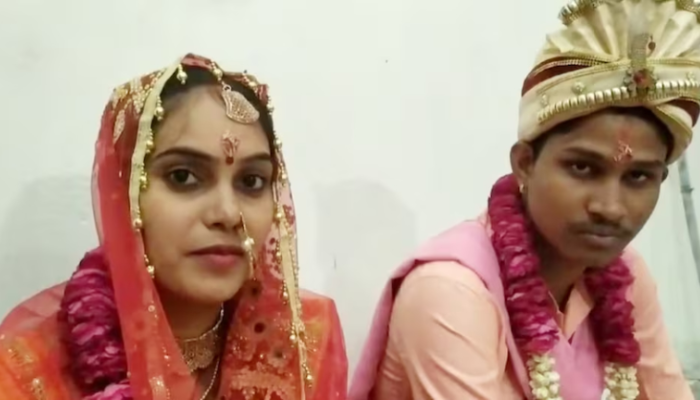
Shama Parveen, a Muslim woman from Aurangabad, Bihar decided to return to the fold of Hinduism and made Shivam Verma who is from Uttar Pradesh’s Ballia her life partner. She will now be known as Poonam Devi. She is a resident of Kazichak village in Jagdishpur and has studied till high school. Her spouse who hails from Rajendranagar has passed 8th grade. He works as a craftsman in a bullion shop.
Shivam Verma had travelled to Buxar for his friend’s wedding almost a year prior and met Shama Parveen during the marriage ceremony there. They started chatting and soon their relationship started evolving into love. The two then decided to tie the knot but the girl’s family was against their relationship and opposed it due to which she left her house. The couple had to roam between multiple places for several days.
Meanwhile, someone told them about Pandit KK Shankhadhar of the Agastya Muni Ashram located in Madhinath, Bareilly. They heard he could arrange their marriage and made their way to his ashram. Pandit KK Shankhadhar checked their documents through an advocate and purified Shama Parveen with Gangajal. He has helped many such couples. The pair was then married according to Hindu rituals and the young woman was also given a Hindu name. She chose the name ‘Poonam’ for herself.
She revealed that her ancestors had converted to Islam due to the Mughal invaders but her faith and belief was in Sanatan Dharma and she worships Hindu gods and goddesses. Speaking of the wicked customs such as “halala” and “triple talaq” she asserted that Islam has no regard for women. According to Shama Parveen, she has voluntarily decided to do “ghar-wapsi” and embrace Sanatan Dharma.
She also possesses great reverence for cows, however, she unveiled that her family ate beef in their house. She mentioned that in contrast to all of this, Hinduism has a deep respect for women. Shama Parveen was scared that she could be forced to marry her cousin and took the decision to marry her boyfriend following Hindu customs as soon as possible.
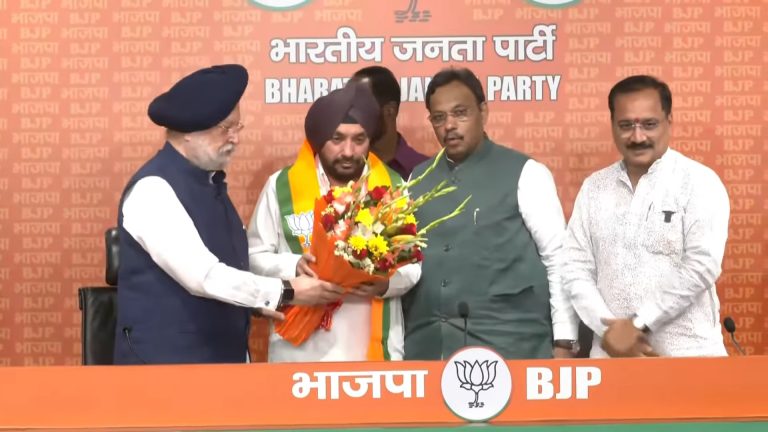
Former Congress Delhi President Arvinder Singh Lovely, who recently resigned from Congress, joined the Bharatiya Janata Party on Saturday.
Lovely joined the BJP in the presence of Union Minister Hardeep Singh Puri, BJP General Secretary Vinod Tawde and Delhi BJP chief Virendra Sachdeva.
Along with Lovely, former Congress MLAs Raj Kumar Chauhan, Naseeb Singh and Neeraj Basoya and former Youth Congress President Amit Mallik also joined the BJP.
Meanwhile, Arvinder Singh Lovely resigned from the Delhi Congress chief on April 28 and wrote a letter to Congress President Mallikarjun Kharge citing that he was against the alliance between Congress and AAP in Delhi.
“The Delhi Congress Unit was against an alliance with a party which was formed on the sole basis of levelling false, fabricated and malafide corruption charges against the Congress Party. Despite that, the Party made a decision to ally with the AAP in Delhi…,” Arvinder Singh Lovely wrote in his resignation letter.
He also highlighted the comments made by the North-East Delhi candidate (Kanhaiya Kumar), for falsely praising the Delhi CM and endorsing the work done by AAP in the Education, Health, Road and Electricity sector.
“Such ill-thought and factually incorrect statements have not gone down well with the Local Party Unit since, the local party workers had an inherent understanding that the alliance was not done in appreciation of AAP’s false propaganda of the development of Delhi and was in fact, a “compromise- to improve the chances of victory for the Party as part of the National Alliance,” he said.
Voting for all seven Lok Sabha seats in Delhi is scheduled to take place on May 25, during the sixth phase of the ongoing general elections. The counting for all seven phases is scheduled for June 4.
(This news report is published from a syndicated feed. Except for the headline, the content has not been written or edited by OpIndia staff)
In a shocking incident of crime against a minor, a Taxi driver named Haji Muhammad has been booked under the POCSO act for sexually harassing a minor girl who hails from the Dalit community in Rajasthan. It is alleged that the Taxi driver who used to drive her to school, sexually harassed the 12-year-old victim for over a month. After the girl narrated her ordeal with her mother, her family filed a Police complaint. Subsequently, the Police have booked the accused under the stringent Protection of Children From Sexual Offences (POCSO) Act. The accused is currently absconding.
According to reports, the family of the victim, residing in Pali, Rajasthan, had arranged for a taxi to transport their minor daughter to school. The 12-year-old girl used to travel alone in this taxi, making her vulnerable to the ill intentions of 35-year-old taxi driver, Haji Muhammad. The incident came to light when the girl told her mother that the Taxi driver uncle indulged in bad touch.
According to the complaint, finding her alone, the accused Haji Muhammad started inappropriately touching the victim and sexually harassing her. It is further alleged that he sexually harassed her daily for over a month. Narrating the ordeal, the victim stated that he used to ask her to sit in the front seat of the car and would then inappropriately touch her below the waist.
According to the minor, Haji Muhammad used to ask her to touch his body. He used to say to the victim that she should come to him when she grew up. He used to lure the victim by promising her a taxi ride. Additionally, he had also threatened the minor not to tell anything about his acts to her parents otherwise he would kill them.
After enduring sexual harassment for over a month, the victim approached her mother and shared everything with her mother. Later, her family approached the school management as well as the police.
The family members lodged a police complaint against Haji Muhammad. A case has been registered against him under several serious sections including POCSO and SC/ST Act. The minor has also undergone a medical examination. The accused Haji Muhammad has been absconding since the case was registered, and the police are currently conducting raids to apprehend him.
Cab driver Adil Khan accused of raping a woman multiple times after developing an acquaintance and later spiking her cold drink and blackmail
In a separate incident from Jaipur, a cab driver named Adil Khan is accused of raping a woman after developing an acquaintance and exchanging numbers in the garb of cab booking.
According to reports, police said that a 39-year-old woman resident of Rajpark registered a case that she had booked a cab to go to the market in December 2023. Back then, she met cab driver Adil for the first time. Accused Adil Khan claimed to be a resident of Transport Nagar. He asked her to note down his mobile number to book his cab. After that, cab driver Adil started calling her repeatedly and pressuring her for friendship. Along with friendship, he even offered to marry her.
Later, he came home to meet her on 22nd March and brought a cold drink that was spiked with drugs. After giving her the spiked drink, the accused raped her while she was unconscious. It is alleged that he also recorded the act of raping her. When she regained consciousness and protested, accused Adil Khan promised to marry her. He then started sexually assaulting her on the pretext of marriage. When the victim pressed to marry her, he not only refused to marry her but also went on to rape her multiple times by blackmailing her with her obscene videos.
The incident came to light when the victim lodged a report against the accused cab driver at Transport Nagar police station.
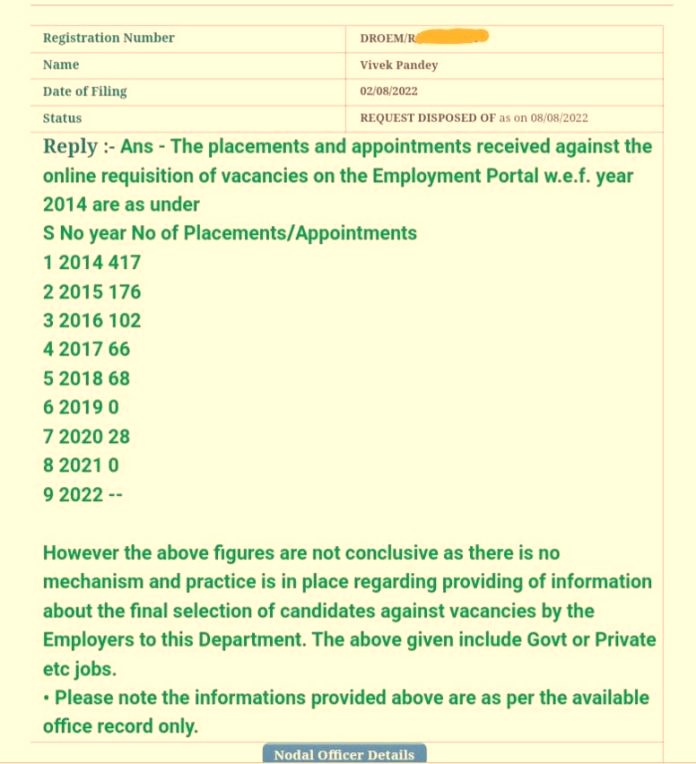
The Arvind Kejriwal-led-Delhi government has not provided a single job since 2021, revealed a Right to Information (RTI) obtained by activist Vivek Pandey on Friday (3rd May).
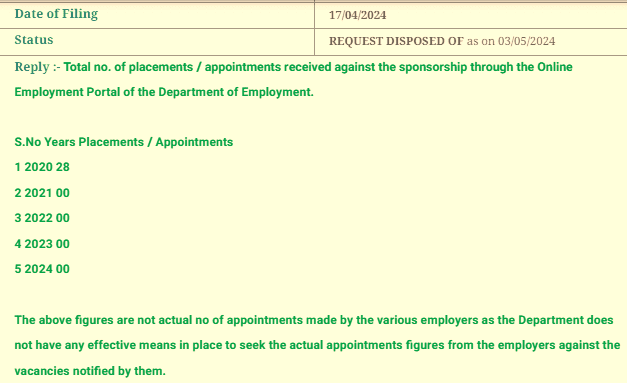
According to the RTI reply, only 28 jobs were provided in 2020 through the employment portal of the Delhi government’s Department of Employment. Since then, no employment opportunities have been provided to the job seekers.
RTI filed to Directorate of Employment exposes a stark reality: Since 2020, only 28 jobs have been provided.
Despite Arvind Kejriwal's pledge to deliver 12 lakh jobs.
When the RTI reply is compared with another RTI filed by activist Vivek Pandey in 2022, we find that the Kejriwal government had provided 176 jobs in 2015, 102 jobs in 2016, 66 jobs in 2017, 68 jobs in 2018 and 0 in 2019.
The total number of jobs, provided through the Employment portal, in the past 9 years (2015-2024) thus stands at 440. This is in complete contrast to the claims of providing 12 lakh jobs to the youth of Delhi by Aam Aadmi Party supremo Arvind Kejriwal.
Screengrab of the RTI reply obtained in 2022
According to the employment portal of the Delhi government, a total of 16.22 lakh job seekers had registered on the platform launched by the Kejriwal government.
The claims by Arvind Kejriwal of providing 12 lakh jobs to the youth in the National Capital were questioned by Assam Chief Minister Himanta Biswa Sarma in April last year.
During a press conference, the Assam CM inquired, “He (Arvind Kejriwal) said that his government gave 12 lakh jobs. How he can give this many jobs in seven years when there are only 1.5 lakh job vacancies in Delhi?”
In April 2023, BJP leader Manoj Tiwari also hit out at Arvind Kejriwal for misleading people with inflated claims of employment. “Kejriwal is the biggest liar and the most corrupt and dishonest chief minister in the country. It sounds good that 12 lakh jobs have been given, but it is a false claim as has been proved by a RTI reply of his government itself,” he had said.
AAP defended itself in 2023
At that time, the Aam Aadmi party had defended itself by claiming that the data provided in the RTI was limited to the employment portal and did not account for government and state-wise data on jobs.
“If the BJP leaders were educated enough, they wouldn’t have been embarrassing themselves daily by making such ridiculous statements. They are citing an RTI response of the employment directorate of Delhi government, which itself states that it does not maintain government-wide and state-wide data on jobs generated,” it had claimed.
“Just the number of bus marshals appointed in Delhi’s buses is over 13,000. Delhi government has already presented a detailed summary of 12 lakh jobs created in the city in Delhi Assembly, including nearly 2 lakh jobs in Delhi government,” the party further added.
Former President of Congress party and its current ideologue, Rahul Gandhi officially deserted the family ‘bastion’, Amethi, on 3rd May 2024 to file nominations from Raebareli, a perceived safer seat for the Gandhi scion in the background of 2019 defeat at the hands of BJP leader Smriti Irani in Amethi. While the BJP has cornered the Congress leader with his “Daro Mat” catchphrase, the grand old party in a flurry of tweets described it as a “Masterstroke” and a deft “Chess move”.
A smarter political move has not been witnessed in recent times. A hundred Modis can’t match the political deftness of the Gandhis. #KaunSmriti ?
Pertinent to note, this comes amid Rahul Gandhi’s recent re-launch, for the umpteenth time, as a Chess ‘Grandmaster’. However, this is not the first time the Gandhi scion has “come of age” as a sporting icon, an athletic politician, and a ‘Youth leader’.
Incidentally, the grand old party led by Rahul Gandhi had a strike rate of around 12% and 8% in direct fights against the BJP in 2014 and 2019 Lok Sabha elections respectively, exposing the political inefficiency of Rahul, the current Congress ‘ideologue’. Similarly, apart from a few victories of regional Satraps within the grand old party, Congress under Rahul Gandhi has displayed no signs of stabilisation, let alone resurgence. Consequently, the Congress party has been forced to recurrently devise newer plans and re-branding efforts to relaunch Rahul Gandhi that can be aptly summed with the tagline, ‘leader wahi, khel/Avatar nayi‘ (Translation – Same leader in a different game/Avatar).
Rahul Gandhi: The Chess Genius
Recently, Congress party released a short video in which Rahul Gandhi featured as a ‘Chess genius’. He claimed that he defeated his tutor in his first attempt while learning the basic skills of the game at the young age of 7.
Lauding the foresight of Rahul Gandhi, Congress wrote, “Strategy, patience & foresight! (pawn emoji) Just like in chess, Shri @RahulGandhi stays ahead of the game, always thinking several moves ahead!”
In the video released by Congress party, Rahul Gandhi said, “You know, the first time I played chess was when I was seven years old. This person taught me chess, they just taught me the rules, and then I played the game with them. And then the first time I played, I beat them. And they got really angry with me because I beat them.”
According to Rahul Gandhi, “an expert player in the game” can turn the opponent’s most powerful piece to start working for him. Ironically, this sounds akin to the ‘conspiracy theory‘ that the senior-most Congress leader, Rahul Gandhi, is the biggest campaigner/asset for his rival party, the BJP.
Replying to the query, ‘What do you like about Chess?’, the Congress leader added, “One of the most interesting things about Chess is once you start to get slightly better at it the opponent pieces actually operate almost like your own. So you don’t just look at your pieces you look at the opponent’s pieces, your pieces, and the board and then very often, it can be the opponent’s piece that is very powerful piece for the opponent is actually working for you.”
Further in the video, Rahul Gandhi explained the similarities between Chess and Politics asserting that the most important skill in both these traits is to “control the centre”. He explained, “In chess, the idea is make sure that you are controlling the centre, and you can apply pressure on the centre from the sides in different ways. But if you don’t understand the centre and you don’t have a view on the centre, you cannot make that properly. In the same way, if you don’t have a clear idea of what you are trying to do in politics, you don’t understand the centre, and it means you won’t be able to operate.”
Rahul Gandhi listed French Defense, Sicilian Dragon, and King’s Indian as his favourite openings and boasted himself as the Best Chess player among Indian politicians.
Further, Rahul Gandhi mentioned Russian Grandmaster Garry Kasparov as his favourite player adding that he puts a lot of psychological pressure on the opponents and is a nonlinear thinker. Incidentally, his favourite player retorted by taking a hilarious dig at the Congress leader.
Notably, an X user shared a sarcastic post about Rahul Gandhi’s chess prowess arguing that he felt relieved for Grandmasters and World Champions Viswanathan Anand and Garry Kasparov that they didn’t have to face Rahul Gandhi, the “greatest chess genius of our time”. Responding to the post, Kasparov took a veiled pot shots at Rahul Gandhi by advicing him to focus on winning Raebareli seat before venturing or challenging greats in other games.
Kasparov wrote, “Traditional dictates that you should first win from Raebareli before challenging for the top!” followed with a laughter emoji.
Traditional dictates that you should first win from Raebareli before challenging for the top! ?
While replying to a few more posts by Indian X users, Kasparov went on to describe Rahul Gandhi’s latest avatar of a ‘pro’ in Chess as some sort of superficial or casual act terming it as “dabbling”. Kasparov argued that while he may not have expertise in Indian politics, he can’t fail to see a politician “dabbling” in his beloved game.
Quoting a post by Ranvir Shorey, he replied, “I very much hope my little joke does not pass for advocacy or expertise in Indian politics! But as an ‘all-seeing monster with 1000 eyes,’ as I was once described, I cannot fail to see a politician dabbling in my beloved game!”
I very much hope my little joke does not pass for advocacy or expertise in Indian politics! But as an "all-seeing monster with 1000 eyes," as I was once described, I cannot fail to see a politician dabbling in my beloved game! https://t.co/MlBnR4PeZ6
I very much hope my little joke does not pass for advocacy or expertise in Indian politics! But as an "all-seeing monster with 1000 eyes," as I was once described, I cannot fail to see a politician dabbling in my beloved game!
The light-hearted banter sparked a frenzy among netizens, prompting them to troll Rahul Gandhi by crafting a Game of Thrones-style introduction reminiscent of that used for Daenerys Targaryen played by Emilia Clarke.
I can’t stop my tears ?. Russian Chess Grandmaster and former World Chess Champion, is trolling our resident Chess Champion/Martial Arts Expert/Hockey Player/Wrestler and leader @RahulGandhi , mercilessly. Kasparov doesn’t know Rahul Gandhi ji is a National shooting champion… pic.twitter.com/K8KrqlY7Ic
Did Congress give Political ‘Nob’ a Sports makeover?
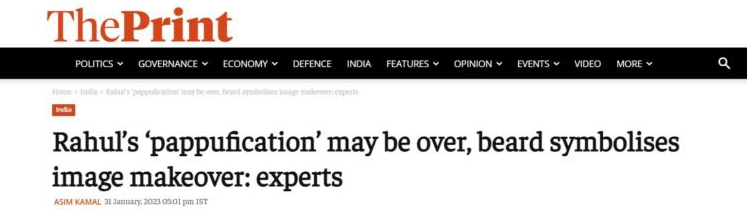
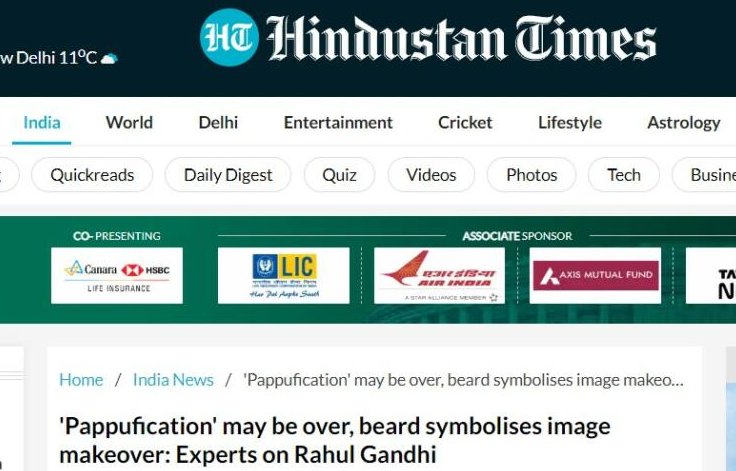
While, his favourite chess player, Garry Kasparov, soiled Rahul Gandhi’s efforts by calling his Chess video a “dabbling” move, the grand old party had earlier exploited his pass time activities to present him as a Sporting legend. They have flaunted these Sporting skills of Rahul Gandhi in furtherance of their efforts to rebrand and catapult him as a “political leader” and relinquish the image of Pappu (De-Pappufication of the Congress leader).
(Congress re-launching Rahul Gandhi again and again aiming to ‘De-Pappufy’ the Congress leader, as once peddled by the Congress sympathising ecosystem.)
(Congress wants ‘De-Pappufication’, hence exploiting Rahul Gandhi’s pass time activities hoping to catapult him as a Sporting legend in National politics)
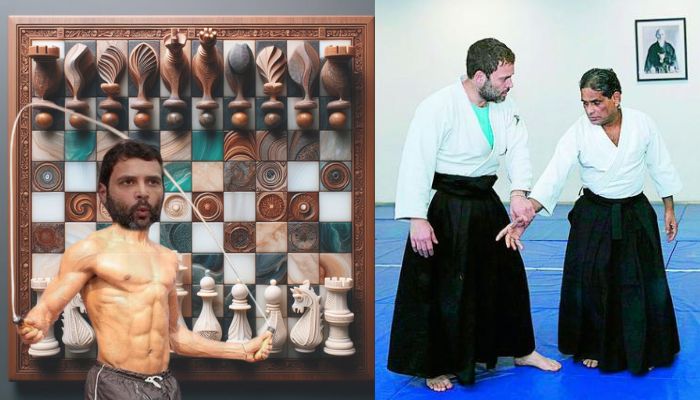
Strikingly, resembling Gurmeet Ram Raheem’s boastful description about himself, Rahul Gandhi had once introduced himself as a Sports enthusiast and a ‘pro’ in several sporting fieds.
In 2017, Rahul Gandhi had boasted, “I exercise, run, swim & also hold a black belt in Aikido but I never speak of these in public. Sports is important in my life.”
I exercise, run, swim & also hold a black belt in Aikido but I never speak of these in public. Sports is important in my life: Rahul Gandhi pic.twitter.com/UvZqNjQ8df
In the run-up to the 2019 Lok Sabha elections, the Congress leader flaunted his skills in martial arts. On several occasions, he highlighted that he is a ‘black belt’ in Aikido, a Japanese martial art form.
In 1989,National Rifle Association Of India Certified Rahul Gandhi is Position Holder in 25 Mtr.Centre Fire Pistol @ National Shooting Champ pic.twitter.com/BvwbDnudQx
Until now, Congress has only revealed that Rahul Gandhi is a black belt in Aikido, a national shooting champion, trained in Brazilian jiu-jitsu martial art, sword fighting, and an excellent swimmer, among many other secret hidden sporting talents. Additionally, the Congress leader is a trained Pilot and had also learnt the traits of ‘Boxing’.
#WATCH: Congress leader Rahul Gandhi doing push-ups and 'Aikido' with students of St. Joseph's Matriculation Hr. Sec. School in Mulagumoodubn, Tamil Nadu pic.twitter.com/qbc8OzI1HE
While the Congress hoped to use his sports skills to boost his political image nationally, it only fueled critics’ claims that he could excel anywhere but in politics.
Rahul Gandhi has abs, good swiming skills, dimples, and a black belt in Aikido. Sab kuch hai bhai ke paas except one thing needed to become a politician – Dimag.
All these efforts have faced harsh criticism due to the Congress leader’s dismal performance in electoral politics. In the vein of Game of Thrones, while Congress may wish to introduce him akin to how her courtiers introduced Daenerys Targaryen, in the political realm, he has turned out to be more like Jon Snow who knows nothing about ‘electoral success’ and the domain of his choosing.