Home Blog Page 1238

While Muslims insist that Bhojshala complex in Madhya Pradesh is Kamal Maula mosque here is the list of ancient evidence that proves them wrong

On March 22, Friday, a team from the Archaeological Survey of India (ASI) began a survey of the ancient Hindu place of worship- the Bhojshala complex situated in the tribal-dominated Dhar district of Madhya Pradesh.

The ASI team, comprising more than a dozen members, accompanied by senior local police and district administration officials reached the complex on Friday morning.

The survey began after the Madhya Pradesh High Court (Indore bench) on March 11 directed the Archaeological Survey of India (ASI) to conduct a scientific investigation, survey, and excavation at the Bhojshala complex. The high court granted the order for a scientific survey to the Archaeological Survey of India (ASI) based on multiple evidence and signs submitted before the bench.

Notably, the 11th-century Bhojshala is an ASI-protected monument. Hindus believe it is a temple of Goddess Vagdevi (Saraswati) but the Muslim side disputes it claiming that it is Kamal Maula Mosque.

During the excavation and floor-making operations of ‘Bhojshala’ in 1987, the Archaeological Survey of India (ASI) discovered over thirty-two idols of Hindu deities, including Lord Kuber.

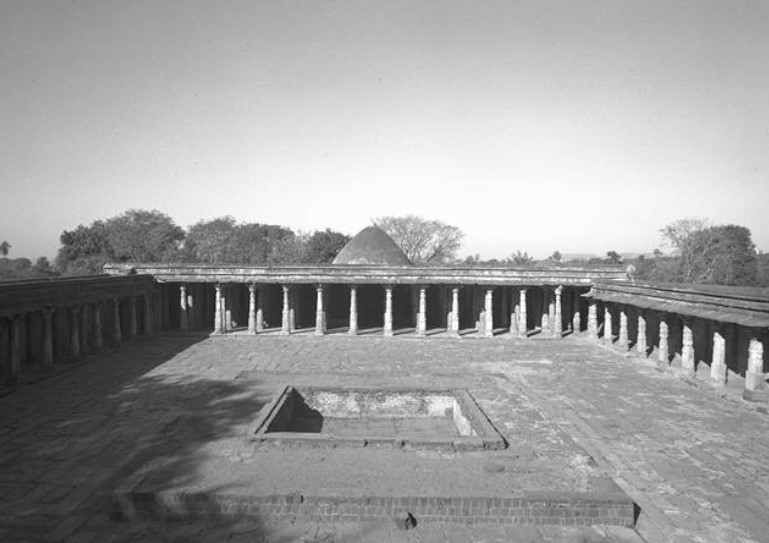
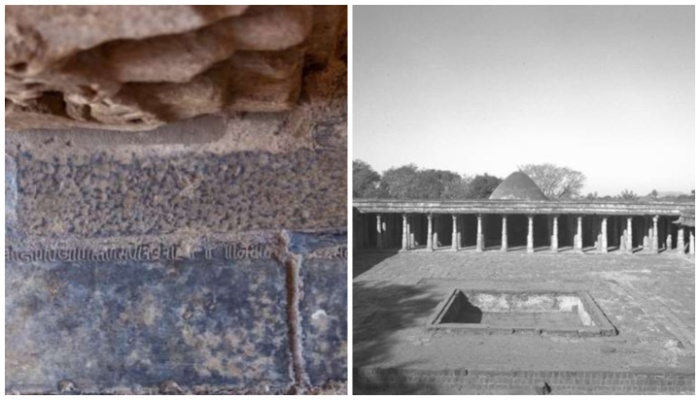
The pillars of Bhojshala are adorned with figurines of Hindu gods and goddesses. Eight lotuses were spotted on the roof above the pillars. The lotus is a vital part of Indian culture and a prominent and auspicious symbol in Hinduism. In fact, it is common for Hindu gods and goddesses to be depicted sitting on a lotus throne, as a gesture of divinity, purity, and power.

In addition to what has already been mentioned, a number of other artefacts unearthed within the Bhojshala complex in 1987 discredited the propaganda that the complex has always belonged to Muslims. The current Kamal Maulana Mosque, which was erected by Muslim conquerors after the temple was razed, has remnants of the Bhojshala.

The carved pillars used in the mosque are the same ones utilised in the Bhojshala. Engraved stone slabs affixed to the mosque’s walls still contain valuable works. These inscriptions go into great depth about Sanskrit grammar. Besides that, some inscriptions praise the emperors who came after Raja Bhoj. There are also inscriptions in classical Sanskrit with theatrical compositions. These inscriptions are notable for being written in characters from the 11th and 12th centuries A.D.

The temple was considered to be the centrepiece of Dharanagari’s 84 squares, the city of palaces, temples, universities, theatres, and gardens. The goddess Saraswati’s statue is presently housed at the London Museum. The royal poet Madan mentioned this Mata Saraswati shrine in his poems as well.
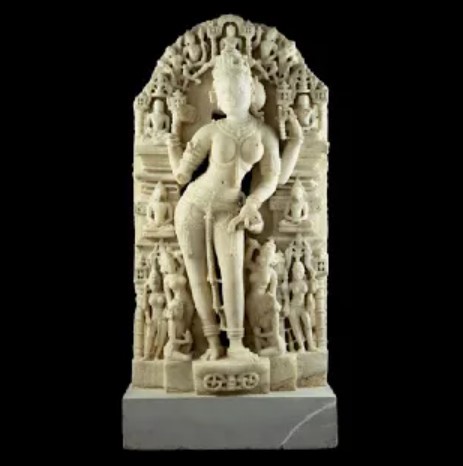
Saraswati Idol from Bhojshala currently housed at the London Museum

Hindu artefacts found during excavation in Bhojshala in 1987

  • There are many such pillars in Bhojshala where the idol of the Hindu God is seen destroyed. The conch and chakra are also visible.
  • A massive ‘yagya kund’ exists inside the premises, where yagya was practised for centuries during the king’s feast. In addition, the womb contains the state emblem of the Parmar dynasty.
  • Raja Bhoj had written 84 texts, out of which two instruments are also present, Kaalsarp Yantra, Siddha Yantra, Nagmani Bandh Yantra etc.
  • In the room occupied by ASI, there are statues of two gatekeepers on each side of the door with the names Jai and Vijay and above is the statue of Lord Ganesha.
  • ‘Om Namah Shivay’ is written in the inscriptions in Pali language.
  • Another black stone that has been preserved by the Archaeological Survey of India bears the writing Om Saraswati Namah. The word Sitaram is written in the inscription.
  • On the entrance to the temple’s sanctum sanctorum, there is a bell sculpture. Within the pillars of Bhojshala is a statue of Yakshini.
  • Adjacent to the Bhojshala complex is a small well known as ‘Akal Kuiya’. It is thought that the touch and anointing of Goddess Saraswati once cleaned its water. It is currently located in the Kamal Maulana complex.
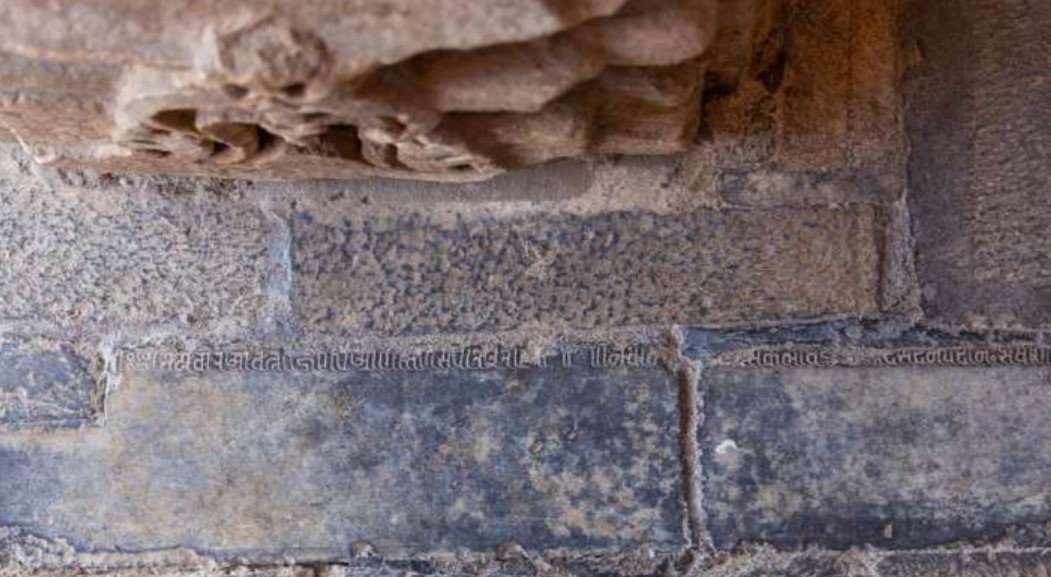
Image credit: India TV
Yagna Kund in Bhojshala

The Islamic invasion and destruction of the Bhojshala complex, Hindu students were massacred, temple destroyed

In 1305, 1401 and 1514 AD, Muslim monarchs repeatedly wrecked the majestic temple and centre of learning at Bhojshala. In 1305 AD, the ruthless and barbaric Muslim tyrant Alauddin Khilji destroyed Bhojshala for the first time. Nevertheless, the process of Islamic invasion began 36 years before, in 1269 AD, when a Muslim Fakir named Kamal Moulana reached Malwa.

Kamal Moulana utilised deceitful methods to convert many Hindus to Islam. He spent 36 years gathering extensive information on the Malwa area and turning it over to Alauddin Khilji. Khilji massacred 1200 Hindu students and teachers at Bhojshala for refusing to convert to Islam, and he demolished the temple complex. The current mosque has the name of the same Kamal Maulana.

Another Muslim conqueror, Dilawar Khan, demolished Vijay Mandir (Surya Martand temple) and attempted to turn a portion of Saraswati Temple Bhojshala into a dargah in 1401 AD. Muslims perform Namaz at the same Vijay Mandir today. Again in 1514 AD, one  Mehmudshah besieged Bhojshala and attempted to transform it into a dargah. He encroached on the area outside Saraswati Temple and established ‘Kamal Moulana Makbara.’ It is on this basis that Bhojshala is being claimed to be a Dargah.

In 1997, Congress leader and then CM Digvijaya Singh issued order permitting Muslims to offer Namaz every Friday but prohibiting Hindus from even entering the complex

In 1952, the Central Government gave up Bhojshala to the Archaeological Survey of India. 

Prior to March 12, 1997, Hindus were permitted to take darshan but unable to do puja. However, in 1997, CM Digvijaya Singh issued an order permitting Muslims to offer Namaz at Bhojshala every Friday but prohibiting Hindus from even entering Bhojshala. Hindus were only permitted to enter and offer puja at Bhojshala during Vasant Panchami.

Bhojshala was opened for Hindus in April 2003. Darshan was allowed to Hindu devotees every day, apart from Tuesday, when they may worship using flowers.

In order to regain complete access to the entire premises for worship, the current petition filed has stated that the destruction of a temple and its continuation in the same form is a continuing trauma for the worshippers, denying them spiritual power, and in such a situation, the worshippers’ lives remain in jeopardy, giving day to day tease and a feeling of humiliation done by the invader, and such continued wrong has to be rectified under the sweep of Article 13 (1) of the Constitution of India to protect the life and religious rights guaranteed under Article 21 and 25 of the Constitution of India.
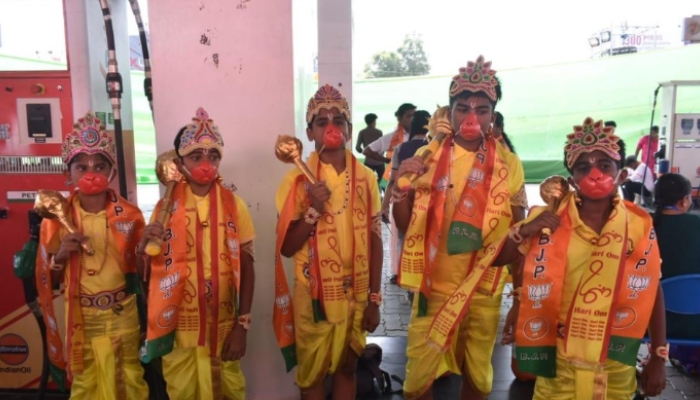
Coimbatore: Students dressed as Hindu deities and in saffron attend PM Modi’s roadshow, police books management of 3 schools over their presence

On Thursday, the Coimbatore City Police filed a case against the administration of three schools for taking 22 students to Prime Minister Narendra Modi’s roadshow on March 18th. Many of the students who attended the roadshow had donned saffron clothes or dressed as Hindu deities.

Chinmaya Matriculation School, Chinmaya CBSE School in Vadavali, and Chinmaya School in R.S. Puram had the students dressed as Hindu deities, wearing saffron cloth strips with party symbols.

The School Education Department, along with Assistant Returning Officer P. Suresh, launched an investigation and issued notices to the schools. Since this action violated the Model Code of Conduct (MCC), the Assistant Returning Officer filed a complaint with the Saibaba Colony police.

Subsequently, a case was filed under Section 75 of the Juvenile Justice (Care and Protection of Children) Act on Thursday.

Earlier, District Education Officer (primary schools) Punitha Anthonyammal and officials conducted an inquiry with the management and spoke with the children in the school.

Sources revealed that approximately 50 students were gathered at the Saibaba Colony junction on Monday evening. Allegedly, the management had “instructed” the children to participate in the roadshow, with some dressed as Hanuman. Activists demanded action against the school management, citing the enforcement of the model code of conduct.

In response to the allegations, district election officer-cum-collector Kranthi Kumar Pati ordered an investigation and directed the chief education officer to submit a report.

Delhi High Court dismisses Congress party’s petition challenging IT Department’s reassessment proceedings, read details of the case

The Delhi High Court on 22nd March rejected the Congress party’s appeals against the Income Tax Department’s three-year reassessment proceedings, dealing a major blow to the nation’s main opposition party ahead of the Lok Sabha election. “We dismiss the writ petitions,” declared a bench of Justices Yashwant Varma and Purushaindra Kumar Kaurav while pronouncing the significant judgement.

The political party submitted appeals against the tax reassessment actions that the authorities had started against it in the fiscal years 2014–15, 2015–16 and 2016–17. Congress argued that limitations prevented these proceedings. The high court had already reserved its order on 20th March. The Congress party’s senior counsel, Abhishek Manu Singhvi had contested that the IT department could have gone back to a maximum of six assessment years and that tax reassessment actions were bound by limitation.

According to the IT department, however, the Congress has “escaped” with around Rs 520 crore in income. After the revenue was estimated to be more than Rs 199 crore, the assessing officer submitted a tax demand of more than Rs 100 crore for the assessment year 2018–19.

Previously, the High Court rejected to intervene in the Income Tax Appellate Tribunal’s (ITAT) decision to not stay the IT department’s notice to Congress to collect over Rs 100 crore in overdue taxes. Purushaindra Kumar Kaurav and Justice Yashwant Varma announced that there was no reason to tamper with the 8th March order. However, the Delhi High Court had granted liberty to Congress to move the ITAT again in case of any change of circumstances.

The development transpired the day after the Congress accused the Narendra Modi administration in a press conference of severely damaging the party’s finances in the run-up to the Lok Sabha poll.

What is the tax case

The IT Department has found credible evidence linking Congress allies to the party’s cash donations and transactions in different states including Madhya Pradesh and Karnataka since 2019, according to a report in News18.

As a result, the IT Department initiated reassessment procedures for the assessment years of Congress returns from 2014–15 to 2020–21. The department believes that there were infractions pertaining to the Section 13 (A) tax exemptions claimed in those years as well. If proven, an extensive notice might also be served shortly to Congress.

According to sources, Congress has not been assisting with the case till now and has not responded to inquiries from IT regarding the merits, even though notices and summonses containing damning material have been sent to the party for clarification. Congress might have failed to complete its audited book of accounts, which would be a serious breach of Section 13(A) and subject the total income from 2014 to 2021 to taxation, per the IT Department’s reservations.

Sources highlighted that Congress filed writ petitions against each of the seven years. On 20th March the Delhi High Court heard the pleas for the first three years and junked the motion two days later.

Other two cases

According to sources, Congress lost its exemption from taxes for the assessment year 2018–19 since it submitted its returns 33 days later than expected and acknowledged receiving financial donations totalling Rs 14.49 lakh. The Congress had asked for that year’s income of Rs 199 crore to be excused.

Sources reported that there is no legal provision for a lower penalty once you lose your exemption under Section 13 (1), putting all of your income subject to tax. As a result, the IT Department served the Congress with a notice worth Rs 105 crore in 2021, requiring that it pay Rs 21 crore or 20% of the total to halt the full recovery. However, Congress only deposited Rs 78 lakh and the Commissioner of Income Tax (Appeals) rejected its request. The Delhi High Court also denied the Congress party’s plea on 13th March.

Therefore, on 16th March, the IT Department was able to retrieve Rs 135 crore from Congress bank accounts, which comprised a demand of Rs 102.66 crore and interest of Rs 32.4 crore.

 IT Department served Congress with a demand notice for Rs 53 crore related to the 1994–1995 assessment year. Sources pointed out that the IT Department raised the alarm about this particular financial year’s assessment as early as 1997, citing the denial of the Section 13(A) exemption for a lack of audited accounts. Before the High Court decided in favour of the IT Department in 2016, the case was pending in IT tribunals and the High Court for several years.

According to sources, Congress has filed an appeal with the Supreme Court in this case, and the hearing is scheduled for 1st April. They added that the IT Department has been “lenient” with Congress in the past because the party has been granted a lot of time and certain lawsuits have been dragged out for years. The High Court’s strong verdicts which have criticised Congress for acting leisurely to resolve these issues were also mentioned by the sources.

Gujarat: CCTV footage shows man in skull cap trying to set fire to Sankaracharya Math in Bharuch; note threatening priest with ‘Sar Tan Se Juda’ found

On March 22, Friday, a man allegedly attempted to burn down a Shankaracharya Math in Gujarat’s Bharuch town. He also reportedly left behind an ominous message for its priest, threatening to behead him.

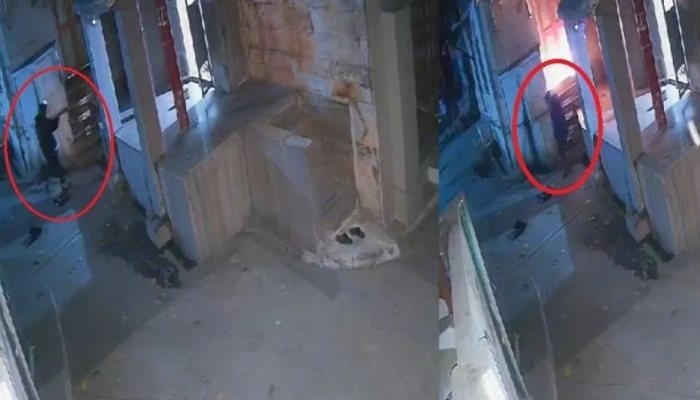
The CCTV footage of the incident showed a man in a black shirt and a skull cap hurling something towards the door of the religious institution located in the Navchowki Ovara area alongside the Narmada River before igniting it. Among the items tossed towards the door, were papers bearing a handwritten message reading ‘Gustakh Pir Ki Saza, Sar Tan Se Juda‘ were discovered.

Based on the CCTV footage, the Bharuch police set up seven teams, including the local police station, local Crime Branch, Special Operations Group and other units, to track down the accused.

“Around 5.30 am, a person threw some material on the door of the math in an attempt to set it ablaze. CCTV has captured the act. We have formed various teams to conduct a detailed investigation into the case. An FIR has also been registered in this regard,” Mayur Chavda, the district superintendent of police told reporters, confirming the incident at the Math.

Muktanand Swami, a maths priest, told reporters that he was present when the incident unfolded.

According to Swami, the Shankaracharya Math and the two nearby temples are part of Dwarka Sharda Peeth, one of the four prominent peeths, founded by the Aadi Sankaracharya.

According to the seer, the man entered the Math premises around 5.30 am, poured some kind of inflammable liquid all over the premises and set fire to a part of the Math. “Before fleeing he also threw some bits of paper that had some threatening messages in the air. On checking the CCTV footage, we saw that he had entered from the back door,” Muktanand Swami said.

“When I returned to my math after performing puja at the adjoining temple around 5 am, my neighbour Dilip Dave came running and informed me that a person was throwing some material on the math’s door. That man then set ablaze the door, which I doused afterwards,” said the priest.

It should be mentioned that Sri Shankaracharya Math Dwarkashardapith is in charge of overseeing the Sri Pashupati Mahadev Temple, where the incident took place. Local Hindus were incensed at the occurrence, and activists from several organisations came to the temple as soon as it was reported. Following that, stringent plans were put in place to avoid any unpleasant incidents, and the local police were also informed.

Notes with ‘Sar Tan Se Juda’ scribbled thrown inside the Sankaracharya Math in Bharuch

After reviewing the CCTV footage, the police discovered that the miscreant entered the building from the riverbank and made his way to both the math and the temple.

The police said that the culprit tried to set fire to the premises by setting the door ablaze and also left behind some pieces of paper, one which contained a sinister threat for the Math’s priest “Gustakh Pir Ki Saza, Sar Tan Se Juda”.

“AAP not a party but a company”: From Arvind Kejriwal being kingpin to how proceeds from liquor scam were used for elections, here is what all ED told the court

On Friday (22nd March), the Enforcement Directorate told the Rouse Avenue Court that Delhi CM and Aam Aadmi Party supremo Arvind Kejriwal is the “kingpin of the liquor scam”. ED also said that “key conspirator” Kejriwal was directly involved in framing the now-scrapped Delhi liquor policy. ED made shocking revelations before the court while seeking a 10-day remand of Arvind Kejriwal. The Delhi CM has been presented before the court after his arrest by ED last night.

Additional Solicitor General SV Raju told the court, “Delhi Chief Minister Arvind Kejriwal is the main conspirator. He conspired with some other leaders and was directly involved in the implementation of the liquor policy.”

ASG Raju further informed the court that CM Kejriwal was involved in the handling of proceeds of crime as well in the Goa election campaign. Moreover, Kejriwal was continuously in touch with the then deputy CM Manish Sisodia.

He added that the accused Vijay Nair was residing in a house near Kejriwal’s residence. Nair was staying in the house given to AAP leader and minister Kailash Gahlot. Nair acted as the middleman between the “South Group” and the Aam Aadmi Party. Manish Sisodia called Vijay Nair to Kejriwal’s house and handed him documents pertaining to liquor policy.

Kejriwal handed Delhi liquor business to South Group in exchange for kickbacks

In another shocking allegation, ASG SV Raju told the court that Kejriwal had sought kickbacks from the South Group in exchange for favours. He added that the South Group got control over the liquor business in Delhi in exchange for the kickbacks sent to Kejriwal.

“I will now explain his role in using the proceeds of crime. Proceeds of crime are not only the Rs 100 crore bribe received but also the profits made by the bribe payers. It was over Rs 600 crore,” ASG VS Raju said in the court today.

Drawing attention to former Delhi deputy CM Manish Sisodia’s role in the scam, ASG Raju told the court that he also played a key role in the case. ED further stated that the allegations have been corroborated by Call Detail Records (CDR).

Money used to fund Goa elections

The ASG further told the court that Rs 45 crore were transferred to Goa via Hawala. The money was sent through four routes adding that ED has examined the money trail backwards. He added that the statements of the accused and witnesses have been corroborated with the call detail records (CDR).

“Arvind Kejriwal asked Sarath Reddy to trust Vijay Nair. The money was transferred twice, first 10 crores and then 15 crores through Bachi Babu. Kejriwal wanted funding for Punjab and Goa elections,” Raju added.

AAP not a party but a “company”: ASG tells court

ASG Raju said that Aam Aadmi Party is not a party but a “company” adding that every person responsible for the conduct of the company should be held guilty.

“Apart from personal liability, Kejriwal is also liable to be punished for vicarious liability. He is also responsible for the affairs of the AAP. He is responsible for the conduct of the party. He is the national convenor and responsible for the party at national level. He is the brain behind the party and controls its major activities,” ASG said.

Kejriwal deliberately disobeyed summons, did not cooperate in the investigation

Highlighting Kejriwal’s perpetual defiance of ED summons and reluctance to cooperate in ED’s probe into the liquor scam, ASG said, “He has wilfully disobeyed the summons. The conduct of disobeying the summons. At the times of search, he did not give correct facts. He was non-cooperative in the investigation. We want to interrogate him and gather information.”

As reported earlier, Aam Aadmi Party supremo Arvind Kejriwal was arrested on Thursday after an Enforcement Directorate team arrived at his residence to question him and carry out searches in connection with the liquor policy scam. He was subsequently taken to the agency’s headquarters.

Kejriwal has on Friday withdrawn his Supreme Court plea against his arrest ED. Abhishek Manu Singhvi, Kejriwal’s counsel, told the Supreme Court that he will argue the case before the Magistrate over his remand when the ED brings him before the Rouse Avenue court in Delhi.

Kejriwal’s arrest came after the Delhi High Court on Thursday refused interim protection from coercive action to Kejriwal and said at this stage the court is not inclined to grant interim relief. Notably, Kejriwal had over the past few months received numerous summons from the probe agency for questioning, however, Kejriwal skipped all of them. On Sunday, ED issued its ninth summon to CM Kejriwal in connection with two different cases – a liquor policy case and a case linked to the Delhi Jal Board. 

Allahabad HC declares ‘UP Board of Madarsa Education Act 2004’ unconstitutional, says it violates principles of secularism

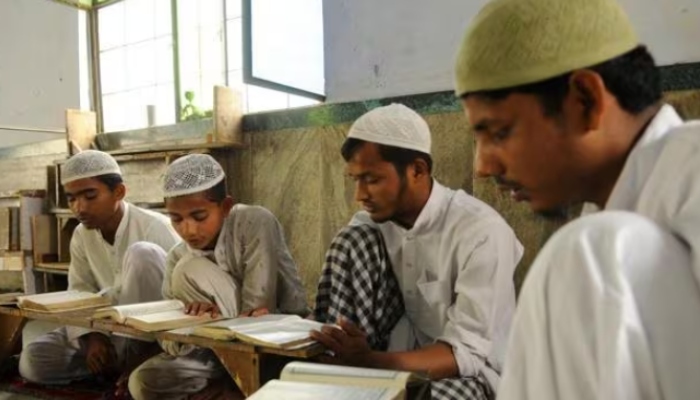
The Allahabad High Court (Lucknow Bench) pronounced the ‘UP Board of Madarsa Education Act 2004’ as unconstitutional, and infringing the fundamental principles of secularism.

While holding the legislation to be ultra vires, the Division, led by Justice Vivek Chaudhary and Justice Subhash Vidyarthi, also instructed the Uttar Pradesh government to devise a plan to accommodate students currently enrolled in madrasas in the formal education system.

This verdict comes months after the state administration resolved to inspect the state’s Islamic education establishments, and it also constituted a SIT in October 2023 to investigate madrassas’ money from abroad.

The High Court’s decision came in response to a writ petition filed by Anshuman Singh Rathore challenging the authority of the UP Madarsa Board, as well as objecting to Madarsa’s management by the Minority Welfare Department. 

During prior proceedings, the High Court had questioned both the Union of India and the State government about the rationale for operating the Madrasa Board under the purview of the Minority Department rather than the Education Department of the state.

Furthermore, the Court raised concerns about the possibility of arbitrary decision-making and emphasized the significance of transparency in educational institution management.

NCPCR’s efforts to get Madarsa students into the formal education system

It is important to note that the National Commission for the Protection of Child Rights (NCPCR) has been raising its voice to enroll students learning in Madarsa into the formal education system. Recently, on 14th March, it sought an inquiry into the ‘open schools’ established by the Jamiat Ulama-i-Hind, an Islamic organization with the support of the National Institute of Open Schooling (NIOS). The NCPCR stated that the Islamic organization was committing an organized crime by keeping the minor children studying in Madarsa away from formal education by allegedly providing them Islamic education under the guise of ‘open schools’.

It has previously requested all the Indian states and UTs to investigate all government-funded and recognized madrasas that admit non-Muslim youngsters. The NCPCR had also requested that the investigation include physical verification of the youngsters before admitting them to schools.

On 5th January 2024, it summoned the chief secretaries (CS) of 11 states and union territories (UTs) for the delay in complying with its directive to identify non-Muslim children, including Hindu children, studying in madrasas so that they could be admitted to schools. The summons had been issued to the CS of Haryana, Madhya Pradesh, Goa, Telangana, Jharkhand, Kerala, Karnataka, Chhattisgarh, Andhra Pradesh, Meghalaya, and the Andaman and Nicobar Islands.

The central body states that Article 28(3) of the Constitution prohibits educational institutions from obligating children to participate in religious teaching without parental assent. It stated that madrasas, as institutions, are primarily responsible for providing religious education to children and that it has been learned that those madrasas funded or recognized by the government provide religious education and very little formal education to children.

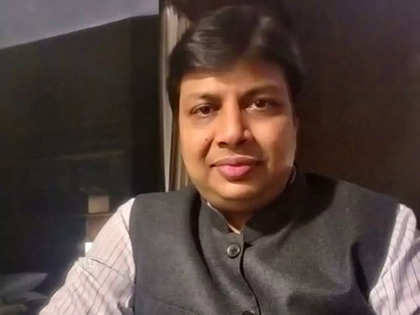
Gujarat Congress leader Rohan Gupta quits party citing ‘constant humiliation’ and ‘character assassination’, had earlier withdrawn from Ahmedabad East seat

0

Gujarat Congress leader Rohan Gupta resigned from the grand old party on Friday, citing “constant humiliation” and “character assassination,” days after withdrawing his candidacy from the Ahmedabad East constituency in the Lok Sabha elections 2024.

In a post on X (formerly Twitter), Rohan Gupta expressed his distress over senior Congress leaders linked to its Communication department. He mentioned that his father, who is currently battling serious health conditions, recounted instances of betrayal and sabotage over the past 40 years.

“He doesn’t want me to pay the same price as the whole family has seen the mental trauma I have gone through in the last two years, which was caused by the senior leader connected with the Communication Department,” Gupta wrote on the microblogging site.

The former Congress leader mentioned, “My father could foresee the same thing happening to me, which I couldn’t. He endured it and ended up deteriorating his health, undergoing bypass surgery, something he never wanted for me.”

Gupta stated that he is unwilling to endure any further assaults on his self-esteem. The person who has humiliated him for the past two years, as stated in the letter, will likely continue to do so in the future, with no one able to stop them.”With a heavy heart, I have made the difficult but necessary decision to resign in order to protect my self-respect. My conscience no longer allows me to remain in the party. This same leader has also harmed the party with his arrogant and rude behavior,” he added.

On March 19, Rohan Gupta withdrew from the Ahmedabad East Lok Sabha seat contest due to his father’s serious medical condition. Gupta, who was the Congress’ national spokesperson, was among the candidates declared by the party on March 12.All 26 Lok Sabha seats in Gujarat are scheduled for polling in a single phase on May 7, with vote counting set for June 4.

PM Narendra Modi conferred with Bhutan’s highest honour Order of the Druk Gyalpo in Thimphu

0

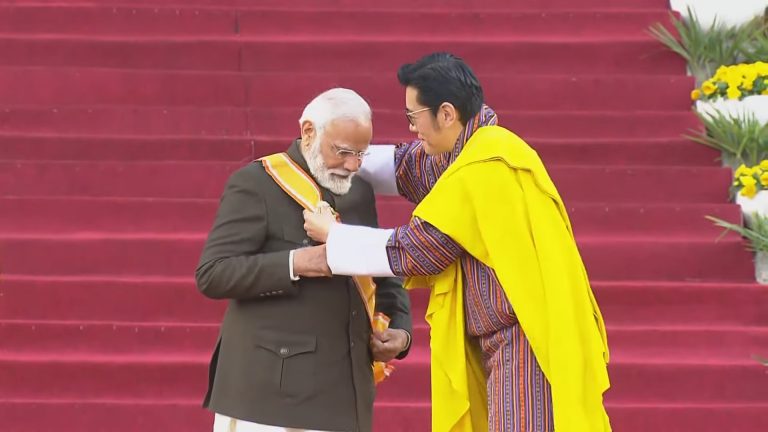
King of Bhutan conferred on Friday Prime Minister Narendra Modi the Order of the Druk Gyalpo, the highest honour of the Himalayan country.

As per ranking and precedence established, the Order of the Druk Gyalpo was instituted as the decoration for lifetime achievement and is the pinnacle of the honour system in Bhutan, taking precedence over all orders, decorations and medals.

Earlier PM Modi, who is on a two-day state visit had called on Bhutan King Jigme Khesar Namgyel Wangchuck at the Tashichho Dzong Palace in Thimphu.

He also attended a cultural programme at the Tendrelthang Festival Ground in the presence of Bhutan King.

Earlier, PM Modi received a rousing welcome from the people who turned out in large numbers to accord a warm reception in Bhutan.

In an unprecedented welcome for PM Modi in Bhutan, people lined up the streets across the entire stretch of 45 kilometers from Paro to Thimphu. Hundreds of locals awaited Prime Minister Modi’s arrival at the palace.

After he arrived at the Tashichho Dzong Palace earlier today, PM Modi received a ceremonial welcome there.

During his visit to Bhutan, PM Modi will attend various programmes to further enhance India-Bhutan bilateral partnership.

PM Modi also received a special welcome at his Hotel in Thimphu as youngsters from Bhutan gave a cultural performance of Garba on the song written by PM Modi. Making the Gujarati folk dance more graceful, youngsters wore Gujarat’s traditional attire, Ghagra-choli and Kurta Paijama.

The performance was staged after PM Modi interacted with the members of the Indian diaspora and the local people of Bhutan who gathered to welcome him outside the Hotel in Bhutan’s national capital, Thimphu.

The members of the Indian community on meeting PM Modi expressed their happiness and said that they felt honoured to meet PM Modi.

India and Bhutan share a unique and exemplary bilateral relationship founded on mutual trust, goodwill, and understanding.

Formal diplomatic ties between the two countries were established in 1968, with the cornerstone being the Treaty of Friendship and Cooperation signed in 1949 and subsequently renewed in February 2007.

Over the years, high-level exchanges have played a pivotal role in nurturing the strong bond between India and Bhutan.


This news report is published from a syndicated feed. Except for the headline, the content has not been written or edited by OpIndia staff)

TMC exploits death of Hindu Bengali, claims victim died due to CAA but forgets how Mamata Banerjee fearmongered about the law before his death

A day after the death of a youth named Debasis Sengupta in the Subhashgram neighbourhood in the South 24 Parganas district of West Bengal, the ruling Trinamool Congress (TMC) government in the State began exploiting his death for political gains.

In a tweet on Thursday (21st March), the official X (formerly Twitter) handle of the TMC claimed that Sengupta committed suicide due to the ‘fear’ of implementation of the Citizenship Amendment Act (CAA) and National Register of Citizens (NRC). It wrote, “The disastrous impacts of the Modi Government’s catastrophic decision!”

“Debasis Sengupta, a 31-year-old resident of Netajinagar committed suicide and was brought dead at the Sonarpur Rural Hospital. His family members clarified that Debasis had been having frequent panic attacks over his citizenship being revoked as a consequence of CAA and NRC,” the party further claimed.

It alleged, “Narendra Modi is out for blood and he will stop at nothing. Let this be on your conscience, Modiji!”.

The party shared a video of relatives of Debasis Sengupta, who was heard telling TMC councillor Arup Chakraborty that the victim was tensed about the implementation of the CAA and NRC in the country.

“He had lost his mind over the NRC/ CAA. He was worried about being sent to Bangladesh. He used to say that he did not have all the documents (like local card). He did not come from Bangladesh. He was born here,” the aunt of the deceased man said.

While indicating that he was not fully stable, she continued, “He began panicking. I used to tell him to not watch YouTube and to be aware of the fake news disseminated there.”

Thereafter, TMC leaders used this statement of the aunt of the deceased youth to allege that he killed himself as a result of the enactment of the Citizenship Amendment Act.

TMC Chandrima Bhattacharya alleged that the untimely death of Debasis Sengupta was the ‘grim impact of the Modi Govt.’s forceful CAA implementation.’

TMC leader Kunal Ghosh alleged that Debasis Sengupta took his own life due to the ‘constant fear’ of detention camps and incarceration. “At one point, the mental pressure became too much that he committed suicide,” he claimed.

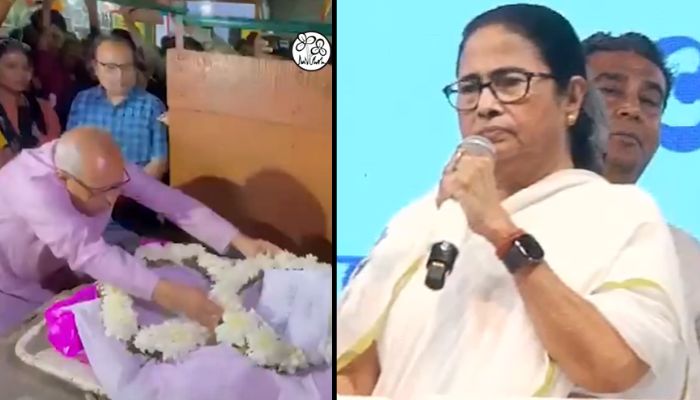
While making a political spectacle over the unfortunate death of the young man, TMC leaders lined up to garland the dead body of Debasis Sengupta.

A week before the death of Debasis Sengupta on 20th March this year, the West Bengal Chief Minister left no stone unturned in fearmongering about the CAA and NRC.

During a public meeting in North 24 Parganas on 12th March this year, she claimed, “You will not get the benefits of schemes such as Swasthya Sathi, Lakshmir Bhandar, Widow Pension Scheme, Old Age Pension…You will first be rendered illegal and there is no guarantee that you will ever be considered legal by this government.”

“Remember, this is a jumla by the BJP. If anyone gets citizenship, then, I will have no problem. I will be happy. Give the power at the hands of the District Magistrate (DM), like it used to happen before. Why did the Centre keep the power with themselves?” Mamata Banerjee alleged.

She brazened out,”First they will declare people as illegals and intruders. So whoever was a citizen will be rendered illegal. If this law (CAA) is applied, then, there will be no clarity. I have taken the opinion of legal advisors and they told me that the law has been brought to torture and harass people.”

“You cannot get the benefits of the scheme before elections but they took away your rights with the implementation of CAA. They took away your properties, Aadhar cards…” Mamata Banerjee continued.

“Whoever is happy now, read my book and find out about the dangers of the CAA. Two people will get citizenship and 8 others will be excluded. Will they send those 8 people to detention camps?” she alleged.

While continuing her rumour mongering, the West Bengal CM said, “Do not fall for their words…BJP will promise you a lot of things. They are liars and jumlabaaz.” She claimed that people of the Northeast, the Muslim and the Hindu communities across India are crying over CAA.

Mamata Banerjee then repeated the lie that the Aadhar cards of Mathuas and Namashudras in West Bengal have been suspended.

While TMC is busy politicising the untimely death of 31-year-old Debasis Sengupta, it must be mentioned that the party supremo has been at the helm of peddling disinformation about the CAA and the NRC.

Future Gaming gave ₹542 crore to TMC: Top 10 donors of 7 parties, who did top 5 companies donate to, and more: Read full analysis of Electoral Bonds Data

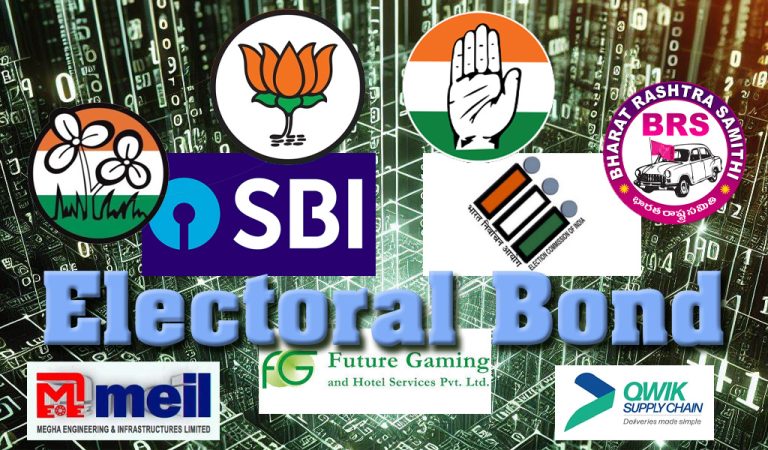
The Election Commission of India on 21th March published the detailed Electoral Bond data submitted by the State Bank of India on the orders of the Supreme Court of India. This data includes the Alphanumeric numbers corresponding to each electoral bond purchased by donors and encashed by political parties. Although the data has been published in two separate PDF files, it is possible to link donors with parties, using the Alphanumeric provided by SBI.

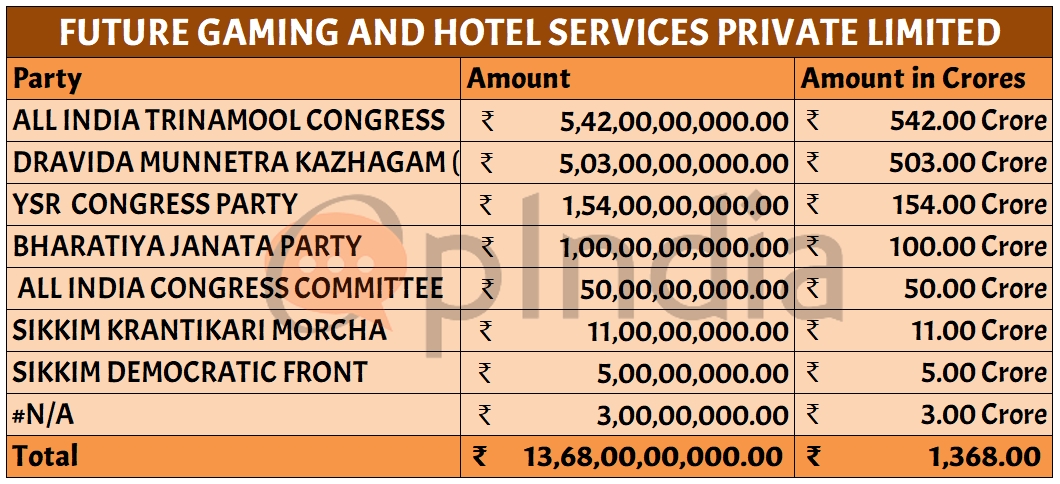
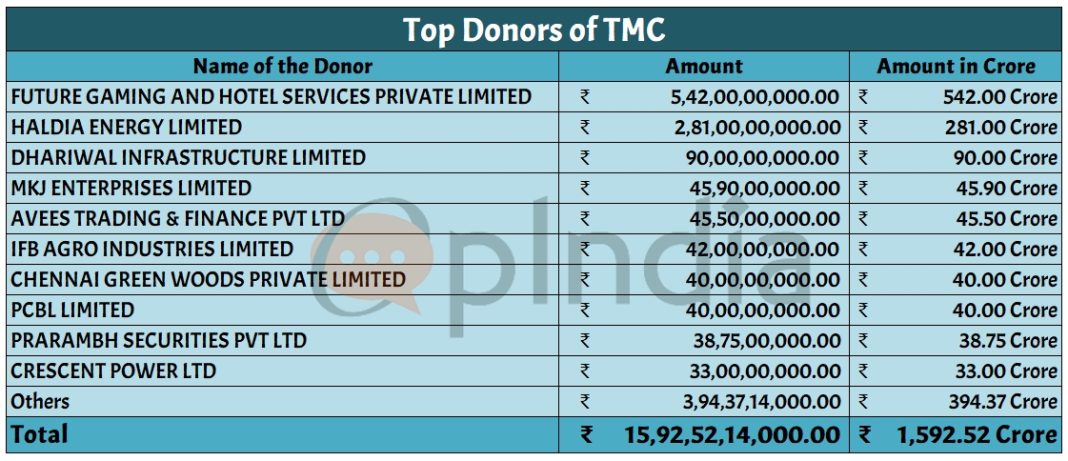
After analysing the data, it can be seen that Future Gaming and Hotel Services Private Limited, the scam-tainted lottery company, donated a whopping ₹542 Crore to Trinamool Congress. Earlier DMK had disclosed that it received ₹509 from the Company. Now, it can be seen that TMC received the highest amount from the company.

Notably, the amount DMK received from the company, as per the data published yesterday, is ₹503 crore, while the company had declared an amount of ₹509 crore. Similarly, there are mismatch in the data for purchasers and the data for political parties. While there are 20,421 rows in the party data, there are only 18,871 rows in the donor file, with a difference of 1550 records.

This is because, the data is only for the period from 12 April 2019 to 11 January 2024, the period for which the Supreme Court had sought the data. As the Electoral Bond Scheme was launched in January 2018, data for more than a year is included in the data published by SBI. As a result, bonds that were purchased before 12 April 2019 but encashed by parties after that date, have been included in the party data but missing from the donor data. Similarly, Electoral Bonds which were purchased during the last two weeks before 11 January 2024 but not encashed by the parties yet, are seen in the purchaser data but missing from the party data.

This has meant that, in the political party list, there are 1680 such Electoral Bond numbers which are not found in the Purchaser list, amounting to ₹623.21 crore. Similarly, there are 130 Electoral Bond numbers in the purchaser data which are not present in the party list, and the total amount for these bonds are ₹9.63 crore. As a result, there are a total of 1,810 Electoral bonds which can’t be linked to both donors and parties, and total amount of such bonds is ₹632.84 crore.

For the purpose of this report, we have considered only those electoral bonds that are present in both purchaser and party files. Therefore, the numbers reflected here are less than individual numbers for parties and donors.

Coming back to Future Gaming, it can be seen that the company donated ₹542 crore to TMC, ₹503 crore and ₹154 crore to YSR Congress party. BJP was the fourth highest recipient with ₹100 crore.

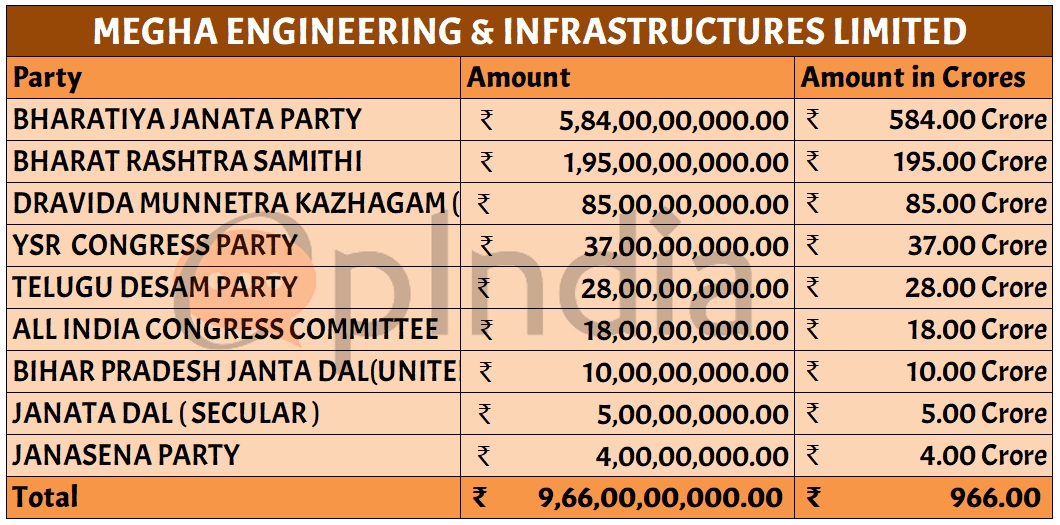
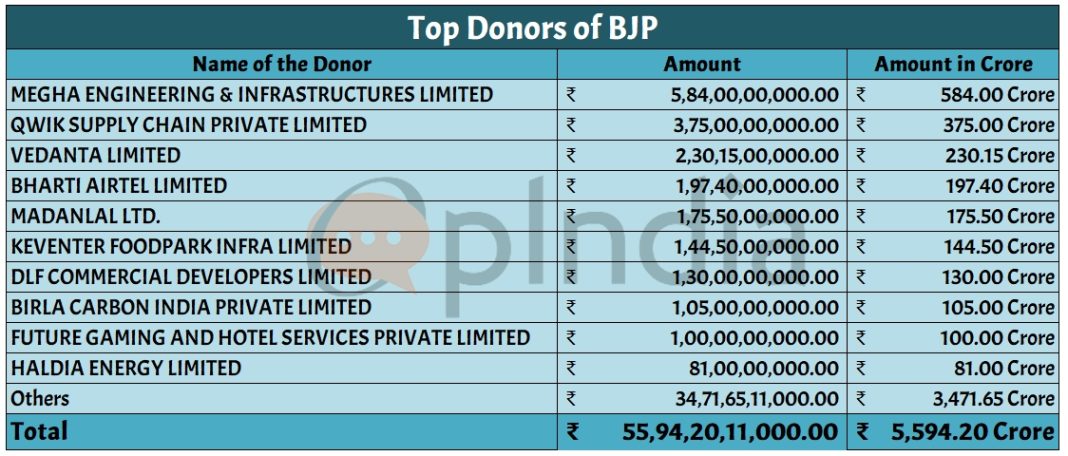
The second largest donor through electoral bonds is Megha Engineering, and there were allegations by the left-liberal camp that the company donated heavily to BJP in exchange for getting large infrastructure projects. The data shows that although BJP received ₹584 crore, the highest amount of donation from the company, it also made significant donations to non-NDA parties like BRS (₹195 crore), DMK (₹85 crore) and YSR Congress (₹37 crore) etc.

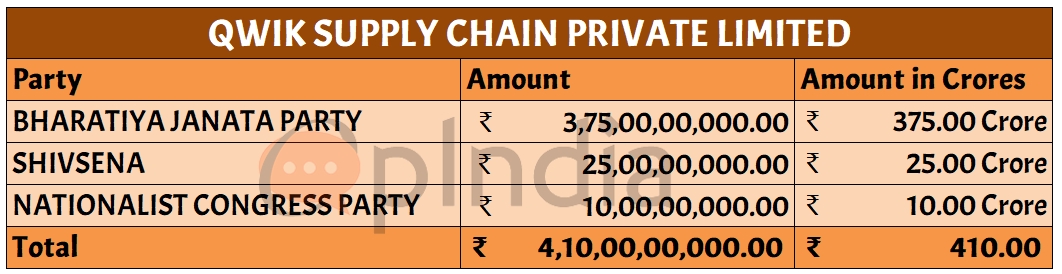
Qwik Supply Chain Private Limited, a logistic partner of Reliance group, donated ₹375 crore to BJP through electoral bonds. The company also gave ₹25 crore to Shiv Sena and ₹10 crore to NCP.

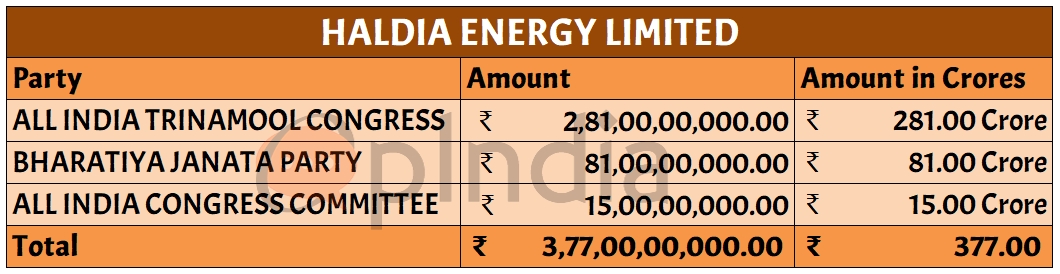
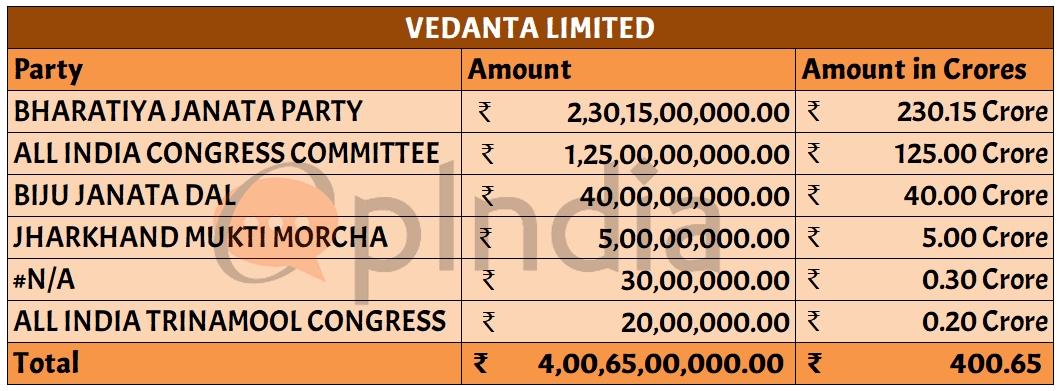
Another top donor was Haldia Energy Limited, which gave ₹281 crore to TMC. On the other hand, the top donation by Vedanta Group was for BJP, at ₹230 crore.

If we look at partywise data for top receivers of Electoral Bonds, we can see that Megha Engineering, Qwik Supply Chain, Vedanta, Bharti Airtel and Mandanlal Ltd were the top five donors of BJP. Among these, Megha Engineering gave ₹584 crore, which the highest amount given to a company by a single donor during the period. Among the top 10 donors for BJP, the top 9 gave over ₹100 crore.

TMC, the second-highest recipient of Electoral Bonds, received ₹542 crore from Future Gaming, the second-highest amount given to a party by a single donor. TMC also got ₹281 crore from Haldia Energy.

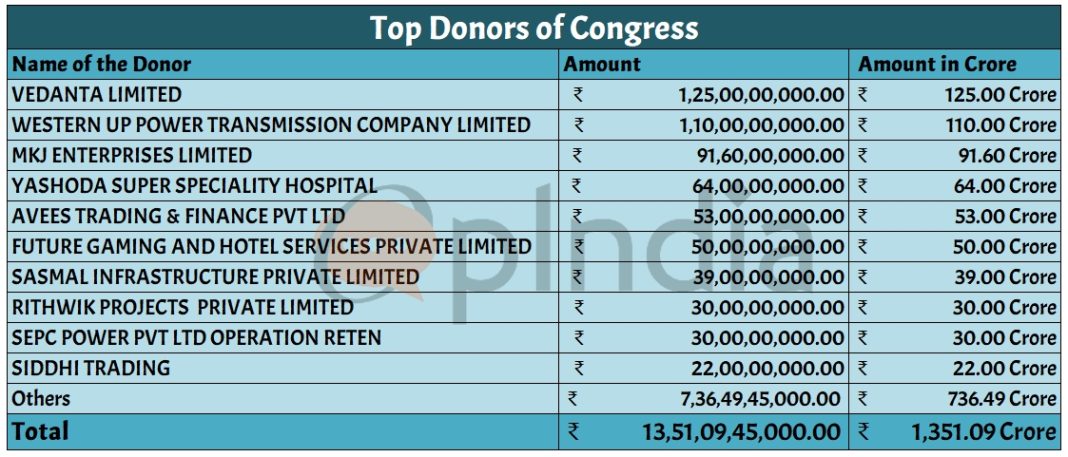
Congress received the highest amount of ₹125 crore from Vedanta, followed by ₹110 crore from Western UP Power. The party got ₹50 crore from Future Gaming.

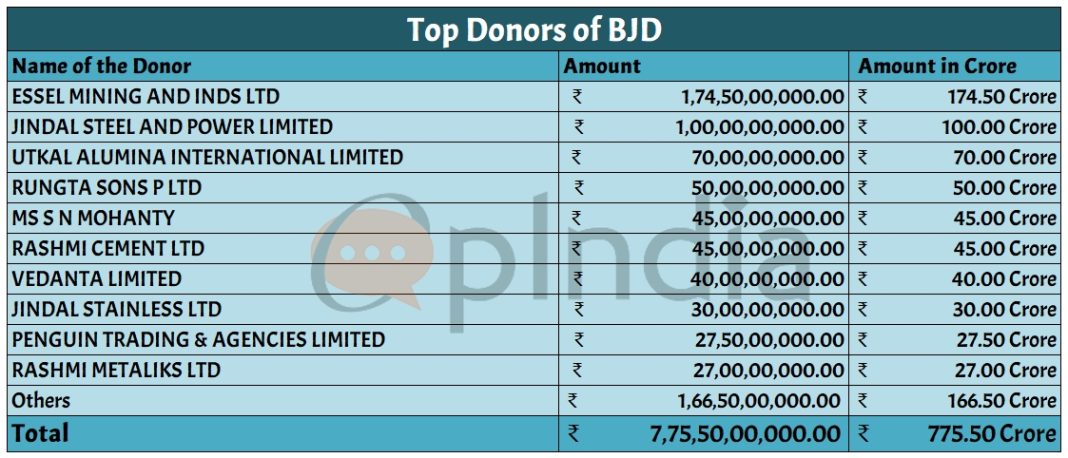
BJD received most of the contributions from companies involved in mining and related industries, like Essel Mining (₹174.5 crore), Jindal Steel (₹100 crore), Utkal Alumina (₹70 crore) etc.

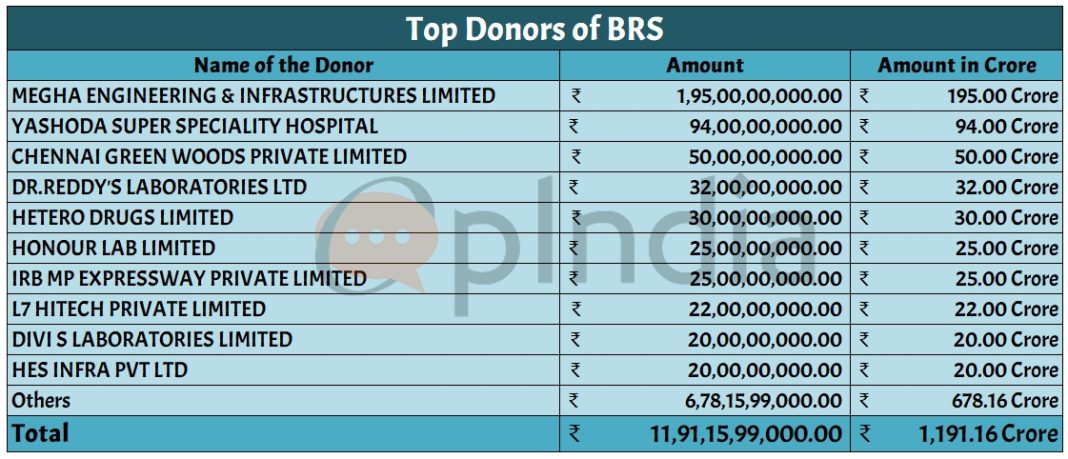
Megha Engineering was top donor for BRS with ₹195 crore, followed by Yashoda Super Speciality Hospital (₹94 crore).

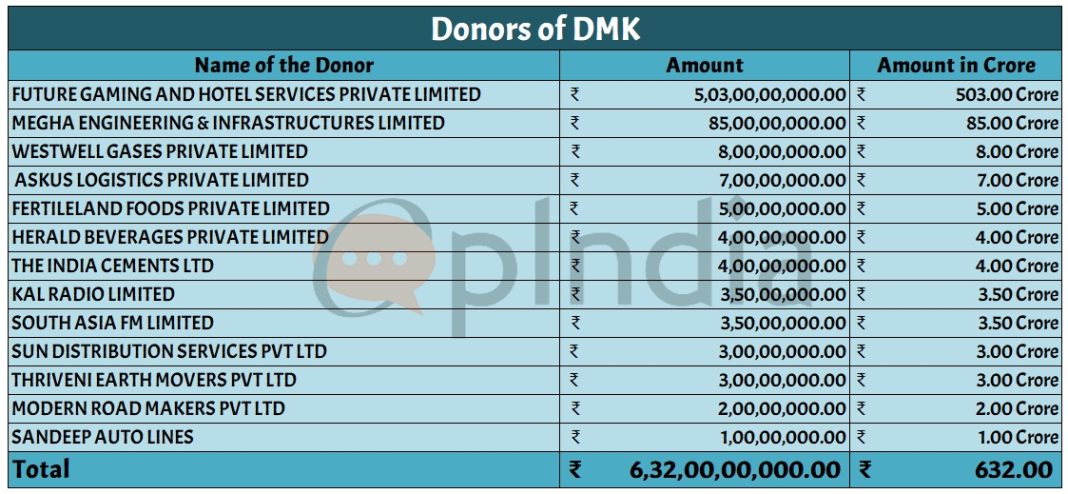
DMK received almost all of electoral bonds from just company, Future Gaming and Megha Engineering. The party received must less amounts from some other donors.

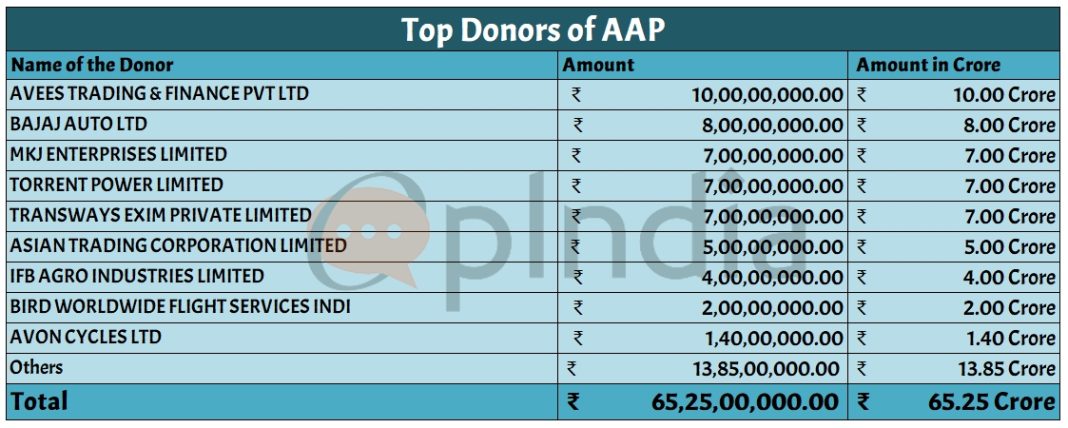
AAP received a total of ₹65.25 crore in electoral bonds during this period from companies like Aveer Trading, Bajaj Auto, MKJ Enterprise, Torrent Power etc.

As mentioned above, the numbers given here are for only those Electoral Bonds that are present in both donor and party data. We have excluded 1,810 records worth ₹632.84 crore which are present in only one dataset. Therefore, the actual amounts received by parties and donated by the purchasers of Electoral Bonds will be higher.