Home Blog Page 1482

Karnataka: ‘Shrikanth Pujari may be released tomorrow’, informs the Kar Sewak’s lawyer

0

Amid a heated exchange of arguments between BJP and Congress in Karnataka over the arrest of Hindu activist Shrikanth Pujari for his alleged involvement in the Babri Masjid demolition riots in 1992, his advocate Sanjeev Badasaka on Friday asserted that the leader could be released by Saturday if the court passes an order in their favour.

Speaking to ANI, over the arrest of Hindu activist Shrikanth Pujari, advocate Sanjeev Badasaka said “Yesterday an argument happened, we convinced very well before the Court. The matter was posted for orders. We hope that the Court passes an order in our favour. If the Court passes an order in our favour then he may be released tomorrow evening. The matter has been posted for bail orders,” he said.

Meanwhile, Leader of Opposition in Karnataka, R Ashok alleged that the reason behind the arrest of the Hindu activist is the scheduled grand consecration of Ram Mandir on January 22.

“Congress party arrested a ‘Karsevak’ because the Ram Temple is going to be inaugurated this month, to create fear among the people of Karnataka. BK Hariprasad has already given a statement of a ‘Godhra-like’ incident re-entry in Karnataka. Siddaramaiah went one step ahead and arrested a ‘Karasevak’, he said.

Karnataka BJP president BY Vijayendra on Tuesday accused the Congress-led state government of being “anti-Hindu”.

“Karnataka government is proving again and again that it is an anti-Hindu government. Yesterday in Hubballi, they reopened a 31-year-old case, and Hindu worker Srikant Poojari was arrested; we strongly condemn this,” Vijayendra said.

However, the Congress party refuted all allegations of “political vendetta” in connection with the arrest of a man linked to the riots that took place after the Babri Masjid demolition in 1992.

Speaking on the arrest, CM Siddaramaiah asked, “What should be done to the wrongdoers? Should we just leave them? We have told the police to dispose of old cases. No innocents have been arrested. We will proceed according to the court’s direction,” he said while speaking to reporters during his visit to Basapur Airport in Koppa.

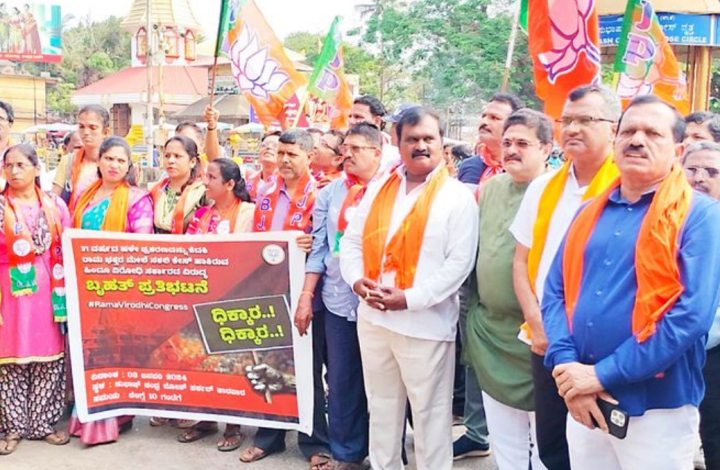
The Bhartiya Janata party staged a protest in front of the town police station against the arrest of the Hindu leader. 

(This news report is published from a syndicated feed. Except for the headline, the content has not been written or edited by OpIndia staff)


Did you know that a dumping yard in Rajasthan’s Kishangarh is famously known as the Switzerland of Rajasthan? Here’s why

In Rajathan’s Kishangarh, a dumpyard for marble slurry has become the dream destination for many. Famously known as the Switzerland of Rajasthan, the Kishangarh Dumping Yard is not your ordinary dumping yard.

Marble slurry is basically the powdered waste released while cutting marble.

The area is located about 90 kilometres from Jaipur and 18 miles northwest of Ajmer. It is also known as the Ice Mine of Rajasthan owing to the snow-like white landscape spread across 82 acres covering around 332 bighas of land.

The layers of marble slurry overlapping each other give it a look like that of a snow-clad Kashmir valley and a blue lake gives it an Iceland-like look. The location is a hot choice for the film industry and influencers alike as it offers the perfect design set up and instagrammable pictures and videos at afforable prices.

The location is also a preferred destination for wedding photography. It was reportedly in 2003 that the Rajasthan State Industrial Development and Investment Corporation (RIICO) and Kishangarh Marble Association started disposing marble slurry from nearby processing units into the ground.

It is since then that the landscape has been filled to a great height since decades of marble slurry dumping. White trees have also been added for beautification ever since tourism increased. The height of the dump is now raised to about 15-20 metres.

The entry here is free of cost. However, commercial shooting, wedding photography are charged and DSLR charges are extra too.

Charges are Rs 50,000 for commercial video shoots and Rs 5,000 for wedding photography.

Moreover, a confluence of movies and wedding shoots is born here in the marble dump yard. While the demand for pre-wedding shoots is skyrocketing, the poses preferred by many couples is the signature ‘Suraj hua madham’ pose and such.

Celebrities like Anil Kapoor, Kapil Sharma and Tiger Shroff have shot here too. Naturally, the location has provided a big boost to tourism in an otherwise industrial city.

Kishangarh was once the capital of a 400-year-old kingdom mainly known for its art of miniature paintings. Today, it is the largest supplier of marble in Asia.

Kanan Saxena, head of zoology department at Meera Government Girls College, Udaipur, report said, “Slurry is basically calcium carbonate added with other minerals or chemicals like dolomite, gypsum and sulphates. It destroys the soil cover and contaminates ground water, prohibiting vegetation.”

The marble particles are easily inhaled and can lead to respiratory diseases. The quality of air according to experts is also quite poor in the area to the extent that wounds take time to heal. It is also known to contaminate ground water to a large extent.

Even so, these factors don’t deter the commercial interests of the people for its easy-on-the-pocket facility. The Kishangarh dump yard fulfils the same purspose that a scenic winter valley in Kashmir and Himachal would but at a much lower price.

Moreover, it saves time too, particularly for the film industry to travel from Mumbai to Rajasthan.

With the craze for Instagram reels and YouTube shorts, young tourists now travel all the way to Kishangarh dumping yard just so that they can take click some pictures and record videos.

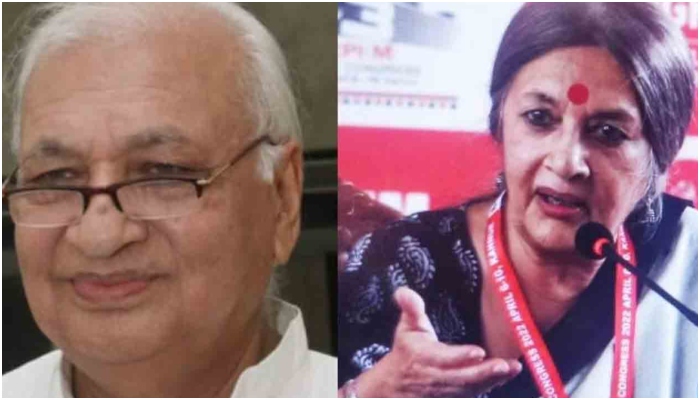
‘Has she fought any election?’: Kerala Governor Arif Mohammed Khan’s befitting response to CPIM’s Brinda Karat

As relations between the Kerala government and Governor Arif Mohammed Khan deteriorated, the Governor snubbed CPI(M) Politburo member Brinda Karat in Thiruvananthapuram on Friday (5th January). In response to Brinda’s remark that Arif Khan might run for Lok Sabha from Kerala on a BJP ticket, he asked, “Has she contested any election? I wish to treat her comments with the contempt it deserves.”

The Governor stated this shortly before departing for Mumbai, from where he will return in two days. Notably, there were no protests by CPI(M) student and youth wing activists, as seen in recent days, who waved black flags at him.

Regarding the lunch invite controversy, Arif Mohammed Khan explained that he did receive an invitation to the Christmas/New Year lunch thrown by Pinarayi earlier this week, but he did not go. When the media questioned him about his absence, he responded, probably referring to Pinarayi, “Do you ask questions like this to the others?”

He further rejected any disagreement with the state government, arguing that he was only carrying out his legal responsibilities.

This is a couple of days after Brinda Karat, senior leader and Politbureau member of the Communist Party of India (Marxist), slammed Kerala Governor Arif Mohammad Khan, saying it would be more suitable for the Governor of Kerala to immediately enter electoral politics.

“If the Honourable Governor is so interested in coming directly into politics. he should do so because the 2024 Lok Sabha election is scheduled to be held so it would be part of his political understanding,” Brinda Karat said.

“Perhaps it would be more appropriate for the Governor of Kerala to directly come into the electoral politics. Take the BJP ticket and fight for any seat in Kerala. Dudh ka dudh Pani Ka Pani ho jayega” she added.

Former Rajya Sabha MP Brinda Karat also stated that whatever the issue is, the Honourable Governor should discuss it with the Chief Minister rather than making public statements every day that discredit the governorship and discredit or attack the role of an elected government.

Arif Mohammed Khan, the governor of Kerala, and Chief Minister Pinarayi Vijayan are at odds after the governor accused the CM of employing goons to attack his car. The Governor had faced black flag rallies from the CPM’s student branch, during which his convoy was allegedly targeted. In his response, Kerala’s Chief Minister accused the governor of disturbing the state’s peace. The state has also filed a petition with the Supreme Court, claiming that the Governor refused to sign a number of bills.

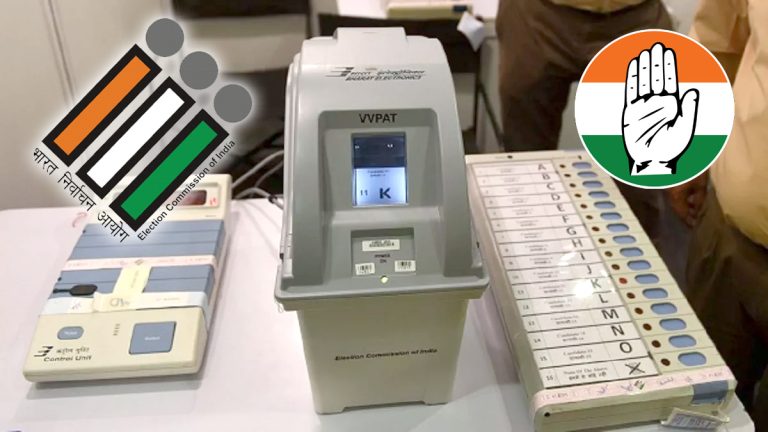
All queries already addressed, no new issue raised, have full faith in EVMs: ECI responds to fresh allegations on EVM and VVPAT by Congress

0

Refuting the Congress general secretary Jairam Ramesh’s allegations on Voter-verified paper audit trail (VVPAT) and Electronic Voting Machine (EVM), the Election Commission of India (ECI) said that the Commission has “full faith” in the use of EVMs in the election.

The reply comes after Jairam Ramesh wrote a letter to the Election Commission seeking an appointment to meet the delegation of INDIA bloc leaders to discuss the issue of Voter-verified paper audit trail (VVPAT).

Responding to Congress leader, the ECI stands firm asserting that literature in the public domain on EVM including the latest updated FAQs (85 Questions) answers all reasonable and legitimate aspects of the use of EVMs adequately and comprehensively.

“Rule 49A and 49M of Conduct of Election Rules 1961 governing VVPAT and handling of paper slips were introduced by INC on August 14, 2013,” ECI said.

“While responding to an earlier letter dated 09.08.2023, ECI earlier also on 23.08.2023 comprehensively addressed all queries and detailed material including updated FAQs, EVM Manual, Powerpoint presentation on EVM, Status paper on EVM, legal backing of the EVM ecosystem and the judicial validation through various judgments of Supreme Court and various High Courts over a credible 40 years journey of EVMs,” it said.

The Commission further said that the recent letter dated December 30, 2023, does not raise any un-responded issue on EVM/VVPAT.

“Memorandum dated August 9, 2023, has already been duly replied on August 23, 2023. Further, para wise reply to issues raised due to incorrect and inadequate appreciation of material available in the public domain in a follow-up letter dated 2nd October 2023 by Omar Hooda, in an individual capacity, is further replied by Annexure I to this letter covering all aspects of EVMs like non-tampering, non-hacking, microcontrollers, end-to-end verifiability, legal provisions, counting, technical competency, manufacturing, source code etc,” ECI responded to Congress leader.

They further stated that it is reiterated that material made available by ECI in the public domain on EVMs, including the latest updated FAQs, adequately and comprehensively covers all reasonable and legitimate aspects of the use of EVMs in the Indian election.

“The current letter dated 30th December 2023, said to be in sequence of the earlier letters, has no new assertions or reasonable and legitimate doubts which require further clarifications,” it said.

The Election body further stated that current EVMs in use in Indian elections are compliant with the extant legal framework created and strengthened by the successive Union Governments of the day and jurisprudence evolved over 40 years by the Constitutional Courts of India.

“Anything beyond existing legal framework and established jurisprudence is beyond the singular domain of the Commission,” it added.

“It is not out of place to mention Writ Petition (Civil) 6635/2021 and CM 20855/2021 in Delhi High Court and SLP (Civil) 16870/2022 filed against use of EVM/VVPATs in Indian election, wherein High Court and Supreme Court of India had not only dismissed the petitions but imposed cost of Rs 10,000/- and Rs 50,000/- respectively on the petitioner for filing publicity seeking frivolous petition,” it said.

The Commission further said that as mentioned various aspects related to VVPAT are sub judice in the Supreme Court of India in Writ Petition.

“Needless to further reiterate that political parties and candidates are associated at every stage of handling EVMs, starting from FLC, storage, movement, training, randomisation, commissioning, mock polls, start of poll, close of poll, counting etc,” it added.

The Commission further said that based on the outcomes of the elections conducted using EVMs, legal framework, established jurisprudence, technical security and administrative safeguards, the Commission has full faith in the use of EVMs in elections.

“It is beyond any explanation that out-of-context references are being made to other Countries and their Constitutional Courts about the use of EVMs in elections. Based on the outcomes of the elections conducted using EVMs (Annexure-II), legal framework, established jurisprudence, technical security and administrative safeguards, the Commission has full faith in the use of EVMs in elections,” it stated.

Earlier on January 2, Jairam Ramesh wrote a letter to the Election Commission seeking an appointment to meet the delegation of INDIA bloc leaders to discuss the issue of Voter-verified paper audit trail (VVPAT).

The letter stated, “…a request for an opportunity for a 3-4 member team of INDIA party leaders to meet with you and your colleagues and talk a few minutes to put forward our point of view on VVPATs. Surely, this is a perfectly reasonable and legitimate request.”

As stated in the letter, the INDIA parties’ delegation requested several times for a meeting to discuss Electronic Voting Machine (EVM)-related concerns through a memorandum.

Referring to ECI’s clarification of the delegation’s memorandum as ‘generic’, the letter stated, “There was no meeting or hearing provided to the INDIA Parties’ delegation despite repeated requests.”

“On October 2, 2023, a follow-up representation was sent by us through counsel. The representation raised specific concerns which remained unaddressed in the ECI’s clarification of August 23, 2023. No response was received on the same,” the letter mentioned.

The letter added that the delegation sought an appointment again on December 20, 2023, to “discuss and provide suggestions on the use of VVPATs” based on a resolution passed at the meeting of leaders of INDIA parties held on December 19, 2023.

“We have been trying to meet with the ECI to hand over a copy of this resolution and have a discussion but have not been successful so far in doing so,” the letter stated.

The fourth meeting of the Opposition’s INDIA bloc, held in Delhi on December 19, 2023, passed the resolution on Electronic Voting Machines (EVMs) and the suspension of MPs from Parliament.


(This news report is published from a syndicated feed. Except for the headline, the content has not been written or edited by OpIndia staff)
Union Home Ministry orders CBI probe into supply of sub-standard medicines in govt hospitals and Mohalla Clinics in Delhi

0

The Ministry of Home Affairs has on Friday recommended a Central Bureau of Investigation (CBI) probe into the alleged procurement and supply of spurious and non-standard drugs in hospitals run by the Delhi government and mohalla clinics, according to sources.

The said sources stated that the ministry today asked the CBI to register an FIR into the supply of “sub-standard” drugs to Delhi government-run hospitals.

Delhi government’s Directorate of Vigilance had on December 26 written to the Union Home Ministry, requesting it to assign the investigaton into the supply of “sub-standard” drugs to state-run hospitals to the CBI.

Delhi Vigilance Minister Saurabh Bharadwaj wrote to the Health Secretary about the supply of ‘not of standard quality’ drugs in the national capital, urging the latter to procure alternative arrangements.

“It has been brought to my notice that the Vigilance Department, GNCTD, has directed the secretary (health) to immediately remove the five drugs that were ‘not of standard quality’, from the stock where they have been supplied,” read the letter.

“It was observed that in the recent past, certain essential consumables like absorbent cotton wool and rolled bandages were found ‘not of standard quality’ and were removed from the stock where they were supplied. The hospital authorities then did not make any alternative arrangements for the same and consequently, patients were inconvenienced since they were required to buy these consumables out of their own pockets,” it said.

The letter further read, “Since the aforementioned five drugs, which are to be removed from the stock, are also essential in nature and required for treatment of hypertensive disorder, seizure disorder, gastritis infections and respiratory diseases, hence, alternative arrangements should immediately be in place to make them available so that the general public is not inconvenienced and the treatment of patients is continued uninterrupted.”

“You are directed to inform me regarding the alternative arrangements made by DGHS and the hospitals for making available the five medicines, amlodipine, levetiracetam, pantoprazole, cephalexin and dexamethasone, of standard quality and their fresh stock position in the healthcare facilities, at the latest within a week,” it added.

Earlier, Delhi Lt Governor V K Saxena had recommended a CBI inquiry into the matter to the Home Ministry.


(This news report is published from a syndicated feed. Except for the headline, the content has not been written or edited by OpIndia staff)

‘Have violated Islamic values’: Taliban now arrests women for wearing ‘bad hijabs’ in Afghanistan

The Taliban arrested women in Kabul for wearing “bad hijab” as part of their efforts to reinforce Afghanistan’s severe female dress code regulations, a spokesman at the country’s vice and virtue ministry said on Thursday, January 4.

The latest development adds to the growing difficulties encountered by Afghan women and girls, who are already barred from education, employment, and public settings by the Taliban since they seized power in 2021.

Abdul Ghafar Farooq, a spokesman for the vice and virtue ministry, did not indicate how many women had been jailed for what constitutes “bad hijab.” However, he said that the arrests were made three days ago. He added that female police officers were sent to arrest the women after they failed to follow the ministry’s advice of dressing appropriately.

The crackdown emphasizes the Taliban’s austerity measures since taking power in 2021, which are similar to those in neighbouring Iran, which has imposed the hijab for decades.

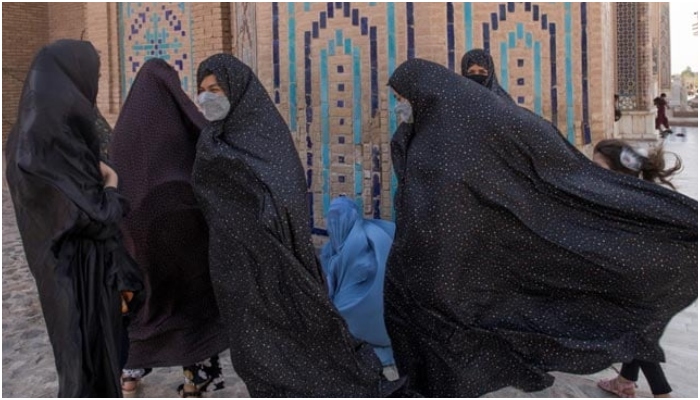
In May 2022, the Taliban issued a diktat requiring women to cover their faces and only reveal their eyes and promote the head-to-toe burqa, similar to restrictions imposed under the Taliban’s previous administration between 1996 and 2001. According to the Taliban spokesman, the ministry has been receiving complaints about women wearing incorrect hijab in Kabul for the past two years.

In response to the concerns, the ministry issued guidelines to ladies and asked them to carefully adhere to the dress code.

“These are the few limited women who spread bad hijab in Islamic society. They violated Islamic values and rituals and encouraged society and other respected sisters to go for bad hijab. Police will refer the matter to judicial authorities or the woman will be released on strict bail. In every province, those who go without hijab will be arrested,” Farooq warned.

Restrictions on women by the Taliban regime in Afghanistan

Notably, since the Taliban government came to power in Afghanistan in 2021, it has imposed draconian restrictions on the rights to freedom of expression, association, assembly, and movement for women and girls. Women are prohibited from holding important positions in all spheres of life and are required to adhere to the strict Islamic dress code. They are also excluded from employment and education. Women are also barred from entering parks and gyms and from travelling without a male relative. 

This recent restriction on women’s rights is part of a systematic and broader range of regressive measures taken by the Taliban since the terror outfit regained control over Afghan soil, two years ago. 

Teenage girls and women have been barred from classrooms, gyms, and parks. They have also been banned from working for the United Nations. Women are forced to wear only such dresses which would allow them to reveal only their eyes.

Women in Afghanistan can only work in hospitals as nurses and doctors. Currently, this is the last and only job women are allowed to perform under Taliban rule. However, media reports claim that these increasing restrictions have forced women to work secretively from home as teachers and makeup artists. 

From 1996 to 2001, the previous Taliban regime had also imposed sweeping restrictions on Women’s rights and curbed their freedoms. For Afghan women, the recent closure of beauty parlours reminds them of the dark times under the previous Taliban-controlled Afghanistan.

However, when the US invaded Afghanistan in 2001, beauty salons reopened and operated normally till the Taliban regained power two years ago. Although the Taliban didn’t immediately shut down hair and beauty salons, they asked shops to cover and spray-paint their windows and posters to conceal the faces of women on them. 

Last year in January, the Taliban government instructed the country’s female clothing retailers to mask the mannequins showing off the latest fashions. The mannequins with their heads covered have come to represent the Taliban’s puritanical rule over Afghanistan.

Mahsa Amini from Iran was killed for wearing an improper hijab

The crackdown emphasizes the Taliban’s austerity measures since taking power in 2021, which are similar to those in neighbouring Iran, which has imposed the hijab for decades. Earlier in the year 2022, a 22-year-old Iranian woman named Mahsa Amini was reported dead after being brutally beaten by the ‘Morality Police’ for wearing an ‘improper hijab’.

The woman was spotted by the ‘morality police’ while she was wearing an improper hijab that showcased some of her hair. She was taken to a ‘re-education class’ where she was allegedly tortured by the police leading to the death of her brain.

Amini’s death sparked global outrage condemning Iran’s law for treating women in such a manner. Several women cut their hair to protest against Amini’s death. However, the Iranian police maintained that the woman had died due to illness and not due to the actions of the country police.

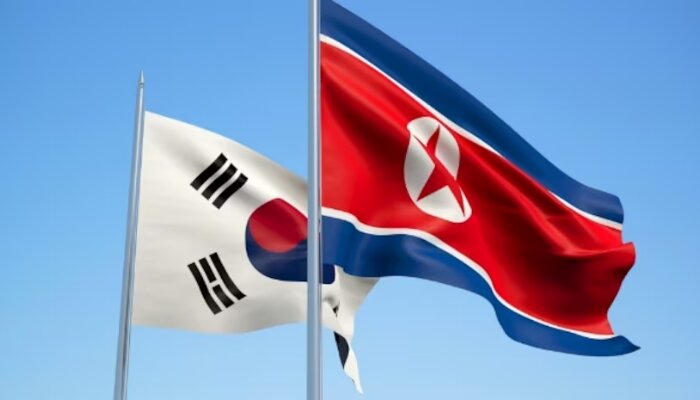
South Korea orders evacuation of islands after North Korea fires more than 200 artillery rounds nearby in a significant flare-up

More than 200 artillery rounds were launched into the sea by North Korea on 5th January along a tense maritime border with South Korea, according to a military official. The residents of Yeonpyeong and Baengnyeong islands were told to seek shelter because of an unidentified “situation.”

The Ministry of Defense declined to disclose whether the order was a result of the country’s reaction drills or artillery fire from the North. However, islanders received a text message confirming “naval fire” to be carried out by the South Korean military starting at 3 p.m. (0600 GMT). The information was verified by an island official.

According to an official on Yeonpyeong island, which is located just south of the contentious Northern Limit Line (NLL) sea boundary, the South Korean military sought the evacuation, prompting the island’s population to take refuge there. South Korea’s military said in a news briefing that there was no civilian or military injury inflicted by North Korea’s firing.

Lee Sung-joon, a spokesman for the South Korean Joint Chiefs of Staff declared, “The North Korean military conducted over 200 rounds of firing today from around 09:00 to 11:00 (1200 to 0200 GMT) in the areas of Jangsan-got in the northern part of Baengnyeong Island and the northern areas of Yeonpyeong Island. This is an act of provocation that escalates tension and threatens peace on the Korean peninsula.”

He added, “We sternly warn that North Korea bears full responsibility for this escalating crisis and strongly urge them to immediately cease these actions. Our military closely tracks and monitors the situation in close coordination with the United States, and will take appropriate measures in response to North Korea’s provocations.”

The officer informed that all of the North Korean artillery projectiles had landed on the northern side of a disputed maritime border and that the South Korean military, along with the U.S. military has been keeping an eye on Kim Jong Un’s government near its coastline.

Civilians have been ordered to evacuate, according to local officials on Yeonpyeong island, who described the directive as a “preventative measure” to AFP. Yeonpyeong Island in South Korea is located in the Yellow Sea. It is situated 12 kilometres south of the Hwanghae Province’s shoreline in North Korea and about 80 kilometres west of Incheon and is home to at least 2,000 individuals as well as military personnel stationed there. It is situated around 120 km (75 miles) west of Seoul and reaching the area requires more than 2.5 hours of ferry travel.

An evacuation order was also announced by the Baengnyeong Island authorities which has a population of around 4,900 and is far to the west of Yeonpyeong. A district administrator at Baengnyeong island told AFP, “We are making the evacuation announcements at the moment.” He also mentioned that he received word that the South Korean military would be conducting a naval drill soon. Kim Jin-soo, who lives in Baengnyeong island remarked, “At first I thought it was the shells fired by our military but was told later it was by North Korea.”

In November 2010, Pyongyang launched a volley of 170 artillery projectiles onto Yeonpyeong Island which killed four people and two of them were civilians in what was the first attack on a populated area by the North Koreans since the 1950–53 Korean War. After the dictator test-fired multiple highly advanced intercontinental ballistic missiles and cemented the nation’s nuclear power status in the constitution, ties between the two Koreas are at an all-time low.

Kim Jong Un demanded that the nation’s military arsenal be increased ahead of a battle that he threatened could “break out at any time” and threatened to launch a nuclear strike on the South at Pyongyang’s crucial year-end strategy talks. According to KCNA’s version of the meeting, he instructed his armed forces to retain the “overwhelming war response capability” and accused the United States of posing “various forms of military threat”.

When the South announced it would begin border drills in November, the North proclaimed the agreement that the two leaders of Korea had made in 2018 to defuse tensions and prevent an unintentional war from breaking out as null and void. Military exercises along the border, including those along the east and west shores of the sea, were to end, as agreed upon by the two sides.

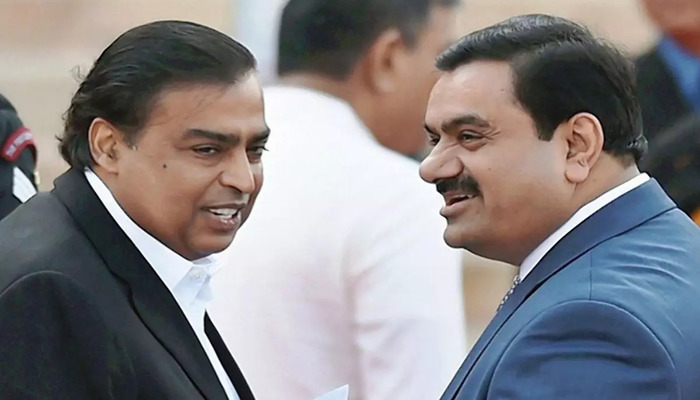
Gautam Adani overtakes Mukesh Ambani to become India’s richest person on the Bloomberg Billionaires Index

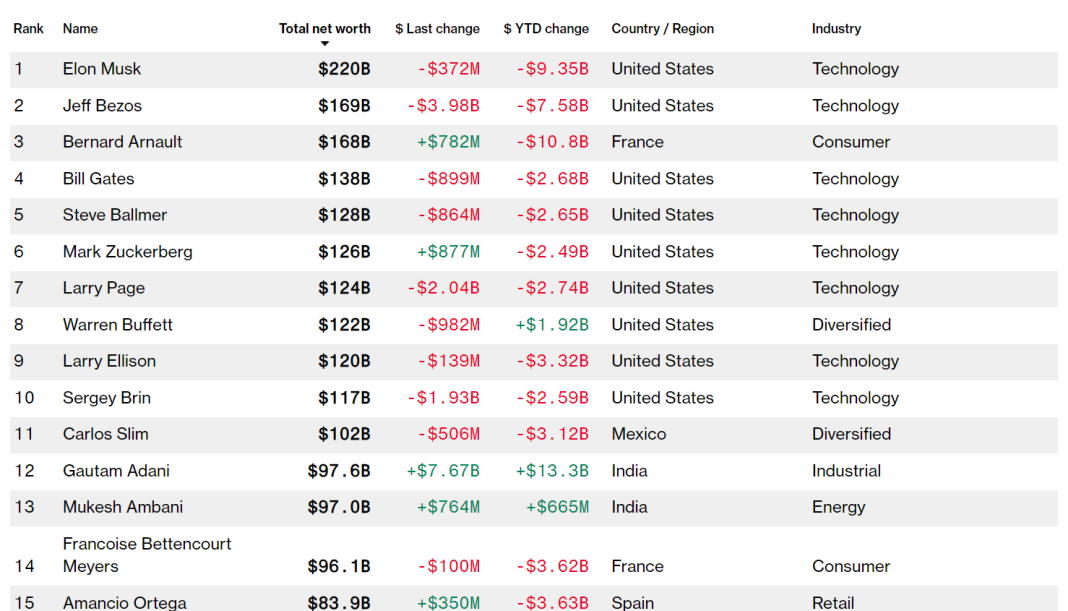
In the Bloomberg Billionaires Index, Gautam Adani, chairman of Adani Group, has surpassed Mukesh Ambani, chairman and managing director of Reliance Industries, to become the richest Indian. Adani has risen to 12th place, surpassing Ambani, who is now 13th. Adani’s total net worth has increased to $97.6 billion, while Ambani’s net worth stands at $97.0 billion. Both billionaires have climbed up on the list.

Bloomberg Billionaire Index (Source: Bloomberg website)

The majority of Adani’s wealth arises from the Adani group’s six listed entities. According to Bloomberg, the companies and stakes are as follows: Adani Power (70%); Adani Total Gas (37%); Adani Energy Solutions (73%); Adani Ports (66%); and Adani Green Energy (56%).

This comes just one day after Adani Group shares surged, boosting Gautam Adani’s net worth by $7.67 billion. Gautam Adani’s wealth has grown by $13.3 billion year to date (YTD), the most among the world’s top 100 billionaires.

“The comeback of the first-generation entrepreneur, who started off as a diamond trader in the 1980s, caps an eventful year for Adani’s ports-to-power conglomerate. Despite denying Hindenburg’s allegations of corporate fraud, the Adani Group lost more than $150 billion in market value last year and spent months wooing back investors, lenders, repaying debt, and assuaging regulatory concerns,” the Bloomberg report reads. 

Earlier on Wednesday, the Supreme Court refused to order an investigation into Adani Group by a special investigation team (SIT) or the Central Bureau of Investigation (CBI), a major relief to the business house, in response to allegations of fraud, misgovernance, and stock price manipulation levelled by US short-seller Hindenburg Research.

The court said that the Securities and Exchange Board of India (Sebi) is conducting a “comprehensive investigation” that “inspires confidence.” It ordered that the investigation be completed within three months. Thus far, SEBI has concluded its investigation into 22 of 24 items.

As reported earlier, the Supreme Court order stated that the Organised Crime and Corruption Reporting Project (OCCRP) report could not be used to cast doubt on the SEBI probe. It stated that reliance on the OCCPR report is rejected and that reliance on a third-party organisation report without any verification cannot be relied on as proof.

Adani-Hindenberg row

In January last year, Hindenburg Research accused the Adani Group of fraud and stock price manipulation. The charges were denied by Gautam Adani. Also, no regulatory failure was found by the expert committee which was constituted by the Supreme Court.

In May of last year, a 6-member expert panel had failed to find any wrongdoing on SEBI’s part regarding Adani Group. The committee concluded that the Adani Group has disclosed the information of all the beneficial owners of the business. The report also listed all the details of these beneficial owners as obtained from SEBI.

The Adani Group had trashed the Hindenburg Research report as a ‘malicious combination of selective misinformation and stale, baseless and discredited allegations’. The court reportedly refused to order an SIT probe on the allegations made by short-seller Hindenburg. It added that there is no evidence that SEBI was negligent in taking action and no reason to suggest any conflict of interest on SEBI’s part.

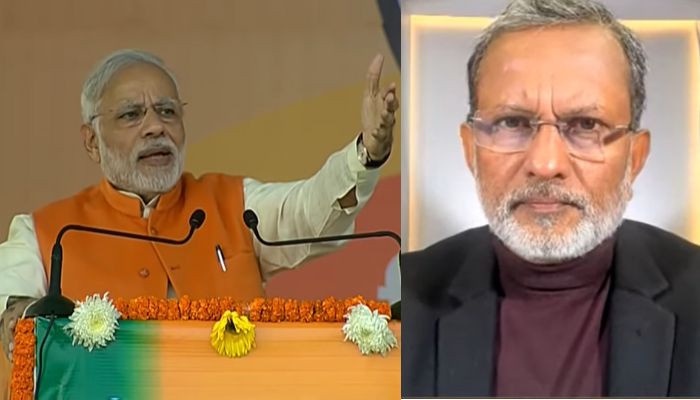
Days after defending PM Narendra Modi on EVM issue, Ajit Anjum says that Modi doubted EVMs before 2014

Within 2 days of defending PM Narendra Modi on the EVM (electronic voting machine) issue, propagandist Ajit Anjum has now said that PM Modi had doubted the EVMs in the past. He expressed his agreement to this allegation during an interaction with Mahmood Pracha in a YouTube video on 5th January. In this video, Mahmood Pracha was talking about his latest movement wherein he is demanding 50 EVMs from the election commission to prove that EVMs can be hacked. On 3rd January, Ajit Anjum shared a fact check that showed how such allegations against Modi are false.

During this talk, at 20:17 in the YouTube video, Mahmood Pracha said, “Every political party in India has doubted EVM at some point in time. Even our prime minister Narendra Modi doubted it.” Reacting to this with a nod, Ajit Anjum said, “Yes, before 2014.” Interestingly, it was Ajit Anjum who defended such allegations against Narendra Modi just 2 days ago.

On 3rd January, an X account named Prakash Raj shared a clipped video of Prime Minister Narendra Modi in which he was seen saying that even the developed countries in the world use ballot papers for voting. In the caption of the post, Prakash Raj wrote, “I would like to tell truck drivers, blocking the roads won’t help. Get EVMs banned, that’s it. Look, this old man is also saying the same thing.”

Presenting a link to the fact-check report, Ajit Anjum replied to this post, “For your information, let me tell you that this video is incomplete. This is from a rally in Moradabad in 2016. If you listen completely, you will know that Modi is only advocating EVM in this speech.”

In the fact-check shared by Ajit Anjum, it is explained how Narendra Modi is often accused by his opponents in politics as well as by his opponents in media that he would oppose the EVMs before coming to power in 2014. Further, it is also explained that the video often cited to bolster this claim is not from before 2014 era, but it is from 2016.

In 2016, PM Modi addressed a Parivartan rally in Moradabad. In this rally, he talked about India’s progress in terms of the use of electronic voting machines compared to the United States using ballot papers. He said at 55:08 in the full video shared from his YouTube channel, “Some people claim our country is poor, our people are uneducated, they don’t know anything. Brothers and sisters, when there is an election in educated countries, the ballot paper is still used today. People first read names and then put labels. This happens in America too. This is India, those whom you call illiterate, poor, they know the process of voting by pressing a button.”

The fact-check by Boom Live has debunked the claim that PM Modi opposed the EVMs before 2014. For this, it also proved that the video used to accuse Modi is doctored and from a rally held in 2016. Ajit Anjum used the same fact-check report to counter a similar allegation. Just two days after this, Ajit Anjum contradicted himself on his YouTube channel. He nodded to Mahmood Pracha and said that PM Narendra Modi expressed doubts about EVM before 2014.

Writing such judgments is absolutely wrong: Supreme Court criticises Calcutta HC judges after they advised adolescent girls to ‘control sexual urges’

On Thursday (4th January), the Supreme Court of India came down heavily on two Calcutta High Court Judges who asked adolescent girls to ‘control sexual urges’ so that they are not deemed ‘loser’ by society.

A 2-Judge Bench of Justice A S Oka and Justice Ujjal Bhuyan deemed the observations by the Calcutta High Court as ‘problematic’ and also questioned the legal principles involved in the judgment.

“It’s not only about these observations, but the findings of the court. Writing such judgments is absolutely wrong. What kind of principles the judges have invoked! In case of settlement, there is a series of judgment on that,” Justice AS Oka noted.

He emphasised, “But here, the court has said that the POCSO section should be amended and as the section is not amended, they will exercise power under Section 482.”

On being pointed out about other ‘problematic’ paragraphs in the Calcutta High Court Judgment, the Judge said, “Every paragraph is problematic. We have marked all the paragraphs.”

Judges not expected to preach/ express personal views: Supreme Court

Earlier on 8th December last year, the Supreme Court took suo motu cognisance of the Calcutta High Court order and remarked, “In an appeal against conviction, the high court was called upon to decide only the merits of the appeal and nothing else.”

“Prima facie, we are of the view that, in such a case, the judges are not expected to either express their personal views or preach,” it added. The apex courted noted that the observations by the Calcutta High Court were ‘objectionable’ and ‘completely unwarranted.’

It pointed out that the observations also violated the rights of adolescents, as guaranteed by the Indian Constitution under Article 21.

The Background of the Controversy

On 18th October last year, a 2-Judge Bench of the Calcutta High delivered a verdict, overturning the conviction of a 25-year-old man accused of having sexual intercourse with a 14-year-old girl and sentenced to 20 years in prison.

While doing so, Justice Chitta Ranjan Dash and Justice Partha Sarathi Sen listed out specific duties for adolescent boys and girls. The court ruled,

“It is the duty or obligation of every female adolescent to (i) Protect her right to the integrity of her body, (ii) Protect her dignity and self-worth, (iii) Thrive for the overall development of her self-transcending gender barriers, (iv) Control sexual urge or urges as in the eyes of the society she is the loser when she gives in to enjoy the sexual pleasure of hardly two minutes, (v) Protect her right to autonomy of her body and her privacy.It is the duty of a male adolescent to respect the aforesaid duties of a young girl or woman and he should train his mind to respect a woman, her self-worth, her dignity and privacy, and her right to autonomy of her body.

“We do not want our adolescents to do anything that shall push them from the dark to the darker side of life. It is normal for each adolescent to seek the company of the opposite sex, but it is not normal for them to engage in sex devoid of any commitment and dedication. Sex shall come automatically to them when they grow self-reliant, economically independent and a person which they dreamt one day to be, it concluded,” the Judges had said.