Home Blog Page 1483

Delhi High Court dismisses China-funded NewsClick’s plea challenging orders passed by Income Tax Dept, demanding stay: Details

0

The Delhi High Court has dismissed the News Portal NewsClick plea challenging the orders dated November 3 and February 20 passed by the Income Tax Department and said it has not been able to make out a prima facie case in its favour. 

The bench of Justice Manmohan and Justice Mini Pushkarna, while passing the order recently, said that the petitioner’s plea of financial stringency based on its balance sheet also inspires no confidence, as according to the Assessing Officer, the accounts have not been properly maintained. To put it mildly, the petitioner has a ‘lot to answer’ in the appeal, said the bench. 

Newclick recently approached the Delhi High Court, challenging the orders dated November 3rd and February 20th, passed by the respondents, whereby the petitioner’s application for a stay of demand during the pendency of the appeal before the Commissioner of Income Tax (Appeals) against the assessment order dated December 30th, 2022, has been dismissed. 

The petitioner had further prayed for a stay of demand during the pendency of the petitioner’s appeal before the Commissioner of Income Tax (Appeals). 

Senior Advocate Devdutt Kamat appeared for the petitioner and submitted that the discretion to stay the demand during the pendency of an appeal has to be exercised judiciously and reasonably, based on relevant grounds, with due application of mind, and must not be exercised arbitrarily, capriciously or based on irrelevant considerations. He states that in complete violation of this mandate, the impugned orders are arbitrary, have been passed mechanically, and suffer from complete non-application of mind. 

Recently, the Delhi Police special cell arrested NewsClick’s founder and Editor-in-Chief Prabir Purkayastha and HR Head Amit Chakravarty under Sections IPC and UAPA. 

The Delhi Police’s Special Cell, in its FIR against news web portal NewsClick’s founder and Editor-in-Chief Prabir Purkayastha, stated that the People’s Dispatch Portal, owned and maintained by M/S PPK Newsclick Studio Pvt Ltd, has been used for intentionally peddling false narratives through paid news in lieu of crores of rupees of illegally routed foreign funds as part of a conspiracy. 

The Delhi Police FIR further stated that foreign funds in crores have been infused illegally in India by Indian and foreign entities inimical to India in pursuance of a conspiracy with the intention to disrupt the sovereignty and territorial integrity of India, to cause disaffection against India and to threaten the unity, integrity, and security of India. 

Foreign funds in crores have been infused illegally in India by Indian and foreign entities inimical to India in pursuance of a conspiracy with the intention to disrupt the sovereignty and territorial integrity of India, to cause disaffection against India and to threaten the unity, integrity, and security of India, as stated in the FIR.

(This news report is published from a syndicated feed. Except for the headline, the content has not been written or edited by OpIndia staff)

HM Amit Shah likely to re-introduce amended three criminal law bills in Lok Sabha

On 12th December, Union Home Minister Amit Shah will likely introduce three criminal law bills in Lok Sabha after amending them based on the standing committee’s recommendations. The three bills previously introduced in Lok Sabha on 11th August were withdrawn by the Home Minister on 11th December, subjected to the amendments. The three bills that will replace the colonial-era criminal laws are the Bharatiya Nyaya Sanhita Bill, 2023, the Bharatiya Nagarik Suraksha Sanhita Bill, 2023, and the Bharatiya Sakshya Bill, 2023.

Source: yuvnique/X

Hindustan Times quoted an unnamed source familiar with the matter saying, “Based on the committee’s recommendations, amendments have been proposed in the three criminal law bills, which the home minister will introduce along with two other bills around 5 pm on Tuesday.”

Reportedly, Prime Minister Narendra Modi and his office disagreed with two of the proposed amendments as they were seen as against the Supreme Court and its judgments. The two suggestions aimed to criminalise adultery and homosexual sex. Notably, the Supreme Court had struck down the law that made adultery an offence, saying it was discriminating against women, perpetuating gender stereotypes and diminishing the dignity of women. Though the apex court had struck down the criminalisation of homosexual sex between consensual adults, the committee suggested retaining it in the new bill.

Notably, after introducing the bills in August this year, they were sent to the standing committee on home affairs for review. The committee submitted a report on 6th November and proposed 50 amendments to the bills. Reportedly, HM Shah said in the Parliament, “Based on the committee’s recommendations, amendments are proposed in the Bharatiya Nyaya Sanhita Bill, 2023. It is proposed to introduce a new bill in place of the Bharatiya Nyaya Sanhita Bill, 2023.” Similar statements were made to withdraw the other two bills as well.

The three criminal law bills seek to replace colonial-era criminal laws named the Indian Penal Code (IPC), 1860, the Code of Criminal Procedure (CrPC), 1973, and the Indian Evidence Act, 1872.

HM Shah introduced bills to replace colonial-era criminal laws

In August 2023, the Home Minister introduced three bills to replace the British-era criminal code in the country—the move aimed at removing colonial legacies, with 475 referencing the British Raj being eliminated.

The notable changes in the law included a shift in the focus to crime against women and children with penalties for offences like gang rape and rape of minors, including the death penalty. Furthermore, measures against love jihad, organised crime, terrorism and mob lynching were introduced in the bills. Time-bound investigations, trials and judgments were part of the new bills to replace British-era criminal laws. The digitisation of the entire legal process, mandatory community service, and increased use of forensic science are also emphasised.

‘They beat us badly and forced us to return’: More than 3,45,000 Afghans deported from Iran to Afghanistan in two months. Read details

More than 345,000 Afghans have been deported from Iran to Afghanistan in over two months, Afghanistan-based TOLO News reported, citing a senior official of the Taliban-led Ministry of Refugees and Repatriation. 

Abdul Rahman Rashid, Taliban-appointed Deputy Minister of Refugees and Repatriation, said, “Since the first of Mizan (23rd September) till 17 Qaws (December 8) there were approximately 345,000. Each family has been provided with 10,000 Afs in cash assistance by the Islamic Emirate.” 

Mohammad Yousuf and Fatih Khan, who left Afghanistan and went to Iran to make both ends meet, have been deported from Iran. They complained about the mistreatment of Afghan refugees by Iranian forces, according to TOLO News report. 

Yousuf said, “There was no work here, then we went to Iran through illegal paths. They beat us and detained us.” 

Khan said, “They captured us and beat us. They beat us badly and forced us to return.” The deportees raised concerns regarding the lack of employment in Afghanistan and urged the Taliban to make efforts to create jobs for the citizens. 

Shirin Agha, a deportee, said, “We call on our government to provide us with work so the people are not forced to leave.” Ahmadullah, a deportee, called on Taliban to provide them with work. This comes as Iranian officials have said that Afghans without legal documents will be deported from Iran, TOLO News reported. 

Last week, Iranian Interior Minister Ahmad Wahidi reiterated that Afghan citizens who are currently residing in Iran illegally should return to their country, according to TOLO News. However, Wahifi did not mention a group or a country but said that the “enemy” wants to start anti-Afghan sentiments by creating a conflict between Afghans and Iranians. 

He further highlighted that Iran’s capital, Tehran, has also planned for immigrants with documents, according to TOLO News. 

“When the Taliban came here, I told them that you should prepare the ground for them (Afghan immigrants) to return to their country. After all, everyone should return to their own lives. You should come up with a mechanism for their return, and they said to give us some time,” Wahidi said. 

Asifa Stanikzai, a women’s rights activist, said, “Different countries and organisations should continue their humanitarian aid to the refugees who need help, regardless of the internal conditions of Afghanistan.”

(This news report is published from a syndicated feed. Except for the headline, the content has not been written or edited by OpIndia staff)

‘Loo break’: Vivek Ramaswamy faces an awkward hot mic moment during active Space on X with 2.3 million listeners, Elon Musk quips ‘Hope you feel better’

0

Indian American businessman and GOP Presidential hopeful Vivek Ramaswamy faced an embarrassing moment when he forgot to mute his mic while taking a ‘loo break’ from an active X (Twitter) space. Around 2.3 million listeners were tuned in when Ramaswamy encountered the hot mic moment. 

On the X (Twitter) Space, Ramaswamy was participating in a discussion on the future of technology. During the session, Elon Musk was explaining the rationale behind reinstating the banned X account of Alex Jones, founder of the website Infowars, back on his micro-blogging platform. However, interjecting in the conversation, Ramaswamy conveyed that he would have to take a short break, hurriedly stating, “Gentlemen, I have to go.” 

While Elon Musk continued the discussion, the unmistakable sound of running water could be heard in the background.

Pointing towards unusual noises, Alex Jones sarcastically remarked, “Someone’s got their thing open peeing. Somebody’s got their phone in the bathroom.” 

Responding to Jones’ remark, the host Mario Nawfal alerted Ramaswamy that the source of the noise was his phone. Nawfal said, “Vivek, that’s your phone. But I am not able to mute you.” 

On returning from the short break, Vivek Ramaswamy realised that his mic was unmuted and understood what had transpired. He immediately apologised for the embarrassing moment. 

However, on a lighter note, Musk quips, “I hope you feel better now”. To which Ramaswamy replied, “I feel great. Sorry about that guys.”

While the awkward moment was initially met with stunned silence, it sparked a flurry of witty reactions. 

Musk later responded to the post that had caught the incident stating that he was bursting into uncontrollable laughter. Musk wrote, “I’m literally rofl rn.” 

An X user noted encountering a similar awkward moment saying, “As a host of a live show, random shit like that happens, LOL. I left the microphone hot once to come back to find my cat attacking it and meowing into it, LOL.”

Another user tweeted, “Poor guy, this is will (sic) never leave him now.”

A user remarked, “Vivek is literally draining the swamp.” while another user wrote, “That was pretty damn funny.”

‘Vijayan is sending people to hurt me physically’: Kerala governor Arif Khan after attack by SFI goons in Thiruvananthapuram

0

  Kerala Governor Arif Mohammad Khan alleged that Chief Minister Pinarayi Vijayan is conspiring and the government is sending people to hurt him physically

“It is the CM, he is conspiring and he is sending these people to hurt me physically. The constitution seems to be collapsing. The collapse of the constitutional machinery cannot be allowed,” the Governor said, speaking to reporters.

Khan said that hooligans are trying to rule the roads of Thiruvananthapuram.

“Today the ‘gundas’ are trying to rule the roads of Thiruvananthapuram. When they came, I stopped my car and I got down (from my car). Why have they fled? What have I done? Because I do not wish to be pressurised by their tactics, therefore they are trying to threaten me. They are trying to scare me. I am not the person to take things lightly,” the Governor said.

Khan also accused the state police of colluding with them under the direction of the Chief Minister.

“They came before my car. They hit my car from both sides. I got down. Will they allow anyone to come near the car of the Chief Minister? Police knew them but what can the police do when the CM is directing them? When I got down they all got into their jeeps and they ran away. The Chief Minister’s program is going on. Is it possible that people will bring cars and they will bring protesters than them?”

The BJP State president, K Surendran, condemned the alleged attempt to manhandle Kerala Governor Arif Mohammed Khan by the members of the student and youth organisations of the ruling Communist Party of India (Marxist) on Monday.

Arif Mohammed Khan said that his vehicle was hit with hands by members of SFI (Students’ Federation of India) and DYFI (Democratic Youth Federation of India) on both sides after being surrounded by them on Monday. The alleged incident happened when they were protesting against the governor, alleging that he appointed people associated with the BJP in the senates of various universities in the state.

Surendran said that the alleged attempt to assault the governor was made with the tacit support of Chief Minister Pinarayi Vijayan.

“SFI and DYFI criminals tried to manhandle Governor Arif Mohammad Khan in Trivandrum City yesterday and today,” Surendran told ANI.

“The violent incident happened with the silent support of the police. The chief minister, Pinarayi Vijayan, is supporting the perpetrators and culprits in this issue. We strongly condemn the undemocratic acts of the SFI and DYFI” he added.

Governor Arif Mohammed Khan has been facing protests from these organisations of the ruling party over the university appointment issue.

(This news report is published from a syndicated feed. Except for the headline, the content has not been written or edited by OpIndia staff)

Washington Post and its hit job on ‘Disinfo Lab’: Exposing the nefarious campaign to discredit Indian OSINT handle before 2024 Lok Sabha election

Ahead of the 2024 Lok Sabha election, The Washington Post has launched a campaign of sorts to de-legitimise those exposing anti-India narratives and promote individuals disseminating propaganda against India.

On Sunday (10th December), the leftist media outlet carried out a hit job on the Indian OSINT (Open Source Intelligence) handle ‘Disinfo Lab.’ To this effect, it published an article titled ‘Covert Indian operation seeks to discredit Modi’s critics in the U.S.’

The development comes two days after American political commentator Jack Posobiec revealed how The Washington Post ‘journalist’ Priyanshu Verma had been soliciting information about ‘Disinfo Lab.’

Screengrab of the propaganda piece in The Washington Post

‘Disinfo Lab’ is the same OSINT handle, which earlier exposed how the US State Department was relying on misleading data (sourced from Christian evangelist groups and radical Islamist outfits) to allege a decline in India’s religious freedom.

It was thus obvious that US-based leftist media outlets such as The Washington Post would make attempts to de-legitimise ‘Disinfo Lab’ sooner or later.

Based on ‘sources’, Pranshu Verma and his two other colleagues claimed on Sunday (10th December) that the OSINT handle is run by an Indian Intelligence Officer named Lt. Col. Dibya Satpathy.

Screengrab of the website of ‘Disinfo Lab’

The trio at The Washington Post alleged that the objective of ‘Disinfo Lab’ is to ‘research and discredit foreign critics of the Modi government’, ‘combine fact-based research with unsubstantiated claims’, ‘intimidate individuals overseas’ and ‘run covert influence operation.’

However, a cursory look at the website of the OSINT handle reveals that it is focused on uncovering disinformation campaigns, aimed at tarnishing the image of India on a global scale. Nevertheless, this did not stop The Washington Post from making sweeping claims about it.

“The Disinfo Lab’s activities show how the online propaganda campaigns waged by the BJP and its allies have been expanding beyond their traditional, domestic aims of shoring up popular support and denigrating opposition parties — and now seek to influence attitudes far beyond India’s borders,” it brazened out.

The Washington Post and its reliance on controversial ‘experts’

The leftist media outlet roped in several ‘experts’ to suggest that the Indian government led by PM Narendra Modi is using an OSINT handle with 45.6K followers to undermine political rivals and create a global narrative.

One such expert was an ‘academic’ named Joyjeet Pal. He claimed, “The Indian right wing is a new player that has arrived on the world stage and wants to shape global discussion…So far, much of it is done in the same way it’s done within India — through crude, blunt force. But it’s getting smarter.”

The Washinton Post introduced Pal as a University of Michigan Professor ‘who studies disinformation in India.’ Interestingly, he is the same ‘expert’ whose obscure research was used by Indian leftist propaganda outlet The Wire to discredit calls for investigating the unnatural death of actor Sushant Singh Rajput.

Another controversial expert cited by The Washington Post in its report was ‘journalist’ Ajai Shukla. He claimed, “(The defence establishment) exists to serve national and strategic interests, not political interests. But the BJP under Modi has seen critics as anti-Indian, the enemies of India itself.”

Shukla has a history of peddling fake news (here and here) in the context of the India-China border dispute. He had also disseminated conspiracy theories post the 2019 Pulwama terror attack and was dubbed sexist by a prominent Italian journalist.

Despite such dwindling credibility, The Washington Post roped him as an expert for its propaganda-laden piece on ‘Disinfo Lab.’

Leftist media outlet shamelessly defends US State narrative

India has been under tremendous pressure to choose sides, following the Russia-Ukraine war. The US state apparatus and the media on several occasions had even threatened India with sanctions for purchasing oil from Russia, only to receive befitting replies from External Affairs Minister S Jaishankar.

Nevertheless, The Washington Post saw it as an opportunity to attack India’s neutral position in the ongoing crisis. “Coordinated social media accounts have been found to play a role, for instance, in spreading identical posts in support of Russia, an important supplier of weapons and energy to India…” it furthered the US State narrative.

The leftist news outlet targeted the ‘Disinfo Lab’ for exposing the United States Commission on International Religious Freedom (USCIRF) and its biased reporting on India, which is often used to cast aspersions on Indian democracy.

In February this year, OpIndia reported in detail about the ties of former USCIRF Commissioner Anurima Bhargava to far-left billionaire George Soros. We also exposed how the controversial body has relied on the dubious ‘Tek Fog’ story to make insinuations about India.

The Washington Post legitimises anti-Hindu,anti-India activists

Throughout its article, The Washington Post desperately tried to whitewash both anti-Hindu and anti-India activists and paint them as ‘victims’ of the social media exposé by ‘Disinfo Lab.’

One such activist mentioned by the leftist media outlet happens to be Pieter Friedrich, who has ties to Khalistani terrorist Bhajan Bhinder.

The organization released a dossier nearly 100 pages long alleging that Pieter Friedrich, a California-based activist and journalist who has written magazine articles and given public speeches critical of the BJP and affiliated Hindu-nationalist groups, had ties to the Sikh separatist movement and Pakistan’s premier intelligence agency. The Disinfo Lab burrowed into California state records to uncover Friedrich’s employment history, published his parents’ names and plotted detailed graphs about his social media activity,” it claimed.

In 2021, OpIndia reported how Pieter Friedrich evolved from a Christian zealot and a Gandhi basher to a ‘critic of Hindu fascism’ and a Khalistani asset. In June last year, he was slammed for allegedly giving death threats to a Hindu US Representative from Illinois, Raja Krishnamoorthi.

The Washington Post lamented that ‘Disinfo Lab’, which posted a plethora of evidence tying ‘activist’ Sunita Vishwanath to far-left billionaire George Soros and his Open Society Foundations (OSF), was used against Congress scion Rahul Gandhi.

“The Disinfo Lab dug into her past and reported that a nonprofit she launched to help female Afghan refugees had received funding from Soros’s Open Society Foundations. Two months later, after Indian opposition leader Rahul Gandhi attended a meeting in Washington with Viswanath as part of a U.S. tour, Amit Malviya, the head of the BJP’s social media team, tweeted a photo of the meeting and shared a flowchart stamped with the Disinfo Lab logo illustrating Viswanath’s connections to Soros,” wrote the leftist media outlet.

Ties of Sunita Vishwanath to Open Society Foundations, graphic by DisinfoLab

Sunita Vishwanath is the co-founder of an organisation named ‘Women for Afghan Women’, which is funded by OSF. She is also the co-founder of ‘Hindus for Human Rights (HfHr)’ and has tried to create hysteria and panic among Indian Muslims about the National Register of Citizens (NRC).

“We are especially appalled by the most recent nightmare of the Kashmiri people, and the situation of 1.9 million people in India who are rendered stateless due to the imposition of the travesty called the National Register of Citizens”, Vishwanath said in 2019.

In September 2021, she also participated in the Hinduphobic conference ‘Dismantling Global Hindutva.’ The Washington Post also roped in the policy director of Hindus for Human Rights (HfHr), Ria Chakraborty, to make a case for an organisation named ‘Indian American Muslim Council (IAMC).’

According to the Hindu American Foundation (HAF), the Indian Americal Muslim Council has links [pdf] with the banned Islamic terror outfit, Students’ Islamic Movement of India (SIMI).

Besides, the Indian American Muslim Council has ties with Lashkar-e-Taiba (LeT) and Jamaat-e-Islami (JeI) through its founder Shaik Ubaid. The IAMC is a Jamat-e-Islami-backed lobbyist organisation claiming to be a rights advocacy group.

It had been caught spreading fake news to further the Islamist cause in India. It had also been slapped with the UAPA in 2021.

Former Twitter CEO Jack Dorsey with anti-Brahmin poster designed by Thenmozhi Soundarajan

The Washington Post also made references to anti-Brahmin activist Thenmozhi Soundarajan and her organisation ‘Equality Labs’. Soundarajan had shot to fame in 2018 after the then Twitter CEO Jack Dorsey clicked pictures with a poster, designed by her, carrying the tagline ‘Smash Brahmanical Patriarchy.’

In April 2022, tech giant Google cancelled a talk by Thenmozhi Soundararajan, owing to the fear that it might create ‘division and rancour’ in the workplace. Google spokesperson Shannon Newberry had said, “We also made the decision to not move forward with the proposed talk which — rather than bringing our community together and raising awareness — was creating division and rancour.”

In November last year, she went on an unhinged tirade against Yoga. During the one-and-a-half-hour-long podcast, Soundararajan cast aspersions on the history of the ancient Indian Hindu practice and claimed that it was used by Brahmins to oppress the Dalit community. She also insinuated that Yoga had an in-built system of hierarchy, which supposedly made it vulnerable to abuse.

Whitewashing of George Soros and his antics

The Washington Post also attempted to whitewash far-left billionaire George Soros and his nefarious anti-India agenda.

The leftist media outlet wrote, “In February, Soros, a frequent critic of Modi, warned in a speech at the Munich Security Conference that the Indian leader was undemocratic and would lose his “stranglehold” over the Indian government. A day later, the Disinfo Lab posted a lengthy tweet thread alleging that Soros had ties to the Muslim Brotherhood and manipulated “fake” U.S.-based advocacy groups to smear India. A spokesperson for Soros’s Open Society Foundations called the Disinfo Lab’s claims “entirely baseless” and said they were part of a “campaign by this site and others in India against advocates of human rights, democratic governance and the rule of law in the service of the political aims of the BJP and its allies.”

India has been fighting a ‘perception war’ on all fronts since the start of 2023. On February 16 this year, George Soros exploited the Adani-Hindenburg controversy and launched a scathing attack on the Indian government.

He claimed, “Modi and business tycoon Adani are close allies. Their fate is intertwined…Adani Enterprises tried to raise funds in the stock market, but it failed. Adani is accused of stock manipulation and his stock collapsed like a house of cards.”

Soros accused Prime Minister Narendra Modi of crony capitalism. “Modi is silent on the subject, but he will have to answer questions from foreign investors and in parliament,” he added.

The Hungarian-American billionaire also said that the ‘shakedown’ caused to the Indian markets due to the Hindenburg Research report will result in ‘much needed institutional reforms’ and ‘democratic revival’. 

George Soros and his vicious ecosystem of NGOs, activists and journalists had been trying to prove PM Modi as an ‘electoral autocrat’ who needed to be ousted for the ‘greater good’ of this country. And it has been a work in progress for a long time.

The Hungarian-American billionaire has also tried to use international institutions, which are funded by him, including Freedom House and  V-Dem (Varieties of Democracy) Institute to tarnish the image of India at a global level.

In January 2020, the American billionaire committed $1 billion to start a global university to “fight nationalists” and climate change, calling them twin challenges that threaten the survival of our civilisation.

The Washington Post ends up vindicating ‘Disinfo Lab’

Throughout the article, The Washington Post resorted to insinuations, and source-based allegations to discredit ‘Disinfo Lab.’ However, it failed to provide any empirical evidence that could dispute any claims of the Indian OSINT handle.

The leftist news outlet had not refuted the assertion by ‘Disinfo lab’ that its exposé had led to the shutting down of several sources of fake data. “In its response to The Post, the Disinfo Lab pointed to its record of forcing “activists” and “human rights fronts” to shut down by exposing them,” it noted.

Ironically, one such source of fake data, DOTO (Data of Database of the Oppressed), was cited by WaPo tech ‘journalist’ Pranshu Verma in an article in January 2023 to allege that ‘religious hatred’ is on the rise in India.

‘Disinfo Lab’ had earlier exposed the fabrications of DOTO, following which the latter first revised and then deleted the database. The OSINT handle also uncovered the lies of another dubious organisation called OFMI (Organization for Minorities of India), following which the latter shut shop permanently.

The Washington Post resorts to ‘shrewd dishonesty’

The leftist media outlet had reached out to prominent people in the hopes of deterring them from sharing informative posts by ‘Disinfo Lab’.

The Washington Post ‘journalist’ Pranshu Verma messaged American political commentator Jack Posobiec on Friday (8th December) and claimed that the Indian OSINT handle is run by an Intelligence officer.

“We are doing a story on a group called Disinformation Lab. Our reporting shows this group combines fact-based research with unsubstantiated claims to paint U.S. government figures, researchers, Indian American human-rights activists and international humanitarian groups as part of a conspiracy, purportedly led by global Islamic groups and the billionaire George Soros, to undermine India. Our analysis found you have retweeted this organisation’s content,” he claimed.

He further added, “Do you know about the organization’s background? Our research has found Disinfo Lab is actually run by an Indian Intelligence Officer. Did you know that?

Pranshu Verma then sought a response from the American political commentator based on his unsubstantiated assertions. “Due to the sensitive nature of this story, the time for response is tight. Please provide a response by the end of day today, Friday, December 8th,” he emphasised.

However, he did not anticipate a befitting reply from Jack Posobiec that would put ‘The Washington Post’ in the dock. ” So if it’s a intel agency run-media outlet that basically makes it the same as the Washington Post then?” the American political commentator wrote.

Jack Posobiec told Verma that The Washington Post is a media outlet run by the United States Intelligence and by his ‘assertion’ would make it similar to ‘Disinfo Lab.’ As expected, the tech ‘journalist’ did not respond to the message.

Excerpt of the article published by The Washington Post

After the article was published, The Washington Post did not reproduce the actual response of Jack Posobiec. While resorting to shrewd dishonesty, it wrote,” Posobiec did not address whether he was familiar with the organisation’s background.

Washington Post and its targeting of India before 2024 elections

With the upcoming Lok Sabha elections in mind, The Washington Post is leaving no stone unturned to make insinuations about the Modi government and target individuals and accounts known for debunking anti-India propaganda.

The development comes amidst growing concerns about ‘regime change’ operations in India and neighbouring Bangladesh.

Just last month, The Washington Post published a misleading piece wherein it dubbed requests for action to X (formerly Twitter) against extemists by Indian government as ‘global standard for online censorship.’

Screengrab of the news report by The Washington Post

Earlier, it romanticised an Islamist named Raqib Hameed Naik in an article titled ‘Tracking rising religious hatred in India, from half a world away.’ A vicious fake news peddler, Raqib Hameed Naik is the founder of anti-Hindu disinformation outlet ‘Hindutva Watch.’

He is also infamous for denying the Hindu genocide, perpetrated by radical Islamists in the Kashmir Valley, in the early 1990s. Naik had also mocked the Hindu ‘Shivling’ found inside the Gyanvapi mosque in Kashi.

Screengrab of the article by Pranshu Verma

The Washington Post has also published a dubious report on India and its solar power systems. It has given editorial space to the likes of scam-accused ‘journalist’ Rana Ayyub to parrot the narrative of ‘Muslims are in danger in India.’

None of these articles are random but serve a sinister agenda to create a narrative that paints the incumbent elected government as ‘anti-democracy’ and ‘anti-minority’.

In the US, The Washington Post has attempted to distort public perceptions through its dissemination of the Russian disinformation hoax – A conspiracy theory that suggests that the victory of Donald Trump in the 2016 US Presidential election was influenced by Russia.

It had also suppressed the ‘Hunter Biden Laptop’ story and influenced the outcome of the 2020 US Presidential election. With less than 6 months left for the 2024 Lok Sabha elections, the Indian public must be wary of attempts by Western publications to peddle their sinister agenda

Jammu and Kashmir: PDP suspends all political activities for next 7 days after SC upholds abrogation of Article 370

0

The Peoples Democratic Party (PDP) has suspended all of its political activities for the next seven days.

The party said the decision has been taken to stand in solidarity with the people of Jammu and Kashmir in the wake of the Supreme Court’s verdict on Article 370.

A five-judge Constitution bench of the Supreme Court on Monday unanimously upheld the validity of the Union government’s 2019 decision to abrogate Article 370 of the Constitution, which conferred the special status of Jammu and Kashmir, while pointing out that Article 370 is a “temporary provision.”

“The party president, Mehbooba Mufti, was scheduled to address various worker conventions as part of her ongoing public outreach programme, and many such conventions were scheduled over the next few days. Many other political activities were also scheduled by the party. But to stand in solidarity with our people at this crucial juncture in the wake of the Supreme Court of India’s verdict on the issue of Article 370, we have decided to cancel all our political activities for the next seven days,” Syed Suhail Bukhari, PDP Chief Spokesperson, said in a statement.

The Supreme Court on Monday upheld the Union Government’s decision to abrogate Article 370 of the constitution which gave special status to Jammu and Kashmir and said that every decision taken by the Centre on behalf of a State can’t be subject to a legal challenge.

A five-judge Constitution bench comprising Chief Justice of India DY Chandrachud, Justices Sanjay Kishan Kaul, Sanjiv Khanna, BR Gavai, and Surya Kant delivered the verdict.

CJI Chandrachud reading out the judgement said that every decision taken by the Centre on behalf of a State under proclamation can’t be subject to a legal challenge and it will lead to the administration of the State to a standstill.

Supreme Court said that it has held that Article 370 was a temporary provision. “The proclamation of Maharaja stated that the Constitution of India will supersede. With this, the para of Instrument of Accession ceases to exist…. Article 370 was an interim arrangement due to war conditions in the State. Textual reading also indicates that Article 370 is a temporary provision,” the Court said.

The Court also noted that Article 370 was meant for the constitutional integration of Jammu and Kashmir with the Union and it was not for disintegration and the President can declare that Article 370 ceases to exist.

“Concurrence of the State government was not required to apply all provisions of the Constitution using Article 370(1)(d). So, the President of India taking the concurrence of the Union government was not malafide,” the Court noted.

The Supreme Court also directed the Election Commission to hold Jammu and Kashmir Assembly elections by September 30, 2024. The Supreme Court said given the Centre’s submission on the restoration of the statehood of Jammu and Kashmir, it directs that statehood shall be restored as soon as possible.

(This news report is published from a syndicated feed. Except for the headline, the content has not been written or edited by OpIndia staff)

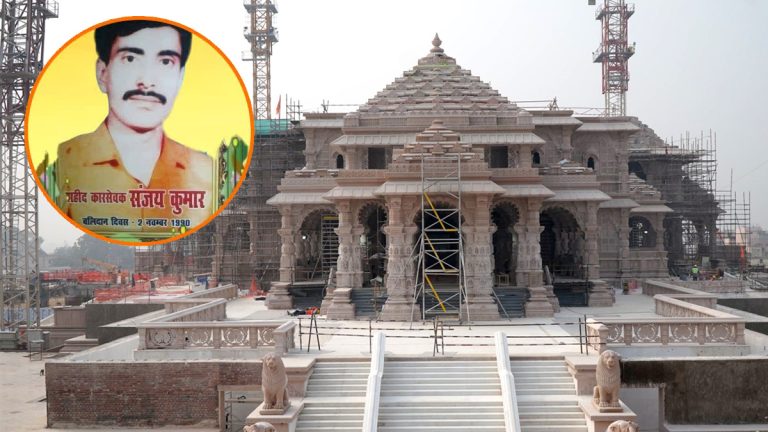
Mohit Pandey to be the chief priest of Ram Mandir in Ayodhya: While the leftist ecosystem is linking it with caste, here is why it has nothing to do with caste

The process of selecting priests to perform prayers at the Ram Mandir in Ayodhya was recently completed. As part of the process, regular applications were invited from interested devotees, and around 3000 people participated. The interested parties had to undergo a rigorous selection process that included specific criteria for choosing the priests for the Ram Mandir. In this entire process, 200 applicants were interviewed, out of which 50 candidates were selected for the post of priests.

Subsequently, the reports saying that Mohit Pandey had been selected as the chief priest went viral on social media. Reacting to these reports, certain social media users tried to cast aspersions and raise questions over the selection process for priests asking why only a Brahmin was selected for this post.

Many predictable handles, fanning the casteist divide and playing SC, OBC cards, started linking his selection with Brahminism highlighting his name, Manoj Pandey. 

A Dalit portal named ‘The Mooknayak’ tweeted in Hindi, ” Mohit Pandey will become the priest of Ram temple! Is it forbidden for Dalits to become priests?” 

Dilip Mandal fumed and wrote, “This temple is being built by the Government of India as a trust. It is not anyone’s ancestral property. There should be an agitation if the reservation is not given in the temple management. Everyone will give Dakshina and only one caste will withdraw all the money, this will not work.” 

An X user named Suraj Yadav in a sarcastic tone claimed that Dalits, OBCs, and Tribals are not Hindus. He wrote, “If he is a Hindu then he is selected. Keep in mind that Dalits, backward people, and tribals are not Hindus. Shudras, Ati Shudras, and people outside the caste system have no place either in the trust or in the place of worship. And this is especially for those Yadavs who are supporters of Manuvad or Brahminism.”

However, the pertinent thing is that those who are casting aspersions, neither know about the selection process nor are they aware of the merit due to which Mohit Pandey was selected for the post of Chief Priest.

For those unversed, the necessary condition to become a priest in the Ramlala temple was that the candidate should have studied Vedas, Shastras, and Sanskrit from a recognised Gurukul. Additionally, the candidate must have been initiated into the Ramanandiya tradition. In line with that, attention was paid to the knowledge of Vedas, rituals, and Vedic mantras during the interview process to select priests for the Ram Mandir. The upper limit for the candidates was fixed at 30 years.

Furthermore, despite their selection as Priest and Chief Priest, the selected candidates will have to undergo a long training period, which would last for 6 months, before they start performing their duties. In this training phase, they will be imparted in-depth knowledge of Vedas, rituals, Vedic mantras, and Ramayana. Only after the training phase is over, the priests will be able to perform the worship of Ramlala.

Candidates were adjudged on the selection criteria

As per the selection criteria, it was necessary to be a scholar of the Ramnandiya tradition, as well as to have expertise in the knowledge of Vedas, Shastras, and Sanskrit. The fact that Mohit Pandey passed all the selection criteria based on merit and ability, just like other candidates who were also evaluated, means that allegations of casteism and religious favoritism don’t arise. 

Notably, Mohit Pandey studied for seven years at Dudheshwar Ved Vidyapeeth, Ghaziabad. He obtained a Shastri (Bachelor) degree from Sri Venkateswara Vedic University, affiliated with Tirumala Tirupati Devasthanams in Tirupati. In 2023, he earned a master’s degree in Samaveda. He is also a scholar of the Ramanandiya tradition and possesses expertise in Vedas, Shastras, and Sanskrit.

Likewise, other selected priests include youth from Uttar Pradesh, Bihar, Rajasthan, Madhya Pradesh and Maharashtra. All the selected priests belong to the Ramanandiya tradition and have expertise in the Vedas, Shastras, and Sanskrit.

Mohit Pandey chosen as per the selection process

Speaking with The New Indian Express, Professor Rani Sadashiva Murthy, Vice-Chancellor of Sri Venkateswara Vedic University expressed happiness over the selection of Mohit Pandey to the post of Chief Priest of Shri Ram Lal Temple. 

Murthy said, “Many students from the University serve as priests and acharyas in various temples. A soft-spoken person, Pandey’s nature, focus and dedication to his studies have earned him the opportunity to serve Lord Ram in the esteemed Ayodhya Ram mandir.”

Mohit Pandey’s journey, from Ghaziabad to Tirupati and now Ayodhya after being selected as the Chief Priest of Ram Lala, is a testament to his dedication and rigorous training. Institutions like Dudheshwar Ved Vidyapeeth and Sri Venkateswara Vedic University in Ghaziabad have played a crucial role in nurturing individuals with spiritual abilities, as evidenced by their selection process.

In such a situation, those who are pointing fingers at his selection and linking it with castism are vitiating society by fanning the caste divide. 

While the ecosystem has been carrying out smear campaigns and cast aspersions, it is important to highlight that there are several temples in different states of India, there are not only Dalit or Women priests, prayers are performed by Dalit women priests in these temples.

In a previous article, OpIndia highlighted temples in which women and Dalits have been performing the responsibility of priests. Click here to read this complete report. 

Key takeaways from Supreme Court’s verdict upholding the abrogation of Article 370

The Supreme Court on Monday (11th December) upheld the abrogation of Article 370, which grants a special and separate Constitution to Jammu and Kashmir. Article 370 and Article 35A of the Indian Constitution gave special status to Jammu and Kashmir thereby giving it a separate identity than the rest of India.

On 5th August 2019, the Modi government revoked Article 370 and 35A thereby enabling the full and final Constitutional integration of the region into India. The same was immediately challenged by Advocate Manohar Lal Sharma who filed a petition under Article 32.

The five-judge Constitution bench comprising of Chief Justice DY Chandrachud, Justices SK Kaul, Sanjeev Khanna, BR Gavai and Surya Kant delivered a series of significant observations while upholding the abrogation of Article 370.

There were three judgments authored by the Supreme Court including by the CJI, Justice Gavai and Justice Surya Kant. A concurring opinion was authored by Justice SK Kaul and Justice Sanjeev Khanna had concurred with both judgments.

On the issue of the President empowered to withdraw executive and legislative powers from the state and transfer it to the Union

To the question of the power of the President under Article 356 to designate the executive and legislative powers of a state to the Union, the CJI listed a 6-point conclusion.

Upholding this power, in the 6th and last point, the CJI stated that every decision taken by the Union on behalf of the state is not subject to challenge.

“Opening up challenge to every decision would lead to chaos and uncertainty. It would in effect put the administration in the state at a standstill,” CJI Chandrachud read.

The SC laid down the criteria to assess action under Article 356 after it is exercised or brought into effect.

The criteria stated by the SC was in three points which read as follows:

“a) The exercise of the power by the President under Article 356 must have a reasonable nexus to the object of the Proclamation.”

b) The person challenging the exercise of power must prima facie establish that it is a malafide or extraneous exercise of power. After a prima facie case is made, the ownership to the Union to justify that the exercise of the power had a reasonable nexus for the object of the proclamation.

c) The exercise of power by the President for everyday administration of the state is not ordinarily subject to judicial review.”

This essentially means that the Supreme Court laid down criteria for challenging the implementation of Article 356 after it is invoked by the Union. And this requires for the objecting party to prove that the exercise of the power is malafide.

Moreover, the Supreme Court refused to accept the petitioner’s argument that the Union Government cannot take action which has irresversible consequences when a proclamation under Article 356 is imposed.

The SC also did not accept the petitioner’s argument that Parliament can assume only the lawmaking powers of the legislature of the state when the Proclamation under Article 356 is issued.

The Court observed that while exercising the powers of the legislature of the state under relevant Articles, the Parliament and the President are not delayed or blocked by absence of competence.

On the issue of whether Jammu and Kashmir retained “internal sovereignity when it joined the Union of India”

The SC held in clear words that the state of Jammu and Kashmir did not enjoy internal sovereignity when it joined the Union of India by signing the instrument of accession.

The SC cited the instrument of accession signed by the then ruler of Kashmir Raja Hari Singh.

The SC observed that according to paragraph 8 of the instrument of accession, “nothing in the instrument would affect the continuance of the sovereignity of the Maharaja in the over the state.”

The SC then observed that on 25th November 1949 a proclamation was issued for Jammu and Kashmir by Yuvraj Karan Singh which declared that the Constitution of India would not only supercede all other constitutional provisions in the state but also abrogate them.

The SC held that that with this proclamation, the paragraph 8 of the instrument of accession ceased to be of legal consequence.

The bench held that the proclamation reflects full and final surrender of Jammu and Kashmir to its sovereign ruler, to India, to her people who are sovereign.

Furthermore, the SC categorically stated that neither does the Constitutional setup nor any other factors indicate that J&K retained an element of sovereignity.

In a significant observation, the SC stated that the Constitution of Jammu and Kashmir was only to further define the relationship between the Union of India and the state of J&K whereas, it observed, that the relationship itself was already defined by the instrument of accession, the proclamation of 1949 and “more importantly” by the Constitution of India.

The SC pointed the absence of the reference to sovereignity in the Constitution of Jammu and Kashmir.

“In contrast, the Constitution of India emphasizes in the preamble that the people of India resolve to constitute themselves or to constitute India into a sovereign, socialist, secular, democratic Republic,” the CJI read.

The SC stated that Article 1 and Article 370 of the Indian Constitution make it evident that J&K is an integral part of India. The apex court also pointed out that the same is reiterated in Section 3 of the constitution of J&K which is unamendable.

The SC also observed that the Preamble of the constitution of J&K; sections 3, 5 and 147 of the state constitution coupled with Article 1 of the Indian Constitution read with the First Schedule as well as Article 370 “indicate in no uncertain terms” that J&K is subordinate to the Indian Constitution first and only then to its own constitution.

The SC also observed that the Constitution has provisions specific to the varying concerns of various states depending upon the degree of their concerns. These provisions, the SC observed, are specific to that state.

To that effect, the SC noted that the powers and privileges of Jammu and Kashmir are not distinguishable from the powers and privileges that are enjoyed by other states.

On the issue of the challenge to Constitutional Order (CO) 273

The SC said that in order to answer this question, the bench had to decide on two other issues. The first issue was whether Article 370 is temporary.

The SC held that Article 370 is a temporary provision “on the reading of the historical context in which it was included”. The SC elaborated on the same as follows.

SC held that the Article 370 was implemented to provide for an “interim arrangement until the constituent assembly of J&K was formed and to take a decision on the legislative competence of the union on matters other than the ones stipulated in the instrument of accession and ratify the Constitution”.

The second reason for Article 370, the SC observed, as a temporary purpose and interim arrangement in view of the special circumstance because of the war-like conditions in the state.

The SC observed that a textual reading of Article 370 indicates that it is a temporary provision.

The second issue was the effect of the dissolution of the constituent assembly of Jammu and Kashmir on the scope of powers under clause 3 of Article 370.

In a big blow to the petitioners, the SC upheld the powers of the President under Article 370 clause 3 to issue a notification declaring that Article 370 ceases to exist.

Moreover, the SC ruled that the President of India very much has this power even after the dissolution of the constituent assembly of J&K.

The reasons cited by the SC for the same were as follows. The SC stated that clause 3 of Article 370 encapsulates the process by which the states could ratify the Constitution of India.

The Constitution of India was ratified by every ruler of every Indian state on recommendations of the constituent assembly.

In states where the constituent was not yet formed, the ruler had to ratify the Constitution. Once the constituent assembly was formed in these states, they could call for modification to the Constitution required for the state.

The SC ruled that the recommendation of the Constituent assembly was not binding on the President.

Furthermore, the SC observed that constituent assembly of Jammu and Kashmir was formed for framing the Constitution for the state and was not intended to be a permanent body but one for a specific purpose.

Hence, the SC observed, that the power conferred to Article 370 clause 3 was only for the period of transition when the constituent assembly of J&K was formed pending the drafting of the state constitution.

The Supreme Court observed that holding that the power under Article 370 clause 3 cannot be exercised after the dissolution of the constituent assembly would lead to the freezing of the process of integration.

The SC added that the power of the President notfying that Article 370 ceases to exist applies equally to all states including to J&K under the First Schedule of the Indian Constitution.

“Article 370 1D and Article 370 (3) were introduced with the purpose of constitutional integration and not for disintegration. So the power under Article 370 1D and Article 370 clause 3, even when exercised to its fullest extent does not freeze the system of integration contemplated by art 370 but is rather intended to enhance constitutional integration between the Union of India and J&K,” the SC ruled.

Lastly, the SC observed that the President determines whether special circumstanes which warranted Article 370 have ceased to exist and that “it is a policy decision which completely falls within the realm of the executive”.

The SC clearly observed that the Court cannot sit and appeal over the decision of the President of India on whether the special circumstances that led to Article 370 have ceased to exist.

“However, the decision is not beyond the scope of judicial review,” the SC observed adding that the exercise of executive power can be challenged on the grounds of malafide.

A very significant observation made by the Supreme Court was that the Constitutional integration of J&K into the Union of India was a process ongoing for the past 70 years and not a sudden one.

The SC observed that it was not that only Article 1 and Article 370 were applied to J&K and neither was the entire Constitution suddenly applied to J&K after 70 years.

“The slew of Constitutional orders issued by the President under Article 370 1D applying various provisions of the Constitution and applying provisions of modification indicate that over the course of the last 70 years the Union and J&K have through a collaborative exercise Constitutionally integrated the state of J&K with the Union,” it observed.

The SC thereby also upheld that the exercise of power by the President to issue CO 273 was valid. Constitutional Order (CO) 273 issued by the President essentially sealed the abrogation of Article of 370 in J&K.

On the issue of challenge to CO 272

The SC held that all provisions of the Constitution can indeed be applied to J&K under Article 370 1D.

The SC categorically ruled that the power under Article 370 1D can be used to apply one provision, more than one provision, an entire part of the Constitution or all the provisions of the Constitution that is the entire Constitution.

“The provision does not make a distinction between one or all provisions of the Constitution. Non application of mind cannot be claimed merely because of CO 272 applies all provisions of the Constitution to J&K in one go,” the SC ruled.

On the issue of challenge to CO 272

The SC held that the President seeking the concurrance of the Union Government instead of the state government to issue CO 272 is not invalid.

The SC observed that the application of power by President under Article 370 1D is similar to the application of Article 370 clause 3 notifying that Article 370 shall cease to exist with the exception that the former can be reversed and the latter cannot.

The SC ruled that consultation and collaboration between the Union and the state is necessary only where a application provision of the Indian Constitution would require amendment to the state constitution.

This, the SC observed, is to ensure that the constitution of the J&K is not inconsistent to the Indian Constitution. The SC observed that the principle of consultation and collaboration by the Union with the state is not required to be followed.

The SC further held that the exercise of power is malafide only if inteded to deceive. The SC ruled that the President securing the concurrance of the Union of India on behalf of the state government is not malafide.

On the validity of Parliament’s exercise of power under Article 3

The Supreme Court cited the observations of the 5-Judge SC bench in Babulal Parate case. Th had held that the views held by the state legislature under the proviso to Article 3 are not binding on the Parliament.

The SC held that the Parliament’s exercise of power under the first proviso of Article 3 is valid and not malafide, the SC held.

On the issue of validity of Jammu and Kashmir Reorganisation Act 2019

The SC mentioned the submission of the Solicitor General that the statehood of J&K will be restored and that the status of Union Territory is only temporary.

The SC also mentioned that the SG submitted that the status of Ladakh as a UT will not be affected by the restoration of the statehood of J&K.

In view of the submission, the SC held that it is not necessary to determine whether the reorganisation of J&K into two Union Territories of Ladakh and J&K is permissible under Article 3.

The SC also ruled that elections to J&K cannot be put on hold until statehood is restored and directed that the Election Commision of India take steps to conduct elections in J&K on 30th September 2024.

The SC directed that the restoration of statehood should be done as early as possible.

The epilogue by Justice SK Kaul

Justice SK Kaul’s epilogue after his judgement was a key highlight of the judgment by the Supreme Court. A Kashmiri Pandit himself, Justice Kaul echoed the struggles of the community.

He called on the “need to achieve collective understanding of the human rights violations perpetuated both by state and non-state actors of the people of this region”.

Justice SK Kaul recommended the setting up of a Truth and Reconciliation Committee (TRC) to investigate the violation of human rights violation both by state and non-state actors perpetrated in Jammu and Kashmir at least since 1980s and recommend measures for reconciliation.

“The commission should be set up expeditiously before memory escapes. The exercise should be time bound,” he said.

“Inko nahi samjha sakta”: Amit Shah takes a dig at Congress over stance on SC verdict concerning Article 370

0

Home Minister Amit Shah on Monday took a dig at Congress over its stance of disagreeing with the Supreme Court judgement over how Article 370 was abrogated from Jammu and Kashmir and said the opposition party will continue to lose elections with such a stand.

Replying to the debate in the Rajya Sabha on the two bills relating to Jammu and Kashmir, Amit Shah said it was an important day as the bills will be passed by Parliament on a day the Supreme Court upheld the abrogation of Article 370.

The Jammu and Kashmir Reservation (Amendment) Bill, 2023 and the Jammu and Kashmir Reorganisation (Amendment) Bill, 2023 were passed by Lok Sabha last week.

Targeting the Congress, Amit Shah said the opposition party has said it does not agree with how Article 370 has been abrogated.

He said due procedure and rules were followed while abrogating Article 370 in August 2019 and now the Supreme Court has also given its verdict.

“Main inko nahi samjha sakta, meri maryada hai (I cannot them make them understand, I have a limit),” he said.

The Home Minister said Article 370 led to separatism, which nurtured terrorism.

He said Congress should consider changing its position. “…or your numbers will go down further. There will be a contest in 2024 (Lok Sabha polls), Modiji will become PM for the third time,” Shah said.

Congress on Monday said that the judgement of the Supreme Court in the cases concerning the abrogation of Article 370 of the Constitution has decided many issues but has left open some issues that are also vitally important.

“Prima facie, we respectfully disagree with the judgement on how Art. 370 was abrogated. We reiterate the Congress Working Committee resolution dated August 6, 2019, that Art. 370 deserved to be honoured until it was amended strictly by the Constitution of India,” Congress leader P Chidambaram said addressing a joint press conference.

“We are also disappointed that the Supreme Court did not decide the question of dismembering the State and reducing its status to two Union Territories. That question has been reserved for adjudication in a suitable case in the future,” he said.

“The Indian National Congress has always demanded the restoration of full statehood for what has become the Union Territory of Jammu and Kashmir. We welcome the Supreme Court’s verdict in this regard. Full statehood must be restored immediately. The aspirations of the people of Ladakh must also be fulfilled,” he added.

Chidambaram said the party welcomes the Supreme Court’s direction to hold assembly elections. “However, we believe that the elections should be held immediately and there is no reason to wait until September 2024. When elections are held, the people of Jammu & Kashmir will have an opportunity to express their views on the crucial questions that were debated in the Hon’ble Supreme Court — an opportunity that has been denied to them so far,” Chidambaram added.

The Congress leader said the Supreme Court judgement has 476 pages and the party will study it carefully.

(This news report is published from a syndicated feed. Except for the headline, the content has not been written or edited by OpIndia staff)