Home Blog Page 1758

‘Why should court get into it?’: Supreme Court rejects Hindu Personal Law Board’s request to declare ‘Ram Setu’ as a national monument

0

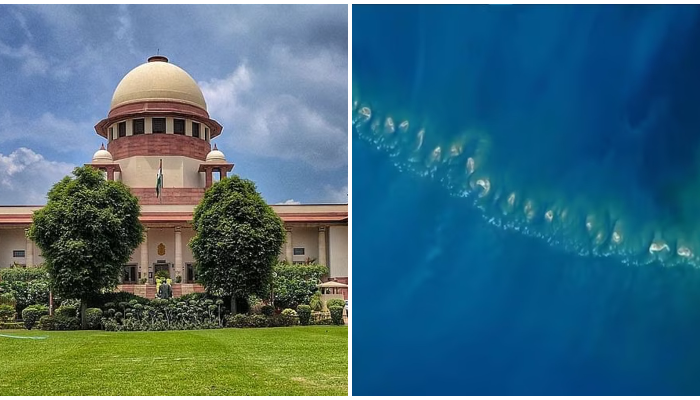
The Supreme Court turned down a plea on 3 October for a decree designating the ‘Ram Setu’ as a national monument as defined in the Ancient Monuments and Archaeological Sites and Remains Act, 1958. It further sought to authorise the building of a wall in the sea for a few meters or kilometres to manage darshan at the site. The apex court dismissed the request and stated that these are concerns of administrative procedure for the government.

The president of the Hindu organisation, Ashok Pandey, an attorney based in Lucknow, submitted the motion as a writ petition in accordance with Article 32 of the Indian Constitution. The petitioner asked the panel of Justices Sanjay Kishan Kaul and Sudhanshu Dhulia to combine the matter with one presently pending by Bharatiya Janata Party leader Dr. Subramanian Swamy who proposed national heritage status for the ‘Ram Setu.’ The bench entirely refused to do the aforementioned and added that the lawyer should instead approach the government because this is an administrative affair.

Justice Kaul questioned the necessity of filing yet another suit when Dr Subramanian Swamy’s plea is still pending. “What do you want,” he asked. “What can the court do? How can the court direct to construct a wall? These are administrative matters of the government. Why should we get into it,” the court implored after the lawyer voiced his appeal.

“No, we are not connecting it. We are not inclined to interfere under Article 32 of the Constitution of India to give any directions which the petitioner seeks. Dismissed,” the highest court pronounced when he requested to tag the petition with the aforementioned lawsuit. “No. Suddenly you want to say my name should also be added,” remarked Justice Kaul.

The petition highlighted the historical event and read, “In case this Setu comes in open, it will give way to people across the world to come to Dhanuskoti (Rameshwaram) for the Darshan of the bridge constructed under the orders of Lord Ram. In case it is done, the common man will be able to walk on this bridge for a few meters. It will fulfil the desire of crores of persons like the petitioner to walk, sit and sleep on the bridge through which Ram along with his army went to Lanka to kill Ravan and to establish Ram Rajya in Lanka.”

It further conveyed, “It is indeed good that Sri Nitin Gadkari, the minister given the charge of this department declared in the Parliament that Sri Ram Setu will not be destructed and without destruction of the same, the Setu Samudram Shipping Canal Project (SSSCP) will be completed.”

Dr. Subramanian Swamy brought up the issue of the ‘Ram Setu’ being recognised as a national heritage in his 2007 argument and opposed the Sethu Samundram Ship Channel project. An 83 km long waterway between Mannar and Palk Strait was to be developed as part of the Setu Samundram project by means of substantial dredging. The Ram Setu was reported to be impacted by the project. He has spoken about this issue previously on several occasions.

The Ministry of Culture is currently considering giving ‘Ram Setu’ national heritage status, as the Solicitor General of India Tushar Mehta had notified the Supreme Court.

Off the southern coast of Tamil Nadu, there is a chain of limestone shoals called ‘Ram Setu’ also known as ‘Adam’s Bridge’. It stretches from Mannar Island off the northern coast of Sri Lanka to Pamban Island close to Rameshwaram in the southern state. The bridge is mentioned in the Ramayana where it is asserted that Lord Ram who is the seventh incarnation of Lord Vishnu built it in order to travel to Lanka and rescue his wife Goddess Sita from the clutches of powerful Rakshasa king Ravana.
“Central assessment may be required”: SC to hear petitions filed by Gandhi family & AAP challenging transfer of tax assessment to Central Circle

The Supreme Court on Tuesday (3rd October) heard a bunch of petitions filed by Congress leaders and AAP challenging the decision of the Income Tax department to transfer their tax assessment from faceless to Central Circle.

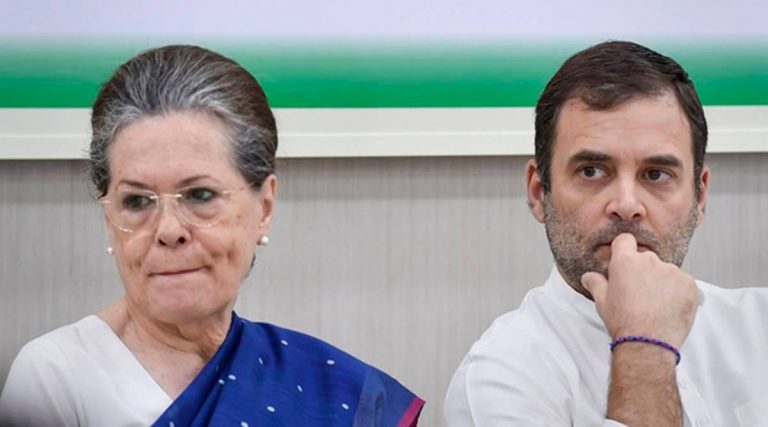
The petitions have been filed by Congress leaders Sonia Gandhi, Rahul Gandhi and Priyanka Gandhi Vadra, and trusts linked to them, challenging the transfer of their Income Tax assessments to the Central Circle. The Aam Aadmi Party has also filed a similar plea with the Supreme Court.

The Gandhis had moved SC following the dismissal of their petitions on 26th May by the Delhi High Court. The SC will now hear the case on 9th October.

In a setback to the Gandhis and AAP, the apex court said that “centralised assessment may be required for income tax purposes where there are cross-transactions between individuals”.

Faceless tax assessments are done through electronic mode with the aim to eliminate the human interface between the taxpayer and the income tax department.

The Central Circle, on the other hand, is authorised to check evasion and takes over evidence gathered by the IT department’s investigation wing during searches. This is what the Congress and AAP are essentially contesting in the court.

Senior Advocate Arvind P Datar told the SC that several proceedings were launched after the faceless assessment was introduced in 2019. But then following the search in a case involving alleged arms dealer Sanjay Bhandari, there was an arrest and matters of his clients were tagged together “because of Robert Vadra, who is the son-in-law of one of the parties”.

The two-judge bench said, “Insofar as individuals are concerned…if there are cross-transactions, centralised assessment may be required.”

Advocate Datar was appearing for the members of the Gandhi family, Sanjay Gandhi Memorial Trust, Rajiv Gandhi Charitable Trust and Rajiv Gandhi Foundation, Jawahar Bhawan Trust and the Young Indian.

The SC also questioned AAP over a five-month delay in filing a plea against the IT department’s decision to transfer its case for assessment to the Central Circle.

Justice Khanna, presiding over the two-judge bench, told senior advocate Abhishek Manu Singhvi, “In a case like this, a delay of even one month is fatal. You have to explain why there was so much delay in filing the petition. We will be dealing with each case separately.”

The court sought original files on the matter asking the Additional Solicitor General Balbir Singh whether review and verification committee are chosen by computer in case of faceless assessment officers. Singh was representing the Income Tax department.

“I don’t want explanations, but a factual answer. Also, would like to know the stage of proceedings. You please get the original files of the matter,” Justice Khanna told Singh.

Delhi High Court had dismissed the petitions

In January 2021, the Principal Commissioner (Income Tax) issued an order to transfer the cases of Gandhis for assessment year 2018-19 to the Central Circle. The Gandhis moved court challenging the same.

On 26th May, the Delhi High Court dismissed the petitions filed by Gandhis against the Income Tax department’s decision to transfer their faceless tax assessments to Central Circle.

The HC said that it is of the view that the transfer of assessment to the Central Circle was as per law by way of the impugned orders passed under Section 127 of the (IT) Act.

In a big setback, the court also said that the Central Circle’s jurisdiction is not confined only to search cases, and no assessee has any fundamental or vested legal right to be assessed by a faceless assessing officer.

The HC had also rejected separate petitions filed by Sanjay Gandhi Memorial Trust, Jawahar Bhawan Trust, Rajiv Gandhi Foundation, Rajiv Gandhi Charitable Trust, Young Indian and the Aam Aadmi Party, raising similar legal issues over transfer of their assessments to the Central Circle.

Why is the Congress opposing the Central Circle tax assessment?

The SC’s response about centralised assessment was in reference to the close links between proclaimed offender and fugitive Sanjay Bhandari and Robert Vadra, Rahul Gandhi’s brother-in-law, as submitted by Senior Advocate Datar representing the Gandhis.

It is notable in this context that the same Central Circle 27 which has been handling the cases linked to Robert Vadra, will now be reassessing the tax filings of Sonia, Rahul, Priyanka and their many “not-for-profit” foundations.

Moreover, as a potential investigation stares at the Vadra Congress, the Congress has tried to distance itself from Robert Vadra. It has reportedly maintained in the past that Robert Vadra is a private individual and the party leadership has nothing to do with his business activities.

On 4 January 2022, Income Tax officials interrogated Robert Vadra linked to the investigation into alleged tax evasion. Vadra had allegedly purchased properties in the United Kingdom through shady arms dealer Sanjay Bhandari.

Vadra is also accused of receiving kickbacks from a petroleum deal conducted in 2009 into the properties. Bhandari and Vadra’s close links and their alleged manipulation of defence deals under the UPA regime have also been under scanner.

Sanjay Bhandari’s name cropped up when Deepak Agarwal, a hawala operator, was being scrutinized in an entirely separate case involving funding to the Aam Aadmi Party. It was discovered that Rs. 69 crore to seven of Bhandari’s companies came from the same hawala operator.

It was only then that his phones were tapped and the raids conducted. The raids, as people are well aware, opened the pandora’s box thus exposing Robert Vadra’s deep involvement with Bhandari.

Congress corruption comes full circle

In October 2022, the Rajiv Gandhi Foundation (RGF), a non-governmental organisation linked with the Gandhi family, had its Foreign Contribution Regulation Act (FCRA) licence revoked by the Centre for alleged violation of the foreign funding law. Licence of Rajiv Gandhi Charitable Trust (RGCT) has also been cancelled. Both the organisations cannot receive foreign funding anymore.

In July 2020, the MHA formed an inter-ministerial committee led by an Enforcement Directorate (ED) officer to investigate three foundations linked to the Gandhi family, Rajiv Gandhi Foundation (RGF), Rajiv Gandhi Charitable Trust (RGCT), and Indira Gandhi Memorial Trust, for alleged violations of the Money Laundering Act, Income Tax Act, and FCRA.

In August last year, the Enforcement Directorate (ED) had temporarily sealed the office of Young Indian located inside Congress-owned National Herald building in Delhi.

The action by the central investigation agency was taken as a part of a money laundering investigation. As per reports, ED officials said they sealed the office as there was no one present when they reached to raid Young India’s office.

Uttar Pradesh: Principal Aftab Ahmed arrested for sexually abusing more than a dozen minor students, had challenged parents ‘to do whatever you can’

A deeply distressing incident around charges of misconduct involving minor students against a principal of a government school in Uttar Pradesh’s Azamgarh has come to light. The perpetrator has been identified as a 55-year-old man named Aftab Ahmed and the shocking instance surfaced on 1st October. He is accused of engaging in inappropriate conduct with dozens of students at the institution, and has been arrested on the basis of complaint filed against him.

He served as the principal of a composite school located in Katghar village within the Sidhari police station area of Azamgarh. He subjected both boys and girls to illicit behaviour and made them hold his private part, according to the police complaint submitted by the parents of one of the victims.

Parents and guardians were left outraged and appalled by these alarming allegations. They pointed out that the horrific episode affecting their young ones had persisted for a while. Another instance of him carrying out similar actions emerged a few years ago. At that point, he resolved the conflict by expressing regret and apologising. However, he resumed molesting youngsters after some time.

Aftab Ahmed sexually harassed a 13-year-old pupil belonging to the scheduled caste community on the fateful day. He confided in his mother who took immediate action and arrived at the school to confront the offender along with the parents of other victims. He reacted aggressively when the family members showed up at the educational institution and refused to take responsibility for his abhorrent activities.

The anguished mother mentioned that he got into a heated argument with them. He insulted and abused them as well as challenged, “Put forth every effort. You won’t be able to do anything.” Notably, there are believed to be approximately a dozen students of both genders who have endured sexual violation at his hands with ages ranging from 10 to 13.

In an important development, the families of the targeted students have come forward as witnesses and have sought stringent action against the culprit. The authorities have registered a case against him under various sections of the Indian Penal Code (IPC), including 354 (outraging the modesty of a woman), 294 (obscene acts or words), and 504 (intentional insult with intent to provoke breach of peace), along with sections of the SC/ST (Prevention of Atrocities) Act and the POCSO (Protection of Children from Sexual Offences) Act.

The police have confirmed his arrest and that he would brought before the court to apply for remand. OpIndia has a copy of the complaint. The Superintendent of Police (SP) City of Azamgarh informed that the investigation was handed over to the Deputy Superintendent of Police (DSP) of the area after a complaint was received. A case has been lodged against the principal under the appropriate legislation after the claims were established following an inquiry. Authorities have reaffirmed their commitment to conducting a complete probe and delivering justice to the victims.

Decoding Rahul Gandhi’s lies on caste-based census: After granting the share of OBCs to Muslims, Congress tries to shift benefits for Dalits to Christians

The complete I.N.D.I. alliance, in collaboration with Congress and Rahul Gandhi, is fervently championing the cause of caste-based census and the principle of ‘proportional representation based on population.’ The caste census figures have been unveiled in Bihar, and amidst this backdrop, Rahul Gandhi has been persistently asserting that the Congress government had carried out a nationwide caste census, calling on the Modi government to disclose its findings. Rahul Gandhi continues to make such assertions, warranting a thorough examination and analysis of his claims and statements.

Rahul Gandhi’s Claim No. 1: Congress Conducted Caste Census, urges Modi Government to Make It Public

The Reality: Congress Did Not Conduct Any Such Census. Rahul Gandhi claims that caste-related statistics were recorded during the 2010-11 census. The Congress government remained in power until 2014. However, the census data was released in 2011. Therefore, the question arises as to when the process of caste-based census was completed. Under which rules was the caste census conducted? When was the notification issued for the caste-based census?

It’s worth noting here that the census is a continuous process governed by constitutional provisions. Officially, there hasn’t been a caste-based census conducted since 1931. Even if the Congress government had initiated such a census, why weren’t the figures released?

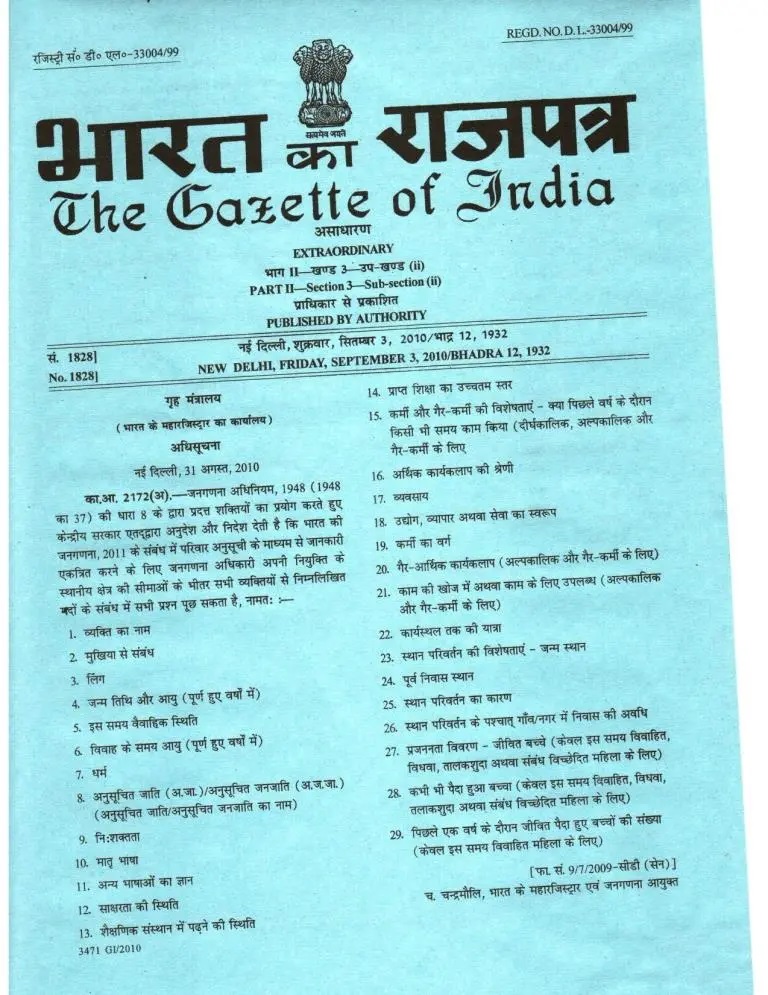
Now, let’s discuss the notification regarding the 2010 census. In that notification, there is no mention of the OBCs anywhere. We are providing a copy of the format of that census here.

The format issued for the 2010 census (Image Source: census India, Government of India).

Moreover, the Congress’s reference to the 2011 Socio-Economic and Caste Census (SECC) is inaccurate, as the figures from that census are not usable. The Central Government even submitted an affidavit to the Supreme Court in 2021 regarding this matter. In response to the Maharashtra government’s petition, the Centre stated in the Supreme Court affidavit that the caste/tribe data in the 2011 Socio-Economic and Caste Census is flawed and not suitable for use.

Before the caste census in Bihar, in 2015, the Congress government in Karnataka also conducted a similar census. However, the reasons why the data from that census was not released remain unknown. In such a scenario, it could be surmised that the top leadership of Congress may have suppressed those figures because they were not favourable to their cause.

Now, the question arises: did Congress refrain from releasing the caste census data because they feared losing their vote bank? If not, then why were these figures not disclosed until 2014? The sudden recall of this census by Congress raises political questions.

Under the leadership of Narendra Modi, the BJP, particularly under the NDA umbrella, has exhibited remarkable performance in general elections, both in 2014 and 2019. The divisive caste-based parties couldn’t make a dent in Narendra Modi’s electoral juggernaut. So far, the opposition has been unable to find a chink in Narendra Modi’s development and nation-first policies. In this light, it seems that the Congress is attempting to challenge Narendra Modi’s dominance in the name of caste-based divisions, even though it doesn’t appear feasible, no matter how many alliances it forms with caste-based and dynastic parties.

Rahul Gandhi’s Claim No. 2: Only 3 OBCs among 90 in Central Secretariat

Rahul Gandhi has been raising the issue of only 3 OBC officers among the 90 officials currently deployed in the Central Secretariat. In this regard, it is essential to ask him first how many OBC officers were appointed in the Central Secretariat during the UPA’s tenure from 2004 to 2014.

Now, let’s explore why the number is low and why it may not be fair to connect it directly to the government. To understand the context of this issue, we need to go back to the times of India’s first Prime Minister, Jawaharlal Nehru. BJP’s National President, JP Nadda, even raised this matter in Parliament. He mentioned that during Pandit Nehru’s tenure, the Kakasaheb Kalelkar report was commissioned. Following that, the Mandal Commission report was introduced during the eras of Indira Gandhi and Rajiv Gandhi but wasn’t implemented. It finally came into effect in 1990, whereas during the times of Indira and Rajiv, this report remained largely neglected.

JP Nadda further stated that in 1992, the Supreme Court directed the provision of reservations for OBCs in services. Consequently, from 1995-1996 onwards, OBC-SC-ST reservations were initiated in All India Services. The current Cabinet Secretaries were appointed prior to 1992. However, in the coming years, we can expect an increase in the number of OBC Secretaries. This can also be understood by considering that Cabinet Secretaries are the highest-ranking senior officials.

Reaching the position of Cabinet Secretary isn’t something that can happen overnight. Over time, individuals gradually rise through the ranks to attain these senior positions, as JP Nadda emphasised in Parliament. Therefore, Rahul Gandhi’s claim that the Modi government isn’t appointing OBC individuals as Cabinet Secretaries lacks a solid foundation.

Rahul Gandhi’s Claim No. 3: Congress Advocates for the OBC Community’s Welfare

The truth behind Rahul Gandhi’s claim is that Congress has been one of the staunchest opponents of the OBC community. Whenever the question of reservations arises, the Mandal Commission is mentioned. Who commissioned the Mandal Commission? The answer is that it was established during the tenure of Morarji Desai’s Janata Party government in 1979, with its report being published in 1980. The question that arises here is why the Mandal Commission was not implemented during Indira Gandhi’s time from 1980 to 1984 or during Rajiv Gandhi’s term from 1984 to 1989.

In 1990, the Janata Dal government, supported by the BJP from the outside, implemented the Mandal Commission recommendations. In light of this, Rahul Gandhi’s claim has once again proven to be incorrect.

The reality is that the Congress government, by providing reservations to Muslims from within the OBC quota, essentially made a dent in the share meant for OBCs. In various states, including Karnataka and Maharashtra, the Congress government exceeded the prescribed limits for reservations. Even in these states, a portion of the OBC reservation (4%) was allocated to Muslims, a move that underscores the fact that the Congress government hasn’t acted in the best interests of the OBC community but has rather been their biggest adversary. This prompts us all to question whether Congress truly advocates for the welfare of the OBC community.

Rahul Gandhi’s ‘Divide and Rule’ Political Strategy: What Lies Behind It?

As straightforward as this question may seem, its answer is equally tangled. India’s population is undergoing rapid changes, and the game of converting Hindus to Islam and Christianity through various means has been ongoing for some time now. However, there is a catch in this scenario. Those who undergo religious conversion to become Muslims or Christians often continue to identify themselves as Dalits or OBCs on official documents.

To understand the meaning of this, it becomes crucial to know about a judgment from the Madras High Court related to demographic changes and reservations in Kanyakumari.

In early 2022, during the hearing of a case, the Madras High Court remarked, “Talking about religions, there is a demographic change observed in Kanyakumari. Hindus are no longer in the majority of the district since the 1980s. Although the 2011 census indicates that Hindus constitute the largest religious group with 48.5% of the population, this may differ from ground reality. It should be noted that a significant number of Scheduled Caste individuals have converted to Christianity but continue to identify themselves as Hindus to avail of reservation benefits.”

Since Congress has long been associated with the appeasement of Islamic fundamentalists and nurturing Christian missionaries, they are integral components of that ecosystem, which allowed Congress to maintain power for so many years and still serves their interests in anti-India global propaganda. In this context, the attempt is being made through a caste-based census to include those individuals who have already converted to crypto-Christians but continue to identify as Hindus to avail themselves of reservation benefits. Through caste-based census, they aim to integrate these individuals into various categories, thereby depriving genuine Hindu OBC-SC-ST communities of their rightful entitlements.

It’s worth noting that while a caste-based census was conducted in 1931, the census in 1951 omitted the caste column and counted only the population of Scheduled Castes and Scheduled Tribes. This change was made because there was a mandate to provide reservations for these communities, and therefore, it was essential to determine their numbers accurately.

Indian Air Force receives the first LCA Tejas twin-seater trainer aircraft from HAL

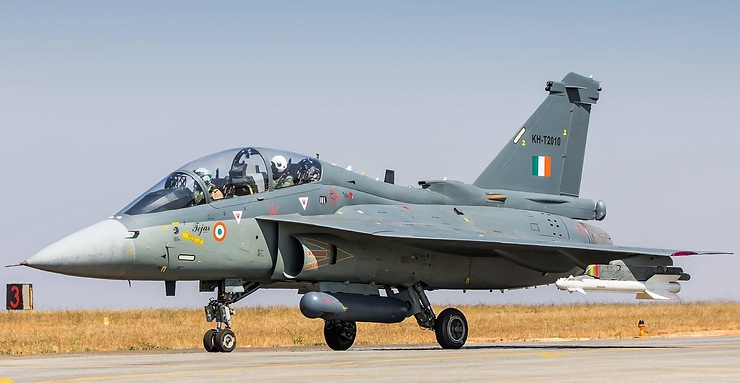
Indian Air Force (IAF) chief Air Chief Marshal VR Chaudhari received the Light Combat Aircraft (LCA) Tejas twin-seater trainer aircraft from Hindustan Aeronautics Limited (HAL) Chief Managing Director CB Ananthakrishnan in Bengaluru on Wednesday.

“Today is a momentous day and a matter of pride for me to accept the first two-seater LCA aircraft. This day will go down in history as a really remarkable one that exemplifies the prowess of the Indian domestic aviation industry,” Chaudhari said speaking at the ceremony in Bengaluru.

The Air Force chief said that two LCA squadrons have already been set up and a contract has been signed for 83 additional LCAs.

“It is a matter of pride for us, in the Indian Air Force having set up two LCA squadrons already. We have now signed a contract for 83 additional LCA (Light Combat Aircraft) and we are moving forward to procuring 97 more LCAs. In the coming years, we will have a fleet of 220 LCAs in the inventory of the Indian Air Force,” the Indian Air Force chief said.

“I once again wish each one of you the very best to ensure that we in the Indian Air Force receive our orders on time and start flying them in a good period of time. My compliments to all the stakeholders and best wishes to all of you for a bright and successful future,” he added congratulating the aviation industry.

Speaking at the event Minister of State Defence Ajay Bhatt said, “Today is a historic day. I am very proud to be in HAL and to witness all agreements done here. We have handed over the first LCA twin-seater to IAF.”

On the Atmanirbhar push in the field of Indian aviation, Bhatt said, “Some years ago we were dependent on other countries for fighter jets. PM Modi wants India to do better in all fields. We are getting Atmanirbhar.”

The HAL handed over the first Light Combat Aircraft (LCA) twin-seater trainer version aircraft to the Indian Air Force (IAF) in Bengaluru on Wednesday.

HAL has an order of 18 twin seater from IAF and is planning to deliver eight twin seater in FY 2023-24. Further, 10 twin seaters would be delivered progressively by 2026-27. Further orders are also expected from IAF.

LCA-Tejas is the largest R-D program ever undertaken in India making its maiden flight in 2001 and has achieved various milestones since then. It is going to be the backbone of the IAF fleet in years to come and is slated to be produced in high numbers by Hindustan Aeronautics Limited in Bengaluru, as HAL has already received an order of 123 aircraft out of which 32 fighters have been supplied to IAF and two squadrons already operational with Indian Air Force (IAF) at Sulur, AF base.

LCA Tejas is a 4.5 generation, all weather and multi-role fighter aircraft. The aircraft is designed to be a multi-role aircraft capable of taking up offensive air support, close combat and ground attack role at ease. It is also designed to undertake Ground Maritime Operations.

LCA Mk1A is the most advanced version of the LCA Tejas. It is equipped with AESA Radar, EW suite consisting of radar warning and self-protection jamming, Digital Map Generator (DMG), Smart Multi-function Displays (SMFD), Combined Interrogator and Transponder (CIT), Advanced Radio Altimeter and other features.


(This news report is published from a syndicated feed. Except for the headline, the content has not been written or edited by OpIndia staff)

Pro-Khalistani graffiti found in Dharmashala 3 days ahead of ICC World Cup match

0

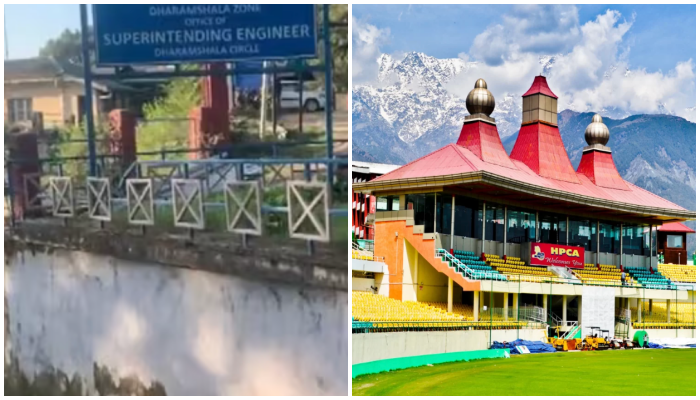
Pro-Khalistan graffiti was found written on the walls outside a government office in Dharamshala, Kangra district, police officials said. 

Meanwhile, the police took immediate action and painted the wall to remove the slogan. Notably, this comes three days before the start of ICC World Cup matches in Dharamshala. Dharamshala Police is investigating the matter.  

In a similar incident on September 27, Pro-Khalistan graffiti was found written on the walls at Delhi’s Kashmiri Gate flyover, after which Delhi Police registered a case in the matter.

A video came into notice on September 27, wherein certain visuals of defacement through graffiti were seen. As per the signage boards visible in the video, an extensive search was launched in the area of North District, and graffiti was found on the Yudhister Setu flyover coming from Seelampur towards Kashmere Gate, police said.

Meanwhile, the police registered the FIR under relevant sections of IPC and the Delhi Prevention of Defacement of Public Property Act.

(This news report is published from a syndicated feed. Except for the headline, the content has not been written or edited by OpIndia staff)

Maharashtra: Surge in deaths at government hospitals sparks concern, minister acknowledges doctor shortage and mismanagement of funds

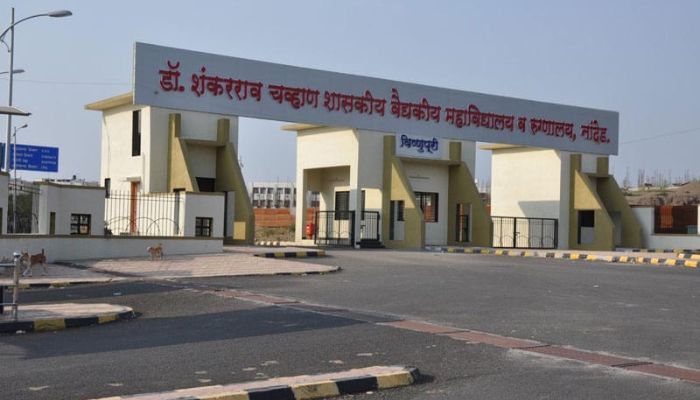
On Tuesday, October 3rd, the tragic death toll at Dr Shankarrao Chavan Government Medical College and Hospital in Nanded in Maharashtra surged to 35, marking an alarming increase from the previous day’s count of 24 casualties. Among these unfortunate victims, there were 16 infants and 19 adults. Among the infants who succumbed to this unfortunate fate were twin boys, who were born underweight on Sunday and passed away on Monday.

Medical Education Minister Hasan Mushrif paid a visit to the Nanded hospital on Tuesday. Following discussions with medical professionals and administrative personnel, he acknowledged that the deaths were indeed a result of a shortage of doctors. In response, he stated that the government is in the process of devising a plan to address this deficiency by hiring doctors on a contractual basis until the regular recruitment process can fill the vacancies.

According to a report by ANI, Hasan Mushrif, the Minister of Medical Education in Maharashtra, questioned why the hospital had not used its remaining Rs 4-5 crores to purchase medicines. Mushrif expressed deep concern over the housekeeping issues and emphasized that the matter was being taken very seriously. He raised questions about the hospital’s delayed medication procurement despite having sufficient funds.

He said, “The issue of housekeeping is very serious, we have taken that seriously. They still have Rs 4-5 crores. Why didn’t they purchase medicines? Our committee will give an answer. We will bring the medical college staff here. Every person’s life is important to us, and children’s life is important to us and for this, we will work very fast. There is no issue of funding but why didn’t they purchase medicines on time, we allowed the dean to buy 40 per cent of medicines. We will investigate this.”

The minister added, “A Committee of doctors has been formed to investigate the whole matter and action will be taken against those who are found guilty in this matter. There was no shortage of drugs in this hospital. We are immediately increasing the beds in hospital. Till now, 31 people have died in this hospital.”

Mushrif was joined by Guardian Minister Girish Mahajan during his visit to Nanded. The meeting also saw the presence of former Chief Minister and MLA Ashok Chavan and Member of Parliament Pratap Chikhalikar. Following the discussions, Mushrif announced his intention to bring up the conditions of medical colleges and hospitals across the state, not just Nanded, at the forthcoming cabinet meeting.

In the Dr Shankarrao Chavan Government Medical College and Hospital, located in Nanded, Marathwada region, a total of 24 fatalities were recorded within a 24-hour period between September 30th and October 1st. Subsequently, between October 1st and October 2nd, seven more deaths were reported. This brought the overall count of casualties to 31 within a span of 48 hours.

According to the ANI report, Dr Shyamrao Wakode, the in-charge dean of Dr Shankarrao Chavan Government Medical College and Hospital in Nanded said that the deceased patients suffered from various ailments, including snake bites, arsenic and phosphorus poisoning, among others. Dr. Wakode cited challenges related to staff transfers, budget issues, and the procurement of medicines as contributing factors to the crisis.

Meanwhile, at the Government Medical College and Hospital (GMCH) in Chhatrapati Sambhaji Nagar, within the span of 24 hours until Tuesday morning, a distressing minimum of 18 deaths have been recorded. Among the deceased, there are also two newborn infants. The hospital is currently grappling with a shortage of medications, forcing patients to wander in search of medicines.

Hospital Superintendent Dr Vijay Kalyankar, on the other hand, asserted that the fatalities were not attributed to a deficiency in staffing or medications. The revelation of these fatalities has caused quite a stir, highlighting the dire situation in Maharashtra’s government hospitals.

Union Minister of State for Health, Bharti Pawar, has asked for a comprehensive report on the fatalities occurring in both hospitals. She said, “This is an unfortunate incident. We have spoken to the concerned authorities and sought an explanation. The situation at the Nanded hospital is grave. Further action will be taken after we receive a detailed report.” The government of Maharashtra is further looking into these issues at the government hospitals in the state.

The public health care system in Maharashtra has many loopholes, which were primarily exposed during the COVID-19 pandemic. The health infrastructure of the state crumbled entirely during the first 2 waves of COVID-19, with critical patients wandering from hospital to hospital for a bed, people gasping for oxygen and crematoriums running out of wood to cremate the deceased victims.

Despite the fact that the COVID-19 pandemic situation has significantly improved in recent months, the state government’s hospital and healthcare facilities have remained unchanged. In the last couple of years, several hospitals across Maharashtra reported incidents of mishaps, leading to the deaths of patients and hospital staff, underscoring the precarious state of health infrastructure in the state.

Nepal: Stones pelted and ‘Sar Tan Se Juda’ slogans raised during Eid procession, administration imposes prohibitory orders

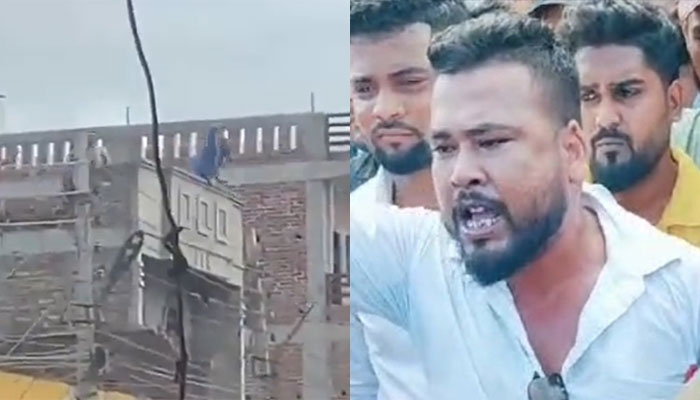
On 3rd October, the Banke district administration office imposed an indefinite curfew within the Nepalgunj sub-metropolis area effective from 1 PM. The curfew was imposed following reports of stone pelting incidents during a band organised by the Hindu groups over slogans raised during the Eid Milad procession on 1st October. Reportedly, the Islamists in the procession raised slogans such as ‘Sar Tan Se Juda‘. The public property was damaged during the procession. This is the first time in 26 years that communal clashes have been reported in Nepal. Following the reports of violence, the India-Nepal Rupaidiha border has been sealed. Videos of Islamists pelting stones at Hindus went viral on social media.

Chief District Officer (CDO) Bipin Acharya said in a statement that the administration passed the prohibitory orders over concerns about potential risks to the general public’s safety and disruption of peace in the area. CDO added that gatherings, rallies and unrestricted movement of the people would not be allowed in the areas between the Rapti River Bridge in the east, the road leading to Indrapur of Khajura in the west, Ranjha Chowk in the north, and the Jamunaha checkpoint in the south of Banke district. Furthermore, if anyone found in violation of the orders would face legal action.

District Administration Office of Banke issued a notice on 2nd October urging people to refrain from indulging in activities that might hurt religious sentiments. The administration also urged the public not to get into blame games on social media.

Anti-Hindu slogans in Eid procession

An X user, Treeni, shared a detailed thread on what happened in Nepal during the Eid procession. In the video shared by the X user, slogans of ‘Sar tan se juda’ and ‘Labaik labkail’ were heard.

The procession was taken out from the Tribhuvan circle of Nepalganj. The Islamists in the procession indulged in arson and allegedly attacked Hindus. The videos were shared by Nepali Muslim pages on social media.

Furthermore, the X user identified a person named Sharafat Khan, who was leading the procession. He is the ward president of Ward 5 in Nepalganj.

There were videos of Khan allegedly inciting Islamists against Hindus. ‘Sar tan se juda’ slogans were raised in his presence, as per the videos shared by the X user.

Following the Hinduphobic procession and slogans, the Hindu group, The Omkar Family, called for Nepalganj Bandh.

As they were taking out a peaceful protest rally, they were attacked by the Islamists who pelted stones and petrol bombs from buildings.

The attack on Hindus led to communal clashes in the area, after which prohibition orders were issued by the administration.

Pertinently, OpIndia reported in 2022 the gradual change in democracy underway in Nepal with mosques, madarasas, and other Islamic seminaries cropping up in a predominantly Hindu-majority country. The disproportionate change in democracy was meticulously catlogued by OpIndia, which can be read here.

Canada now wants ‘private talks’ with India, after 41 Canadian diplomats were asked to leave Delhi within a week

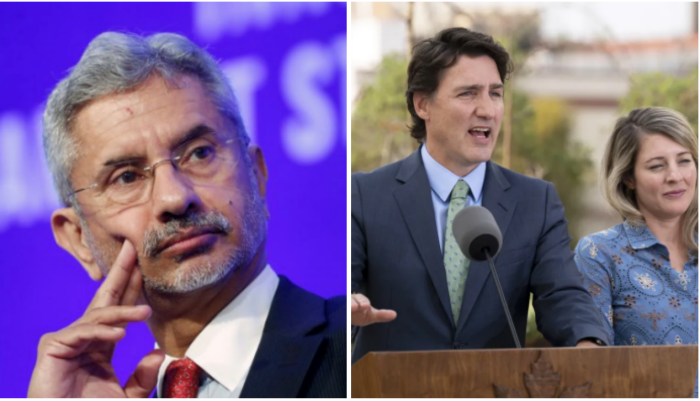
Canadian Foreign Minister Melanie Joly on Tuesday said that the country wants “private talks with India to resolve a diplomatic dispute” over the killing of Khalistan terrorist Hardeep Singh Nijjar, Reuters reported.

“We are in contact with the government of India. We take Canadian diplomats’ safety very seriously and we will continue to engage privately because we think diplomatic conversations are best when they remain private,” Reuters quoted Joly as saying to reporters. 
The statement by Joly comes after a report said India had asked Canada to withdraw 41 diplomats.

India has told Canada that it must repatriate the diplomats by October 10. Neither Joly nor Prime Minister Justin Trudeau responded when asked if the report was accurate, as per Reuters.

There is a strain in India-Canada relations following Prime Minister Justin Trudeau’s allegations regarding the Indian government’s ‘potential role’ in the fatal shooting of Khalistan terrorist Hardeep Singh Nijjar.

Nijjar, who was a designated terrorist in India, was gunned down outside a Gurdwara, in a parking area in Canada’s Surrey, British Columbia on June 18.

Trudeau, during a debate in the Canadian Parliament, claimed his country’s national security officials had reasons to believe that “agents of the Indian government” carried out the killing of the Canadian citizen, who also served as the president of Surrey’s Guru Nanak Sikh Gurdwara.

However, India has outrightly rejected the claims, calling it ‘absurd’ and ‘motivated’.

Notably, Canada has yet to provide any public evidence to support the claim about the killing of Hardeep Singh Nijjar. The country has said it wants to “work constructively with India” regarding the allegations.

Trudeau on Tuesday said that his country was not “looking to escalate the situation with India,” adding that Ottawa wants to remain on the ground in New Delhi to help Canadians, Reuters reported. 

“Canada is not looking to escalate the situation with India, will continue to engage responsibly and constructively with New Delhi. We want to be on the ground in India to help the Canadian families there,” Reuters quoted Trudeau as saying. 

Trudeau had said last week that Canada is still committed to building closer ties with India, despite “credible allegations of the Indian government’s involvement” in the killing of Khalistani terrorist Hardeep Singh Nijjar, Canada-based National Post reported. India has rejected the claims as “absurd” and “motivated”.

Pointing to the increasing influence of India worldwide, Trudeau said that it is “extremely important” that Canada and its allies continue to engage with India.

“India is a growing economic power and important geopolitical player. And as we presented with our Indo-Pacific strategy, just last year, we’re very serious about building closer ties with India,” he had told reporters.
“At the same time, obviously, as a rule of law country, we need to emphasize that India needs to work with Canada to ensure that we get the full facts of this matter,” National Post quoted Trudeau as saying.

(This news report is published from a syndicated feed. Except for the headline, the content has not been written or edited by OpIndia staff)

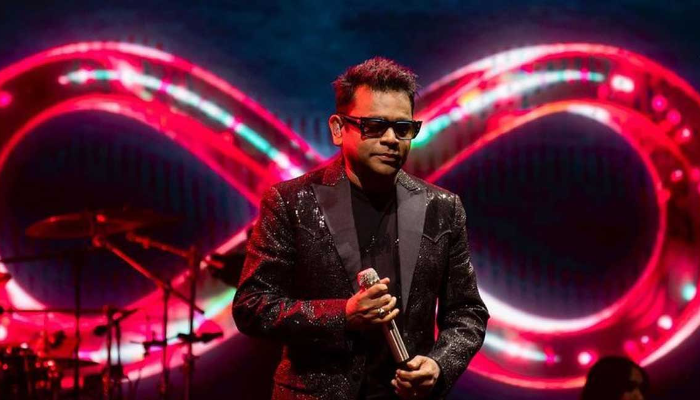
AR Rahman slaps Rs 10 crore defamation case after surgeons association accused him of not performing at an event despite taking payment

On Wednesday, October 4, reports emerged that renowned music composer AR Rahman has sent a Rs 10 crore defamation notice to the Association of Surgeons of India. He has asked the association to withdraw the complaint against him within three days. 

The defamation notice was in response to a complaint filed against him by the Association of Surgeons of India at the Chennai police commissioner’s office, which stated that the musician received an amount of Rs 29 lakh in 2018 for a concert that he never performed.

His attorney responded and refuted all of the charges and his team has asked for Rs 10 crore as restitution for the attempt to smear the world-famous music director. He addressed a legal notice to the Association of Surgeons of India seeking that they drop their complaint against him within three days. He dismissed all of the accusations and argued that there were third parties involved of whom his client was unaware.

The counsel pressed for an unequivocal apology from the association for tarnishing the Oscar-winning musician’s reputation in the legal notification and to make a reparation payment of Rs. 10 crores for defaming him. If they do not pay the compensation, the ‘Jai Ho’ composer is going to pursue legal and criminal action.

The allegation stemmed from the lawsuit that AR Rahman who had been paid the money to put on a concert presentation in 2018 never did so and has refused to refund it. According to the organisation’s statement, he was approached to perform at an event hosted by the Annual Conference of the Association of Surgeons of India (ASICON) 2018. He consented to the same on one of the three days of the gathering in exchange for an advance payment of the aforementioned amount. Furthermore, it was stated that there would be no return if the function was scrapped.

Later, however, ASICON allegedly terminated the gig and insisted that he give back the sum because the ticket price for the concert was higher. His manager Senthil Velan asserted that the organisers afterwards contacted them and told them to return the deposit following which a complaint was lodged against the record producer.

Music concert of AR Rahman in Chennai turns into a nightmare

Prior to this, the winning music composer received a lot of flak when his Chennai concert turned into a nightmare after the organisers reportedly oversold the tickets which led to overcrowding and mass molestation.

AR Rahman’s ‘Marakkuma Nenjam’ (Will the heart forget) gala took place in Chennai’s Adityaram Palace on 10 September which was marred by multiple molestation reports, a stampede-like situation and bogus tickets. Despite having valid tickets, many people were turned away because of the crowding.

Following the controversy, AR Rahman took to X (formerly Twitter) to inform that refunds would be initiated for those who could not attend the event despite purchasing tickets. He, however, did not address the allegations of mass molestation levelled by the victims.